
Why Does Limescale Form in Water? From Rain to Tap
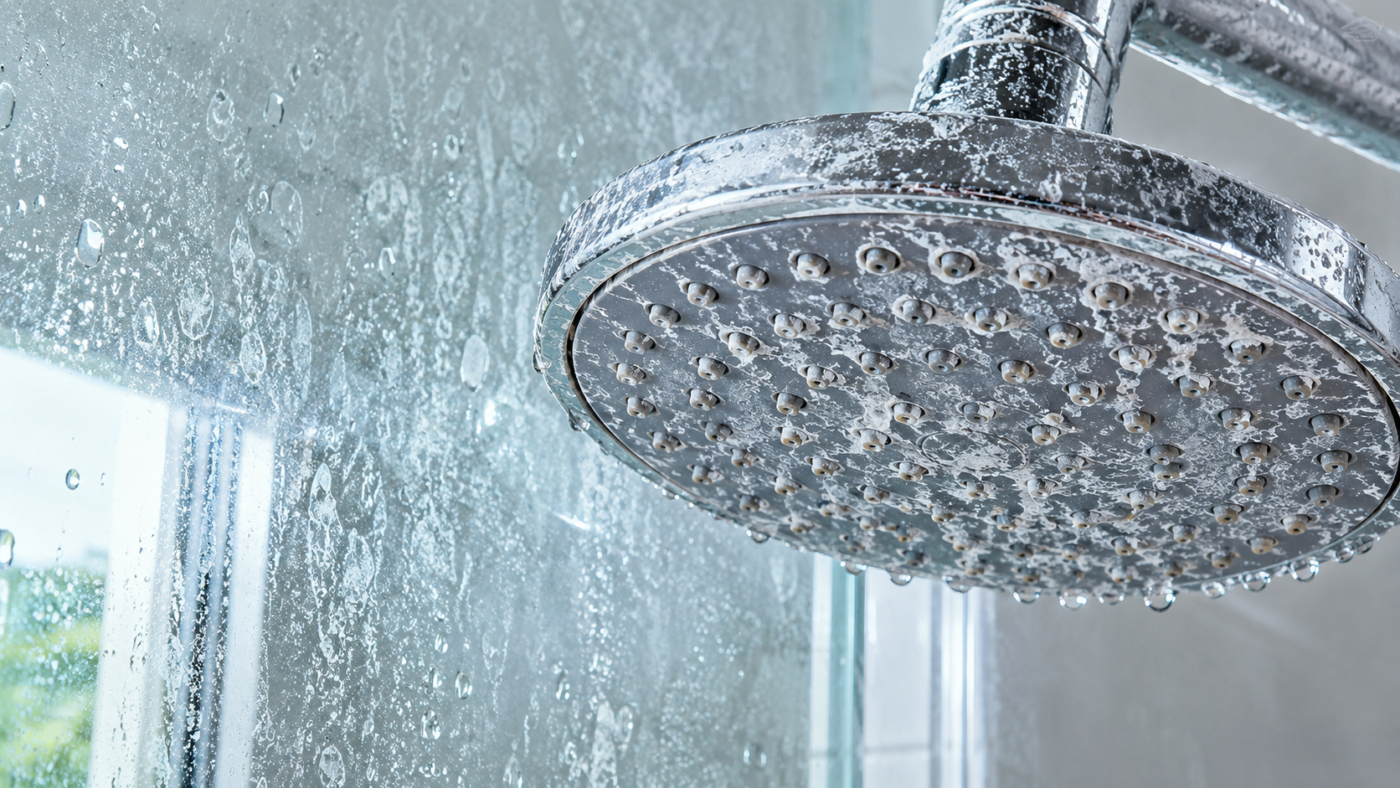
A white layer in the bottom of the kettle, dried marks on the shower screen, a dulling at the end of the tap… All of them trace to the same source: limescale in water. That layer is not dirt but the minerals the water carries in solution becoming visible. So where do those minerals get into the water, why are there so many in some areas and none at all in others, and how is it brought under control for good?
This article explains where limescale comes from. We took up the damage limescale does to household appliances, the units of hardness measurement and the choice of unit in separate articles; the focus here is what limescale in water is chemically, by what mechanism it forms, and why it makes such a great difference even between two cities in the same country. Understanding the cause lets you ask the right question when choosing the answer.
What Is Limescale in Water?
Limescale in water is the calcium and magnesium compounds held in solution passing into a solid state under the effect of heat or evaporation and collecting on surfaces. The water takes those minerals from the rock layers underground. The components cannot be seen in the water; but when they precipitate they form a white, hard layer that is difficult to scrape off.
The chemical counterpart of the white layer we call limescale in everyday speech is mostly calcium carbonate. Magnesium compounds accompany it. How much of those two minerals is in the water settles the hardness of that water.
The critical distinction here is this: water can contain limescale while it is still running clear. The sediment you can see is the part of the dissolved mineral that has passed into a solid state. So limescale in water is there before it becomes visible; it has simply not precipitated yet.
We took up in detail what hardness means, in which units it is measured and its signs in our water hardness and the signs of limescale article.
How Does Limescale Form? The Journey From Rain to Tap
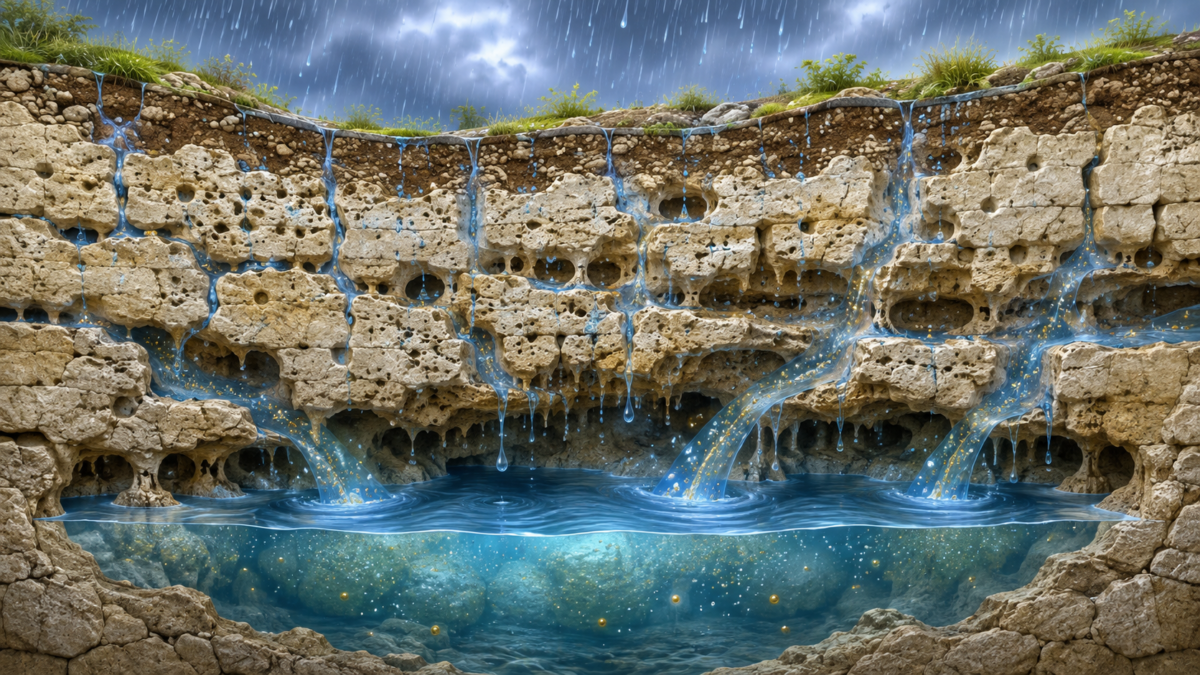
Rainwater is so nearly free of minerals it could be called pure. As it filters into the soil it takes up carbon dioxide from the air and the ground and becomes slightly acidic. As that acidic water passes through rocks such as limestone and dolomite it dissolves calcium and magnesium. The groundwater is loaded with those minerals and reaches the mains in that state.
The process can be summed up in four steps. Every step directly affects the amount of limescale in water:
-
The Rainwater Turns Acidic
Taking up carbon dioxide from the atmosphere and the soil layer, the rainwater becomes carbonic acid, a weak acid.
Result: the water gains the chemical ability to dissolve minerals. -
It Passes Through the Rock Layers
As it filters through layers rich in limestone, chalk and dolomite, calcium and magnesium ions get into the water.
Result: the type and thickness of the rock settle the level of hardness. -
It Builds Up in the Groundwater
The longer the water stays in the aquifer, the greater its dissolved mineral load.
Result: wells at different depths in the same area can give different hardness. -
It Precipitates With Heat and Evaporation
When the water heats, carbon dioxide leaves as a gas, the solubility falls and the minerals pass into a solid state on the surfaces.
Result: limescale is most visible on heated surfaces and at the points where water dries.
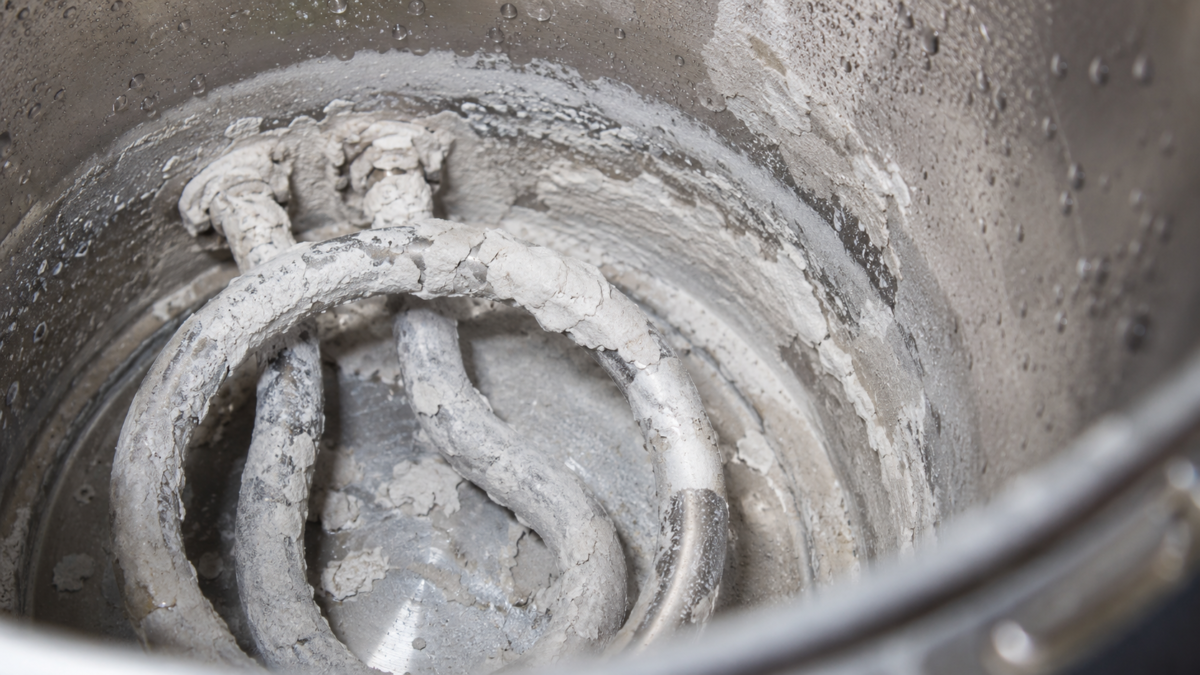
That last step explains why limescale collects in the kettle, the boiler and the water heater in particular. Heat is the trigger that turns a dissolved mineral into a solid. So a hardness that goes unnoticed on the cold water line for years can show itself on the hot water side within a few months.
On the hardness of water and the mechanism by which limescale forms, the US Geological Survey’s technical assessment of water hardness offers a comprehensive background.
Why Is Limescale Not the Same in Every Area?
The difference in hardness comes from the geology. Water rising in basins dominated by limestone and dolomite is hard, while in areas where insoluble rocks such as granite and basalt dominate it is soft. The type of source is decisive too: reservoir and surface waters are generally softer, well and groundwater harder.
That is why limescale in water levels can differ from city to city, and even from one neighbourhood to another in the same city. In one building a boiler blocks in three years, while a few kilometres away the same make of unit causes no trouble at all.
The general tendency by type of source runs like this:
| Water Source | The Hardness Expected | Why |
|---|---|---|
| Rainwater | Very soft | It has almost no mineral load |
| Reservoir and surface water | Soft to medium | Its contact time with rock is short |
| Spring water in a karstic area | Hard | It is fed from limestone layers |
| Deep well water | Hard to very hard | It stands a long time in the aquifer |
| A mixed supply (reservoir and well) | Variable with the season | The proportion from each source changes across the year |
The last row of that table is often missed. Many municipalities raise the proportion of well water in summer when the reservoir levels fall. The amount of limescale in water can then fluctuate markedly across the year and the user gets the feeling that it never used to be like this.
Where well water is used the picture is more variable still. We looked at the other risks in well water in our article on whether well water is safe to drink.
Can Limescale Be Measured? Units of Hardness
Yes. Hardness is expressed in French degrees (fH), German degrees (dH) or as calcium carbonate equivalent (mg/L CaCO3). French hardness is widely used in Türkiye. The measurement can be made in minutes with a chemical test kit; for a definitive result an accredited laboratory analysis is preferred.
Limescale in water — choosing an answer without measuring is the mistake made most often. A unit bought without knowing the hardness either falls short on capacity or is larger than it needs to be.
| French Hardness (fH) | The Class | What It Means in Practice |
|---|---|---|
| 0 – 7 | Very soft | Limescale build-up is almost never seen |
| 7 – 15 | Soft | The signs are rare and no measure may be needed |
| 15 – 30 | Moderately hard | Build-up starts on heated surfaces |
| 30 – 45 | Hard | The signs are clear and a measure is advised |
| 45 and above | Very hard | A lasting answer is needed |
You can measure the hardness of the water at home yourself with a simple limescale test kit. For a broader picture, the list of parameters in our how a water analysis is done article gives guidance. For those who want to follow the total dissolved solids load, the TDS value offers a separate indicator; but TDS alone does not give the hardness.
Where and How Does Limescale Show Itself?
Limescale appears first on the surfaces where water heats and dries: the kettle, the boiler exchanger, the water heater element, the showerhead and the ends of taps. Then it builds up on the inner surface of the plumbing and narrows the bore. Soap not foaming and washing becoming stiff are indirect signs of the same cause.
Limescale in water shows its signs by degrees; that is why most users only notice the problem when a fault appears.
Heated Surfaces
The layer building up on elements and exchangers slows the passage of heat and energy consumption rises.
The Inner Wall of the Plumbing
The bore of the pipe narrows, the flow falls and complaints about pressure begin.
Taps and Heads
The holes block, the water runs scattered and weak, and the surfaces dull.
Cleaning and Comfort
Soap does not foam, detergent use rises and permanent marks are left on surfaces.
We took up the cost of limescale on the white goods and boiler side in our what hard water does to white goods article. If there is a complaint about a drop in pressure, our what happens if the water pressure is low article is a useful complement.
Where there are reddish marks and a rusty look in the water the cause is different; in that case iron rather than limescale may be involved. We explained the distinction in our how iron is removed from water article.
Why Are Temporary Methods Not a Lasting Answer?
Vinegar, citric acid and descaling chemicals only clean the build-up that has formed; they do not change the hardness of the water. Boiling is no lasting answer either, because the mineral does not leave the pan, it only settles to the bottom. Those methods clean the result; they do not remove the cause.
Limescale in water is fought in two ways, and when the two approaches are compared the difference becomes clear:
Temporary methods
They remove the layer that has formed; they do not prevent it forming.
- Scrubbing with vinegar and citric acid
- Descaling chemicals
- Boiling and pouring off the sediment
- Cleaning the aerator at the end of the tap
The lasting method
It lowers the hardness of the water at the inlet and prevents the build-up from the start.
- Choosing the right capacity with a hardness measurement
- A softening system on the main line
- Regular regeneration and salt checks
- Periodic resin checks
Chemical descalers have an unseen cost too: constant use can create wear on chrome and enamel surfaces. And the antiscalant chemical used on the industrial side to protect a membrane is not a product designed for domestic use; its purpose is different.
The Lasting Answer: Softening the Water at the Inlet
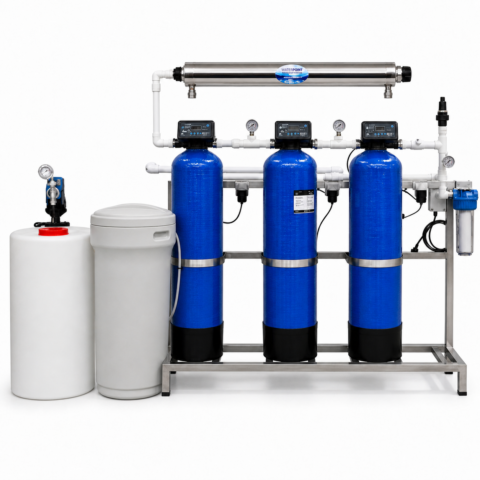
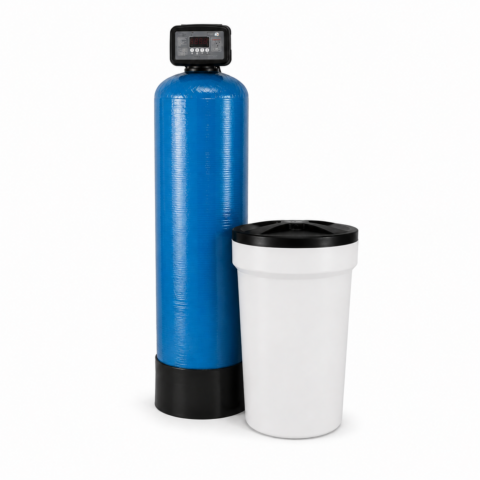
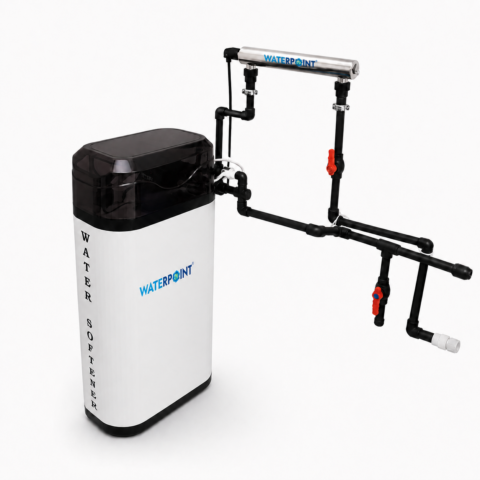
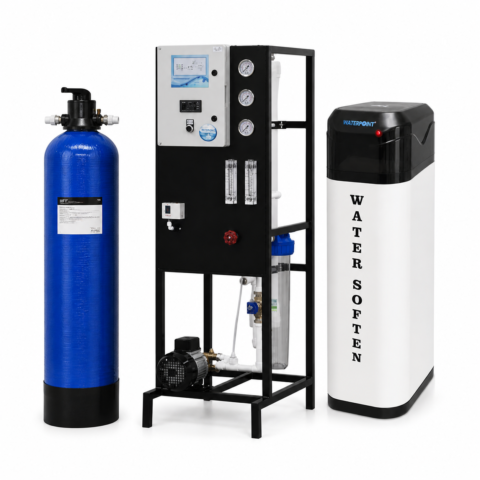
The lasting answer is for the calcium and magnesium ions that cause the hardness to change places with sodium in a resin bed before the water enters the house. That process is called ion exchange, and the unit is called a water softening system. When the system saturates it is regenerated with brine and recovers its capacity.
Softening targets not the point where limescale forms but its source. Once the hardness ions in the water are taken out, there is nothing left to precipitate on a heated surface. The chain of faults caused by limescale in water is broken from the start.
We explained the technical detail of how it works in our central water softening system article, and the relationship between the salt and the resin at the heart of the cycle in our what is regeneration article. The life of the resin and its replacement were taken up separately in our water softening resin article.
Establishing the right capacity is the most critical step in this business. The number of people, the daily consumption and the hardness measured are assessed together. You will find the criteria for choosing step by step in our how to choose a water softening system guide. For the model options you can look at the water softening systems category.
The types of installation that come to the front by living space separate out like this:
| Where It Is Used | The Leading Solution | A Note |
|---|---|---|
| A flat (2-4 people) | A mini cabinet softening unit | A compact body suited to tight spaces |
| A large flat and a villa | A maxi cabinet softening unit | A higher daily capacity |
| A detached house inlet | A detached house inlet system | It protects the whole line from a single point |
| An apartment block and estate inlet | An estate inlet system | It is chosen to the shared flow |
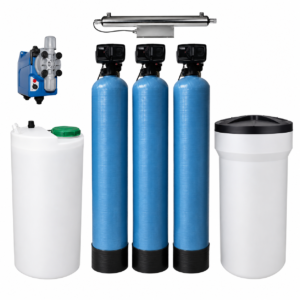
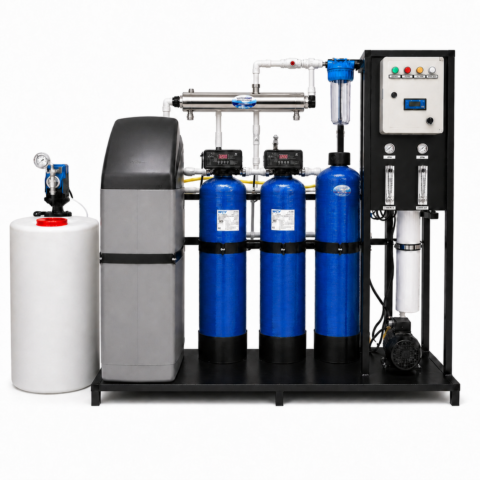
| A business and production plant | An industrial-type limescale treatment unit | A tandem option for uninterrupted running |
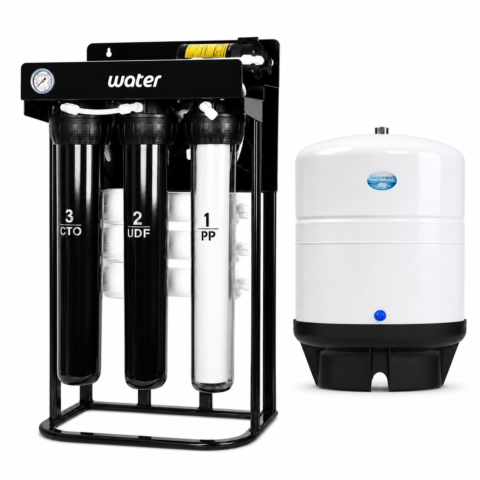
A water softening system removes hardness; it does not treat drinking water. Staged treatment for drinking water is a separate system. Where both needs are present, softening at the line inlet and drinking water treatment in the kitchen are planned together.
What Is Done Once the System Is Installed?
Two things are followed once a softening system is installed: the salt level and the hardness measurement. If the salt tank empties, regeneration cannot be carried out and the unit starts letting hardness through. And a lasting rise in the measurement shows that a check is needed on the resin or the valve side.
The maintenance load is lighter than people think; but left unfollowed the unit quietly goes out of service and limescale in water starts building up again.
What the User Can Do
- Checking the salt tank regularly
- Using water softener salt of a suitable quality
- Measuring the outlet hardness with a test kit
- Observing that the regeneration timer is working
- Following the change at the taps
- Putting the measurement results on record
What Technical Service Will Do
- Assessing the state of the resin bed
- Renewing the cation resin where needed
- Setting and calibrating the control valve
- Cleaning the brine line and the injector
- Measuring the flow and pressure values
- Adjusting the capacity to the consumption
The work in the right-hand column is done on a system under pressure. Leaving valve and resin work to an authorised service is the right approach both for the life of the unit and for safety.
Find out the hardness of your water first
The only way to choose the right capacity is to measure. Let us establish the system that suits the hardness value in your home together.
See the Water Softening SystemsA Short Checklist for Limescale
When you notice the signs, follow six steps in order: measure the hardness, establish whether the sign is on a heated surface or across the whole line, find out the type of source, tell temporary cleaning apart from a lasting answer, have the capacity worked out to your consumption, and keep checking after installation. That order prevents unnecessary spending and a wrong choice of unit.
- Measure: Find out the French hardness value with a test kit and note the result.
- Locate it: If the sign is only on the hot water side, precipitation caused by heat is dominant.
- Find out the source: Mains, well or mixed; ask whether there is seasonal change.
- Separate them: A cleaning product wipes away the result, softening removes the cause.
- Have it worked out: Have the right capacity established with the number of people and the daily consumption.
- Keep track: After installation, check the salt level and the outlet hardness regularly.
The first item on that list is the step most often skipped. Decisions made without a measurement do not solve the limescale in water problem; they only put it off.
How Does Limescale Shorten the Life of Treatment Units?
Hardness tires not only the plumbing but the treatment equipment too. Calcium compounds build up on the surface of a reverse osmosis membrane, the permeability falls and the unit has to work harder to produce the same amount of water. When the pre-filters are not renewed on time that process speeds up and the membrane life shortens markedly.
That is a situation met with often on domestic units but whose cause is understood late. The user changes the membrane and the same complaint returns a few months later; because the real cause has not been removed.
Where the hardness is high, a two-layer approach works: softening at the line inlet and staged treatment in the kitchen. In that way limescale in water is held before it reaches the membrane and the consumables cost falls.
We explained how the membrane works and why it depends on the pre-stages in our what is a membrane filter article. And we took up what settles the interval for changing in our filter change guide.
There is a practical way of following the performance: recording the measured value of the outlet water regularly. A TDS meter is enough for that. If the value is rising permanently, the stages or the membrane need assessing.
The hardness is measured first, then softening is planned at the line inlet, and drinking water treatment is chosen last. Going in the reverse order — that is, fitting a drinking water unit directly onto a line with high hardness — uses the consumables up quickly and does not solve complaints caused by limescale in water.
What Does Limescale Cost a Business?
In businesses limescale turns directly into a cost item: fuel consumption rises in a steam boiler, marks are left on glass and steel surfaces in dishwashers, more colour and treatment chemicals are used in hairdressing salons, and water marks form after drying at a car wash. The shared cause of all of them is the hardness of the water.
A problem that looks like a loss of comfort in domestic use becomes a measurable expense in commercial use. As the daily water consumption rises, the wear caused by limescale in water speeds up too.
The effects that come to the front by sector are these:
| The Sector | The Effect That Stands Out | The Article Concerned |
|---|---|---|
| Hairdressers and beauty salons | A rise in chemical use, sediment after washing | Water treatment in hairdressing salons |
| Restaurants and hotels | Marks on glasses and steel surfaces, equipment failures | Water treatment in restaurants |
| Car washes | Permanent water marks after drying | Water treatment at car washes |
| Production plants and boiler houses | A rise in fuel consumption, scaling in the boiler | Boiler feed water |
| Greenhouses and agricultural irrigation | Blockages in the drip line | Irrigation water treatment |
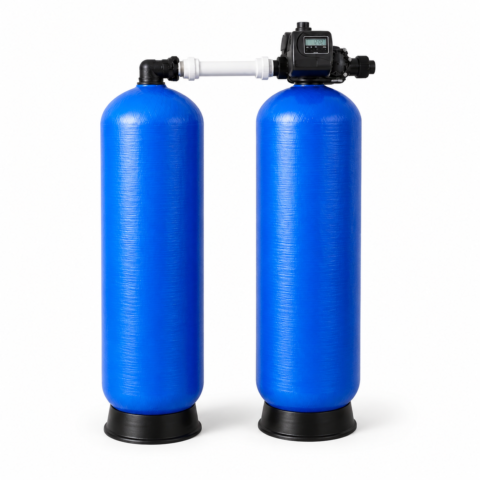
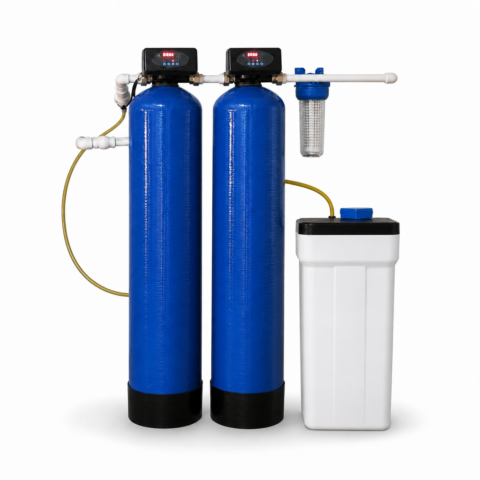
On the business side the capacity calculation runs differently from a home: the instantaneous flow, the hours of operation and the need for uninterrupted production are what decide. Where there is no tolerance for an interruption, twin-column solutions such as a tandem softening system are preferred; while one is in regeneration the other carries on working.
Frequently Asked Questions About Limescale in Water
Is limescale in water harmful to health?
Calcium and magnesium are minerals found naturally in drinking water. The real effect of hardness is on the use side: build-up on heated surfaces, narrowing in the plumbing and difficulty in cleaning. Health questions should be put to a doctor; this guide covers the technical side.
Why does limescale build up more in the kettle?
Because the factor that triggers precipitation is heat. When water heats, the dissolved carbon dioxide leaves, the solubility of the minerals falls and they pass into a solid state. For the same reason the boiler exchanger, the water heater element and the dishwasher heater are the components that scale up fastest.
If the water runs clear, is there no limescale?
No. Clarity is no indicator. The minerals are in solution in the water and cannot be seen. Limescale becomes visible only when it passes into a solid state after heat or evaporation. So the assessment should be made by measurement rather than by eye.
Does boiling remove limescale from water?
Boiling precipitates part of the bicarbonates that make up temporary hardness; but the mineral does not leave the pan, it settles to the bottom. The compounds that make up permanent hardness are not separated by boiling. So boiling is not a method of removing limescale.
Do magnetic or electronic limescale preventers work?
Those units do not lower the hardness value of the water; it stays the same before and after a measurement. Their claims rest on reducing adhesion by changing the crystal structure, and the results vary widely with the conditions. The method that gives a measurable and repeatable result is softening based on ion exchange.
Does a water softening unit make the water salty?
No. The salt does not go directly into the water; it is used only to renew the resin and goes to the drain at the end of regeneration. The amount of sodium in softened water rises somewhat in proportion to the hardness removed; but that does not create a salty taste.
Can I buy a unit without having my hardness measured?
You can, but it is not advised. The capacity is worked out from the hardness and the daily consumption. A unit chosen without a measurement either saturates early and lets hardness through or is larger than it needs to be. A simple measurement with a test kit removes that risk.
My mains water is soft — why do I see limescale?
There are two possibilities. The first is the municipality changing the mix of sources seasonally; the proportion of well water can rise in the summer months. The second is the condition of the tank and the plumbing in the building. For a definitive answer, a measurement should be made on water taken directly from the tap.
Once a softening system is installed, is the old limescale build-up cleaned off?
New build-up stops, and the existing layer can fall away over time but does not disappear entirely by itself. Visible surfaces are cleaned mechanically; for old build-up inside the plumbing the state of the system is assessed by a technical service.
Conclusion
Limescale in water is not dirt but the calcium and magnesium the water has gathered from the underground layers passing into a solid state with heat or evaporation. So its source is geological and it varies greatly from area to area. The signs appear first on heated surfaces, then in the plumbing and in the comfort of cleaning. Methods such as vinegar, descalers and boiling only clean the layer that has formed; because they do not change the hardness of the water, the problem returns in a short time. The lasting answer is softening based on ion exchange, which lowers the hardness before the water enters the house. The right order of steps is clear: measure the hardness first, then establish the capacity, then tie the salt and resin checks to a routine. In that way limescale in water stops being a visible problem.
Let’s solve the limescale problem at its source
The site survey is free if the unit is purchased from us; for a survey and measurement only, a survey fee of ₺2,000 applies. To plan the answer that suits the hardness of your water you can reach us on 0850 304 95 25 or at [email protected].
Discover the Solutions