
How Is Seawater Treated? Solutions for Boats and Coastal Sites
You are surrounded by water for miles, yet the fresh water in the tank will run out in a few days. That contradiction — on a boat, on an island, or at a coastal site the mains never reached — comes from the salt in the sea. Salt makes water unfit to drink and to use, and damages plumbing and equipment. This is what seawater treatment systems are built for: turning an abundant but unusable source into something you can work with.
In this guide we take up how fresh water is produced from seawater, where it parts company with ordinary reverse osmosis, and how it is applied on boats and at coastal sites. From the energy it needs to the maintenance it demands, we open every heading you should know before deciding.
What Is Seawater Treatment?
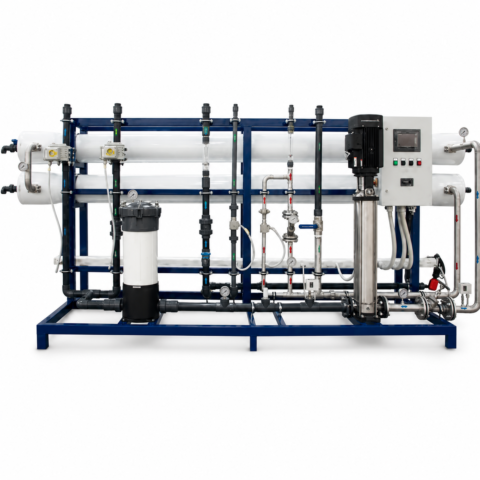
Seawater treatment is the process of separating the dissolved salts in seawater by reverse osmosis to obtain usable water. The water is passed through a special membrane under high pressure; the water molecules cross to the other side while most of the salt stays behind and is returned to the sea as concentrate.
The basic principle is the same as the reverse osmosis used on mains water; what changes is the scale. The salt load in seawater is beyond comparison with mains water, and that difference means every component of the system has to be designed differently from the outset.
In the international literature the process is called desalination. The US Geological Survey’s desalination resource describes reverse osmosis as one of the main methods used in treating seawater.
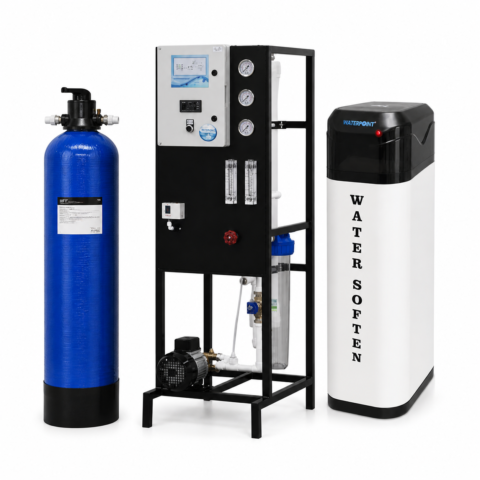
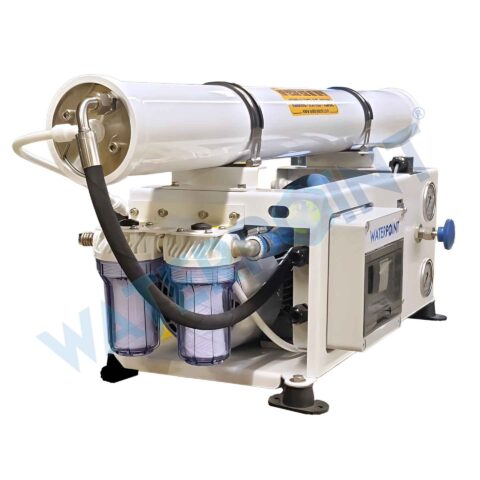
On boats these systems are also known as watermakers. The name differs but the working logic is the same: water taken from the sea is treated in stages and sent to the tank as usable water. The water leaving a seawater treatment unit is brought to its final state with further stages planned around how it will be used.
Why Can’t Seawater Be Used Directly?
Seawater contains a very high proportion of dissolved salt. That salt load raises the conductivity of the water enormously, starts rapid corrosion on metal surfaces and leaves permanent damage in plumbing. As well as being unfit for drinking and household use, it is a direct risk to equipment.
The source of the problem is invisible: the salt is dissolved in the water, so seawater cannot be used even though it looks clear. Its effects appear on several fronts:
Corrosion
The high chloride content starts rapid attack on metal surfaces; pipes and fittings are damaged.
Salt Deposits
It leaves residue on every surface where the water evaporates; scale forms inside equipment.
High Conductivity
The dissolved ion load accelerates electrochemical processes and magnifies the damage.
Unfit for Use
Salt water is not suitable for drinking, cooking or cleaning.
Being by the sea, therefore, does not mean the water problem is solved; on the contrary, using the source untreated damages equipment. We covered conductivity and TDS, which show the dissolved solids load of water, in detail in our TDS article; in seawater those values are far above the usual scales.
The Difference Between Seawater Treatment and Ordinary Reverse Osmosis
The difference comes from the salt load. A system designed for mains water cannot produce the pressure needed to overcome the salt concentration of seawater. Seawater treatment systems therefore use special membranes and high-pressure pumps; a standard reverse osmosis unit cannot do the job.
In reverse osmosis, the natural osmotic pressure has to be overcome for water to pass the membrane. As the salt concentration rises so does that threshold; in seawater it reaches a level beyond comparison with mains water. We explained the basis of the mechanism step by step in our how reverse osmosis works article.
| Criterion | Mains Water RO | Seawater System |
|---|---|---|
| Salt Load | Low to medium | Very high |
| Pressure Required | Relatively low | Markedly high |
| Membrane Type | Standard RO membrane | Membrane made for seawater |
| Pump | Small feed pump | High-pressure pump |
| Materials | Standard components | Corrosion-resistant materials |
| Energy Consumption | Low | Higher |
Every row of the table corresponds to a design necessity. High pressure affects not only the pump but the pipe connections, the membrane vessel and the body material. A seawater treatment unit is therefore not an enlarged domestic device but a different piece of engineering from the ground up.
A standard reverse osmosis unit cannot be run on seawater. The membrane cannot meet the pressure required, the components cannot withstand the corrosive effect of salt water, and the system fails within a short time.
How Does the System Work? Stage by Stage
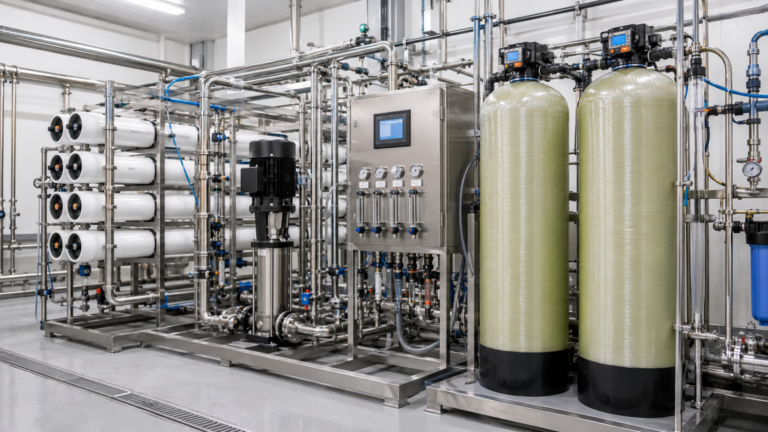
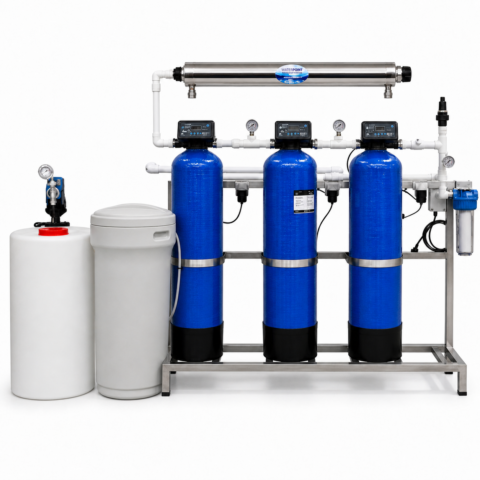
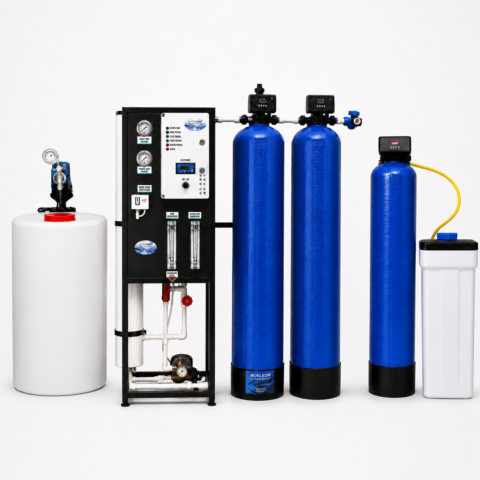
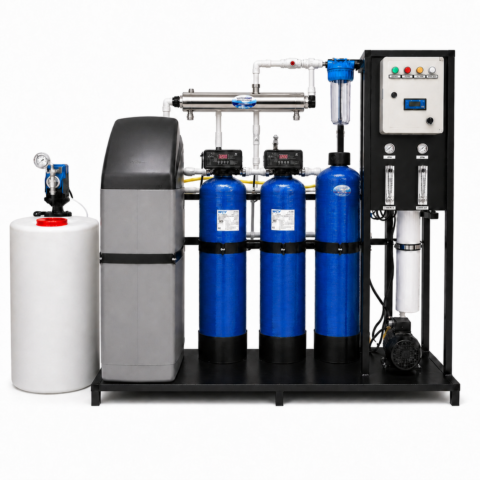
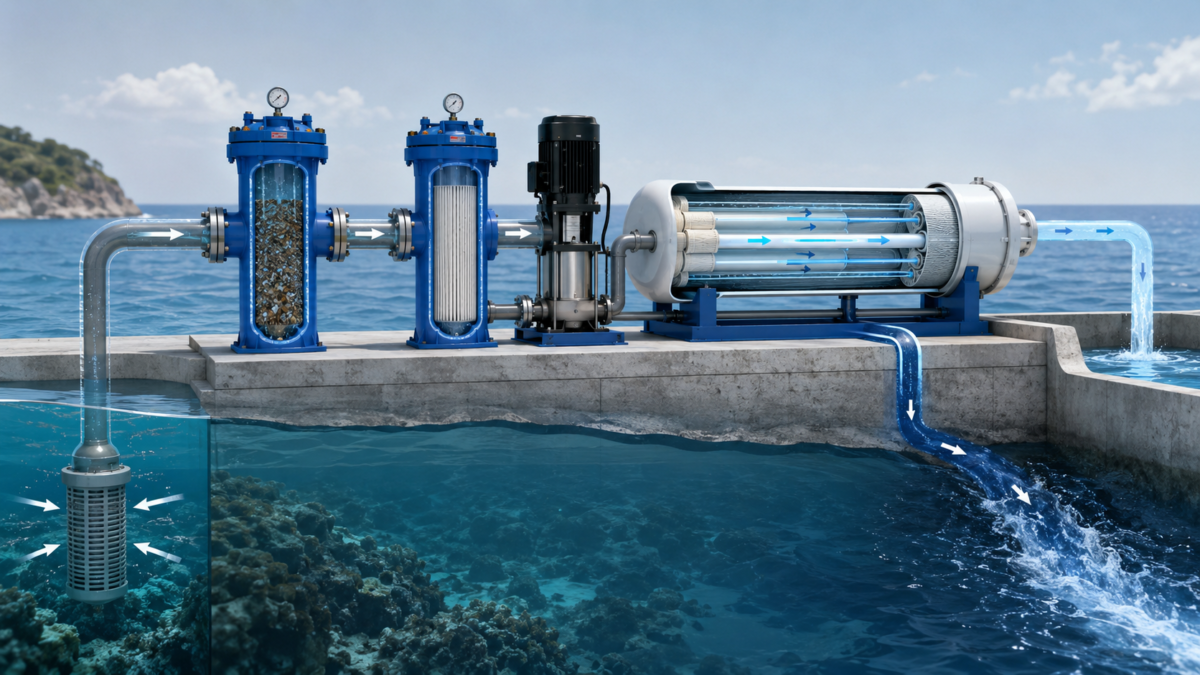
The process advances in stages: seawater intake, coarse pre-filtration, fine filtration, the high-pressure pump, the membrane unit, the separation of treated water and concentrate, and final conditioning. Each stage protects the next; when one is skipped, the efficiency and the life of the whole system fall.
On a typical seawater treatment line, the path the water follows is this:
-
Seawater Intake
Water is drawn into the system from a suitable intake point. The position of the intake directly affects the load of suspended solids and algae.
-
Coarse Pre-Filtration
Large particles, marine organisms and organic matter are separated. This step protects the sensitive stages behind it from mechanical load.
-
Fine Filtration
The remaining fine suspended solids and colloidal structures are held back. The water reaching the membrane is markedly clearer at this point.
-
High-Pressure Pump
The water is raised to a level that overcomes the osmotic pressure of seawater. This is the driving force that makes the system work.
-
Membrane Unit
The water is passed through a membrane made for seawater. The water molecules cross to the other side while most of the dissolved salts are held back.
-
Separating Treated Water and Concentrate
The water that passes the membrane is directed to the treated line, while the concentrate carrying the concentrated salt is returned to the sea.
-
Final Conditioning
Further stages such as carbon, mineral balancing or UV (ultraviolet) treatment are planned according to how the water will be used.
The concentrate line, just as in classic reverse osmosis, is a natural part of how the system works. The salt collecting on the membrane surface has to be swept away continuously; otherwise the surface blocks quickly and production stops.
The Critical Role of Pre-Filtration
Seawater is rich in suspended solids, algae, plankton and organic load. These components block the membrane surface quickly. In a system built without pre-filtration, the membrane loses its performance before it reaches its expected life and a far more expensive replacement is needed.
The content of seawater varies with the season, the weather and the intake point. Suspended solids rise after a storm; algae concentrations rise in warm periods. That variability makes pre-treatment a constant requirement.
Staged pre-filtration is generally built on this logic: coarse particles are separated first, then finer structures are held back, and finally clean inlet water is delivered to the membrane. Where the particle load is high, sand beds come into play; we covered how that stage works and why it is needed in our sand filter article.
Organic load calls for separate attention. Biological film forming on the membrane surface can create fouling even more stubborn than salt deposits. In seawater treatment systems, therefore, pre-treatment is designed around organic load as well as particles.
Saving on pre-filtration looks cheap in the short term. But the seawater membrane is the most valuable component of the system; any installation that fails to protect it meets a far higher cost in the medium term.
Why Is a Seawater Membrane Different?
Seawater membranes are made to withstand high salt concentrations and high working pressure. Their structure is tighter and their bodies stronger, and they can separate up to 99% of the dissolved salts. A standard membrane in these conditions neither provides the separation required nor withstands the pressure.
We set out the general framework of membrane technologies in our membrane filter article; the seawater membrane is the member of that family that works in the toughest conditions. The difference can be summed up as follows:
For mains water
Made to work at low and medium salt loads with relatively low pressure.
- Works efficiently at low pressure
- Suited to mains and well water
- Does not provide the separation needed in seawater
- Carries a structural risk at high pressure
For high salt and high pressure
Designed with a tight structure and a strong body to work in demanding conditions.
- It withstands high pressure
- It separates under a heavy salt load
- Materials suited to a corrosive environment are used
- It requires a special vessel and fittings
Widely used in compact installations, the SW30-2521 seawater membrane is a model preferred in systems with limited space. Where higher output is required, membranes in the SW 2540 size come into play.
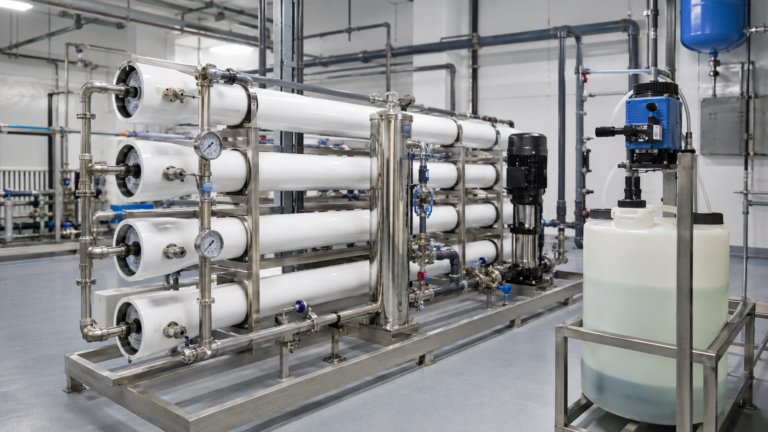
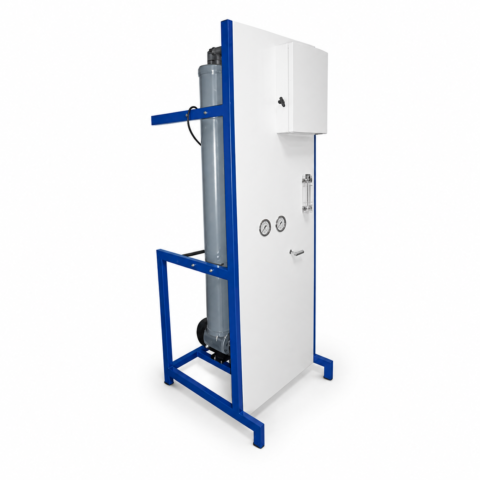
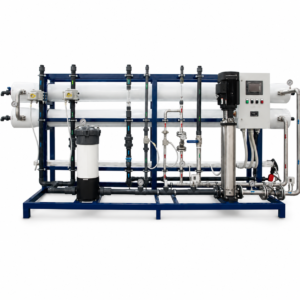
The vessel the membrane works in is at least as critical as the membrane itself. A seawater membrane vessel able to withstand high pressure and a salt environment is an essential component for the safety of the system. The high-pressure pump that provides the pressure is the heart of the build.
Seawater Treatment on Boats and Yachts
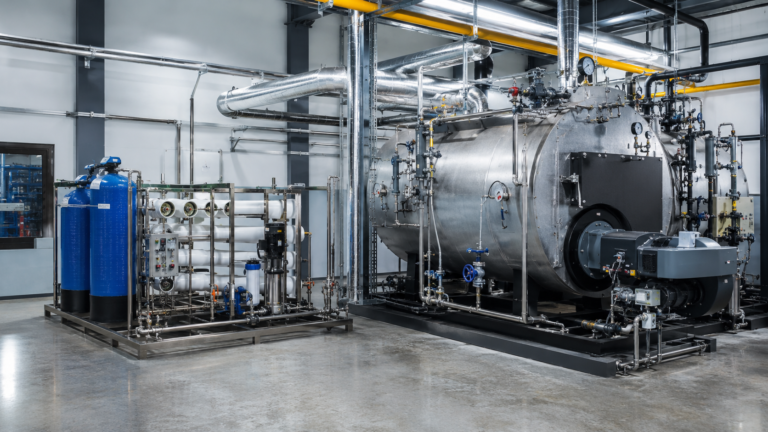
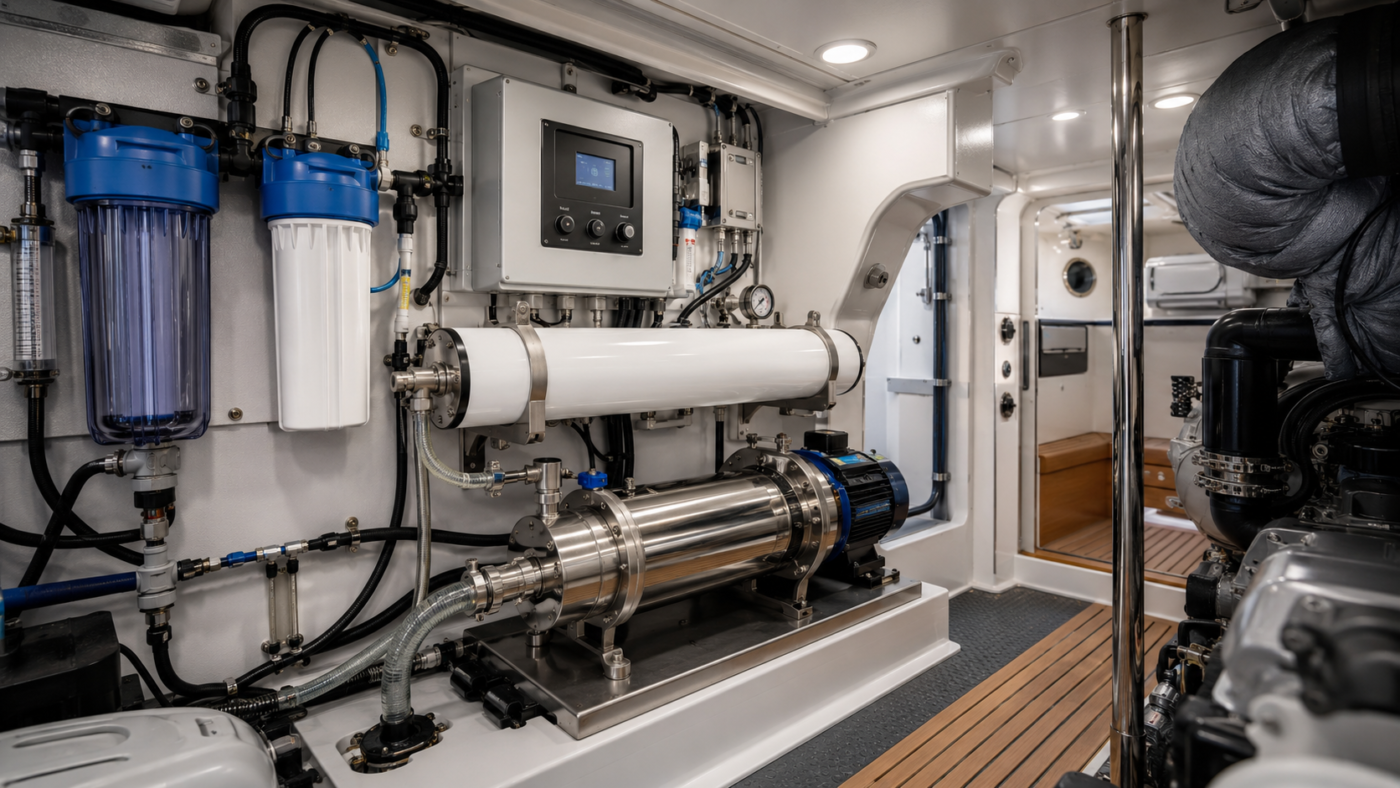
On boats the decisive constraints are space and energy. The system has to be compact, run quietly and be sized to suit the power supply available. A watermaker installed properly removes the need to fill the tank while under way and frees the route from dependence on water sources.
Fresh water is one of the most critical resources on a boat. Tank capacity is limited; on long passages water becomes a factor that shapes the route. A seawater treatment unit installed on board removes that dependence and gives freedom of movement.
The headings that stand out in boat installations are these:
- Space constraint: The system has to be designed compactly to fit the volume available.
- Energy compatibility: The build has to match the capacity of the generator or battery bank.
- Quiet running: Because it runs close to the living space, the noise level matters.
- Vibration resistance: The connections have to be secured to withstand the movement of a passage.
- Easy maintenance: Filter changes and checks have to be accessible enough to carry out at sea.
Designed for these needs, boat-type watermaker systems are built to work in limited space. The capacity is set by the number of people on board and the length of the passage.
Laying up for winter is a separate heading. If the system will stand unused for a long time, the membrane must not be allowed to dry out and the proper preservation procedure has to be followed. Neglecting this can damage the membrane permanently; a check before recommissioning at the start of the season is needed too.
Use at Coastal Sites, Hotels and on Islands
Where mains water is inadequate, salty or absent altogether, seawater treatment offers a permanent infrastructure solution. For coastal hotels, island sites and industrial premises, the system is engineered with the capacity to meet seasonal peaks and gives the site independence in water.
In this segment the problem is usually seasonal. In coastal areas the population multiplies in summer, mains pressure falls and supply becomes difficult. Salinity can also rise in wells near the shore because of seawater intrusion; well water then becomes unusable directly too.
The use cases that stand out at site scale are these:
Coastal Hotels
Uninterrupted water at seasonal peaks; guest comfort is directly affected.
Island Sites
A permanent water source where there is no mains connection.
Marinas
Continuous production is needed for filling boats and for the site’s own use.
Coastal Industry
Process water demand is met without depending on the mains.
Salted Wells
In areas with seawater intrusion, well water is treated and used.
Agricultural Use
The salinity of irrigation water is reduced to the quality aimed for.
At this scale the system is sized project by project. Daily water demand, seasonal variation, the power infrastructure and the installation space are assessed together to set the capacity. Giving a fixed capacity recommendation would not be right; every installation is engineered around the seawater analysis, the capacity and the operating conditions.
Let’s establish the capacity that suits your need
You can look at the options to plan a seawater system suited to your daily water demand and your space and power conditions.
See the Watermaker Systems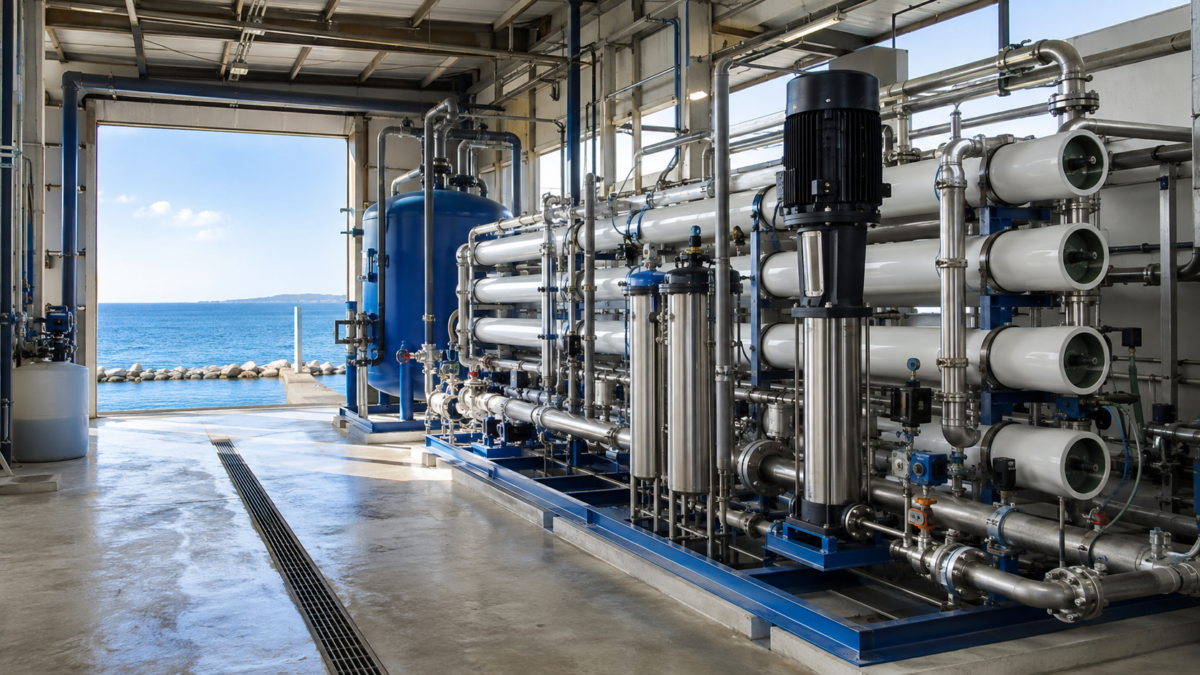
Energy and Running Costs
Because seawater treatment requires high pressure, it consumes more energy than ordinary reverse osmosis. Correct sizing is therefore the most decisive element of the running cost. Energy recovery solutions, meanwhile, are an important approach that lowers consumption on large installations.
The main item of cost is energy, and the reason is a physical necessity: overcoming the osmotic pressure of seawater takes far more power than mains water. That is not a defect of the system but a result of how it works.
The headings that affect the running cost are these:
| Item | Its Effect | How It Is Controlled |
|---|---|---|
| Energy consumption | The largest operating cost | Correct capacity and an efficient pump choice |
| Pre-filter renewal | A regular consumable cost | A suitable pre-treatment build reduces the frequency |
| Membrane renewal | Periodic and costly | Discipline in pre-filtration extends its life |
| Chemical cleaning | Infrequent but necessary | Done on time by following the pressure difference |
| Service and checks | A planned maintenance cost | Made predictable by a periodic service agreement |
The energy recovery approach comes to the fore on large installations. Part of the energy in the high-pressure water leaving the concentrate line is recovered back into the system; this is a design choice that reduces total consumption markedly. At small and medium scale the priority is correct sizing and an efficient pump.
A system chosen with inadequate capacity runs constantly at full load; that both raises energy consumption and tires the components quickly. A system chosen larger than necessary means unnecessary investment and extra space. In a seawater treatment investment, the right scale is at the centre of the economics.
How Is a System Chosen?
Five criteria are decisive in the choice: daily fresh water demand, the space available, the power source, the length of use and access for maintenance. Once these headings are clear, the capacity and the build emerge. Final sizing is always done around the seawater analysis and the operating conditions.
The decision runs in this order:
-
Establish the Daily Demand
How many people, for how long, and for what? Drinking, kitchen, showering and technical use are assessed separately.
-
Measure the Space
The engine room on a boat, the plant room at a site. As well as the volume of the vessels, room to work on them is taken into account.
-
Settle the Power Source
Generator, mains or an alternative source; the power demand of the system has to match that capacity.
-
Define the Pattern of Use
Seasonal or continuous? With intermittent use, preservation and recommissioning procedures come to the fore.
-
Plan Access for Maintenance
Filter changes, membrane checks and access to service support should be assessed from the start.
When these five headings are complete, what you have is not a guess but a definition of requirements. What the outlet water is for should become clear at this stage too: further treatment stages are planned according to use, so that the water reaches the quality needed for drinking and household use.
On the maintenance side the most critical habit is regular monitoring. When the pressure difference, the production rate and the conductivity of the outlet water are followed, a loss of performance is noticed early. A seawater treatment system lasts not because of its installation but because of the discipline of its maintenance.
Frequently Asked Questions
How does seawater treatment work?
Seawater is sent to a special membrane by a high-pressure pump. As the water molecules pass the membrane, most of the dissolved salts are held back and returned to the sea as concentrate. The result is water of usable quality.
Can a standard reverse osmosis unit be used on seawater?
No. Membranes designed for mains water cannot provide the separation needed at the salt concentration of seawater, and the components cannot withstand the high pressure and corrosive environment. Systems designed specifically for these conditions are needed.
Space is limited on my boat — will a system fit?
Boat-type watermakers are designed compactly and built to work in limited volumes. The capacity is set by the size of the boat, the number of people and the length of the passage; space and power conditions are assessed together.
Why is energy consumption higher?
Because a far higher pressure is needed to overcome the osmotic pressure of seawater. That is a physical condition of how the system works. Correct sizing and an efficient pump choice keep consumption under control.
Can the water produced be drunk directly?
The system aims to reach the quality needed for drinking and household use. But further stages such as carbon, mineral balancing or UV (ultraviolet) treatment are planned according to use. Those stages are settled at the engineering stage.
How often is the membrane changed?
There is no fixed period; it varies with the quality of the seawater, the effectiveness of the pre-treatment and how heavily the system is used. The most reliable indicators are a fall in the production rate and a lasting rise in the conductivity of the outlet water.
What should be done if the system will stand unused for a long time?
Before laying up or a long pause, the proper preservation procedure should be followed. Keeping the membrane from drying out and protecting the system are essential. A check and a rinse are also needed before recommissioning.
Conclusion
Seawater treatment is an engineering solution that turns an abundant but directly unusable source into something you can work with. Reverse osmosis lies at its base; but the high salt load of seawater makes special membranes, high-pressure pumps and corrosion-resistant components essential. The success of the system is decided at two points: correct sizing and strong pre-filtration. Pre-treatment protects the membrane from fouling and markedly extends both efficiency and life. On boats, space and energy come to the fore; at sites, seasonal capacity. The right build always follows the same route: a seawater analysis, real consumption data, and engineering around how the water will be used.
Let’s plan the capacity for your boat or site together
To engineer a seawater system suited to your daily water demand and your space and power conditions, you can consult the Water Point expert team.
Explore the Reverse Osmosis Solutions