
What Is Regeneration? The Cycle at the Heart of Softening
That sound of running water from the basement or the bathroom in the middle of the night, the bag of salt going down faster than expected, and the white limescale marks reappearing on the taps after a while… Those three things have a shared explanation, and all of them point to the same process: regeneration. That cycle, at the heart of your water softening system, is the key to understanding how the unit works and why it needs salt.
In this guide we take up the regeneration cycle step by step, starting from ion exchange: why the resin saturates, what the brine does, which stages happen in what order, how the type of valve changes salt consumption, and what lies behind the problems met with most often. By the end of the article you will be able to read the behaviour of your unit and bring salt and water consumption under control.
What Is Regeneration?
Regeneration is the operation of bringing the resin in a water softening system back into working order with brine once it has lost its holding capacity. The calcium and magnesium collected on the resin are stripped off with a high-concentration salt solution and sent to the drain. The resin is loaded with sodium again and the softening continues.
The logic of the system can be understood through a sponge. The resin works like a sponge soaking up the hardness ions in the water; but its capacity is not endless. Once it is full it can hold no more ions. Regeneration is the operation that wrings that sponge out and makes it usable again.
Without that cycle the resin would be a single-use consumable and would have to be replaced entirely once it was full. Thanks to regeneration the same resin can be used for years; the system consumes only salt and a certain amount of wash water. In that respect regeneration is the basic mechanism that makes water softening technology economical.
Your unit running at night has to do with that too. Most systems are programmed for the hours when water use is at its lowest, because unsoftened water can pass into the line during regeneration. The sound you hear is not a fault but the system renewing itself.
Understanding Ion Exchange First
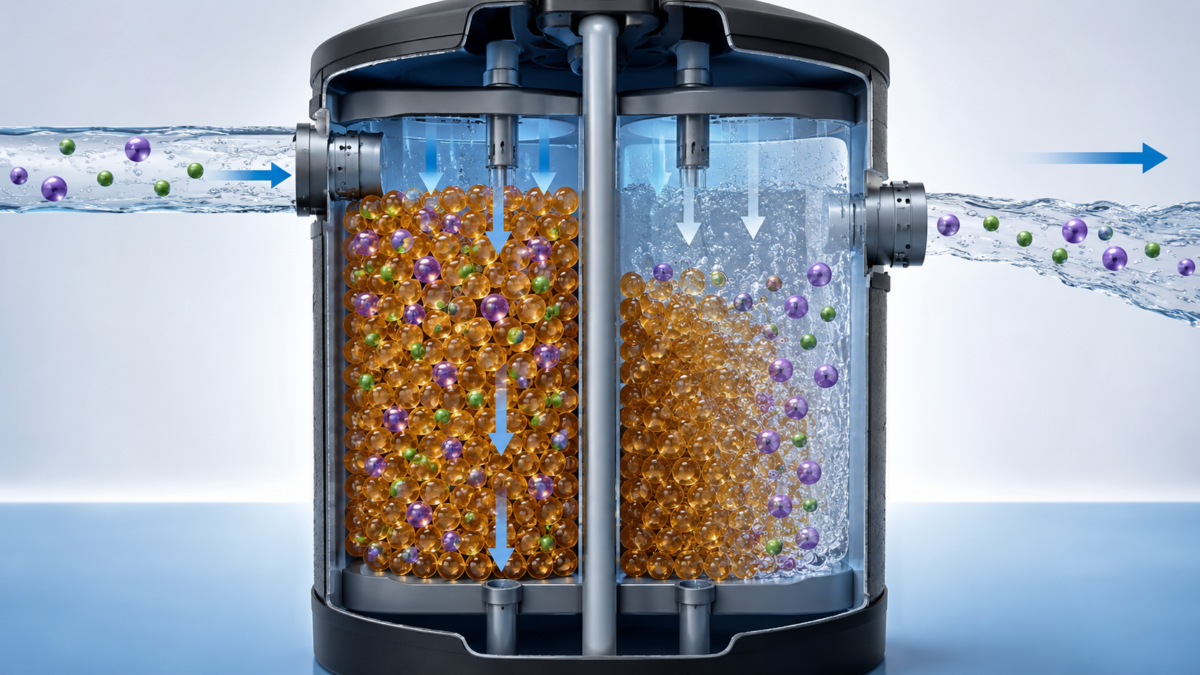
Ion exchange is the resin holding the calcium and magnesium ions in the water and releasing sodium in return. Because the hardness-forming ions are separated from the water, the water softens. The resin makes that exchange with a limited capacity; when the capacity is full, sodium is loaded again through regeneration.
At the centre of that exchange is the cation resin. That material, sitting inside the tank as millions of tiny beads, carries sodium ions on its surface. As the water passes between the beads, calcium and magnesium attach to the resin and sodium is released into the water in return. The water leaving is poorer in the minerals that cause hardness.
Why does such an exchange happen? Because calcium and magnesium tend to attach to the resin surface more strongly than sodium does. That natural order of preference is what lets softening advance by itself. The same order is reversed at the regeneration stage: when a very high concentration salt solution is used, sodium wins by sheer numbers and strips the hardness ions it holds out of place.
At this point a question often asked is worth mentioning: softened water contains a certain amount of sodium. Running a separate line for drinking water, or using an additional treatment stage in the kitchen, is a common practice. That choice can be planned from the outset when the system is designed.
The performance of resin can change over time; breakage, fouling and wear lower the holding capacity. In that case softening efficiency falls even when regeneration is carried out properly, and renewing the cation resin comes onto the agenda.
Why Does the Resin Saturate?
The amount of ions the resin can hold is limited. With every litre of water that passes, a certain amount of calcium and magnesium is held and the capacity falls. Once saturation is reached the exchange comes to a stop; water starts passing through unsoftened and the limescale problem returns. At that point regeneration is essential.
Saturation is a gradual process. The resin bed fills from top to bottom; ions are held in the area the water first touches, and once that area is full the exchange moves further down. When the whole bed is full, hardness starts to appear in the outlet water. In technical language that is called “breakthrough”.
Three factors set the speed at which saturation is reached:
- The hardness of the water: The higher the hardness, the more ions are held in every litre and the faster the capacity is used up.
- The amount used: As daily water use rises, the total ion load passing through the resin grows.
- The resin volume: The capacity of the system directly determines how many litres of water it can soften.
The combination of those three factors also defines the frequency of regeneration. A crowded household on hard water needs regeneration far more often than a home with few people on soft water. So the answer to “why does my unit eat so much salt” usually lies in the water itself.
If you do not know the hardness value of your water, a sound assessment is not possible. We took up in detail how the measurement is made and which parameters are looked at in our water analysis guide.
How Does Regeneration Happen, Stage by Stage?
The regeneration cycle consists of five stages: backwash, brine draw, slow rinse, fast rinse and refilling the salt tank. Every stage takes on a different job and the whole is managed automatically by the valve. When the process is complete, the resin works at full capacity again.
The order and the function of the stages are these:
-
Backwash
Water is passed in the reverse direction and the resin bed is lifted. The sediment and particles collected in the bed are loosened and sent to the drain; the packing between the beads is opened up.
-
Brine Draw
The concentrated salt solution in the salt tank is drawn into the resin bed. Sodium strips the calcium and magnesium attached to the resin out of place; the hardness ions are discharged along with the solution.
-
Slow Rinse
The brine is moved slowly along the bed. That low-speed flow lets the salt touch every point of the resin and completes the exchange.
-
Fast Rinse
The excess salt left in the bed is washed out at a high flow. If that step is not completed, a salty taste can be noticed in the outlet water; the quality of the rinse settles the result directly.
-
Refilling the Salt Tank
A controlled amount of water is taken into the salt tank for the next regeneration. That water dissolves the salt to prepare the new brine, and the system returns to the service position.
All five of those steps are carried out automatically by the valve; no intervention from the user is needed. The length of the stages varies with the capacity of the unit, the resin volume and the valve setting. The water sounds you hear come from the transitions between those steps.
Unsoftened water can pass into the line during regeneration. So the cycle is generally programmed for the hours when water use is at its lowest. Where uninterrupted soft water is needed, twin-tank builds are preferred.
The Role of Salt: Why Special Salt Should Be Used
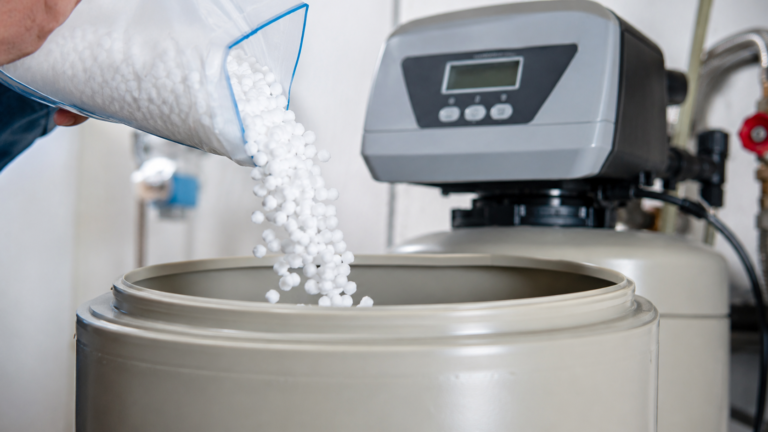
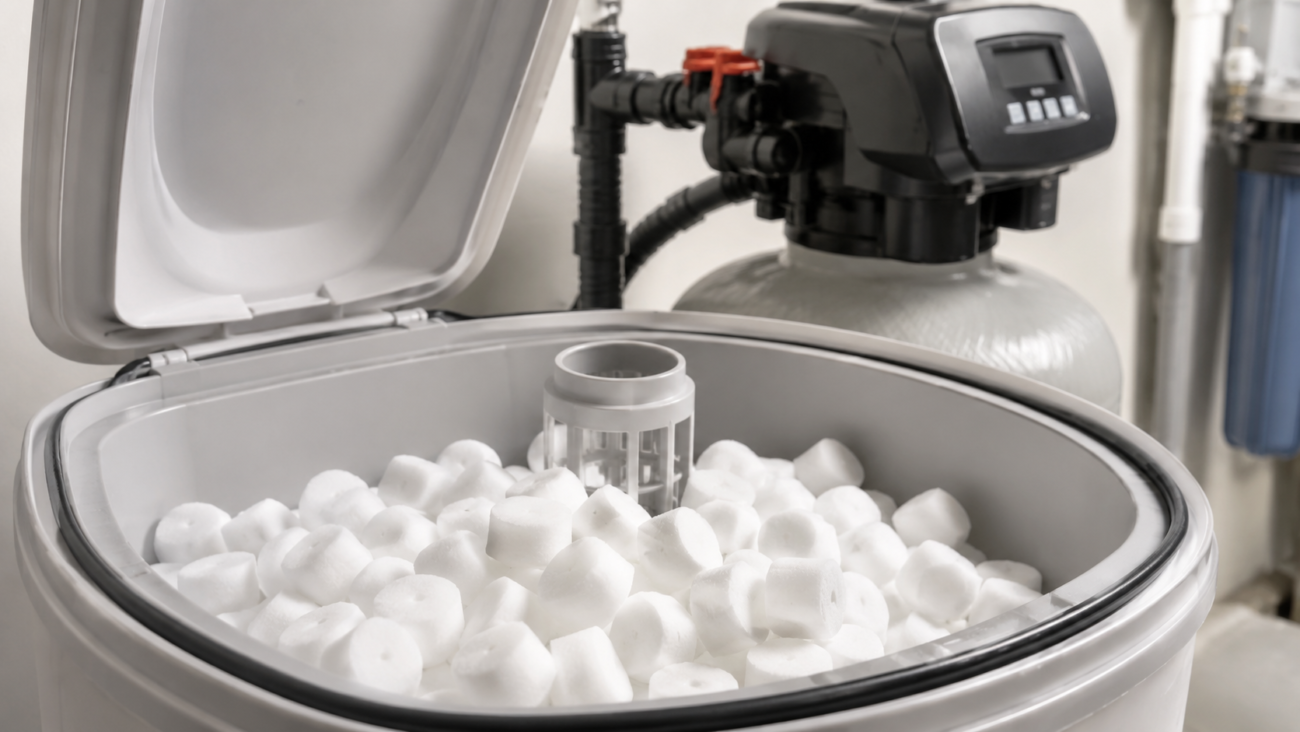
Salt is the driving force of the regeneration process; it is the only source of sodium for the resin. Softening salt is produced at high purity and dissolves without leaving residue in the water. Kitchen salt and salts with additives, on the other hand, leave undissolved residue and can lead to blockages in the salt tank and the valve.
The difference is purity. Table salt contains additives such as anti-caking agents and iodine; those components are not designed for a softening system. Over time they form a layer of undissolved sludge in the bottom of the tank, block the brine line and strain the injector. The result is that regeneration cannot be completed and softening efficiency falls.
Tablet salt is widely preferred for that reason: thanks to its compressed structure it dissolves in a controlled way, leaves less residue in the tank and keeps the brine concentration steady. Using a suitable water softener salt protects both the valve and the resin, and keeps the system going.
Checking the salt level regularly matters just as much. When the tank empties, no brine can be prepared; the valve carries out the regeneration steps but the resin is not renewed. The system looks as though it is working, but the water leaving stays hard. That is the situation users meet with most often and the one most easily prevented.
For an academic framework on ion exchange and the use of salt, the University of Nebraska publication on domestic water softening explains the basic principles of the process and the factors affecting salt consumption.
How Often Is Regeneration Carried Out?
The frequency of regeneration is not fixed; it is set by the hardness of the water, the daily consumption and the capacity of the unit. Hard water and high consumption make the cycle more frequent, while low hardness and light use make it rarer. The right period is set on the valve by assessing those three sets of data together.
An example makes it clear: the same model of unit regenerates at long intervals in an area of low hardness, while in an area of high hardness it uses the same capacity up in a far shorter time. The unit is the same; what changes is the water itself.
Setting the period correctly brings a benefit in two directions. Regeneration carried out too often consumes salt and water for nothing. A cycle carried out too rarely lets the resin reach saturation and hard water pass into the line. The balance between the two is struck by entering the hardness value correctly when the unit is installed.
The choice of capacity bears directly on that balance too. A unit chosen at too small a capacity goes into regeneration constantly to meet the need and consumes more salt over the long run. We took up step by step how the right capacity is established in our softening system selection guide.
The Difference Between Time-Controlled and Flow-Controlled Valves
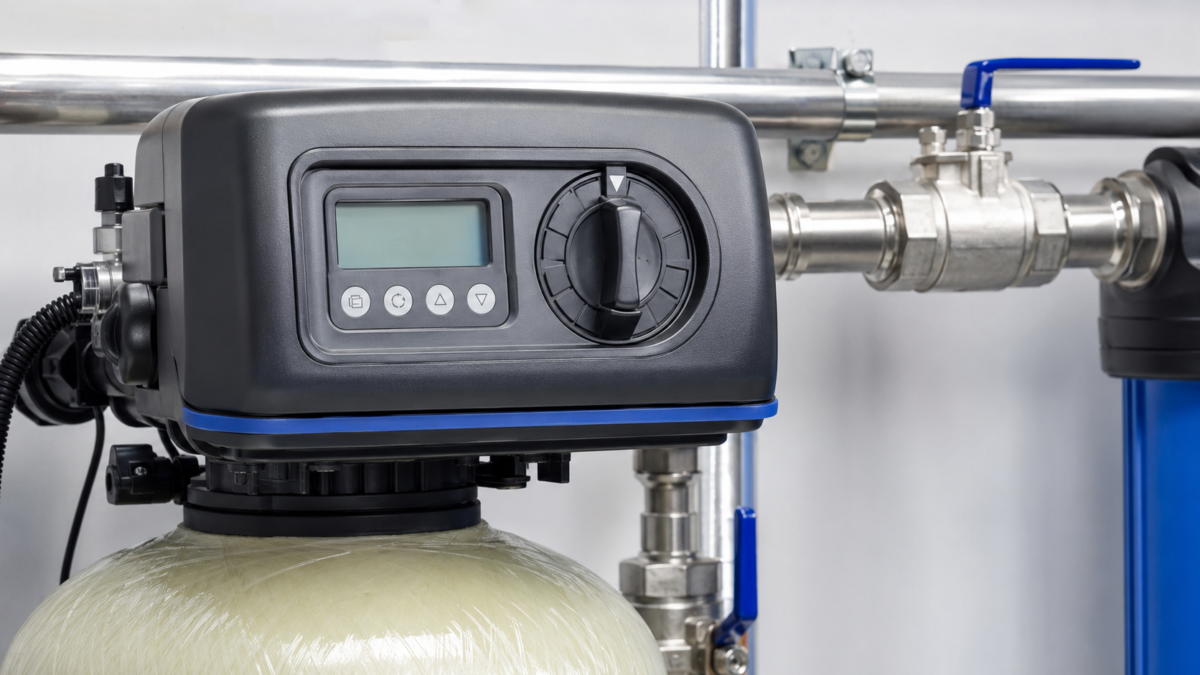
Time-controlled valves start regeneration on a fixed calendar; the cycle runs even where no water has been used. Flow-controlled valves measure the amount of water that has passed with a meter and trigger the cycle only when the need actually arises. That difference creates a marked saving in salt and water consumption.
The valve is the component that decides for the system. The logic it works on directly determines your long-term operating cost:
It works to a fixed calendar
When the set period comes round, regeneration starts automatically; consumption is not taken into account.
- Its structure is simple and predictable
- It works consistently where consumption is steady
- It runs the cycle on days when nothing is used
- It risks early saturation on busy days
It measures the real consumption
The water passing through the meter is followed; regeneration starts only when the capacity is used up.
- It gives an advantage under variable use
- It removes the unnecessary cycle
- It lowers salt and wash water consumption
- It waits over holidays instead of running for nothing
The difference is clearest in a holiday scenario: over a week with nobody at home, a system on a fixed calendar carries on regenerating and consuming salt. A structure that follows consumption waits, because its capacity has not been used up. Spread across a year, that difference turns into a serious saving.
For households with irregular use and businesses that work seasonally, with valves that follow consumption are markedly advantageous. On installations where consumption is regular and predictable, time-controlled valve solutions offer a simple and economical option.
If the valve on your existing system has to be renewed, a volumetric control valve matched to the capacity makes it possible to put regeneration management on a consumption basis.
Regeneration in Tandem Systems
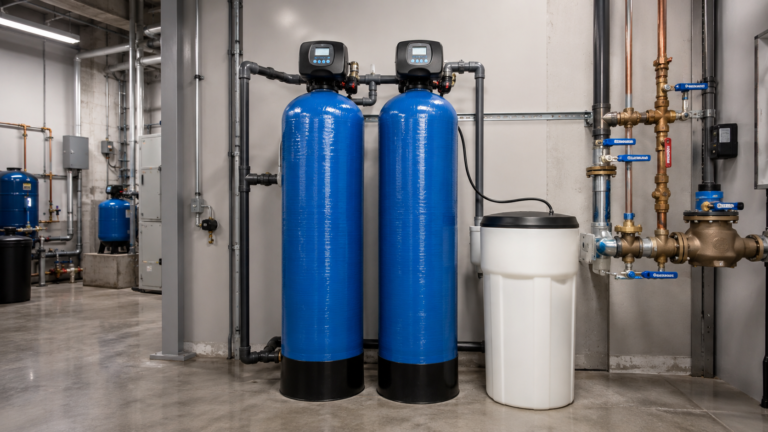
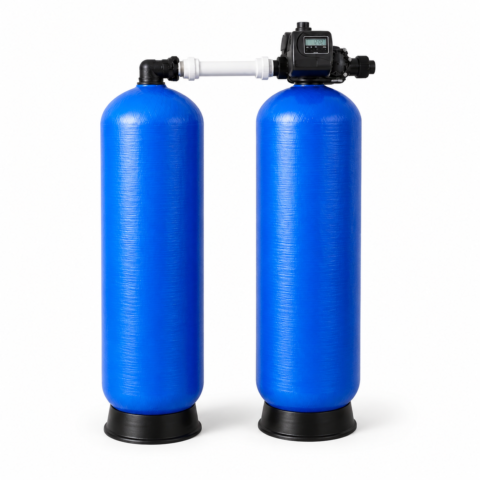
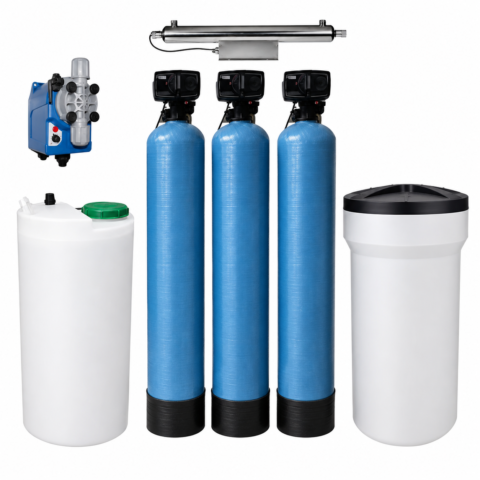
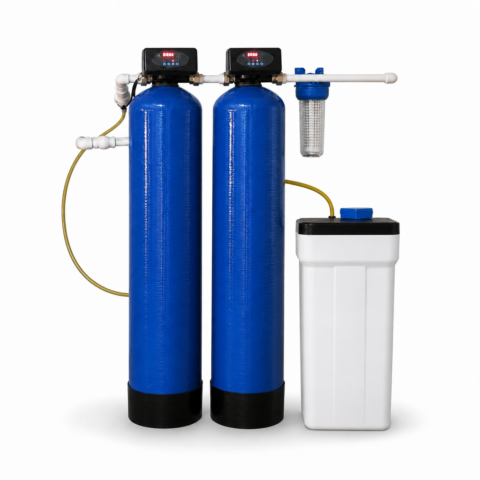
Tandem systems have two resin tanks. While one is regenerating the other stays in service, so the line is supplied with soft water without a break. In plants running twenty-four hours, in hotels and in businesses in continuous production, that build is preferred as the standard answer.
On single-tank systems a short interruption occurs during regeneration; so the cycle is planned for the hours of low use. In domestic use that generally causes no problem. But in a plant that produces at night too, or a hotel serving twenty-four hours, there is no such thing as an “hour of low use”.
In a tandem build the valve brings the tanks into service in turn. When one tank has used up its capacity the system switches automatically to the other, and the tank that has emptied is taken into the regeneration cycle. From the user’s side no interruption is felt at all; the line is fed with soft water continuously.
That structure also removes the planning load. Where single-tank systems need the regeneration hour set correctly, a twin-tank build carries no such constraint. For plants running continuously, twin-tank tandem systems are the direct answer to a need for uninterrupted softening.
Common Problems With Regeneration
The most common problems are these: a salt bridge forming, too much water collecting in the salt tank, the softening stopping, and the system running water continuously. Most of those signs come from the quality of the salt, the valve setting or the brine line. Noticed early, the answer is usually simple.
The table below matches the sign you observe with its likely cause:
| Symptom | Likely Cause | The Point to Check |
|---|---|---|
| The salt is not going down but the water has hardened | A salt bridge may have formed | A hardened layer of salt inside the tank |
| Too much water has collected in the salt tank | The brine cannot be drawn | The injector, the brine line and the valve |
| The softening has stopped altogether | The salt has run out or the resin has tired | The salt level and the state of the resin |
| The system runs water constantly | The valve may not have returned to service | The valve position and the drain line |
| A salty taste is noticed in the water | The rinse was not completed | The fast rinse step and the settings |
| The cycle repeats too often | The hardness setting is wrong or the capacity is too small | The valve setting and the capacity of the unit |
A salt bridge is the problem met with most often and the most deceptive. The salt hardens inside the tank and forms a crust; a void is left underneath but the salt above does not come down. From outside the tank looks full, yet no brine can be prepared. The result is that regeneration is carried out but the resin is not renewed, and the water hardens.
A damp environment and poor-quality salt are usually what lead to that. Using good tablet salt and checking the level in the tank regularly largely prevents the problem.
A Salt Bridge
The tank looks full but no brine forms; regeneration runs for nothing and the water hardens.
A Blocked Brine Line
When the injector or the line blocks, the brine cannot be drawn and water collects in the tank.
A Wrong Hardness Setting
A setting above the real hardness creates an unnecessarily frequent cycle and excess salt consumption.
Tired Resin
Fouled or worn resin cannot recover its capacity despite proper regeneration.
If water is running from the system continuously, attention should not be delayed. When the valve cannot return to service, both the water consumption rises and the regeneration cycle cannot be completed. Technical service support is advised in that case.
Ways to Reduce Salt and Water Consumption
The way to reduce consumption is not to trigger regeneration unnecessarily. Choosing the right capacity, a valve that follows consumption, a setting made to the real hardness, using good salt and periodic maintenance: those five headings markedly lower salt and wash water consumption.
The effect of every heading on the operating cost is concrete:
| The Practice | What It Does | What It Gives |
|---|---|---|
| The right capacity | It balances the frequency of the cycle | It prevents unnecessary regeneration |
| A flow-controlled valve | It follows real consumption | It removes the cycle that runs for nothing |
| The right hardness setting | It uses the capacity to the real load | It lowers excess salt consumption |
| Good salt | It dissolves without residue | It prevents blockages and failures |
| Periodic maintenance | It checks the valve and the line | It catches a loss of efficiency early |
The one overlooked most on that list is the hardness setting. When a hardness above the real value is entered during installation, the system counts its capacity as used up faster than it is and regenerates more often than it needs to. A setting made with a measured hardness value gives a serious saving on its own.
Second comes the choice of capacity. A unit chosen too small produces the same fixed salt and water cost at every regeneration, but repeats it far more often. By the end of the year the difference can more than swallow the price advantage at the start.
Third is regular maintenance. Cleaning the injector, checking the brine line and occasionally emptying and cleaning the salt tank keep the efficiency of regeneration going. Those operations are simple, but the consequences of skipping them are costly.
Let’s establish the build that lowers your salt consumption
To plan the capacity and valve type that suit your hardness value and your consumption, you can look at the options.
See the Softening SolutionsFrequently Asked Questions
What exactly does regeneration mean?
It is the operation of renewing the resin with brine. The calcium and magnesium attached to the resin during softening are stripped off with a high-concentration brine and sent to the drain. The resin is loaded with sodium again and carries on working at full capacity.
Why does my unit run at night?
Because unsoftened water can pass into the line during regeneration, the cycle is generally programmed for the hours when water use is at its lowest. The water sounds you hear come from the backwash and rinse steps; they are not a sign of a fault.
What happens when the salt runs out?
No brine can be prepared and the resin cannot be renewed. The valve carries out the regeneration steps but no exchange takes place; the water leaving hardens and the limescale problem returns. So checking the salt level regularly is the most basic maintenance step there is.
Can I use kitchen salt?
It is not advised. The additives in table salt leave undissolved residue; they can create sludge in the salt tank and blockages in the brine line and the injector. Salts of high purity made for softening should be preferred.
Can I use water during regeneration?
On single-tank systems unsoftened water can pass into the line during that time; use should be avoided if possible. Where uninterrupted soft water is needed, twin-tank builds are preferred, with one tank working while the other is renewed.
When is the resin replaced?
Resin is long-lived but not endless. If the softening efficiency is falling despite proper regeneration, the resin may be fouled or tired. Renewal is then needed; its life varies with the quality of the inlet water and the conditions of use.
Can I drink softened water?
Because of the ion exchange, softened water contains a certain amount of sodium. Running a separate line for drinking and kitchen use, or using an additional treatment stage at that point, is a common practice; that choice can be planned when the system is installed.
Conclusion
Water softening systems consuming salt, running at night and occasionally letting limescale back are not random behaviours; all of them are natural parts of the regeneration cycle. The resin holds the hardness ions in the water, is renewed with brine when its capacity is full, and the cycle starts again. The efficiency of that process depends on three things: the right capacity, the right hardness setting and good salt. And the type of valve is the quiet actor that settles the bill; a structure that follows consumption removes the running-for-nothing on days when nothing is used. Assess your system in that frame and you will both bring salt and water consumption under control and secure a continuous supply of soft water.
Let’s establish the capacity and valve structure that suit your system
To plan the build that best suits your hardness value, your consumption and your need for uninterrupted water, you can consult the Water Point expert team.
Discover the System That Suits You