
How Is Iron Removed From Water? Three Forms, Three Answers
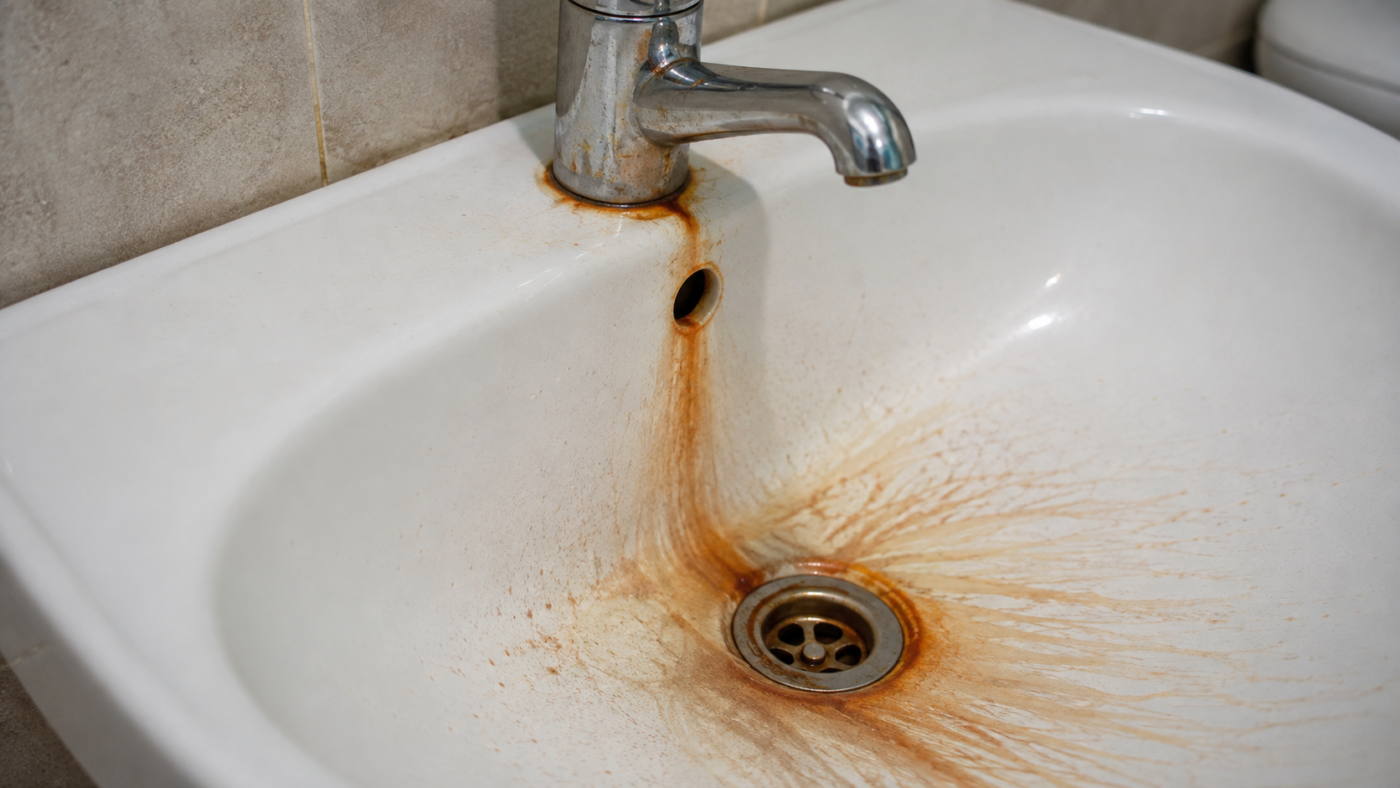
Brown marks in the basin that nothing shifts, a ring in the toilet that darkens over time, a yellowish tone appearing on white washing, and water that changes colour after standing in a glass for a while… Most homes take that for a cleaning problem and try to solve it by changing products. Yet the source is not on the surfaces but in the water running from the tap: iron in water.
In this guide we take up where the iron in the water comes from, the signs by which it shows itself and, most importantly, why there is no single answer to it. Because iron can be present in water in three different forms and each calls for a different approach. The way to choose the right system runs through knowing first which form you are dealing with.
What Is Iron in Water and Why Is It There?
Iron in water is a mineral dissolved naturally out of the rock and soil layers the groundwater passes through. Because it is in solution in an oxygen-free environment the water runs clear; when it meets air it oxidises into a solid form and takes on its characteristic red-brown colour.
Iron is one of the most common elements in the earth’s crust. As rainwater seeps into the soil and moves underground it touches those layers and takes up a certain amount of iron. The depth of the well, the geology and the oxygen content of the water directly settle the amount dissolved.
So the problem is seen mainly in households using well and groundwater. But geology is not the only source: old, rusted plumbing lines can add iron to the water too. Redness in the first water from the mains generally points to that second source.
The most important detail of the subject is this: iron in water cannot always be seen by eye. The water can run clear from the tap; the iron is still in solution. When it meets air and oxidises, the change of colour begins. That delayed reaction is the basic feature that makes the problem hard to diagnose too.
The Signs: What Is Your Water Telling You?
The most common signs are these: water that runs clear and reddens on standing, brown marks in the basin and toilet, yellowing on white washing, a metallic taste in the water and a spoiled colour in tea and coffee. Where there is manganese too, the marks are black-grey rather than brown.
The signs give a clue about which form the problem comes from as well. The table below matches what you observe with a likely cause:
| The Sign Observed | Likely Cause | What It Means |
|---|---|---|
| It runs clear and reddens on standing | Dissolved iron | It oxidises when it meets air |
| It runs cloudy and red from the start | Iron in particle form | The iron is already being carried in solid form |
| A gel-like, slippery deposit | Organic / bacterial iron | There is biological growth inside the line |
| Brown marks in the basin and bath | Iron build-up | Oxidised iron residue on the surface |
| Black-grey marks and sediment | Manganese | A second mineral accompanying the iron |
| Yellowing on washing | Iron in the wash water | Residue settling into the fibres of the fabric |
| A metallic taste | Dissolved iron | The sensory quality of the water is affected |
| A spoiled colour in tea and coffee | Interaction with iron | The colour and taste of the drink change |
What those signs have in common is that they cannot be solved permanently with a cleaning product. The mark is wiped away and comes back a few days later. Because the source is not on the surface but in the water constantly running onto it. Iron in water repeats that cycle for as long as it is not removed.
The washing side is particularly annoying. White textiles washed in iron-laden water take on a yellowish tone over time and do not return to their old state with normal detergent. Some users try to put it right with bleach; but because that speeds up oxidation it can make the mark more marked still.
The Three Forms of Iron and Why They Matter
Iron is present in water in three different forms: dissolved, in particle form, and organic or bacterial. Each behaves differently and calls for a different answer. A system chosen without making that distinction either solves the problem partly or not at all. The right diagnosis is the precondition of the right system.
This section is the backbone of the whole article. Under the same description of an “iron problem” hide three entirely different scenarios:
It runs clear, then reddens
The iron is in solution in the water and cannot be seen. When it meets air it oxidises and the colour changes.
- It comes out clear at the tap
- It reddens on standing
- It passes straight through a filter
- Oxidation is needed first
It runs cloudy from the start
The iron has already turned into a solid form; the water is coloured and cloudy as it leaves the tap.
- The colour is noticed at once
- It settles at the bottom of the glass
- It can be held by filtration
- Pre-filtration becomes critical
It leaves a gel-like deposit
Microorganisms feeding on iron form a slippery, smelly layer inside the line.
- Gel-like residue in the cistern and the line
- An unpleasant smell
- It creates blockages in the line
- It calls for an extra approach
Why does that matter so much? Because dissolved iron, when it meets a filter, passes through without any resistance; the filter cannot “see” it. It first has to be oxidised into a solid form and then held by filtration. Iron in particle form, on the other hand, can be handled directly by filtration.
Bacterial iron is the hardest scenario. Here there is not only a mineral but a biological structure feeding on that mineral. That layer grips the surfaces of the line, creates blockages and cannot be removed entirely by classic filtration; it calls for an extra approach.
Those three forms are often present together. A well can have both dissolved and particle iron; and biological growth may have started inside the line. So a system built for iron in water consists not of a single stage but of a chain established from the analysis result.

Why Are Iron and Manganese Seen Together?
Iron and manganese come from similar geological sources and dissolve in water under similar conditions. So they are found together in most wells. The distinction becomes clear in the colour: iron leaves red-brown marks, manganese black-grey ones. Both are handled on the same logic, but manganese is generally more stubborn.
The shared journey of the two minerals starts underground. At depths where the oxygen falls, both become soluble and are carried along with the water. When they come to the surface and meet air they oxidise separately; and that is what settles the colour of the marks.
In practice manganese is harder to remove than iron. It oxidises more slowly and is more sensitive to the pH of the water. So a system built only for iron may not give the result expected where manganese is present.
A first assessment can be made by looking at the colour of the marks: brown marks point mainly to iron, dark grey and black ones to manganese. But that is only a clue; the definitive distinction is set out by an analysis report.
Iron and manganese in private well systems are taken up comprehensively in academic sources too; Penn State University’s resource on iron and manganese in private water systems explains the behaviour of those two minerals and the approaches to removing them in detail.
A Health Problem or a Matter of Appearance?
Iron and manganese are assessed by the US Environmental Protection Agency under its secondary standards. Those standards are not health limits; they are advisory references set for reasons of appearance such as taste, colour and staining. The assessment that applies in Türkiye is made with the relevant regulations and an accredited laboratory report.
That distinction has to be stated clearly, because there is a widespread worry about the subject. Iron and manganese are not among the primary (health-focused) parameters in drinking water standards but among the secondary (appearance and use-focused) ones.
The aim of the secondary standards is clear: to keep the taste, colour, smell of water and the marks it leaves on surfaces at an acceptable level. Those values are advisory and are not defined as a binding health limit.
Iron in water is first of all a matter of comfort, appearance and equipment. It creates concrete problems under the headings of staining, taste, colour and blockage. Whether your water meets the regulations is assessed only with an accredited laboratory report.
Against that, playing the problem down would not be right either. Its effects on the equipment side are real and costly: drippers block, white goods wear, textiles are damaged and deposits form in the plumbing lines. So the subject is not one of health but it is very concrete indeed in terms of running costs and comfort.
An Analysis First: Which Measurements Should Be Made?
The right answer starts with an analysis. As well as the amount of iron and manganese, the pH, turbidity, hardness and microbiological load should be measured. And the most critical point is establishing which form the iron is in; because dissolved, particle and bacterial iron call for different stages.
A choice made without an analysis rests on guesswork, and systems built on guesswork usually solve the problem only partly. The parameters to request are these:
- Total iron: It shows the amount of iron in the water and the scale of the removal needed.
- Manganese: It sets out whether it accompanies the iron; it changes the build of the answer.
- pH: It directly affects the efficiency of oxidation; it is decisive in choosing the method of removal.
- Cloudiness: It shows the particle load and the grade of filtration needed.
- Hardness: It determines whether an extra softening stage is needed.
- Microbiological load: It allows the possibility of bacterial iron to be assessed.
How the sample is taken matters particularly here. In an iron analysis, leaving the sample standing changes the result; as the water meets air it oxidises and the real position is not reflected. We took up all the details of sampling and reading a report in our water analysis guide.
You can also make a practical first observation: fill a clean glass with water and let it stand for a while. If the water is clear at first and reddens over time, dissolved iron is dominant. If it is cloudy and coloured from the start, the particle form is to the fore. That does not take the place of a laboratory analysis but it shows the direction of the process.
How Is Iron Removed From Water?
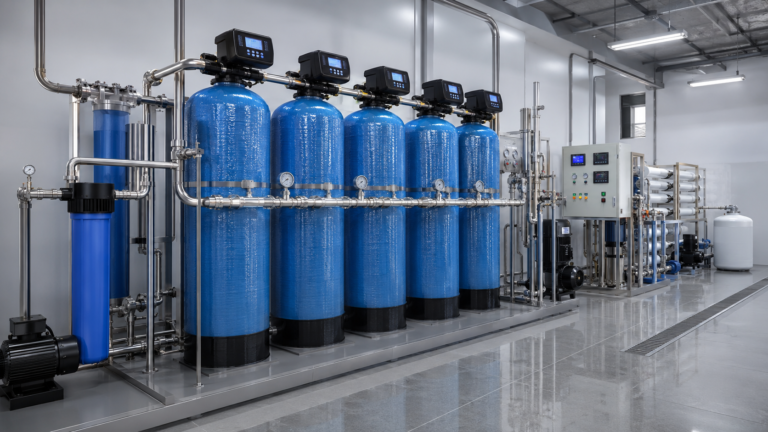
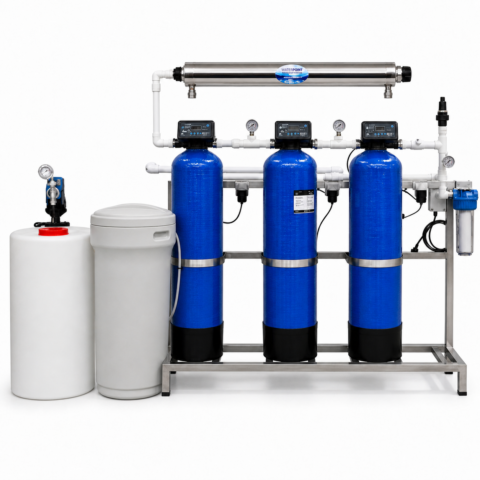
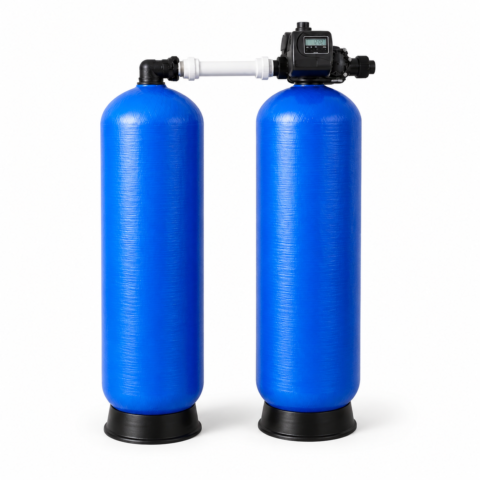
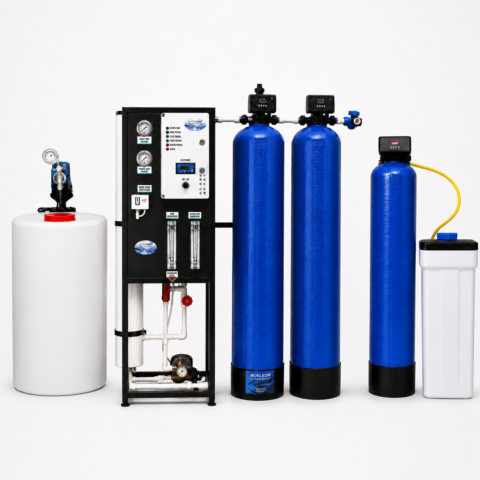
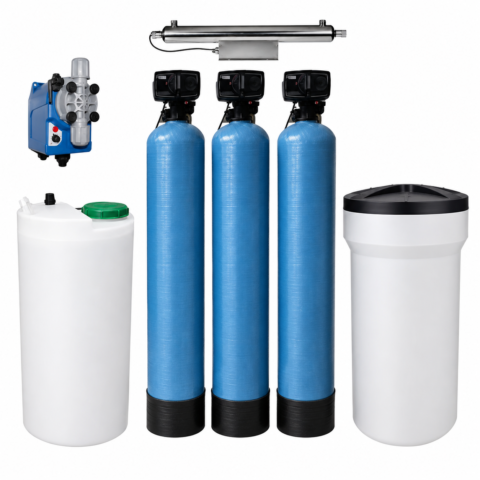
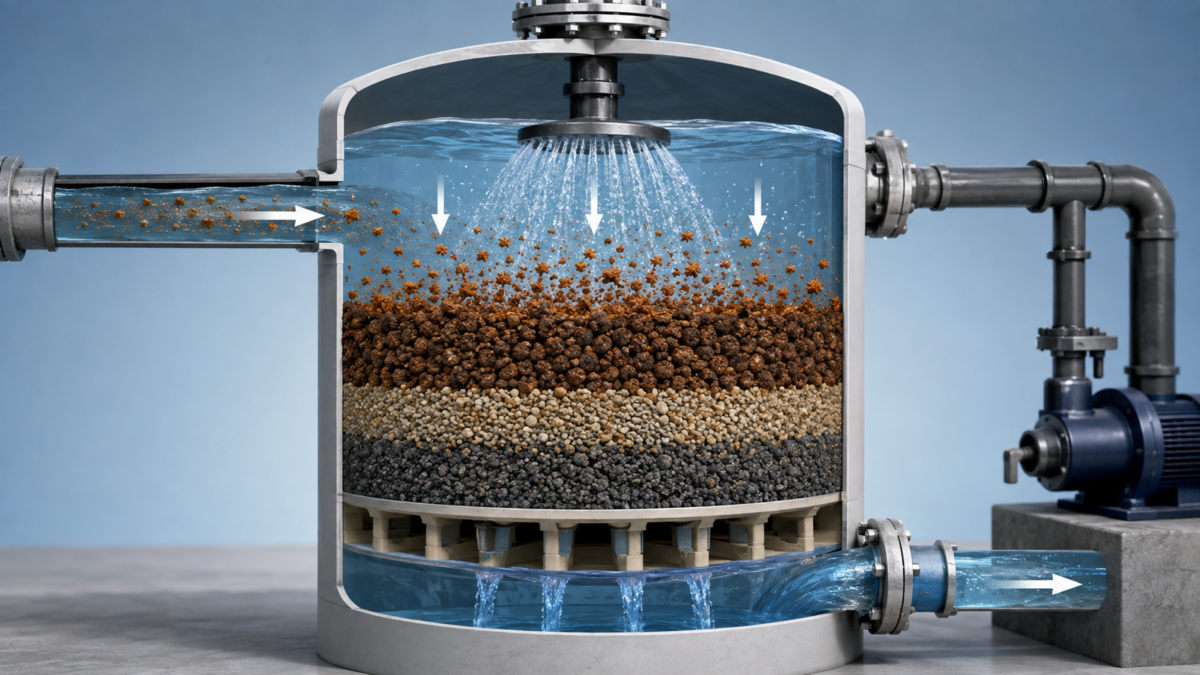
The basic approach has two steps: oxidation first, then filtration. Dissolved iron is turned into a solid form by aeration or by suitable oxidising approaches; it is then held in sand and multimedia filter beds and separated from the water. The method is established from the analysis result and the form the iron is in.
The logic is in fact intuitive. A filter only does its job if there is something it can hold; and dissolved iron is physically as good as absent. So it first has to be made “visible” — that is, turned into a solid particle.
A typical removal chain runs in these steps:
-
Separating Coarse Particles
The sand and coarse sediment coming from the well are separated at the start of the line; the load on the stages behind is reduced.
-
Oxidation
Dissolved iron is turned into a solid form by aeration or by suitable oxidising approaches. The method is established from the water analysis.
-
Filtration
The iron now in solid form is held in a sand or multimedia filter bed and separated from the water.
-
Backwash
The iron collecting in the bed is sent to the drain at regular intervals by reversing the flow.
-
An Extra Stage as Needed
Additional stages are planned for hardness, microbiological load or drinking water quality.
The separator filter systems used for coarse separation lowers the load on the bed from the start by separating the heavy particles by centrifugal effect. We took up how the filtration stage works and why backwashing is essential in our sand filter article.
On agricultural and high-flow uses, sand units with automatic backwashing are preferred; the automation prevents the regular cleaning slipping on water with a high iron load.
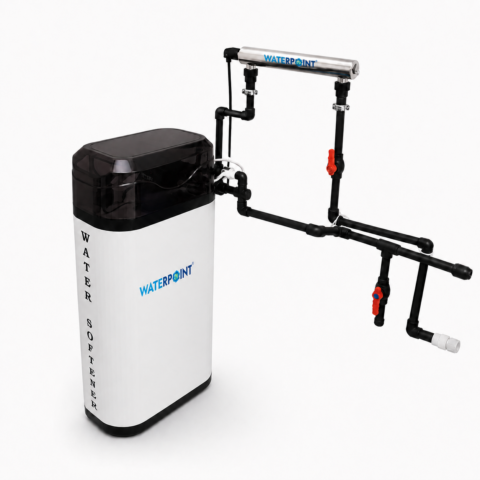
Where bacterial iron is involved the approach widens. The biological layer inside the line has to be dealt with, and a stage that reduces microbiological risks — UV (ultraviolet) treatment, for instance — may have to be added to the build. That decision should always rest on the analysis result.
The exact chemical dosage, method and order of stages cannot be given here; they are established from the form of the iron, the pH value and the flow. An oxidation stage built wrongly can precipitate the iron in the line and make the problem worse.
Does Water Softening Remove Iron?
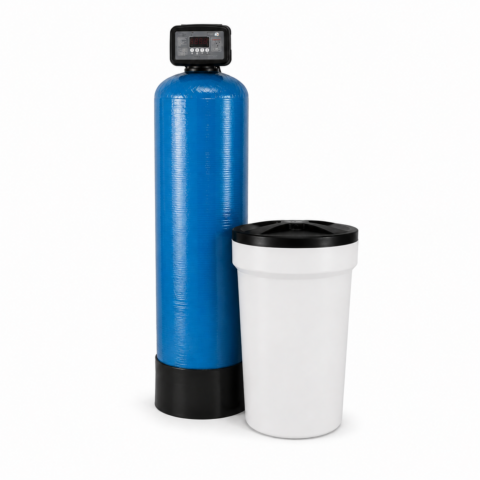
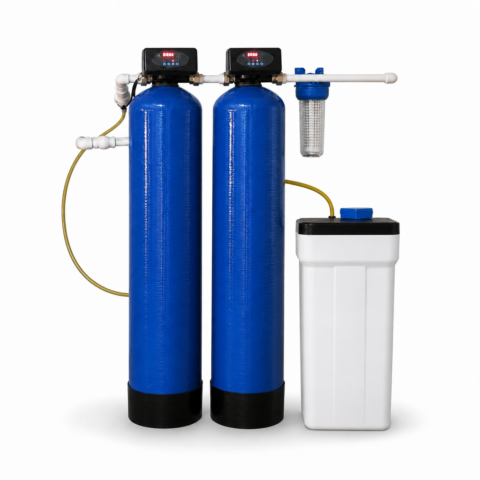
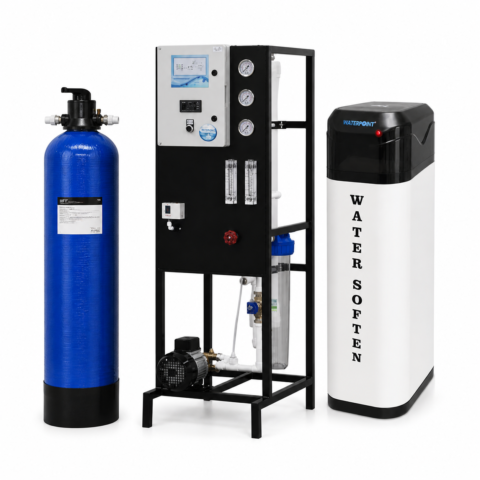
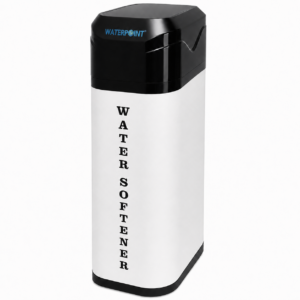
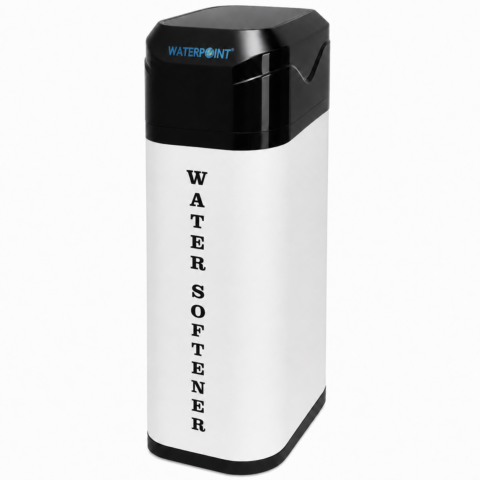
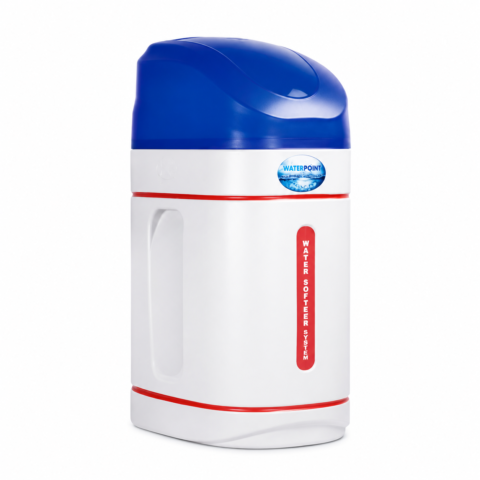
A softening unit can hold a limited amount of iron in a particular form; but it is not designed for removing iron. At a high iron load the resin is fouled, the softening performance falls and the life of the unit shortens. A separate removal stage should be built for an iron problem.
That is one of the most common wrong choices of unit made in the field. A softening unit works by ion exchange and can hold part of the iron in solution too; so at low levels a partial improvement is seen. The user thinks the problem has been solved.
But the process is not sustainable. The iron attached to the resin cannot be stripped off entirely during regeneration; it builds up in the bed over time. The result works in two directions: the softening efficiency falls and the resin is permanently fouled. In short, the answer that looks cheap wears out an expensive component.
The right approach is to handle the two problems separately. Softening for the hardness, and a stage based on oxidation and filtration for the iron. Where both are present the chain is planned in order — iron removal is generally positioned before the softening. We took up the criteria for choosing on the softening side in our softening system selection guide.
Fouling of the Resin
The iron collecting in the bed cannot be stripped off entirely by regeneration and creates a permanent loss of performance.
A Loss of Softening
Fouled resin cannot hold the hardness ions well enough; the limescale problem returns.
A Short Unit Life
A system working under an iron load cannot complete the working life expected.
A Wrong Diagnosis
The partial improvement gives the impression that the problem is solved and delays the real answer.
Iron in Drinking Water: The Point-of-Use Answer
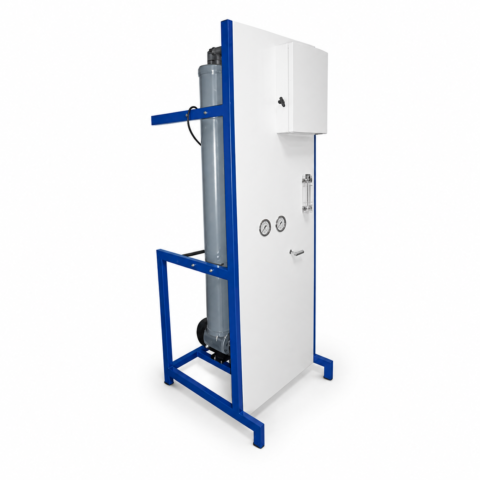
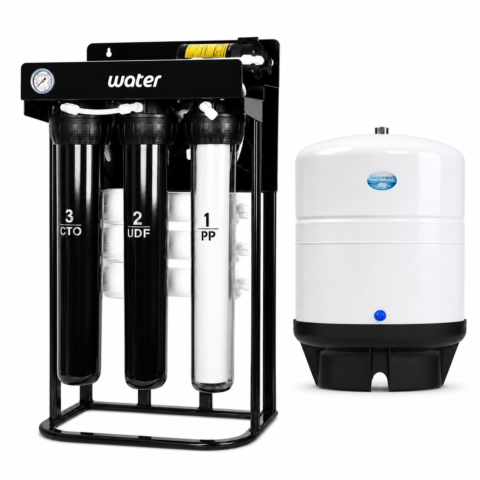
A system installed across a building protects the plumbing and the equipment from iron. For drinking and kitchen use an additional stage is generally planned. Treating the pre-treated water in the kitchen with an advanced stage such as reverse osmosis makes a two-layer build.
That two-layer approach is the most practical answer to the subject. The system installed on the main line protects the whole house: no marks form in the basins, the washing does not yellow, deposits in the plumbing are reduced. We took up how that scope is planned in our building inlet treatment systems article.
On the kitchen side the expectation is different; drinking water quality is the aim there. The pre-treated water is processed at a more advanced stage with reverse osmosis solutions. One important note: a reverse osmosis system should not be positioned on its own against a high iron load; without pre-treatment the membrane blocks quickly.
In households using well water the chain is broader; we explained step by step which problem is solved by which stage in our treatment stages for well water article. And for high-flow installations, industrial well water systems are sized project by project.
Let’s solve the iron problem in your water at its source
To plan the stages that suit your analysis result and the form the iron is in, you can look at the solutions.
See the Well Water SolutionsWhat Is Watched When the System Is Installed?
Six headings are decisive in the installation: the form the iron is in, the system flow, the water and drain available for backwashing, the presence of pre-filtration, the periodic maintenance plan and the space for the layout. Where the iron load is high, protecting the main stages should be planned separately too.
Every heading bears directly on the long-term performance of the system:
- The form of the iron: Dissolved, particle or bacterial; it changes the build of the stages entirely.
- Flow requirement: The system is chosen at a scale to meet the instantaneous water demand of the household or the plant.
- The backwash conditions: A sufficient wash flow and a suitable discharge line are essential.
- Pre-filtration: If the coarse particles are not separated, the bed blocks quickly and the efficiency falls.
- The maintenance plan: On water with a high iron load the stages call for checking more often.
- The layout and the space: Enough room should be left for the tank bodies and for working on the units.
Backwashing is particularly critical in iron removal builds. If the iron collecting in the bed is not discharged regularly it packs down and turns into permanent blocking. That can call for the bed to be renewed partly or entirely.
Maintenance discipline matters just as much. Where the Iron in water load is high, the stages tire faster; following the pressure difference and observing the outlet water regularly show a loss of performance early.
And finally it is worth saying this: iron removal builds take on the job of protecting the main systems too. Where stages such as softening or reverse osmosis are part of a chain, removing the iron before those stages markedly extends both the efficiency and the life of the equipment.
Iron removal is generally positioned at the start of the chain. Softening and advanced treatment stages give the performance expected, and run far longer, when they are fed with water freed of iron.
Frequently Asked Questions
Why does the iron in water run clear from the tap and then redden?
Because the iron is in solution in the water and cannot be seen in that form. When the water meets air it oxidises, turns into a solid form and takes on its characteristic red-brown colour. That delayed reaction is the typical sign of dissolved iron.
Do the brown marks in the basin come off with a cleaning product?
They come off temporarily but that is no lasting answer. Because the source is not on the surface but in the water, the mark returns in a short time. The lasting result comes from removing the iron at the start of the line.
Does iron pose a risk to health?
Iron and manganese are assessed by the US Environmental Protection Agency under its secondary — that is, appearance — standards; those are advisory references, not health limits. The assessment that applies in Türkiye is made with the relevant regulations and an accredited laboratory report.
Does a water softening unit remove iron?
It can hold a limited amount, in a particular form, but it is not designed for that. At a high iron load the resin is fouled, the softening performance falls and the life of the unit shortens. A separate removal stage should be built for iron.
Do the black marks come from iron too?
Generally no; black and dark grey marks point to manganese. Manganese comes from the same geological source as iron and is often found with it. The distinction is made clear by an analysis report, because it affects the build of the answer.
Can the yellowing on washing be reversed?
Residue that has settled into the fibres of a fabric usually cannot be recovered entirely. So the priority is protecting the new washing; once the water is treated at the start of the line, the cycle of yellowing stops.
Which stages are needed, and how is that established?
The build of the stages is established from the form the iron is in and from the analysis results. For dissolved iron, oxidation and filtration; for the particle form, filtration directly; and for bacterial iron, extra approaches. The right diagnosis is the precondition of the right system.
Conclusion
The brown marks in the basin, the yellowing washing and the water that reddens on standing in a glass all trace to the same source. But iron in water is not one problem; it is a heading that appears in three different forms: dissolved, particle and bacterial. Each behaves differently and calls for a different answer, and a system chosen without making that distinction will not solve the problem fully. The right route is clear — an analysis first, then building the stages that suit the form of the iron in the right order, and keeping up regular backwashing and maintenance. Where there is hardness, softening should be planned separately, and for drinking water an additional stage should be considered in the kitchen. Taken up in that frame, both the marks on the surfaces and the load on the equipment disappear for good.
Let’s analyse your water and establish the system that suits the iron together
To identify which form the iron is in and to plan the stages that suit your source, you can get in touch with the Water Point expert team.
Discover the Solution That Suits You