

Free Shipping
Product Category
Activated Carbon Filters
Activated carbon is a filter medium used in water treatment to remove chlorine, taste, odour and organic matter. What separates it from the carbon inside a cartridge filter is that here the carbon is used loose, inside a tank. Tank-type carbon filters handle a far higher flow rate and a far longer s…
- Free Shipping · across Türkiye
Products
Free Shipping
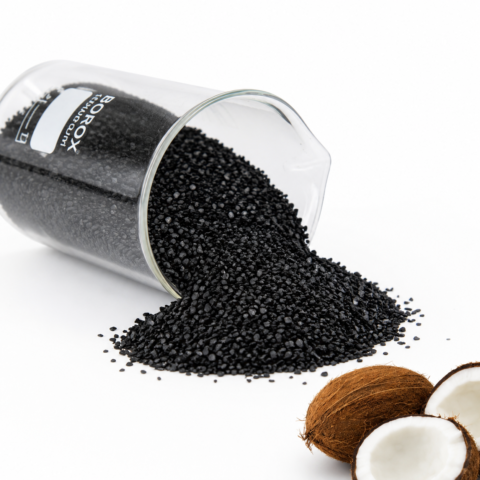
About Activated Carbon Filters
Activated carbon is a filter medium used in water treatment to remove chlorine, taste, odour and organic matter. What separates it from the carbon inside a cartridge filter is that here the carbon is used loose, inside a tank. Tank-type carbon filters handle a far higher flow rate and a far longer service life than a cartridge; that is why they are chosen for flat inlets, building inlets and commercial and industrial applications. For cartridge-type carbon filters, see our Water Filters category.
How Activated Carbon Works
Activated carbon is carbon that has been processed at high temperature to give it a porous structure. As a result, a single gram of carbon reaches hundreds of square metres of internal surface area. As water passes through this porous bed, chlorine and organic compounds attach to the carbon surface. This is called adsorption.
Adsorption has two practical consequences. First, the capacity of the carbon is limited: as the surface fills, its holding power falls and beyond a certain point the carbon begins to release what it has held. Second, contact time is decisive. The more slowly water passes through the carbon bed, the more effective the holding. The same amount of carbon does far less work at a high flow rate.
How adsorption works and what it does and does not remove is explained in detail in our article What Is an Activated Carbon Filter? Its Job, Types and Replacement.
Coconut Shell and Coal-Based Activated Carbon
Coconut shell based
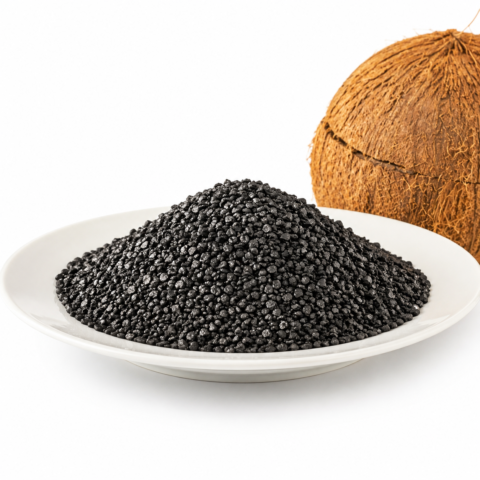
Produced by processing coconut shell. Its pore structure is finer and more regular and its internal surface area is high. It is effective at holding chlorine and small-molecule organic compounds. Because it is harder, it abrades less during backwashing and the bed lasts longer. Coconut Shell Activated Carbon 14,705.52 TL.
Coal based
Produced by processing mineral coal. Its pore distribution is broader; this is an advantage in holding large-molecule organic matter. The initial investment cost is markedly lower. Coal-Based Activated Carbon 4,901.84 TL.
| Property | Coconut shell based | Coal based |
|---|---|---|
| Pore structure | Fine and regular | Broadly distributed |
| Where it stands out | Chlorine, small-molecule organics | Large-molecule organics |
| Abrasion resistance | High | Medium |
| Bed life | Longer | Shorter |
| Initial investment | 14,705.52 TL | 4,901.84 TL |
| Typical choice | Drinking-water line, membrane protection | Pre-treatment, general use |
What decides the choice is the type of problem in the water. If chlorine control and protecting the reverse osmosis membrane are your priority, coconut shell carbon is the longer-term solution. For general-purpose pre-treatment, and where budget is the deciding factor, coal-based carbon does the job.
How a Tank-Type Carbon Filter Is Installed
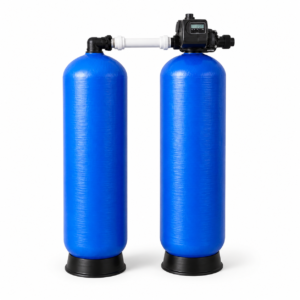
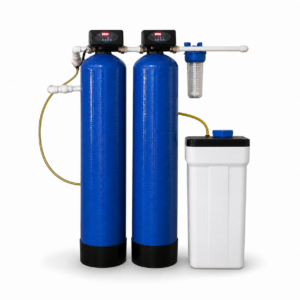
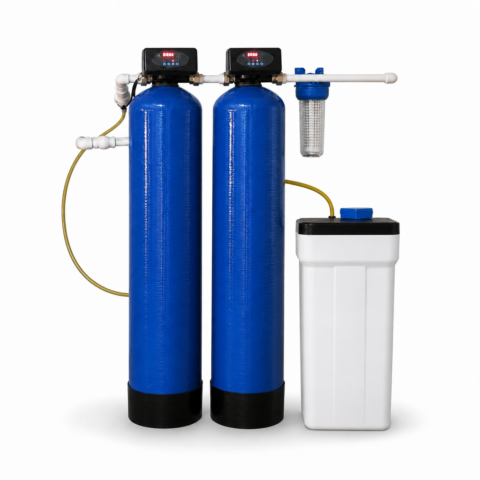
A tank-type carbon filter has three main parts: the tank, the carbon bed inside it and the valve on top. The valve backwashes the bed periodically.
- Tank: The carbon volume is set by the flow rate of the line. The pressure tank you choose directly affects contact time.
- Support bed: A graded layer of sand or gravel is laid beneath the carbon to stop it reaching the distributor.
- Carbon bed: About two thirds of the tank is filled; freeboard is left at the top so the bed can expand during backwash.
- Valve: It manages the backwash and rinse steps. No brine circuit is needed; a filter control valve is used.
Leaving no freeboard above the bed is the most common installation mistake. The bed cannot expand during backwash, sediment cannot be flushed out, and the carbon compacts over time and channels; the water takes a short path through without touching the carbon.
Why Backwashing Is Necessary
A carbon bed accumulates two things over time: chemicals held on its surface and sediment trapped between the grains. Chemical saturation is not resolved by backwashing; sediment build-up is.
During backwash, water is passed in the reverse direction at a high flow rate. The bed expands, the grains separate and the sediment between them is carried out of the top. Without this the bed compacts, pressure loss rises and the water opens a channel through the bed, passing through without touching the carbon.
How often backwashing is needed depends on the sediment load of the water. Once a week may be enough on mains water, while well water with a high sediment load needs it more often. For detail, see our Well Water Treatment category.
When the Carbon Bed Is Replaced
Activated carbon is a consumable. Backwashing clears the sediment but does not bring back the chemical capacity of the carbon. A bed that has reached saturation must be replaced.
The typical replacement interval is 2–3 years, but this depends on the chlorine content and organic load of the water and on daily water consumption. On heavily used commercial lines the interval is shorter.
| Symptom | What it means | What to do |
|---|---|---|
| Chlorine taste and odour are back | The carbon has reached saturation | Replace the bed |
| Pressure loss has increased | The bed is compacted or sediment has built up | Check the backwash setting |
| Fine black grains in the water | The carbon has abraded or the support bed is inadequate | Check the bed and the support layer |
| Backwashing does not fix it | Chemical saturation | Replace the bed |
Where Activated Carbon Sits in the System
The activated carbon stage protects the parts that come after it. It has a critical job in reverse osmosis systems in particular: chlorine damages the membrane surface permanently and that damage cannot be reversed.
| Order | Stage | Job |
|---|---|---|
| 1 | Sediment filter | Holds sand, sediment and rust |
| 2 | Activated carbon | Chlorine, taste, odour and organic matter |
| 3 | Softening (if required) | Hardness removal |
| 4 | Reverse osmosis membrane | Separates dissolved salts |
When the order is wrong, the most expensive part is the one that suffers. Putting the carbon ahead of the sediment filter fills the carbon bed with sediment quickly. Skipping the carbon altogether shortens the life of the membrane directly.
Cartridge Carbon or Tank-Type Carbon
Both do the same job; the difference is scale. What decides the choice is the flow rate of the line and how heavily it is used.
- Cartridge carbon: Suitable for under-sink units and low-flow points. The initial cost is low and replacement is easy. Its capacity is limited, though, and it is changed every 6–12 months.
- Tank-type carbon: Suitable for flat inlets, building inlets and commercial and industrial lines. The initial investment is higher, but the bed runs for 2–3 years and handles a far higher flow rate.
In between sit Big Blue (jumbo) cartridges; they do not match a tank for capacity, but they last markedly longer than a standard cartridge. They can be chosen as a first step in mid-scale applications such as a flat inlet.
What Activated Carbon Removes and What It Does Not
Knowing what activated carbon cannot do matters as much as knowing what it can. A wrong expectation leads to attempts to solve the problem with carbon, and to lost time.
Where activated carbon is effective
- Chlorine: The main source of the sharp taste and odour noticed in mains water. This is where carbon is strongest.
- Taste and odour compounds: Organic compounds that spoil the drinkability of water attach to the carbon surface.
- Organic matter: Naturally occurring organic load is reduced with carbon, particularly on lines fed from surface water.
- Colour: Colour of organic origin falls markedly across a carbon bed.
Problems activated carbon does not solve
- Hardness (limescale): Calcium and magnesium are not held by carbon. The answer is ion exchange; a water softener is needed.
- Dissolved salts (TDS): Carbon does not lower the TDS value. A reverse osmosis membrane is used for that.
- Suspended solids: Sand and sediment are not the job of carbon; a sediment stage must be fitted ahead of it.
- Microbiological risk: Carbon is not used for this purpose. Where it is needed, a UV (ultraviolet) treatment stage is positioned separately.
Every decision taken without making this distinction stays incomplete. Fitting a carbon filter for someone whose complaint is limescale does not solve the problem at all; equally, installing a softening system for someone who complains about chlorine taste will not meet the expectation. The way to pick the right stage is to establish by measurement which problem the water actually carries.
Bed Volume and Flow Rate
One idea decides performance in a tank-type carbon filter: the contact time between the water and the carbon. That time is set by the ratio of bed volume to the flow rate through the line.
The same amount of carbon gives a long contact time at a low flow rate and works effectively. As the flow rate rises the water passes through the bed quickly, contact time shortens and the carbon works far below its capacity. So the right question is not "the bigger the tank the better" but "is the tank matched to the flow rate of the line".
In practice three things are taken into account when the bed volume is set:
- Peak flow: The combined flow rate of every tap and item of equipment that can be open at the same time. It is the busiest moment, not average consumption, that decides.
- Chlorine and organic load: As the load rises, more carbon is needed at the same flow rate.
- Target replacement interval: If you want to renew the bed every three years, you need a larger volume than for renewing it every two years.
Extending the Life of the Carbon Bed
Set up correctly, carbon comfortably completes the service life expected of it. Most of the factors that shorten it have to do with the rest of the system rather than the carbon itself.
- Fit a sediment stage ahead of it. Sediment lodges between the grains of the carbon bed and closes off the active surface. Having a sediment stage ahead of the bed extends bed life directly.
- Set the backwash correctly. If the duration is too short the sediment cannot be flushed out; if it is too long, water runs to waste. Enough freeboard must have been left in the tank for the bed to expand.
- Do not force the flow rate. If the flow rate of the line is above what the bed volume can take, the carbon both does less work and tires more quickly.
- Track saturation by measurement. Regular checks, rather than waiting for a taste and odour symptom, stop you leaving it too late.
- Do not neglect the support bed. A graded sand and gravel layer stops the carbon reaching the distributor and stops the bed collapsing.
Activated Carbon in Industrial Applications
Activated carbon is used for two different purposes on industrial lines. The first is the classic removal of taste, odour and organic matter. The second, and often the more critical, is chlorine protection for the reverse osmosis membrane.
Membranes are expensive on industrial reverse osmosis lines; a single 8-inch membrane can cost several times the carbon bed. Chlorine reaching the membrane leaves irreversible damage. For that reason the carbon stage is positioned not as an "improvement" but directly as a protective investment.
At this scale the carbon bed is usually installed in tanks with automatic backwash and managed by a filter control valve. The bed volume is calculated from the peak flow rate of the line and the chlorine content of the feed water. When capacity has to be increased, parallel tanks can be preferred to one large tank, so that one tank keeps production running while the other is renewed.
Industrial water treatment and industrial packaged systems are the categories where you will find the detail on applications at this scale.
The Order to Follow When Changing Carbon
- 1 — Put the system into bypass. The home or the business should not be left without water; the bypass valve is there for this.
- 2 — Release the pressure. Do not start dismantling before the pressure on the tank and the valve has dropped.
- 3 — Remove the valve. Use the right spanner; forcing it damages the valve thread.
- 4 — Empty the old bed. Take out the carbon and the support bed completely and rinse the inside of the tank.
- 5 — Check the distributor tube. A broken or cracked distributor lets the new carbon escape into the line.
- 6 — Lay the support bed. The graded sand and gravel layer goes in before the carbon.
- 7 — Load the carbon. Cap the mouth of the distributor tube while loading; otherwise carbon fills the tube.
- 8 — Leave freeboard at the top. About one third of the tank must stay empty so the bed can expand during backwash.
- 9 — Run a manual backwash. On first commissioning, one cycle is run by hand to flush the fine dust out of the bed.
- 10 — Record the date. The next replacement decision will be made from this date and from the measurements.
Activated Carbon and Water Analysis
To size the carbon stage correctly you need to know what load the water carries. Decisions made without measurement end either in an oversized and expensive bed or in an installation that falls short.
The basic values to look at are these: the amount of free chlorine sets the load that will tire the carbon bed most. Organic load can consume the capacity of the carbon quickly, particularly on lines fed from surface water. Turbidity and suspended solids show how strong the pre-sediment stage needs to be. Iron and manganese form deposits on the bed surface in well water and may call for separate pre-treatment.
Alongside these values, daily water consumption and peak flow figures are also needed. A carbon bed tires according to the total volume of water consumed; so a bed of the same volume reaches saturation in roughly half the time on a line that uses twice as much water a day.
In domestic and small commercial use, chlorine control and consumption figures are usually enough to guide the choice. On industrial lines, calculating from a laboratory analysis is decisive for both investment and running cost. Send us your water analysis and the flow rate of your line and we can work out the right carbon type and bed volume together.
The Carbon Bed and Pressure Loss
Every filtration stage creates some pressure loss on the line, and an activated carbon bed is no exception. In a healthy bed that loss stays within an acceptable limit and goes unnoticed in daily use. If the loss grows over time, that is a warning sign.
There are three main reasons for pressure loss growing. Sediment build-up is the most common; when the pre-sediment stage is not doing its job, the gaps between the carbon grains fill up. Compaction of the bed is the result of inadequate backwashing; the grains lock together over time. Abraded carbon produces fine dust and blocks the lower section.
The three are told apart by looking at how the bed behaves after a backwash. If pressure returns to normal after backwashing, the problem is sediment and the backwash frequency must be increased. If backwashing does not put it right, the bed is compacted or the carbon has abraded; replacement is then needed.
The way to keep pressure loss low from the start is to choose the right volume. A bed that is small for the peak flow rate of the line both clogs sooner and does not let the water touch the carbon enough. A carbon tank planned together with a pre-filter stage will not cause a noticeable pressure problem for years.
Carbon Bed and Cartridge Cost Comparison
When choosing between cartridge carbon and tank-type carbon at the same point, the decision must not be based on the initial price alone. The cost structure of the two solutions is different.
With cartridge carbon the initial investment is low, but the cartridge is renewed every 6-12 months; the cost repeats at regular intervals. With tank-type carbon the initial investment is high because it covers the tank, the valve and the media; in return the bed runs for 2-3 years and only the media is renewed.
The picture becomes clearer still at points with a high flow rate. A cartridge solution both falls short at high flow and has to be changed far more often. A tank-type solution gives a longer contact time at the same flow rate and, because the replacement interval is long, brings the total cost down.
The decision comes to this: cartridge for low-flow single points, tank-type carbon for high-flow central use.
The Carbon Bed and Water Temperature
Adsorption efficiency is affected by water temperature. Holding is generally more effective in cold water; as the temperature rises, some compounds held on the carbon surface become more likely to be released again.
For that reason the carbon stage is positioned on the cold water line wherever possible. Connecting a carbon filter directly to a hot water line both lowers efficiency and can take some materials outside their working temperature range. The temperature rating of the housing and the media in use must be verified before installation.
Activated Carbon and the Pre-Treatment Stage
Having a sediment stage ahead of the carbon bed is the single most important factor in the life of that bed. Sediment settles between the carbon grains and physically closes off the active surface; the bed then stops doing its job even though the chemical capacity of the carbon is not yet used up.
So when a carbon tank is installed, a pre-filter stage matched to the sediment load of the line must be planned. A standard sediment cartridge is usually enough on mains water; on sources with a high sediment load such as well water, using a washable steel filter first and a consumable cartridge after it is the sounder arrangement.
Activated Carbon Prices 2026
The prices below are the current figures on the product pages and include VAT.
| Product | Type | Where it stands out | Price |
|---|---|---|---|
| Coal-Based Activated Carbon | Loose media | General pre-treatment | 4,901.84 TL |
| Coconut Shell Activated Carbon | Loose media | Chlorine control, membrane protection | 14,705.52 TL |
The tank and the valve the bed needs are chosen separately: pressure tank options and filter control valves are listed in the relevant categories.
What Is Different About Buying Activated Carbon from Water Point
- These are consumables; because their life depends on water quality and on use, they are outside warranty cover.
- CE certified products — we work with products that fall within certification.
- ETBİS registered e-commerce — we are registered in the Ministry of Trade system.
- Invoiced sales — a legal invoice is issued with every order.
- Bed volume calculation — we work out the right amount of carbon together, according to the flow rate of your line.
- Free site survey available — we establish on site whether the problem is in the carbon bed or in another stage. see the details
- Türkiye-wide service network for industrial work — for domestic units we serve İstanbul and the surrounding provinces (such as Kocaeli and Tekirdağ).
Address: Mehterçeşme Mah. 1919 Sk. No: 54/B Esenyurt / İstanbul.
Can’t find the spare part you are looking for?
Send us the brand and model of your unit and we will work out the right filter, membrane, valve or resin together. If the unit is purchased from us the site survey is free; if only a survey and measurement are requested, a site survey fee of 2,000 TL applies.
0850 304 95 25WhatsApp[email protected]Activated Carbon Filters: frequently asked questions
Should I buy coconut shell or coal-based activated carbon?
If chlorine control and protecting the reverse osmosis membrane are your priority, coconut shell carbon is the better fit; thanks to its fine, regular pore structure it holds chlorine and small-molecule organics more effectively, and because its abrasion resistance is high the bed lasts longer. For general-purpose pre-treatment, and where budget is the deciding factor, coal-based carbon does the job.
When is an activated carbon bed replaced?
The typical replacement interval is 2-3 years, but it depends on the chlorine content and organic load of the water and on daily consumption. The clearest symptom is chlorine taste and odour coming back. A taste and odour problem that does not improve after backwashing shows that the bed has reached chemical saturation.
Does backwashing renew the carbon?
No. Backwashing only clears the sediment trapped between the grains of the bed and prevents compaction. It does not remove the substances chemically held on the carbon surface. So backwashing extends the life of the bed but does not renew carbon that has reached saturation.
Should I use tank-type carbon instead of a cartridge carbon filter?
The decision depends on the flow rate of the line. Cartridge carbon is suitable for under-sink units and low-flow points and is changed every 6-12 months. At flat inlets, building inlets and on commercial and industrial lines, tank-type carbon is preferred; the initial investment is higher, but the bed runs for 2-3 years and handles a far higher flow rate.
How much carbon is needed?
What decides this is not the amount of carbon but the contact time between the water and the carbon. Using a small tank on a high-flow line means wasting the carbon; the water passes through without enough contact. The bed volume is calculated from the peak flow rate of the line. Send us the flow rate of your line and we can work out the right amount together.
Does a carbon filter remove limescale?
No. Activated carbon holds chlorine, taste, odour and organic matter; it does not remove the calcium and magnesium in the water, that is, the hardness. The answer to a limescale problem is ion exchange, in other words a water softening system. The carbon stage is used here to protect the softening system.
Black grains are coming through in the water, is that normal?
Some fine carbon dust can be seen in a newly commissioned bed on first use and clears once the line is run off. If black grains keep coming through during use, the carbon may have abraded or the support bed may be inadequate; the bed and the graded support layer need to be checked.
Does reverse osmosis work without a carbon stage?
It works for a short while, but the life of the membrane is markedly shortened. Chlorine damages the membrane surface permanently and that damage cannot be reversed. For that reason the carbon stage must be placed ahead of the reverse osmosis membrane and must be renewed on time.