

Free Shipping
Product Category
Water Filter Taps
Treated water is delivered from its own separate tap, not from the kitchen mixer tap. There are two reasons for this: treated water must not mix with mains water, and the filter tap is built from materials suited to contact with that water. A standard kitchen mixer tap is not designed for the job. W…
- Free Shipping · across Türkiye
- 1-Year Warranty
Products
Free Shipping
Free Shipping
Free Shipping
Free Shipping
About Water Filter Taps
Treated water is delivered from its own separate tap, not from the kitchen mixer tap. There are two reasons for this: treated water must not mix with mains water, and the filter tap is built from materials suited to contact with that water. A standard kitchen mixer tap is not designed for the job. With a filter tap, type, material and installation logic decide the choice; dispenser adapters connect to the same line. For the unit itself, see ourWater Purifiers category; for storage, see ourPressure Tanks category.
Why the Filter Tap Must Be Separate
The water produced by the treatment unit travels on a line that is independent of the mains supply. Connecting that line to the kitchen mixer tap creates both technical and practical problems.
- Mixing risk: At a shared outlet, treated water mixes with mains water and the treatment loses its purpose.
- Pressure difference: Water coming from the pressure tank flows at a different pressure from the mains. A standard mixer tap may not work properly at that lower pressure.
- Material compatibility: On a filter tap, the surfaces in contact with treated water are made from materials suited to it.
- Ease of use: A separate tap makes it clear which water is the drinking water.
Tap Types
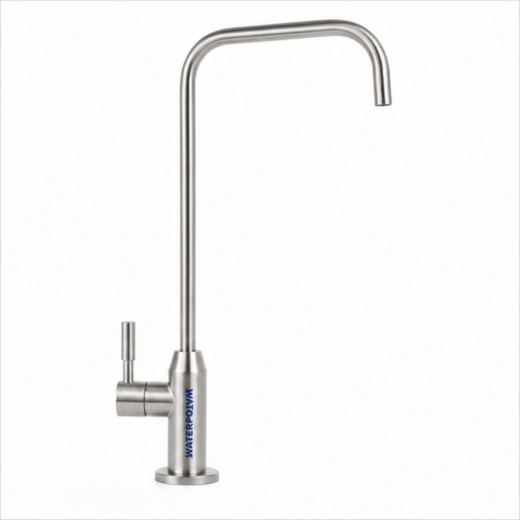
Standard single-flow taps
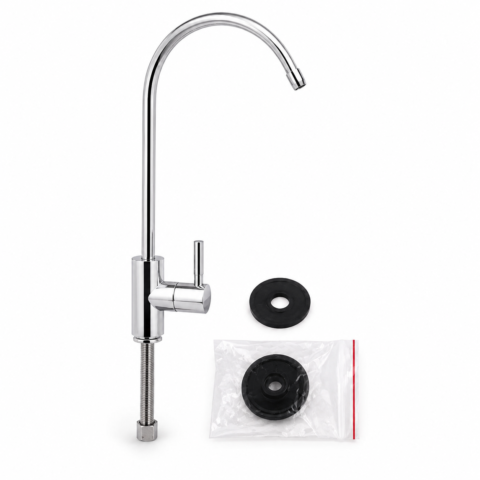
This is the most common type. It delivers treated water only and can have a single lever or a turn handle. It is fitted through a single hole drilled in the worktop. TheLuxe Filter Faucet at 980.37 TL is in this class and is chosen for most standard under-sink installations.
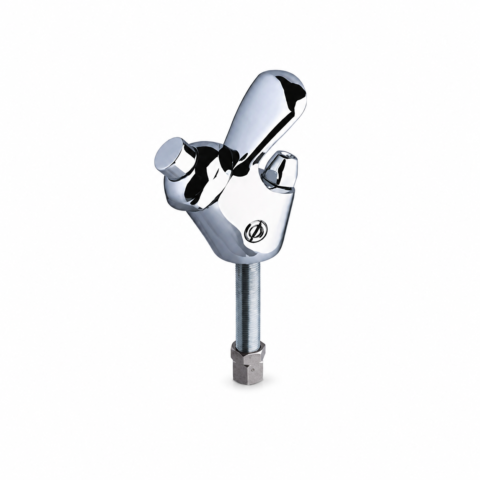
Bubbler taps
A special head at the spout sends water upwards, so you can drink directly without filling a glass. It is common in schools, offices and shared-use areas. TheBubbler Tap costs 1,960.74 TL.
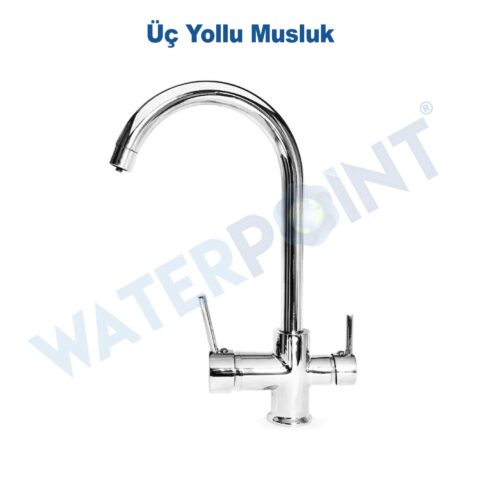
Three-way taps
These combine hot water, cold water and treated water in a single body. No separate hole needs to be drilled in the worktop and the kitchen keeps a clean look. Installation must be done more carefully than for a standard tap, because three separate lines connect to the same body. TheThree-Way Tap costs 6,862.58 TL.
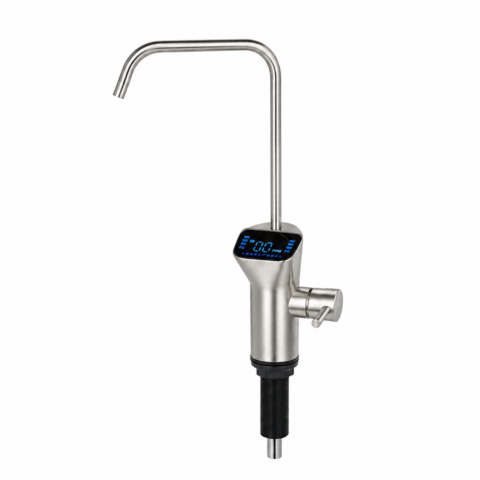
Taps with a digital display
These models let you follow filter service time or water quality on a display in the body. They come with a stainless steel body. TheDigital Stainless Faucet costs 7,352.76 TL.
| Tap | Key feature | Typical use | Price |
|---|---|---|---|
| Luxe Filter Faucet | Single flow, plain design | Standard domestic installation | 980.37 TL |
| Bubbler Tap | Upward bubbler jet | Office, school, shared area | 1,960.74 TL |
| Three-Way Tap | Hot, cold and treated water | Single-hole, uncluttered kitchen | 6,862.58 TL |
| Digital Stainless Faucet | Display monitoring, stainless body | Modern kitchen, users who want monitoring | 7,352.76 TL |
Material and Finish Differences
On a filter tap the body material decides both durability and how it stands up to contact with the water. Stainless steel bodies resist corrosion and suit long-term contact with treated water. Chrome-plated models match the look of kitchen mixer taps.
The quality of the finish decides how the appearance of the tap changes over time. A poor finish goes dull, stains and wears during cleaning. Because treated water has a low mineral content, limescale marking is not usually a problem on the tap surface; on the outside, however, splashes of mains water can leave marks.
Installation: What to Watch For
- Confirm the hole diameter. The shank diameter of the tap and the hole to be drilled in the worktop must match. Drilling granite and marble worktops requires a special bit.
- Check the worktop thickness. There is a limit to the thickness the fixing nut can grip; very thick worktops may need an extension piece.
- Do not force the hose connection. With push-fit fittings it is enough for the hose to be pushed fully home; forcing it damages the seal.
- Do not kink the hose. Sharp bends restrict the flow and in time crack the hose.
- Test for leaks in stages. Instead of turning the water on all at once, open it gradually and check the connection points by eye.
- Label the lines on three-way models. Mixing up the hot, cold and treated lines only becomes obvious after installation and means taking the tap apart again.
Dispenser Adapters and the Shower Head
The outlet of a treatment system does not always have to be a countertop tap. For some uses a dispenser form is more practical.
| Product | Price | Note |
|---|---|---|
| Dispenser Adapter with Reservoir | 1,470.55 TL | Dispenser conversions that use treated water instead of carboys |
| Capped Dispenser Adapter | 735.28 TL | A more economical solution that keeps the reservoir closed |
Details of these products are in ourFiltered Water Dispensers category.
On the bathroom side, theMineral Filter Shower Head at 1,225.46 TL is used. The cartridge inside the shower head makes a difference to the taste, odour and sediment of the shower water. This product is not a central treatment solution, however; for an answer covering the whole home,whole house and building inlet systems should be considered.
Tap Faults: Symptom and Cause
| Symptom | Likely cause | First check |
|---|---|---|
| Weak flow from the tap | Low tank pressure or a blocked filter | Tank pre-charge, pre-filters |
| Leak at the base of the tap | Loose fixing nut or a tired seal | Nut and seal |
| The lever turns stiffly | Worn cartridge | Tap cartridge |
| Drips when closed | Worn internal seal or cartridge | Cartridge replacement |
| Dripping at the hose connection | Fitting not fully seated | Remove the hose and refit it |
| A change in the taste of the water | A line unused for a long time | Run it for a while |
Questions to Ask When Choosing a Tap
- Is there a suitable hole in my worktop? If not, can one be drilled, and does the worktop material allow it?
- Is a single flow enough, or do I want three flows? A three-way model uses a single hole in the worktop, but its installation needs more care.
- Is use heavy? In offices and shared areas a bubbler model can be practical.
- Do I want a monitoring feature? A model with a digital display makes it easier to follow filter service time.
- Does matching the kitchen look matter? Chrome and stainless options give a different appearance.
- Would a dispenser form suit better? For some uses a dispenser adapter is more practical than a countertop tap.
How the Tap Connects to the System
The filter tap connects to the outlet line of the unit. On tank systems that line comes from the tank; on direct-flow systems it comes from the final filter stage. The connection is usually made with push-fit fittings, and most domestic installations use 1/4 inch hose.
The length of the line and the number of bends affect the flow directly. Pressure from the pressure tank is lower than mains pressure, so unnecessarily long hose, sharp bends and crushed sections weaken the flow noticeably. Running the hose as short as possible and with gentle curves preserves the strength of the water at the tap.
Direct-flow systems are different. They have no tank; water is delivered to the tap the moment it is produced. Flow strength depends directly on membrane capacity and feed water pressure. When a tap is chosen for this kind of installation, models that work properly at a low flow rate should be preferred.
A third case is the dispenser conversion. Here the outlet line goes not to a tap but to a dispenser adapter; water collects in the reservoir and is drawn from the tap of the dispenser itself. This arrangement removes the burden of carboys, especially in offices and shared-use areas.
Tap Care and Cleaning
The filter tap is one of the parts that needs the least day-to-day care. Even so, a few simple habits noticeably extend both its appearance and its service life.
- Wipe it with a soft cloth. Abrasive sponges and scouring cleaners dull the finish over time.
- Avoid acidic cleaners. Limescale removers can damage chrome plating, and limescale build-up is not expected on a filter tap in any case.
- Check the spout regularly. If deposits form at the tap spout the flow is disturbed and water can spray.
- Run the water after a long break. On lines left unused for a long time, such as over a holiday, running the first water for a while brings the taste back to normal.
- Catch leaks early. Small damp patches gathering under the sink are the first sign of a fitting working loose.
- Do not force the cartridge. When the lever stiffens, a cartridge replacement should be considered rather than forcing it.
How Many Years the Right Tap Lasts
The filter tap is one of the longest-lived parts of the system. Unlike a cartridge or a membrane it needs no periodic replacement; the same tap can be used for years.
Two things determine its service life. The first isbody and finish quality; stainless bodies resist corrosion and keep their appearance for a long time. The second is theinternal cartridge and seal; these are moving parts, so they wear over time.
In practice a tap is usually replaced not because it has failed but because the kitchen is being renewed or a different model is wanted. On most models, problems such as dripping and stiffness are solved with a cartridge replacement, and the whole tap does not need changing.
Thinking long term when choosing a tap therefore makes sense: a difference of a few hundred lira loses its meaning when spread over more than ten years of use. A poor finish going dull within a few years, by contrast, affects the look of the kitchen directly.
Choosing a Tap by Kitchen Type
Choosing a tap is not only a technical decision; the layout of the kitchen and the worktop material also count.
If there is a spare hole in the worktop the most practical answer is a separate single-flow tap. Installation is simple, the cost is low and, if there is a fault, only that tap needs attention.If there is no room in the worktop or no hole can be drilled the three-way model comes into play; the existing mixer tap is removed and a three-way model fitted in its place, with no extra hole needed.
In shared-use areas the bubbler model stands out. Drinking directly without a glass is practical in settings such as offices and schools. Forusers who like to keep track, models with a digital display make it easier to remember filter replacement time.
The worktop material also enters the decision. Drilling granite and marble worktops requires a special bit and care; in that case a three-way model that uses the existing hole can be the less risky route. On stainless steel and composite worktops, drilling is relatively easy.
The Tap and the Perception of Water Quality
The first impression people form about water quality most often comes from the tap. The strength of the flow, the clarity of the water and the look of the tap are the daily feedback that the treatment system is working.
Weak flow therefore creates dissatisfaction even when the system is technically working without fault. It is rare for weak flow to originate in the tap; usually the cause is the pressure of thepressure tank or thewater filter stages. Even so, simple causes such as a deposit at the tap spout or a kinked hose should also be reviewed.
When a change in the taste of the water is noticed, the tap is rarely responsible. Water standing in a line that has been unused for a long time can taste different when first drawn; running it for a few seconds is enough. If the change in taste persists, the carbon stage and the membrane should be assessed.
Replacing a Tap Step by Step
Replacing an existing filter tap with a new one is a relatively simple job, because no new hole has to be drilled in the worktop.
- 1 — Close the outlet valve of the unit. On tank systems the tank valve is closed, then the tap is left open to release the pressure in the line.
- 2 — Prepare the space under the sink. Clear the working area and put a cloth or a container underneath. The water left in the hose will spill out.
- 3 — Disconnect the hose. On push-fit fittings the collet is pressed in and the hose pulled out. Do not force it.
- 4 — Undo the fixing nut. The nut under the worktop is loosened and the tap lifted out from above.
- 5 — Clean around the hole. The new tap will not seat properly until old seal marks and deposits have been cleaned off.
- 6 — Fit the new tap. The top seal must seat properly and the tap must be aligned to the direction of use.
- 7 — Tighten the nut gradually. Over-tightening can damage the worktop; tightening just enough that the tap does not move is sufficient.
- 8 — Connect the hose. On a push-fit fitting the hose is pushed fully home and a gentle pull confirms that it has seated.
- 9 — Turn the water on gradually. Open the valve slowly and check the connection points by eye.
- 10 — Run the first water off. Running it for a few minutes clears the air that entered the line during installation and any residue.
Common Mistakes When Choosing a Tap
- Ordering without measuring the hole diameter. If the shank diameter and the worktop hole do not match, installation is impossible.
- Not allowing for worktop thickness. On thick worktops the standard fixing nut may not reach.
- Using the mains mixer tap in place of a filter tap. This brings mixing and pressure mismatch problems.
- Kinking the hose sharply. The flow is restricted and in time the hose cracks.
- Assuming the tap is to blame for weak flow. Usually it is tank pressure or the filters.
- Not labelling the lines on a three-way model. If the hot, cold and treated lines are mixed up, the tap has to come apart again.
Common Misconceptions About Taps
"An expensive tap makes the water better." A tap does not treat water; it only carries treated water. The price difference comes from material, finish quality and extra features, not from water quality.
"If the flow is weak, the tap is faulty." The most common causes of weak flow are the pressure of the pressure tank and blocked filters. Weakness that does come from the tap is usually caused by a deposit at the spout or a kinked hose.
"A three-way tap suits every kitchen." Its installation needs more care, because three separate lines connect to the same body. If a second hole can be drilled in the worktop, a separate tap is a simpler and more economical solution.
"A filter tap collects limescale too." Because treated water has a low mineral content, limescale build-up is not expected inside the tap. The white marks on the outside come from splashed mains water.
"A tap is replaced periodically." A tap is not a consumable. On most models, problems such as dripping and stiffness are solved with a cartridge replacement; changing the whole tap is usually unnecessary.
"A dispenser adapter is only for offices." It also suits homes where people want to stop using carboys; the choice depends on habits of use.
Short Maintenance Schedule
The schedule below keeps the system working at the expected performance for years. The intervals are for typical mains water; they shorten with well water and high sediment conditions.
| Interval | Check to carry out | Why |
|---|---|---|
| 3-6 months | Sediment and carbon cartridge replacement | Preserving flow rate, protecting the following stages |
| 6-12 months | Outlet TDS measurement | Numerical monitoring of membrane performance |
| Once a year | Pressure tank pre-charge pressure | Preserving flow strength |
| Once a year | Operation of the pressure switches | Keeping the pump from running unnecessarily |
| Once a year | Connection and leak-tightness check | Early leak detection |
| Once a year | Tap spout and hose check | Preventing flow restriction |
| 2-3 years | Membrane assessment | A replacement decision based on measurement |
| 5-8 years | Pressure tank condition | Checking the integrity of the internal bladder |
The most important part of this schedule is that decisions rest on measurement rather than guesswork. TDS and pressure checks prevent both early and late replacement; early replacement means unnecessary cost, late replacement means damage to equipment. When you cannot be sure of the condition of your system, you can use our site survey and fault-finding service; the site survey is free if the unit is purchased from us.
Checklist After Replacing a Tap
A few minutes of checking once installation is finished prevents most future leak and flow problems.
- Dry under the sink and watch it. In the first few hours, look for damp patches forming; this is the earliest sign of a leak.
- Pull the hose gently. This is how a push-fit fitting is confirmed to be fully seated.
- Open and close the tap a few times. Make sure the lever moves freely and that it does not drip in the closed position.
- Compare the flow strength. If the new tap is noticeably weaker than the old one, there is a kink or a restriction in the hose.
- Check the fixing. The tap body must not move when it is rocked by hand.
- Run the first water off. Running it for a few minutes clears the air that entered the line during installation and any residue.
Choosing Between a Tap and a Dispenser
How you use the outlet of a treatment system depends on your daily habits, and two different arrangements are possible.
A countertop tap is practical for people who draw water while preparing food in the kitchen. It sits right on the worktop, and filling pans and teapots is easy. Installation is simple and it does not disturb the kitchen layout.
A dispenser arrangement suits places where water is drunk by the glass at frequent intervals. With afiltered water dispenser setup the burden of carrying carboys disappears and water is always ready. It is preferred in offices, waiting areas and shared-use points.
The two arrangements are not mutually exclusive. It is possible to run a line from the same system to both a countertop tap and a dispenser adapter; in that case the flow rate of the line and the tank capacity must be planned to serve both outlets together.
Tap Selection in Summary
To sum up: a filter tap does not treat water, it carries treated water separately from mains water and delivers it for use. Three things decide the choice — whether there is a suitable hole in the worktop, how the water will be used, and how well the tap matches the look of the kitchen. If there is room in the worktop, a separate single-flow tap is the simplest and most economical solution; if there is not, a three-way model uses the existing hole. In shared-use areas the bubbler model is practical, and for those who like to keep track, models with a digital display are convenient.
A tap is not a consumable and lasts for years. Problems such as dripping and stiffness are mostly solved with a cartridge replacement. When the complaint is weak flow, tank pressure and the filter stages must be checked first; weakness caused by the tap is rare.
Tap Prices 2026
The prices below are the current values on the product pages and include VAT.
| Product | Type | Price |
|---|---|---|
| Luxe Filter Faucet | Single flow | 980.37 TL |
| Bubbler Tap | Bubbler | 1,960.74 TL |
| Three-Way Tap | Three-way | 6,862.58 TL |
| Digital Stainless Faucet | With digital display | 7,352.76 TL |
What Buying a Tap from Water Point Gives You
- Taps carry a 1-year warranty; misuse is not covered.
- CE certified products — we work with products that fall within the scope of certification.
- ETBİS-registered e-commerce — we are registered in the Ministry of Trade system.
- Invoiced sales — a legal invoice is issued with every order.
- Matching your unit — we choose the tap with you, to suit the outlet line of your existing unit.
- Free site survey available — we establish on site whether weak flow comes from the tap or from the tank. see the details
- Türkiye-wide service network for industrial systems — for domestic units we serve İstanbul and the surrounding provinces (such as Kocaeli and Tekirdağ).
Address: Mehterçeşme Mah. 1919 Sk. No: 54/B Esenyurt / İstanbul.
Cannot find the spare part you are looking for?
Send us the brand and model of your unit and we will work out the right filter, membrane, valve or resin together. If the unit is purchased from us the site survey is free; if only a survey and measurement are requested, a site survey fee of 2,000 TL applies.
0850 304 95 25WhatsApp[email protected]Water Filter Taps: frequently asked questions
Can I deliver treated water from the normal kitchen mixer tap?
It is not recommended. At a shared outlet, treated water mixes with mains water and the treatment loses its purpose. Water coming from the pressure tank also flows at a different pressure from the mains; a standard mixer tap may not work properly at that lower pressure. On a filter tap, moreover, the surfaces in contact with treated water are made from materials suited to it.
Which is better, a three-way tap or a separate tap?
A three-way tap combines hot, cold and treated water in a single body; no extra hole needs to be drilled in the worktop and the kitchen keeps a clean look. A separate tap is simpler and more economical, and easier to install. If a second hole can be drilled in your worktop, a separate tap is enough; if it cannot, the three-way model is the practical answer.
The flow from my tap is weak — is the tap faulty?
Usually not. The two most common causes of weak flow are a drop in the pre-charge pressure of the pressure tank and blocked pre-filters. Before touching the tap, the tank pressure must be checked with the tank empty and the condition of the filter stages must be examined.
Can a tap hole be drilled in a granite worktop?
It can, but it requires a special bit and careful work. There is a risk of cracking when drilling granite and marble worktops. It must be confirmed beforehand that the hole diameter matches the tap shank and that the worktop thickness is within the grip of the fixing nut.
My tap drips when it is closed — what should I do?
This usually comes from a tired internal seal or cartridge. A stiffening lever points to the same cause. On most models a cartridge replacement removes the need to change the whole tap. If there is a leak at the base, the fixing nut and the seal must be checked.
What is a dispenser adapter for?
It turns the outlet of the treatment system into a dispenser form, so treated water is used instead of carboys. The reservoir model stores water in a reservoir, while the capped model is a more economical solution that keeps the reservoir closed. In offices and shared-use areas it can be more practical than a countertop tap.
Is a mineral filter shower head enough for the whole home?
No. The shower head only makes a difference to the taste, odour and sediment of the water at its own outlet; it is not a central treatment solution. For a solution covering the whole home, systems installed at the flat or building inlet should be considered.
Can I install the tap myself?
It is a job that can be done with basic hand tools, but a few points need attention. The hole diameter and worktop thickness must be confirmed beforehand, the hose must be pushed fully home in push-fit fittings, and the hose must not be kinked with sharp bends. The water must be turned on gradually and the connection points checked by eye. If you are unsure, you can get support from our service team.