How many hours does an 8 litre water tank take to fill?
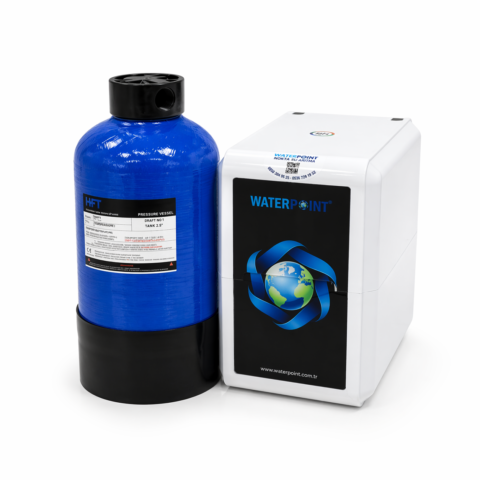
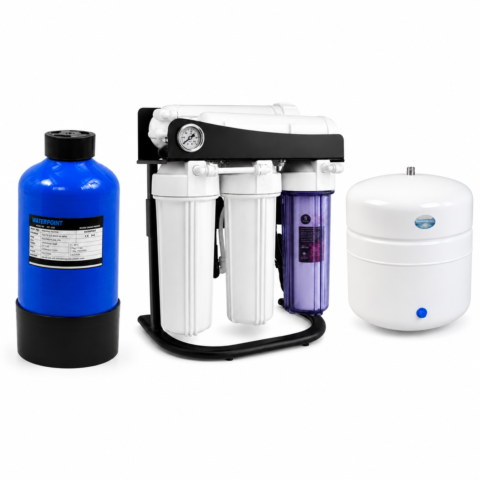
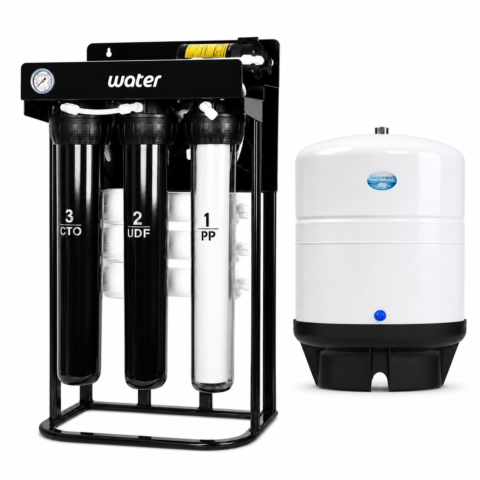
The usable volume of an 8 litre tank is about 5 litres; the rest is taken up by the air cushion. A 50 GPD system without a pump fills that volume in 1 hr – 1 hr 30 min, a pumped 300 GPD system in 8 min – 9 min. The time lengthens as mains pressure falls, as the water gets colder and as the membrane ages.
What is the difference between a water purifier with and without a pump?
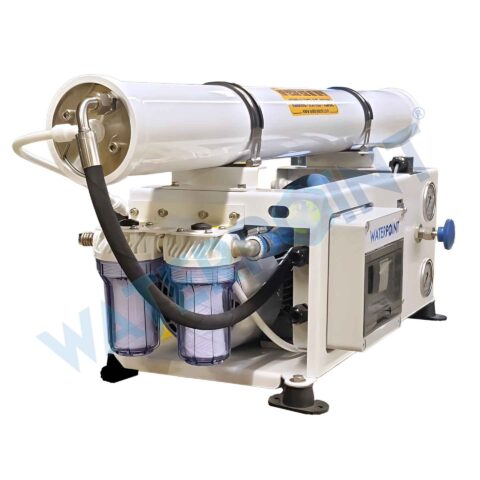
The difference is where the pressure driving the membrane comes from. A unit without a pump works on mains pressure alone, and its output falls quickly below 3 bar. A pumped unit produces the pressure itself; even on a line as low as 1.5 bar it delivers the output on its label. The practical result shows in the tank fill time: the same 8 litre tank takes between half an hour and 1.5 hours on a system without a pump, and 6–9 minutes on a pumped one. In return, a pumped unit needs electricity and is audible while it runs.
How is the capacity of a water softener calculated?
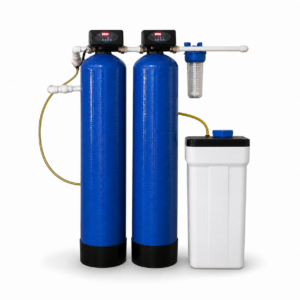
The resin volume is found with this formula: daily water consumption (m³) × hardness (°Fr) × days between regenerations ÷ 6. The number in the divisor is the exchange capacity of the resin — 1 litre of standard cationic resin holds about 60 grams of CaCO₃, and 1 French degree of hardness means 10 grams per cubic metre. For example: if a four-person household uses 0.6 m³ of water a day, the water is 35 °Fr and the unit regenerates every four days, the resin needed is 14 litres.
How much softening capacity does a flat need?
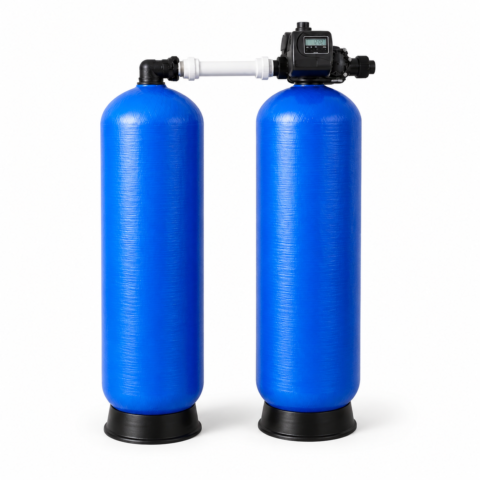
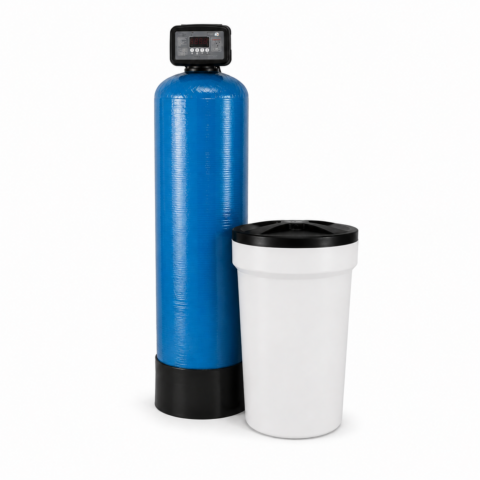
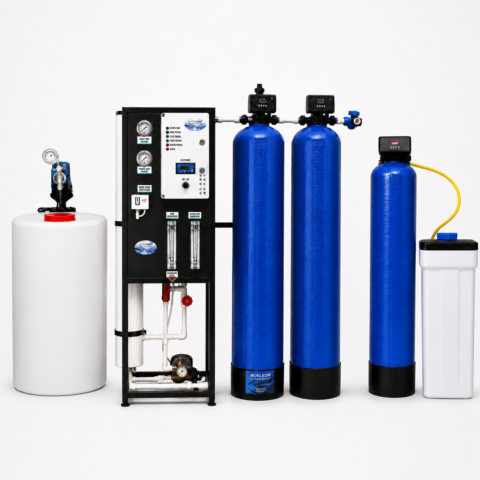
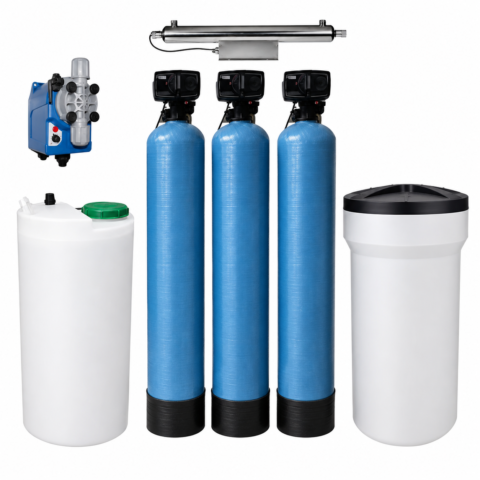
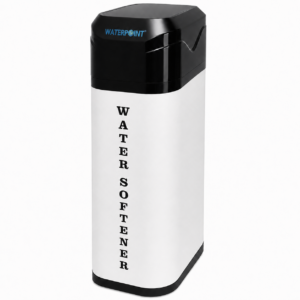
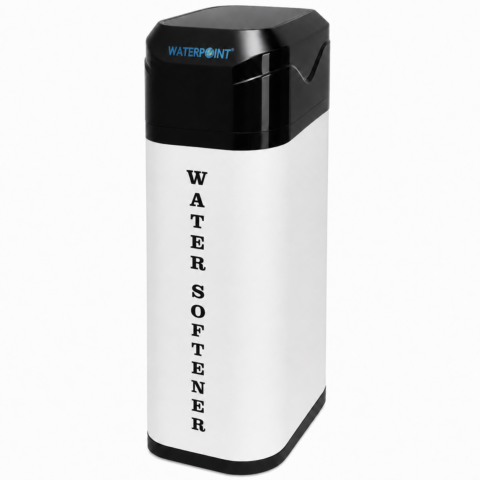
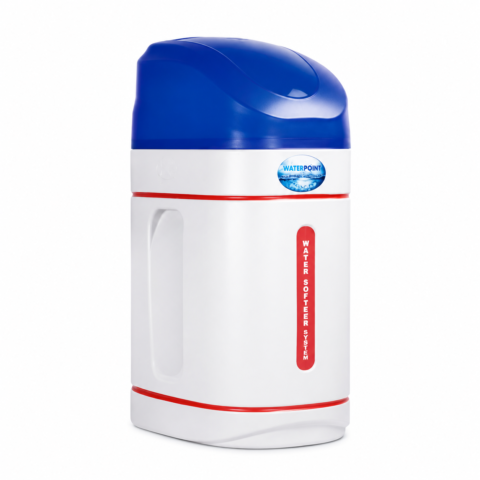
In a four-person flat, daily consumption is taken as roughly 0.6 m³. At 35 °Fr hardness and a four-day regeneration interval, that comes to 14 litres of resin; in the catalogue that corresponds to a cabinet-type softener. If the hardness is 55 °Fr, the resin needed for the same household rises to 22 litres. Household size alone therefore does not set the capacity; share your hardness value and we will work out the capacity that suits you best together.
How many litres is 300 GPD?
GPD means "US gallons per day", and one US gallon is 3.785 litres. 300 GPD therefore means 1,136 litres a day, or roughly 47 litres an hour. By the same calculation, 50 GPD is 189 litres a day, 500 GPD is 1,893 litres a day and 1,000 GPD is 3,785 litres a day.
How many litres of tank does a household of a given size need?
Up to two people, an 8 litre tank is enough. Between three and six people, a 12 litre tank is preferred. At seven people and over the logic of a tank breaks down — you have to wait each time it empties; at that scale the right answer is a direct-flow system with no tank. What decides the tank volume is not the daily output of the unit but the water standing ready when the tap is opened.
Is a bigger-capacity unit always better?
No. A system chosen larger than necessary costs more and works inefficiently, because it runs below its design flow. In softening, a large resin bed will not regenerate for days on low consumption, and stagnant water is left in the bed. In reverse osmosis, an oversized membrane produces more reject water at low draw. The right choice is the smallest system that meets the need; the assistant ranks products by that same rule.
What is WaterAI and how does it work?
WaterAI is a system selection tool that works on the technical data of the Water Point catalogue. Five questions capture where you will use it, your water source and your consumption; it converts the capacity values in the catalogue — written in different units such as "5 Tonnes/Day", "300 GPD" and "8 m³/Hour" — onto a single axis and puts the smallest system that meets your need first. It is a rule engine, and the result screen states plainly which assumptions it worked from. If you share your water analysis values, we will build the system around them.