
What Settles the Taste of Water? The Seven Factors
In two homes in the same city the taps can give different tastes. One is soft and neutral, the other slightly metallic or chlorinated. So what exactly does the taste of water depend on? The answer lies not in a single substance but in a set of interacting variables: dissolved minerals, hardness, chlorine residue, pH, temperature, the material of the plumbing and how long the water has stood in the pipe.
This article explains where taste comes from, systematically. Sub-headings such as chlorine removal, TDS measurement and changes of taste in treated water we took up in separate articles; here the aim is to let you see in a single table all the factors that together make up the taste of water. That way, when you meet a complaint about taste, you know which variable to look at.
Why Is the Taste of Water Perceived Differently From Person to Person?
The perception of taste depends not only on the composition of the water but on habit. A palate long used to a particular mineral profile finds water from a different source strange in the first days. And because the sense of smell largely accompanies taste, water without an odour is perceived as softer.
So assessing the taste of water is a subjective area. Even so, there are measurable parameters underneath it, and when those parameters change, so does the perception.
Let us make an important distinction from the start: fitness to drink and flavour are not the same thing. Water that is safe and compliant with the regulations may not be liked as a drink. The reverse also holds; water that is found pleasant may not be suitable in every condition. So the taste of water is not an indicator of quality but an indicator of composition.
The 7 Factors That Settle the Taste of Water
There are seven main factors that settle taste: the dissolved mineral load, hardness, chlorine residue, pH, temperature, the material it touches and the time the water stands. The first four have to do with the chemical composition of the water, the last three with the journey it makes before it reaches you.
The order below is arranged by how marked the effect is:
-
The Dissolved Mineral Load
The sum of components such as calcium, magnesium, sodium, bicarbonate and sulphate gives the water body. Too low and the water is perceived as flat, too high and it feels heavy.
The indicator: the total dissolved solids. -
Hardness (Calcium and Magnesium)
Hard waters are generally perceived as fuller and slightly chalky, soft waters as flatter.
The indicator: the French degree of hardness. -
Chlorine Residue
The residue left in mains water for safety is the source of the most frequently raised complaint about taste and odour.
The indicator: the residual chlorine level. -
The pH Value
Low pH can create a slightly sour perception, high pH a soapy one. The effect is fainter than that of the minerals but it is real.
The indicator: the pH measurement. -
Temperature
Cold water suppresses the perception of the components in it. The same water when it is lukewarm gives a far more marked character.
The indicator: the serving temperature. -
The Material It Touches
Pipe, hose, tap and storage vessel can lend the water a character. In new plumbing and new equipment that effect is more marked.
The indicator: the age and material of the plumbing. -
Standing Time
Water standing a long time in a pipe or a tank changes its character. That is the reason for the difference in the first water drawn in the morning.
The indicator: how often it is used and the tank volume.
Those seven headings explain almost all complaints about taste. In the next sections we take up the most decisive of them one by one.
For the technical frame of the taste and odour parameters in drinking water, the US Environmental Protection Agency’s guide to secondary drinking water standards offers a detailed reference; those standards are built not on health but on aesthetic parameters such as taste, odour and appearance.
Mineral Content: What Gives the Taste of Water Its Body
The dissolved mineral load makes up the main body of taste. At very low values the water stays flat and level on the palate; at very high values it can be perceived as heavy, salty or bitter. For most palates the most balanced range is the middle; but that shifts with personal preference.
So water from two different sources, though equally clean, can taste very different. The difference is in the composition, not in the quality.
The table below offers a general orientation. These are not firm limits but tendencies that find an answer on the palate:
| The Dissolved Solids Level | What It Is on the Palate | The Common Verdict |
|---|---|---|
| Very low | Flat, level, without character | It has no taste |
| Low – medium | Soft, clean, neutral | Easy to drink |
| Medium | Full, balanced | Like spring water |
| Medium – high | A marked mineral character | A bit heavy |
| High | Salty, bitter, metallic | Hard to drink |
Following that value at home is not difficult. We explained in detail what the amount of dissolved solids tells you in our what is TDS article; for the measurement a simple TDS meter is enough.
An important component of the mineral load is hardness. As the concentration of calcium and magnesium rises, the water is perceived as fuller but at the same time chalkier. We explained what hardness is and how it is measured in our water hardness piece.
Chlorine: The Most Frequent Complaint About the Taste of Water
In mains water some chlorine residue is left to preserve safety along the distribution. That residue can be perceived as odour and taste even at very low levels; because the human nose is quite sensitive to those compounds. Activated carbon holds those components on its surface and markedly reduces the character.
Complaints about the taste of water caused by chlorine have two typical signs: the odour is noticed at once when you bring the glass to your nose, and the aroma in tea and coffee is suppressed.
We covered the removal methods, and why the carbon stage takes on that job, in our how chlorine is removed from water article. For the working principle of carbon you can look at our what is an activated carbon filter article.
Leave a glass of water uncovered in the refrigerator for a few hours. If the character softens because the volatile components have partly separated out, the source of the complaint is most likely chlorine residue. That test is not an answer; it only steers your suspicion about the taste of water to the right heading.
pH and Temperature: Two Variables That Go Unnoticed
The pH value affects taste not directly but indirectly. Low pH can create a slightly sour perception, high pH a soapy one; and low pH can raise the metallic character by interacting with the plumbing material. Temperature is the factor that changes perception fastest: cold water suppresses the noticing of the components.
Those two variables are mostly overlooked when the taste of water is assessed. Yet for some users the difference between the same water cold and at room temperature is greater than the difference in minerals.
| Variable | When Low | When High |
|---|---|---|
| pH | Slightly sour, the metallic tendency rises | Soapy, a soft perception |
| Temperature | The character is suppressed, the water is perceived as neutral | Odour and taste become marked |
| The mineral load | Flat and level | Full, can grow heavy |
| Standing time | Fresh and clean | Stale, a still character |
We looked at the role of the pH value in water and its relation to the plumbing in our article on the pH value of water. If you want to make your own measurement, a simple pH test kit is enough.
Plumbing, Tank and Standing: The Journey’s Effect on Taste
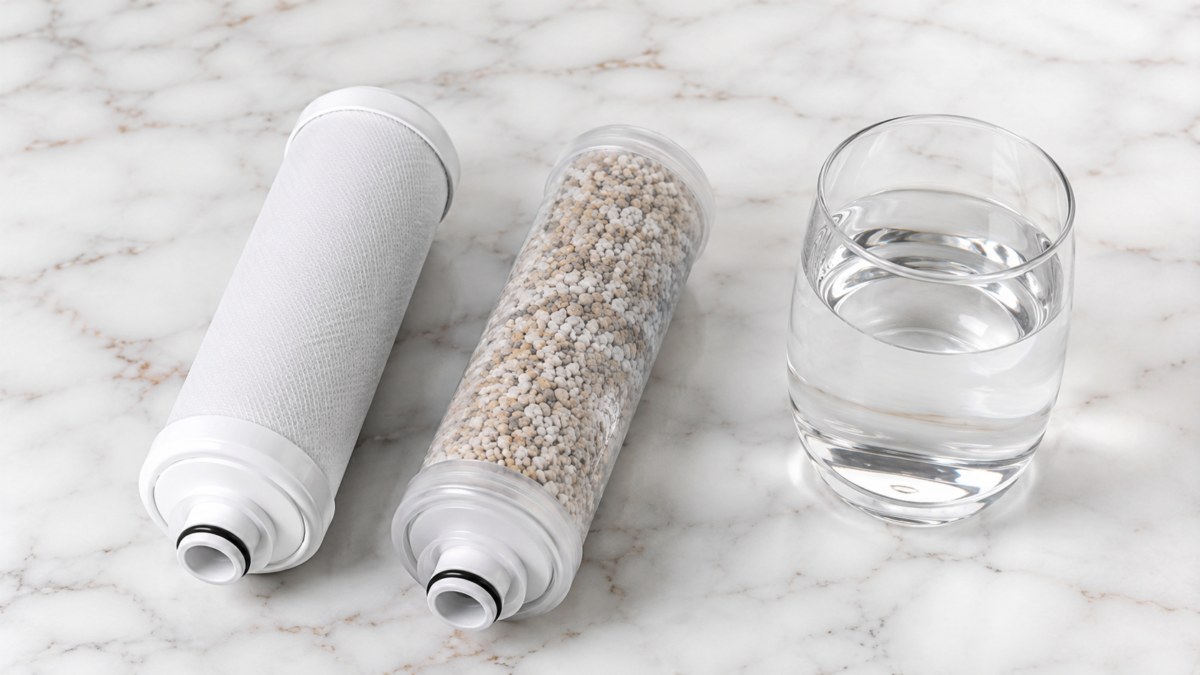
After the water leaves the source it touches pipe, tank and tap. In old galvanised runs the metallic character can rise, in new plastic runs a slight odour can be felt in the first weeks. In buildings with tanks, the longer the standing time the more the water loses its freshness.
That heading explains why a different perception arises in two buildings on the same street. Even though the water coming from the mains is the same, the conditions inside the building differ.
The most practical check is to compare the first water drawn in the morning with the water after the line has run for a few minutes. If the difference is marked, the reason is standing — that is, stagnation.
We explained in detail how water standing in a tank changes its character in our why tank water goes bad article.
The source is the incoming water
A change coming from the mains, the building tank or the main line is involved.
- There may have been a seasonal change of source
- The residual chlorine level may have changed
- The standing time in the tank may have grown longer
- Work may have been carried out on the main line
The source is on the unit side
The stages, the membrane or the tank should be assessed.
- The carbon stage may have saturated
- The final-stage mineral cartridge may be spent
- Water standing in the tank may be involved
- A newly fitted stage may not have been rinsed
If the right-hand column holds — that is, if the problem is seen only on the treated line — our changes of odour and taste in treated water article guides you directly, taking the subject step by step.
How Does Treatment Change the Taste of Water?
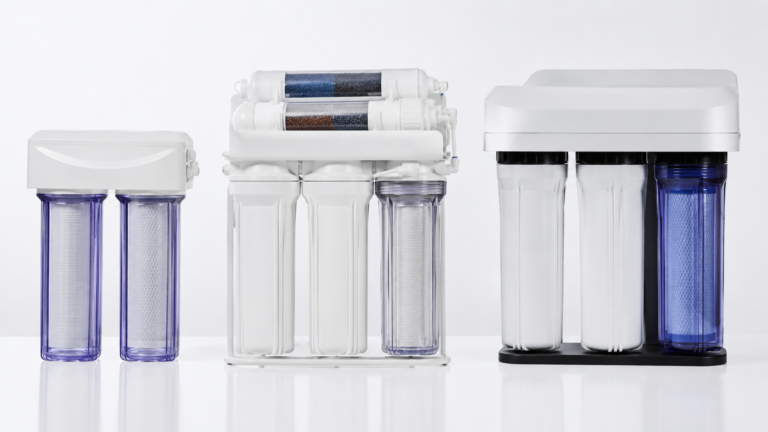
Treatment affects taste in two ways. Carbon stages hold the chlorine residue and the odour components and soften the character. Reverse osmosis, because it lowers the dissolved solids load greatly, simplifies the water; some users find that flat. Using a mineral-bearing cartridge at the final stage brings that balance back.
So treatment has not a spoiling but a transforming effect on the taste of water; it changes the composition. Setting the expectation correctly matters at that point.
We explained how reverse osmosis works and what it separates in our how reverse osmosis works article. The function of the mineral cartridge used at the final stage was taken up in our what is a mineral filter article.
In practice the preferred answers separate out like this:
| The Expectation | The Suitable Stage | Its Effect |
|---|---|---|
| Let the chlorine odour and taste go | A CTO carbon cartridge filter | It holds the odour and taste components |
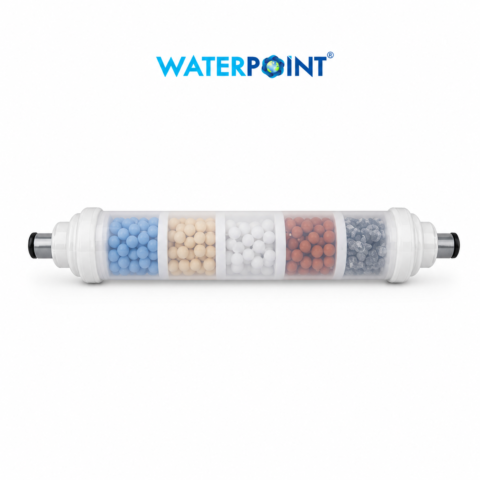
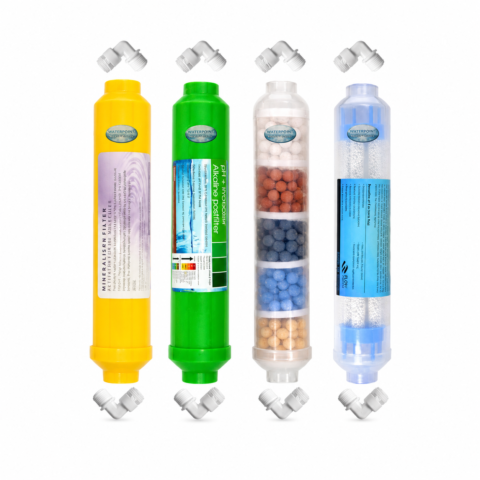
| Let the water not taste flat | A mineral filter stage set | It adds mineral at the final stage |
| Let the drinking be softer | A pH alkaline mineral filter set | An alkaline character and a mineral balance |
| Let the aroma come forward | A flavouring filter | It softens the drinking character |
| A simple and portable answer | A water filter jug | A quick improvement in a small volume |
To see all the stages you can look through the water treatment filter category. We covered which type of unit suits your home in our how to choose a water purifier guide.
The first water from newly fitted cartridges can carry fine dust left from manufacture and a slight character. That water should be drained off. Otherwise a temporary complaint about the taste of water can be taken for a permanent problem.
Why Is the Taste of Water So Decisive in Tea, Coffee and Ice?
The mineral profile of the water used in tea and coffee directly affects extraction. Very hard water suppresses the aroma and forms a film on the surface; very soft water gives a result without body. In ice, because the components concentrate as it freezes, the character becomes more marked still.
In businesses the taste of water shows up directly in how customers perceive them. The reason two branches get different results from the same bean and the same machine is most often the water.
In Tea
In hard water a fine film forms on the surface, the colour dulls and the aroma stays in the background.
In Coffee
The mineral balance settles the extraction; water that is too soft weakens the body.
In Ice
As it freezes the components concentrate, and cloudiness and character rise.
In Equipment
Hard water builds up on heating components, and failures and maintenance costs rise.
For commercial kitchens our content, where we take up the subject in terms of equipment life and flavour together, water treatment in restaurants and hotels offers a practical frame. And for offices and waiting areas we compared the serving side in our a dispenser without a carboy or a carboy article.
How Are the Tastes of Carboy, Mains and Treated Water Compared?
The character of the three sources differs because their compositions differ. Carboy water generally has a fixed mineral profile; mains water changes with the season and the source; treated water depends on the stage build of the unit. For a fair comparison all three should be tried at the same temperature and in the same vessel.
Making the comparison at home is possible but two rules are needed. The first is equalising the temperature, the second is that the vessels be odourless and neutral. A plastic vessel on its own can change your verdict on the taste of water.
| The Source | The Taste Character | Variability |
|---|---|---|
| Carboy water | A fixed mineral profile, a familiar character | Low; it stays similar unless the brand changes |
| Mains water | Mineral and chlorine residue are felt together | High; it depends on the season and the mix of sources |
| Treated water (without a mineral stage) | Plain, neutral, flat to some palates | Low; it is stable as the stages are renewed |
| Treated water (with a mineral stage) | Soft but with body | Low; it depends on the cartridge life |
| Water standing in a tank | Still, with a tendency to staleness | High; it depends on how often it is used |
The column that stands out in the table is variability. For a user what really grates is often not the taste itself but the unpredictability of the taste of water. That is one of the reasons treated water is preferred: the character stays largely constant through the life of the stage.
We compared the cost and convenience of a carboy and treatment in a separate article. You can see the serving options for office and home use in the treated water dispenser category.
Mix the three glasses up without marking them and try them that way. In trials made knowing the label, expectation steers perception markedly. The taste of water — that is the simplest way to reach an impartial verdict on it.
What to Do if the Taste of Water Has Suddenly Changed
First compare: draw water from an untreated tap too and set the two side by side. If the same character is in both, the source is the mains, the tank or the plumbing. If it is only at the treatment tap, the stages and the tank should be assessed. Then run the line for a few minutes and see whether the difference persists.
This checklist explains the greater part of cases about the taste of water without calling out a service:
- Compare: Assess the treated and the untreated water at the same time.
- Run it: Drain the standing water and try again with fresh.
- Check the age of the filters: If the carbon stage has saturated, the character comes back.
- Measure: Compare the dissolved solids value with the earlier records.
- Allow for the season: The mix of sources can change in the summer months.
- Keep a record: Noting when the change began speeds up the diagnosis.
The last item is the one that helps most and is applied least. Once the date of the change is known, finding what happened on that date becomes easy: a filter change, work on the plumbing or a seasonal change of source.
If you want a clear picture from an analysis, we listed which parameters are looked at in our how a water analysis is done article. For the general quality framework you can also look at our is mains water safe article.
Let’s establish the character of your water together
Measuring the mineral load, the hardness and the chlorine residue makes clear which stage is needed. The site survey and measurement are free if the unit is purchased from us.
See the Filter StagesFrequently Asked Questions About the Taste of Water
Why does the taste of water change with the season?
Many municipalities raise the proportion of well water in summer when the reservoir level falls. When the mix of sources changes, so do the mineral profile and the hardness. And in the hot period the chlorine dose can be raised. Those two factors together are the most common explanation for a seasonal difference in taste.
Why does treated water taste flat?
Reverse osmosis lowers the dissolved solids load greatly. When the minerals that give taste its body are reduced, the water is perceived as more level on the palate. That is not a fault but an expected result. Those who care about the drinking character can choose a mineral-bearing cartridge at the final stage.
Does the taste of water show whether it is healthy?
No. Taste is an indicator of composition, not of safety. Water found pleasant can be unsuitable, and water found neutral can be entirely suitable. A safety assessment can only be made by analysis.
Why does water taste better when it is cold?
Coldness suppresses the perception of volatile components and reduces the contribution of the sense of smell to taste. So the same water is perceived as more neutral when cold and more characterful when lukewarm. Serving temperature is a variable most often overlooked in assessing taste.
Why does the water taste different when I first turn it on in the morning?
Water standing in the pipe through the night stays still and touches the plumbing material for longer. After running for a few minutes the character generally returns to normal. If the difference persists, the plumbing or the tank side should be assessed.
If the water tastes metallic, what does that show?
A metallic character can come from the plumbing or be linked to low pH. To tell them apart, first compare with the other taps, then check the pH and the dissolved solids values. If a reddish colour accompanies it, iron should be assessed too.
Does a mineral filter really change the taste of water?
Yes. The mineral cartridges used at the final stage give the water some mineral and reduce the levelness on the palate. The effect is perceived differently from person to person; so it is not a required stage but a matter of preference.
Do jug-type filters improve the taste?
In small volumes they help in reducing the odour and taste components. But their capacity is limited and the cartridge life runs out quickly. For households with high daily consumption they are not a lasting answer but a complementary option.
Is there an ideal mineral value for the taste of water?
There is no single ideal value that holds for everyone. The general tendency is that the very low and very high ends are not liked; the middle levels are found balanced by a wider group. But the habit of the palate is decisive: someone who has long drunk hard water can find soft water lacking in the first days. So the target is not to hit a universal number but to preserve the character the household is used to.
Does boiling improve the taste of water?
Boiling can reduce the odour caused by chlorine because it removes part of the volatile components. Against that, the mineral load of the water does not leave the pan; indeed evaporation raises the concentration in the remaining water somewhat. That is also why the water is perceived as flat and dull once it has cooled. So boiling is not a method of improving taste but a limited side effect.
I changed the filter but the taste did not improve — why?
There are two possibilities. The first is that the new stages were not rinsed enough; the first water should be drained off. The second is that the problem is not in the stage but in the incoming water or in the water standing in the tank. A comparative check makes that distinction quickly.
Conclusion
The taste of water depends not on a single substance but on seven factors working together: the dissolved mineral load, hardness, chlorine residue, pH, temperature, the material it touches and the standing time. The first four describe the composition of the water, the last three the journey it makes before it reaches you. When you meet a complaint about taste the right order is this: first compare the treated and the untreated water, then run the line and rule out stagnation, then check the age of the filter and the measured values. Treatment does not spoil the taste; it changes the composition. Treated water found flat is easily balanced with a mineral cartridge at the final stage. The one thing not to forget is this: taste is an indicator not of quality but of composition.
Let’s choose the right stage together
The site survey is free if the unit is purchased from us; if only a survey and measurement are wanted, a survey fee of ₺2,000 applies. For your complaint about taste and odour you can reach us on 0850 304 95 25 or at [email protected].
Discover the Solutions