

The pH Value of Water: What It Does to Plumbing and Equipment

When an analysis report reaches your hands, some lines feel familiar: you know what hardness means, and you can more or less place what TDS is telling you. But there is one line on that list most users pass over quickly — pH. Yet the pH value of water is a decisive parameter that directly affects the life of your plumbing, the marks on your taps and the efficiency of your treatment system.
In this guide we explain the idea of pH plainly, take up the effects of low and high values on plumbing and equipment, and make clear what this measure — so often confused with hardness — actually shows. We treat the subject as a technical parameter, not as a health heading.
What Is the pH Value of Water?
The pH value of water is a measure showing whether the water is acidic or alkaline. It is settled by the concentration of hydrogen ions in the water. Its importance for plumbing and treatment is great; because the tendency to corrode, the behaviour of limescale formation and the efficiency of some treatment stages all change with this value.
pH does not tell you what is in the water but how it behaves. Hardness reports a quantity, TDS gives a total; pH shows the chemical tendency of the water. That tendency settles how the water will interact with the metal surfaces it touches.
So in an analysis report the pH value of water is not read on its own but together with the other parameters. Assessed alongside hardness, alkalinity and conductivity, the behaviour of the water towards the plumbing becomes predictable.
The frame needs setting correctly from the start: in this article pH is treated as a plumbing and equipment parameter. Whether the water is fit to drink is assessed by the relevant regulations and an accredited laboratory report.
How Is the pH Scale Read?
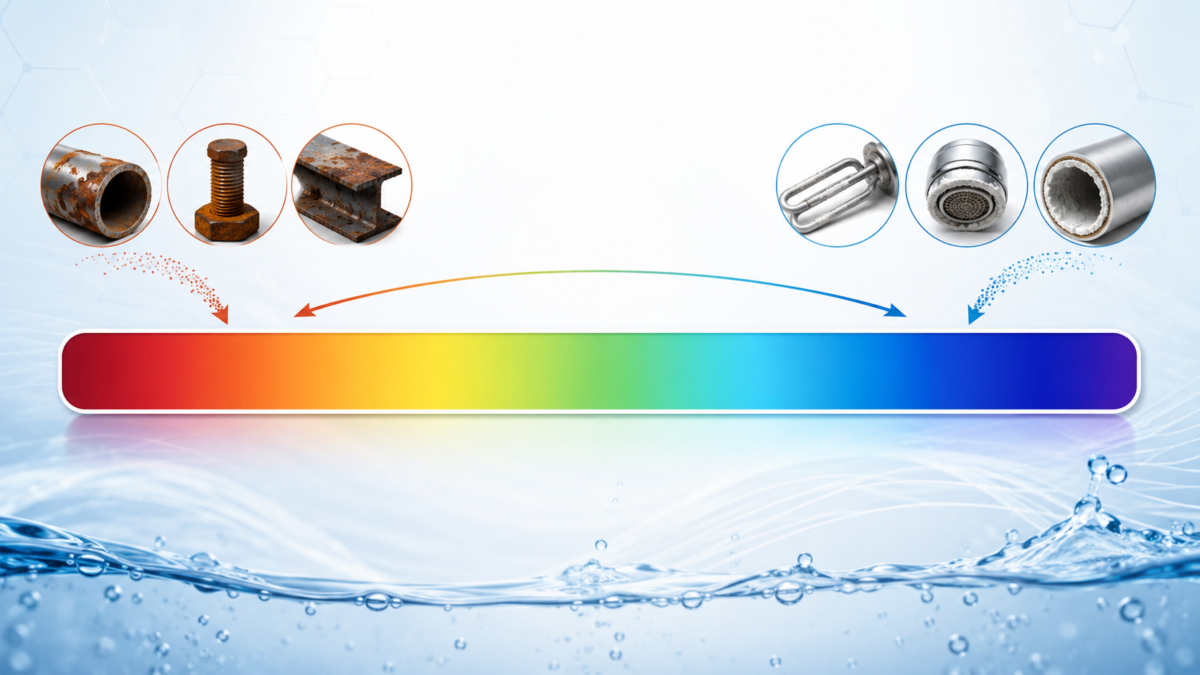
The scale runs from 0 to 14. The value 7 in the middle is taken as neutral; below it is the acidic direction, above it the alkaline. The scale is logarithmic, so a difference of one unit, small as it looks, corresponds to a marked change in reality. That is why even small departures deserve attention.
Being logarithmic is what most users miss. A small departure seen in a report intuitively looks unimportant; yet each unit expresses a difference on the order of a multiple of the one before. So when pH is being assessed, the words a little or a lot can mislead.
The thing to hold in mind when reading the scale is this: the further you go towards the ends, the more the water interacts with the materials it touches. The closer to the middle, the more balanced the behaviour. And balance is what a plumbing system wants.
Another important point is that pH on its own does not define the quality of the water. Water showing a neutral value can carry high hardness; acidic water can be poor in minerals. So the pH value of water is always interpreted together with the other parameters.
What Settles the pH Value of Water?
There are three main factors: the geology of the area, the amount of carbon dioxide dissolved in the water, and alkalinity. Water rising in areas rich in limestone leans to the alkaline side, while in granite and sandstone areas it can be more acidic. Alkalinity settles how much resistance the water shows to those changes.
Geology is the most basic factor. As water moves underground it interacts with the layers it passes through; carbonate-bearing structures such as limestone pull the water to the alkaline side, while in areas without those minerals the water can stay acidic. That is why marked differences are seen from area to area even within one country.
The second factor is dissolved carbon dioxide. When water dissolves carbon dioxide from the atmosphere or the soil it shifts to the acidic side. That is a natural situation seen especially in rainwater and shallow sources.
The third, and perhaps the least known, is alkalinity. Alkalinity expresses the buffering capacity of the water; that is, how much resistance it shows to changes in pH. In water with high alkalinity pH does not change easily; with low alkalinity even small influences lead to marked departures.
In waters of low alkalinity pH is unstable; it can fluctuate with the seasons and with the conditions in the plumbing. So alkalinity should be assessed alongside pH in the analysis result.
For households on well water those three factors are especially decisive. The depth of the well and the surrounding geology bear directly on the pH value of water. We set out which parameters are assessed together in well water in our treatment stages for well water article.
What Problems Does Low pH (Acidic Water) Create?
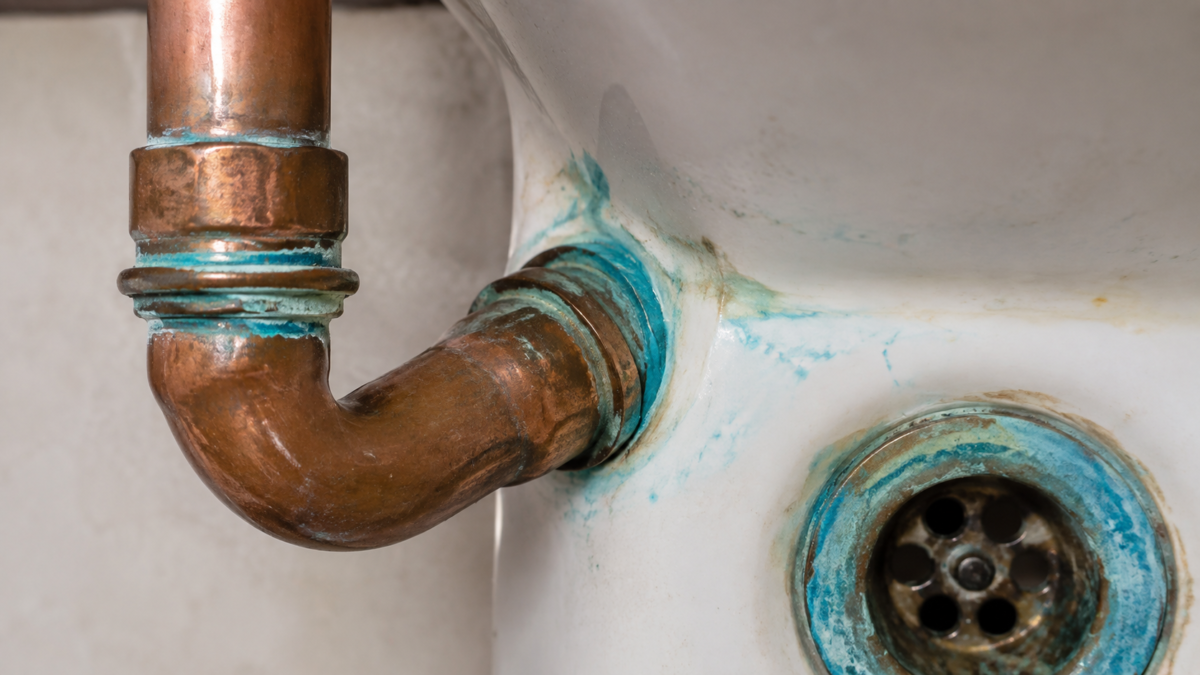
Acidic water interacts more with metal surfaces and speeds up corrosion. Blue-green marks on copper plumbing, pinhole leaks in time, wear on taps and a metallic taste in the water are the most common results. Those signs generally point not to the plumbing itself but to the character of the water.
The most familiar indicator of acidic water is the mark. The bluish-green traces appearing on the surface of a basin or bath are the sign of material dissolving out of copper plumbing. The mark can be cleaned, but it comes back unless the character of the water changes.
The more serious result is leaks. Corrosion thins the pipe wall from the inside; in time point leaks the size of a pinhole can form. Because such leaks generally appear in concealed runs they are noticed late and lead to costly repairs.
Blue-Green Marks
Dissolution in copper plumbing leaves characteristic traces on the surfaces.
Point Leaks
The pipe wall thins from the inside; pinhole leaks can appear.
Tap Wear
The internal parts of taps and mixers wear out earlier than expected.
Metallic Taste
The metallic character felt in the water is the indicator of dissolving material.
Equipment Fatigue
Components such as heaters, pumps and valves wear faster.
Surface Marks
Permanent traces can form on ceramic and stainless surfaces.
The shared feature of those signs is that their cause is usually looked for in the wrong place. The user thinks the plumbing has aged; yet even in newly laid plumbing, if the pH value of water is low the same problems can appear within a short time.
Another effect of acidic water is on the treatment equipment. Metal connections, valve bodies and some components are affected by that condition; so the character of the water should be taken into account from the start in the system design.
What Problems Does High pH Create?
Water on the alkaline side is more prone to limescale precipitation. Build-up on heated surfaces speeds up, the foaming of soap and detergent can fall, and a change is felt in the taste of the water. And the efficiency of some treatment stages is affected by that condition and can fall below expectation.
High pH does not create the limescale problem on its own; but combined with the hardness present it raises the tendency to precipitate. So limescale can behave differently in two waters of the same hardness — what decides is the balance of pH and alkalinity.
The effects seen in daily use are these:
- Faster limescale build-up: Precipitation rises on heated surfaces and on taps.
- Less foaming: Soap and detergent may not give the expected performance.
- A change in taste: A slightly bitter or otherwise different character can be felt in the water.
- Surface marks: Drying droplets can leave more marked traces.
- Treatment efficiency: The performance of some stages is affected by that condition.
On the industrial side high pH bears directly on the management of scaling. We explained in detail how the tendency to precipitate is brought under control in our scale inhibitor chemicals article.
As you can see, both the low and the high direction bring their own problems. So when the pH value of water is assessed the target is not high or low but a balanced range for the plumbing and the equipment.
The International Reference Range and Reading It Correctly
The US Environmental Protection Agency assesses pH within its secondary drinking water standards and advises the range 6.5-8.5. That is not a health limit; it was set for aesthetic and practical reasons such as taste, colour and the effects on plumbing. In Türkiye the assessment to be taken as the basis is the relevant regulations and an accredited laboratory report.
That distinction is critical and is often reported wrongly. Secondary standards differ from primary ones, which are health-based and binding; their purpose is to manage the comfort of use and the effects on the plumbing. For the detailed frame see the EPA’s guide to secondary drinking water standards can be consulted.
So when the pH in your report comes out a little outside that range, the right reflex is not panic but assessing the result in its context. The direction of the departure, the state of the alkalinity and the material of the plumbing should be taken up together.
This content treats pH as a plumbing and equipment parameter. Whether the water is fit to drink is assessed by the relevant regulations and an accredited laboratory report; that assessment falls within the remit of the authorised bodies.
One point should also be stated plainly: claims of the alkaline water is healthy sort that circulate on the internet fall outside the scope of this content and are not supported here. In this article pH is a technical measure assessed within the frame of corrosion, limescale and equipment behaviour.
Our mineral filter article, where we take up in a balanced way what mineral and alkaline final-stage filters do and do not do, clarifies this subject separately.
Are pH and Hardness the Same Thing?
No, they are two completely different parameters. pH shows the acidic-alkaline tendency of water; hardness expresses the amount of calcium and magnesium in it. Soft water does not have to be acidic. And a softening unit removes hardness but does not correct the pH value of the water.
That is one of the things most often confused in the field, and it leads to the wrong choice of unit. The difference between the two ideas can be summed up like this:
It shows behaviour
It expresses whether the water is acidic or alkaline — that is, its chemical tendency.
- It settles the tendency to corrode
- It affects precipitation behaviour
- It does not change with softening
- It is adjusted by neutralisation
It shows quantity
It expresses the calcium and magnesium content of the water — that is, its mineral load.
- It is the main source of limescale build-up
- It is removed by ion exchange
- It is not directly linked to pH
- It is solved with a softening stage
A concrete example: water passing through a softening unit loses its hardness but its pH stays largely the same. So installing a softening unit on acidic water does not solve the corrosion problem. We cover the criteria for choosing a softener in our softening system selection guide.
The same confusion arises with conductivity and TDS. Those three parameters measure different things and cannot be used in place of one another; we explained the idea of dissolved solids separately in our TDS article.
In short: the pH value of water is a measure not of quantity but of tendency. Knowing that distinction is the basis of reading an analysis report correctly and choosing the right answer.
How Does pH Affect Treatment Systems?
pH directly affects the performance of treatment equipment. Membrane efficiency and the tendency to scale change with this value; resin behaviour and the effectiveness of chemical dosing are also sensitive to pH. So in system design pH is a parameter given as much attention as capacity.
On the membrane side the effect runs two ways. In waters shifted to the alkaline side the tendency to precipitate rises and build-up on the surface speeds up; on the acidic side the load on the materials and the fittings rises. We explained the structure of the membrane and its sensitivity in detail in our membrane filter article.
In chemical dosing pH is a direct precondition. In antiscalant applications and in precipitation processes the efficiency of the reactions depends largely on the pH range of the water. Dosing carried out without the right range does not give the expected result.
| Stage | The Effect of pH | The Result |
|---|---|---|
| Membrane | The tendency to precipitate and the load on the materials change | Efficiency and module life are affected |
| Softening resin | Working conditions and bed behaviour are affected | Capacity performance can change |
| Chemical dosing | Reaction efficiency depends on pH | Without the right range no result is obtained |
| Metal fittings | Wear speeds up in acidic conditions | The risk of leaking and failure rises |
| Filtration beds | Some removal methods are sensitive to pH | Iron removal efficiency, for example, changes |
The last row of that table is especially important. The efficiency of oxidation-based methods such as iron and manganese removal depends markedly on the pH range. So if there is a problem of that kind, the pH value of water must always be assessed together with it.
In short, pH is not a nice-to-have detail in system design. It is treated as an input as decisive as the choice of capacity and stages.
How Is the pH Value of Water Measured?
Measurement is done by three methods: a digital pH meter, a test kit and a laboratory analysis. Field measurements give a quick idea, while a comprehensive and official result needs an accredited laboratory. The most critical point is not letting the sample stand; as the water contacts the air the value can drift.
When a sample stands, the balance of the gases dissolved in the water changes and the pH may not reflect the real situation. So the measurement should be made as soon as possible after the sample is taken.
The steps to follow for a correct measurement are these:
-
Use a Clean Vessel
Vessels carrying detergent or chemical residue affect the result directly; choose a clean vessel for the sample.
-
Run the Line for a While
Run it so the water standing in the plumbing drains away; the sample must represent the real source.
-
Measure Without Delay
The sooner the sample is measured the more reliable the result; keep the time in contact with the air to a minimum.
-
Calibrate the Meter
On digital meters calibration is critical; if it drifts, the whole result comes out wrong.
-
Have a Full Analysis Done
Where a decision is to be made, pH should be measured in a laboratory together with alkalinity and the other parameters.
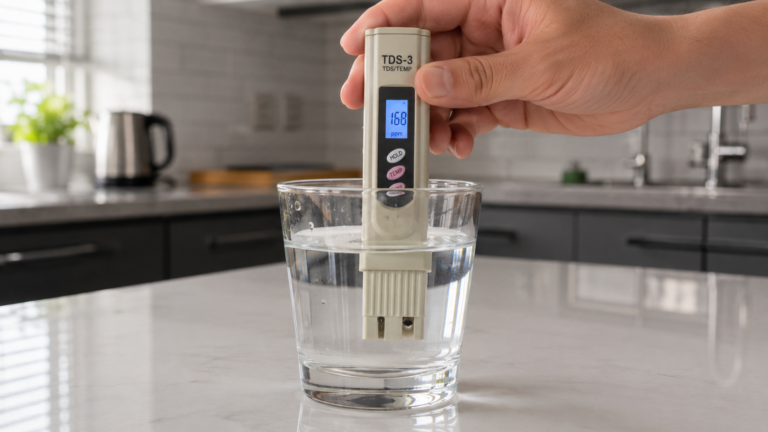
Field meters are valuable for following; they offer a practical way of watching the system work and noticing changes early. The measuring instruments used for following dissolved solids work on the same monitoring logic.
But where a decision such as a system investment is involved, a field measurement is not enough. We walked through the whole process of taking a sample and reading a report step by step in our water analysis guide; the pH value of water is an inseparable part of that report.
How Is a pH Problem Solved?
In acidic waters mineral-bed neutralising filters are generally used; as the water passes through that bed the pH is balanced. In waters on the alkaline side controlled chemical dosing is preferred. In both cases the answer is engineered to the analysis result and the conditions of the plant.
On the acidic water side the approach is physical-chemical: the water is passed through a mineral bed containing calcium and, by dissolving some of that bed, the pH is balanced. Because the bed is used up in time it needs periodic topping up.
That method has a side effect and it should be known from the start: the dissolved mineral raises the hardness of the water somewhat. So in a plant where neutralisation is applied, hardness control can come onto the agenda afterwards. That is why the stages should be planned together.
In waters on the alkaline side controlled dosing comes in. In industrial systems the chemicals used for pH adjustment are applied with automatic dosing equipment and measurement feedback; products such as the liquid caustic soda used for that purpose are among the common choices.
The choice of chemical and the dose fall outside the scope of this content; they are settled by the analysis result, the alkalinity and the flow. Chemical dosing is an industrial application and should be carried out by a technical team.
The order when choosing an answer is this: first the analysis, then the direction and size of the departure, then the material of the plumbing and the purpose of use. When those three come together the suitable method becomes clear. A general prescription is not possible; every plant is assessed on its own conditions.
One last thing should be stated: once the pH value of water is corrected, the damage already done to the plumbing does not reverse; but its progress stops. So the earlier the intervention, the more effective the protection.
Let’s read the pH value in your report together
To plan an answer suited to your analysis result and to the conditions of your plumbing, you can look through the industrial options.
See the Industrial SolutionsFrequently Asked Questions
What does the pH value of water show?
Whether the water is acidic or alkaline — that is, its chemical tendency. Its importance for plumbing is great; it directly affects corrosion behaviour, the tendency for limescale to precipitate and the efficiency of some treatment stages.
What happens if pH is low?
Acidic water interacts more with metal surfaces. Blue-green marks on copper plumbing, point leaks in time, wear on taps and a metallic taste in the water can be seen. Those signs generally come not from the age of the plumbing but from the character of the water.
Does a softening unit correct pH?
No. Softening removes calcium and magnesium from the water; pH is a different parameter and does not change markedly with that process. For a problem of acidic water a separate stage for neutralisation is needed.
Is there a link between pH and hardness?
There is no direct equivalence. Soft water can be acidic or neutral; hard water too can show different pH values. They are separate measures and should be assessed together in the report.
The pH in my analysis report is outside the reference range — should I worry?
First the direction and size of the departure should be assessed. The range the EPA advises is not a health limit but a secondary reference focused on aesthetics and plumbing. In Türkiye the assessment to be taken as the basis is the relevant regulations and an accredited laboratory report.
How is pH measured?
With a digital pH meter, a test kit or a laboratory analysis. Field measurements are practical for following; where a decision is to be made, an accredited laboratory result should be taken as the basis. Measuring the sample without letting it stand is critical for accuracy.
Is alkaline water better?
This content treats pH as a plumbing and equipment parameter; health claims attributed to alkaline water are not assessed here. Technically the target is a balanced range for the plumbing and the equipment — the further towards the ends, the more problems appear in either direction.
Conclusion
That line most often passed over in an analysis report actually says something important about the future of your plumbing. The pH value of water is a measure not of quantity but of tendency: on the acidic side the risk of corrosion, blue-green marks and point leaks rises; on the alkaline side limescale precipitation speeds up and the efficiency of some treatment stages is affected. It should not be confused with hardness — a softening unit removes hardness but does not correct pH. International references assess this parameter within secondary standards focused on aesthetics and plumbing; the binding assessment is made by the relevant regulations and an accredited laboratory report. The right path is clear: first a comprehensive analysis, then an answer engineered to the direction of the departure.
Let’s plan the answer to your analysis result together
To settle the build that suits your plumbing by assessing pH, hardness and the other parameters together, you can get in touch with the Water Point expert team.
Discover the Solution That Suits You