
Refrigerator Water Filter: The Water and Ice Line
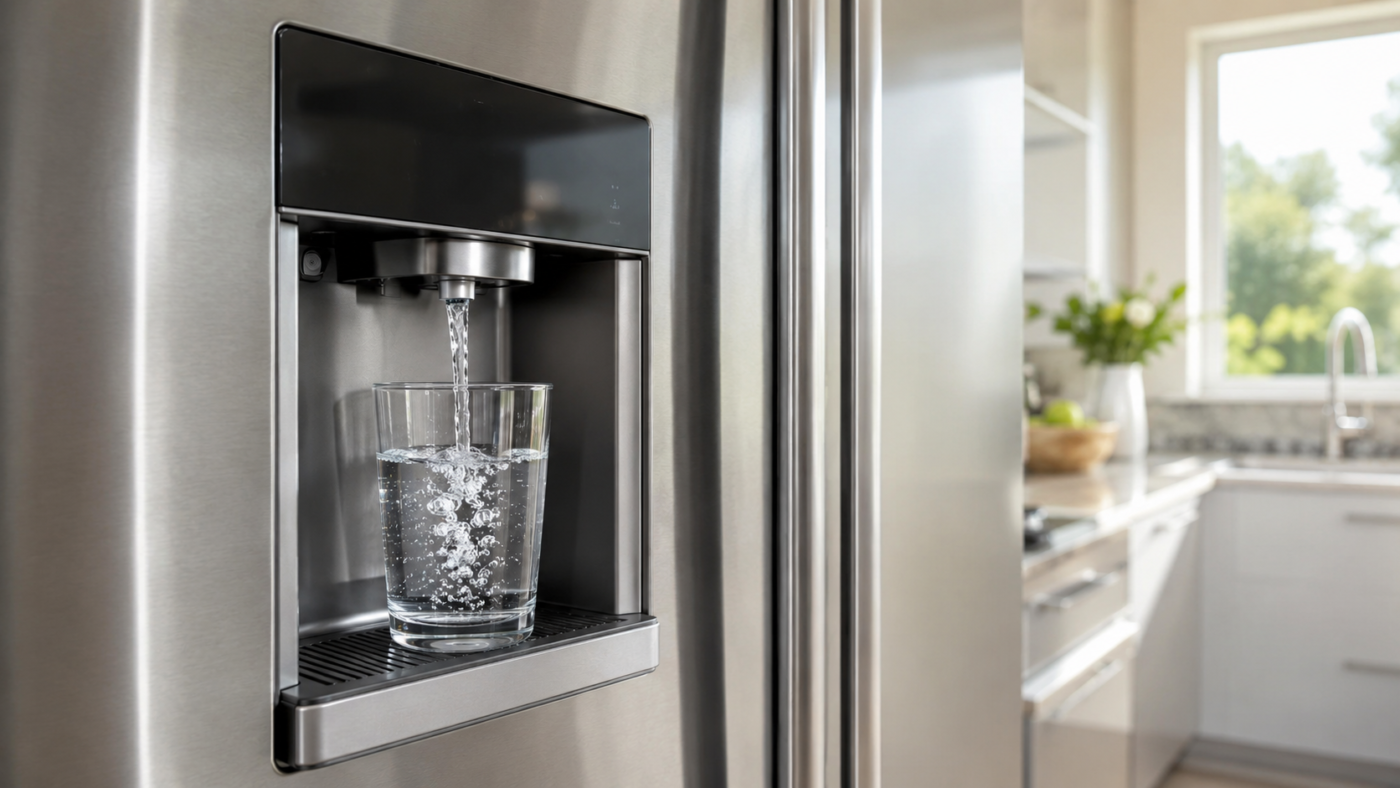
You draw water from the dispenser in the door into a glass and the taste is not what you expected. The cubes coming out of the ice compartment are cloudy and dull at the edges. As the months pass, ice production falls too. The first thought generally goes to the unit: the refrigerator must be faulty. Yet in most cases there is nothing wrong with the unit — the source of the problem is the water coming from the line itself. Refrigerator water filter comes up at exactly this point.
In this guide we take up the line of refrigerators with water and ice: how the water moves inside the unit, which component leads to which problem, the difference between the unit’s own cartridge and an in-line filter, and what to watch when connecting to your existing treatment system.
How Does a Refrigerator Water Line Work?
Refrigerators with water and ice are connected to the mains line. The incoming water passes through the narrow runs inside the unit and reaches the ice maker and the water dispenser in the door. So the content of the water in the line shows up directly in the ice produced and the water taken from the dispenser.
The chain of flow is simple; but every link in it is sensitive to water quality:
The Mains Connection
A feed line is run to the unit from the kitchen line.
The Inlet Valve
The electric valve that controls the unit taking water.
The Internal Line
Narrow-bore pipes distribute the water inside the unit.
The Ice Maker
Water fills the mould and freezes to produce ice.
The Water Dispenser
Drinking water is taken directly from the door.
The last two links of the chain are in direct contact with the user. So whatever is in the line is in the glass too.
The general frame for units of this kind is taken up in international sources under the heading “point-of-use treatment”; the US Environmental Protection Agency’s point-of-use and point-of-entry treatment units source explains that classification.
A refrigerator water filter should be assessed with that flow in mind: positioned at the head of the chain, the filter protects every link.
No brand, model or cartridge code information is given in this content. For the connection structure of your unit, the filter type and compatibility information, the user manual should be taken as the basis.
Why Is a Separate Filter Needed?
The runs inside the unit and the ice maker mechanism are of narrow bore; they are open to sediment and limescale build-up. And the chlorine and organic compounds coming from the mains are carried into the ice and the dispenser water. Filtration reduces that load before it reaches the unit.
The need rests on two separate grounds: protecting the equipment and sensory quality.
On the equipment side the problem is mechanical. The internal runs of the unit are made of thin pipes; the water inlet channel of the ice maker and the dispenser line are of narrow bore too. Sediment and rust particles build up easily in structures like those.
On the sensory side chlorine comes to the front. That residue, present in mains water to protect it along the distribution line, makes a difference in taste and odour when it is carried into the ice and the dispenser water. We covered the source of chlorine and how it is removed at the point of use in our article on chlorine in water.
When the two grounds come together the picture is clear: a refrigerator water filter protects the internal runs of the unit and affects the character of the water that reaches the glass.
Cloudy Ice and the Taste Problem
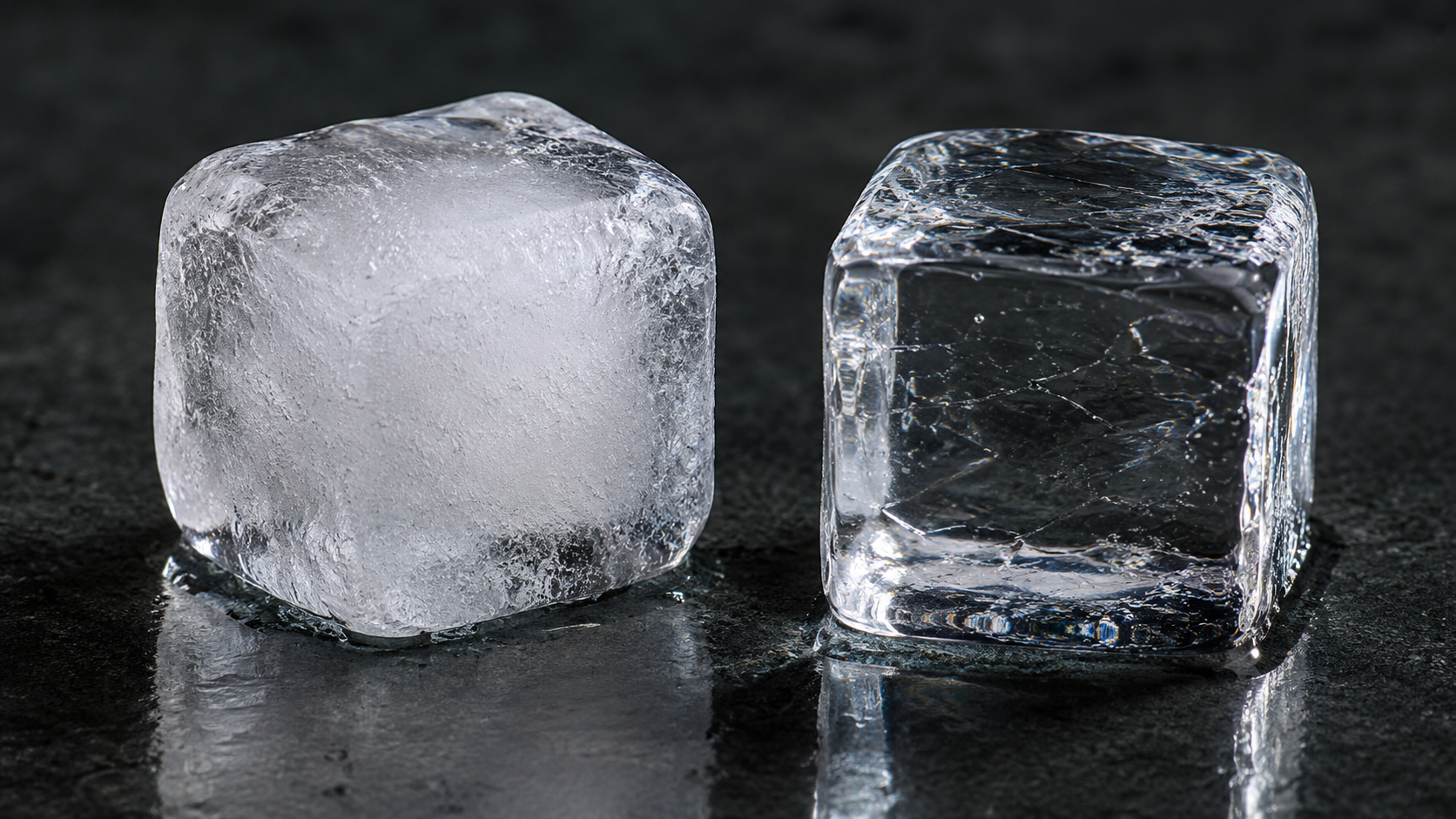
As water freezes, dissolved solids are pushed out of the crystal structure; those that cannot escape are trapped inside the ice. The micro-bubbles that form scatter the light and the cube looks cloudy. And chlorine and organic compounds are carried into the ice; when the ice melts those components go into the drink.
That is the most frequently raised complaint on domestic refrigerators and it is an entirely physical process.
Water with a High Dissolved Solids Load
The substances pushed out during freezing and the micro-bubbles are trapped within the structure. The cube looks cloudy and the centre stays dull.
Water That Has Passed Through a Filter
When the sediment and the sensory load are reduced the appearance improves. The crystal structure forms more evenly and the ice looks clearer.
Another common complaint is odour. The smell of food inside the refrigerator can pass into ice cubes left unused for a long time. That comes not from the water but from the conditions of storage; emptying the ice bin regularly reduces the effect.
On the taste side the source needs telling apart. If the problem is felt in the dispenser water too, the source is most likely the line; if it is felt only in the ice, the storage conditions should be assessed.
We set out the order of diagnosis in odour and taste problems, and how to tell the source apart, step by step in our odour and taste diagnosis guide.
The Difference Between the Unit’s Internal Cartridge and an In-Line Filter
Many models have a filter cartridge inside the unit itself. An in-line filter is fitted to the feed line, ahead of the unit. The two are not alternatives to each other; because the in-line filter holds the coarse load, it can reduce the load on the unit’s internal cartridge.
That distinction is the point users confuse most. The two filters work in different positions and with different jobs.
The unit’s own filter
It is the cartridge defined by the maker and placed inside the unit. It is changed according to the user manual.
- It is positioned on the unit’s internal line
- It is a structure specific to the model
- The change is made according to the manual
- It is directly exposed to the coarse load
It is fitted to the feed line
It is positioned on the line coming to the unit, behind the refrigerator or under the cabinet.
- It is in circuit ahead of the unit
- It reduces the coarse sediment and the chlorine load
- It can lighten the load on the internal cartridge
- Reaching it and changing it are easier
There is no objection to using the two together; on the contrary it is a common build. When the stage on the line reduces the particle and chlorine load, the unit’s own cartridge works with less load.
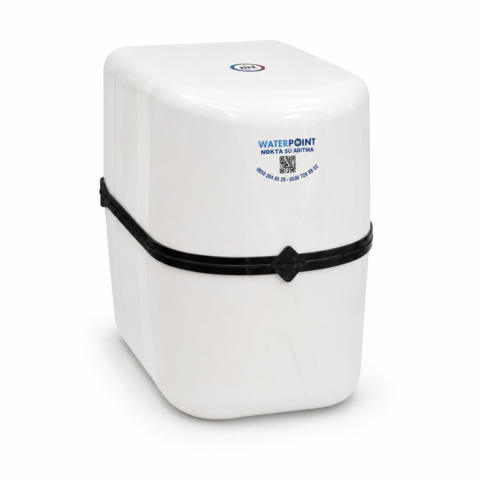
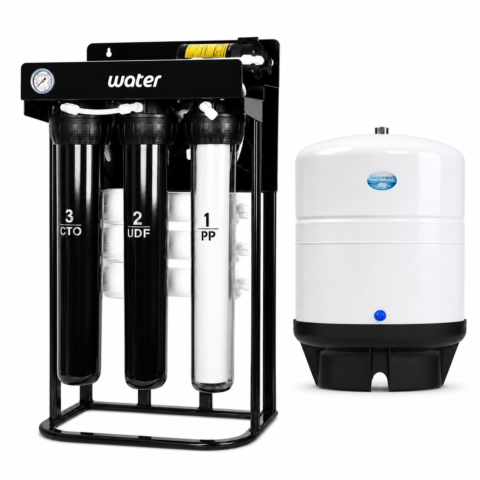
Staged sets can be used in in-line solutions. A staged filter sets that offers sediment and carbon stages together, or a coconut-based activated carbon preferred on its own for chlorine, taste and odour, can be assessed for that purpose.
The type, position and manner of changing of the unit’s own cartridge differ by model; for that information the user manual should be taken as the basis. No cartridge code or compatibility list is given in this content.
What Does Limescale Do in a Refrigerator?
The components that give hardness build up in the narrow runs and in the ice maker mechanism and reduce the bore. As a result the flow of water falls, ice production drops and releasing the cubes from the mould can become harder. Because the effect advances by degrees it is generally noticed late.
Limescale causes trouble at two separate points in a refrigerator: in the water line and in the ice maker.
On the water line side the problem is mechanical. The internal pipes of the unit are of thin bore; build-up narrows that bore and the flow from the dispenser weakens.
On the ice maker side the effect is more marked. Water fills the mould and freezes; at every cycle mineral residue builds up on the surface. In time that build-up can make releasing the cubes harder.
The points affected are these:
The Internal Water Line
Build-up in narrow-bore pipes restricts the flow; the dispenser rate falls.
The Inlet Valve
Build-up on moving parts can affect the taking in of water.
The Ice Moulds
Residue building up on the surface can make releasing the cubes harder.
The Amount Produced
As the cycle lengthens, daily ice production falls.
We covered the general effect of limescale on heat transfer and on equipment in our article on what hard water does to equipment; we do not go deeper into the subject here.
In areas of high hardness a refrigerator water filter does not remove that problem entirely on its own; removing hardness is the job of a different stage. That distinction matters for setting the expectation correctly.
Can It Be Connected to an Under-Counter Treatment Unit?
If there is an under-counter treatment system in the kitchen, a separate feed can be run to the refrigerator from its outlet. In that build there are two headings to watch: the pressure meeting the refrigerator’s requirement, and the system being able to carry the total demand.
That is one of the questions domestic users ask most often, and the answer depends largely on the structure of the system.
The headings to assess are these:
- Pressure: The inlet valve of the refrigerator works within a certain pressure range; the condition in the manual is what counts.
- Tank capacity: In systems with storage the refrigerator is fed from the same reserve.
- Total consumption: Kitchen use and ice production are met from the same system.
- Line distance: A long run can lead to a loss of pressure.
- A system with a pump: In builds with a pump the pressure is generally more stable.
- The connection point: The line should be taken from a suitable point at the outlet of the system.
In a build without a pump and at low pressure, running a line to the refrigerator may not give the expected result; the flow from the dispenser can stay weak and ice production can slow. We covered pressure diagnosis and the role of the pump in our pressure and pumps article.
Builds with storage and a pump work more steadily in that scenario; the common in domestic use can meet both the kitchen line and the refrigerator feed.
We covered the technical points in choosing a system, such as the tank structure, the capacity and the need for a pump, in detail in our unit selection guide.
The working pressure and the connection conditions of a refrigerator differ by model. Before running a line, check the feed conditions in the unit’s user manual; that information shows directly whether the build is suitable.

What to Watch in the Connection
Running the line, matching the fitting and the pipe, and sealing are the most critical headings in this build. And service clearance should be left behind the unit and the line placed so that it is not crushed. For the sizes and connection information the user manual is the basis.
A refrigerator line runs at a point out of sight in the kitchen. That can lead to a leak going unnoticed for a long time.
The line behind the refrigerator is invisible because it sits between the cabinetry and the unit. A single connection that has not seated properly opens up in time as the system comes under pressure and can turn into a leak that goes unnoticed. That in turn can damage the kitchen floor and the cabinetry.
So once the connection is made a check for sealing must be carried out, and in the first days the area behind the unit should be watched by eye.
The points to watch in the connection are these:
- Fitting match: The connection sizes must match; they should not be forced together.
- The pipe route: The line is placed so that it is not crushed and does not make sharp turns.
- Room for service: Enough slack is left that the line is not pulled tight when the refrigerator is drawn out.
- An isolating valve: Having an accessible valve on the line makes any intervention easier.
- The seal check: Once water is turned on, all the connections are examined by eye.
- Access to the filter: The in-line filter is positioned at a point where changing it can be done comfortably.
We covered the general steps of the installation process and the common mistakes in our installation guide; we do not repeat the steps here.
Where you are not sure, having the connection made by a technical service is the right course. In a refrigerator water filter build the real risk is not in the filter but at the connection points.
When Does the Filter Get Changed?
The time to change is settled not by the calendar but by use. The clearest indicators are these: the flow from the dispenser weakening, a fall in ice production, and a change in taste and odour. The period differs with the quality of the incoming water and the consumption.
Stages do not show their saturation from the outside; the water keeps flowing but the holding job falls off. So the following is done through the signs.
The signs showing it is time to change are these:
| Symptom | Likely Cause | What Should Be Done |
|---|---|---|
| The flow at the dispenser has weakened | The stage may have saturated | The state of the filter is checked |
| Ice production has fallen | The feed rate may have dropped | The filter and the line pressure are assessed |
| There is a change in the taste | The carbon stage may have used up its capacity | The stage is renewed |
| The ice has turned cloudy | The sediment and dissolved load may have risen | The age of the filter and the incoming water are assessed |
| An odour after a long break | Water standing in the line | The line is run off, the first ice is not used |
| The unit is giving a warning | The period defined in the manual has run out | The guidance in the manual is followed |
Giving a firm period would not be right; the same stage uses up its capacity far faster in an area with a high sediment and chlorine load. So the signs should be watched as much as the calendar.
For the unit’s own cartridge the period in the user manual should be taken as the basis. On models with a counter the indicator gives a warning; that warning should be followed.
We explained the logic of renewing a stage and how to read the signs in detail in our filter change guide; that content focuses on under-counter systems but the logic of following is the same.
A Refrigerator Left Unused for a Long Time
On a holiday, a move or a long period without use, water stands still in the line and in the ice bin. When coming back into use the line should be run off for a while and the first ice produced should be discarded rather than used.
That is a situation met often in seasonal homes and on returning from a long holiday.
The order to follow when bringing it back into service is this:
-
Flush the Line
Water is drawn from the dispenser for a while to drain the standing water waiting in the line. That step forms the basis of all the steps that follow.
-
Empty the Ice Bin
Ice that has stood a long time is not used and is discarded. The bin is cleaned and left to produce again.
-
Do Not Use the First Ice
The first ice produced after the system restarts is discarded too. That clears the residue in the line.
-
Check the State of the Filters
Even if it has not been used, the period of the stages may have run. If the time is up, renewal is assessed.
-
Look Over the Connection
After a long pause the line and the connections are checked; the area behind the unit is looked at for any wetness.
In seasonal homes those steps should be turned into an opening procedure. We covered the steps for bringing a system back into service after a long closure in our guide to bringing a system into service in seasonal use.
Another practical point: if the home is to be left empty for a long time, the valve on the line to the refrigerator can be closed. That prevents a possible leak from advancing unnoticed.
Let’s establish the filter that suits your refrigerator line
To assess the stages that suit the sediment and chlorine load of your water, you can look through the options.
See the Filter SolutionsHow Is the Right Answer Chosen?
Three headings decide the choice: the hardness and sediment load of the water, whether there is an existing treatment system in the kitchen, and the intensity of use. Once those three pieces of data are clear, whether an in-line filter or a connection to the existing system is needed becomes easy to settle.
The decision runs in this order:
-
Get to Know Your Water
The sediment, chlorine and hardness profile is established. Without knowing the source of the problem the right stage cannot be chosen.
-
Assess the Existing System
If there is an under-counter system in the kitchen, whether a line can be run from its outlet is assessed in terms of pressure.
-
Establish the Intensity of Use
Daily ice and water consumption affects how often the stages will be renewed.
-
Choose the Type of Build
An independent in-line filter, or a connection to the existing system? The decision is the output of the previous three steps.
-
Plan the Connection
The route of the line, the position of the isolating valve and access to the filter are made clear before fitting.
In areas of high hardness a reminder is needed: in-line filtration works on the sediment and chlorine side; removing hardness is the job of a different stage. The expectation should be set accordingly.
Water Point Su Arıtma Teknolojileri operates from Esenyurt, İstanbul under its founder Ali Genç, with more than 20 years of experience in the sector.
Warranty
Units, valves, pumps and tanks carry a 2-year warranty and taps a 1-year warranty. Filters, membranes, resin and salt are consumables and fall outside the warranty.
The Distinction Between Consumables and Spare Parts
Filters, membranes, resin and salt are consumables; valves, pumps and tanks are durable spare parts.
Delivery
Products in stock are dispatched within 1–3 working days; products not in stock are ordered in and the lead time confirmed. Free shipping applies across Türkiye.
On-Site Survey
The survey is free if the unit is purchased from us; where only a survey and measurement are wanted, a survey fee of ₺2,000 applies.
Scope of Installation
The unit is delivered ready to install; the inlet and outlet connections are made. The plumbing labour and materials are the customer’s responsibility. Where a valve setting is needed, free support is given over a video call.
Contact
For orders and information by phone, 0850 304 95 25; to speak to a specialist, the 0536 729 99 52 WhatsApp line and [email protected] can be used.
Frequently Asked Questions
Does it fit every refrigerator?
Because in-line filters are fitted to the feed line they are generally assessed on the match of the connection size. The unit’s own internal cartridge, on the other hand, is specific to the model. So for compatibility the connection and filter information in your unit’s user manual should be taken as the basis.
Can it be used without a filter?
The unit works technically; but the sediment, rust and chlorine coming from the line are carried directly into the ice and the dispenser water. And the narrow-bore internal runs and the ice maker are affected by build-up. So a filtration stage is assessed both for sensory quality and for protecting the unit.
Why does the ice come out cloudy?
As water freezes, dissolved solids are pushed out of the crystal structure; those that cannot escape are trapped in the ice, and the micro-bubbles that form scatter the light. When the sediment and dissolved load are reduced the appearance improves. That is not a fault in the unit but a physical process.
Can I connect it to my treatment unit?
If there is an under-counter system in the kitchen a line can be run from its outlet. What decides is the pressure meeting the refrigerator’s requirement and the system carrying the total demand. In builds without a pump and at low pressure the flow can stay weak; the feed condition in the unit’s user manual should be checked.
Is there a risk of a leak?
Because the line runs behind the unit, a possible leak can be noticed late. So the connections must seat fully, the line must not be crushed, and a check for sealing must be made once the water is turned on. Having an accessible isolating valve on the line also makes any intervention easier.
My ice production has fallen — what could be the reason?
The most common reasons are a saturated stage and the fall in feed rate that comes with it. In areas of high hardness build-up in the ice maker can play a part too. The state of the filter and the line pressure should be assessed first; if the problem continues the unit should be checked by a service.
My ice smells — should the filter be changed?
The source needs telling apart. If the odour is felt in the dispenser water too it is most likely in the line and the carbon stage is assessed. If it is felt only in the ice, food odours in the refrigerator may be passing into it; in that case the bin is emptied and cleaned.
Are an in-line filter and the unit’s cartridge used together?
Yes, it is a common build. Because the stage on the line reduces the coarse sediment and the chlorine load, the unit’s own cartridge works with less load. The two are not alternatives to each other; they sit in different positions with different jobs.
How often should the filter be changed?
There is no fixed period; it changes with the quality of the incoming water and the consumption. The clearest indicators are the flow weakening, a fall in ice production and a change in taste. For the unit’s own cartridge the period in the user manual should be taken as the basis.
Conclusion
A refrigerator water filter serves two jobs at once: it affects the character of the water that reaches the glass and of the ice produced, and at the same time it protects the narrow-bore internal runs of the unit. Cloudy ice is not a fault but the result of dissolved solids being trapped within the structure during freezing; the difference in taste and odour comes from chlorine and organic compounds being carried into the ice. Limescale, meanwhile, builds up in the narrow runs and in the ice maker and lowers the flow and the production. On the answer side there are two options and they are not alternatives to each other: the unit’s own cartridge and an in-line filter fitted to the feed line. If there is an under-counter system in the kitchen a line can be run from its outlet; what decides there is the pressure. And last, the connection: because the line runs out of sight behind the unit, the check for sealing should not be skipped.
Get in touch for the filter and connection that suit your water
Products in stock are shipped within 1-3 working days; free shipping applies Türkiye-wide. For choosing a suitable stage and for support with the connection you can reach us on 0850 304 95 25, to speak to a specialist on the 0536 729 99 52 WhatsApp line, or at [email protected].
Discover the Solution That Suits You