
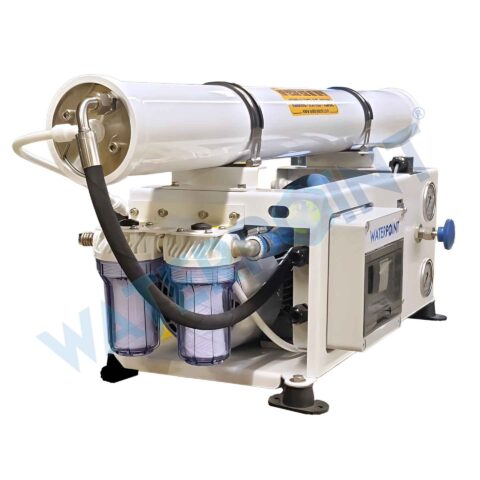
Aquarium Pure Water: RO Units and Water Preparation
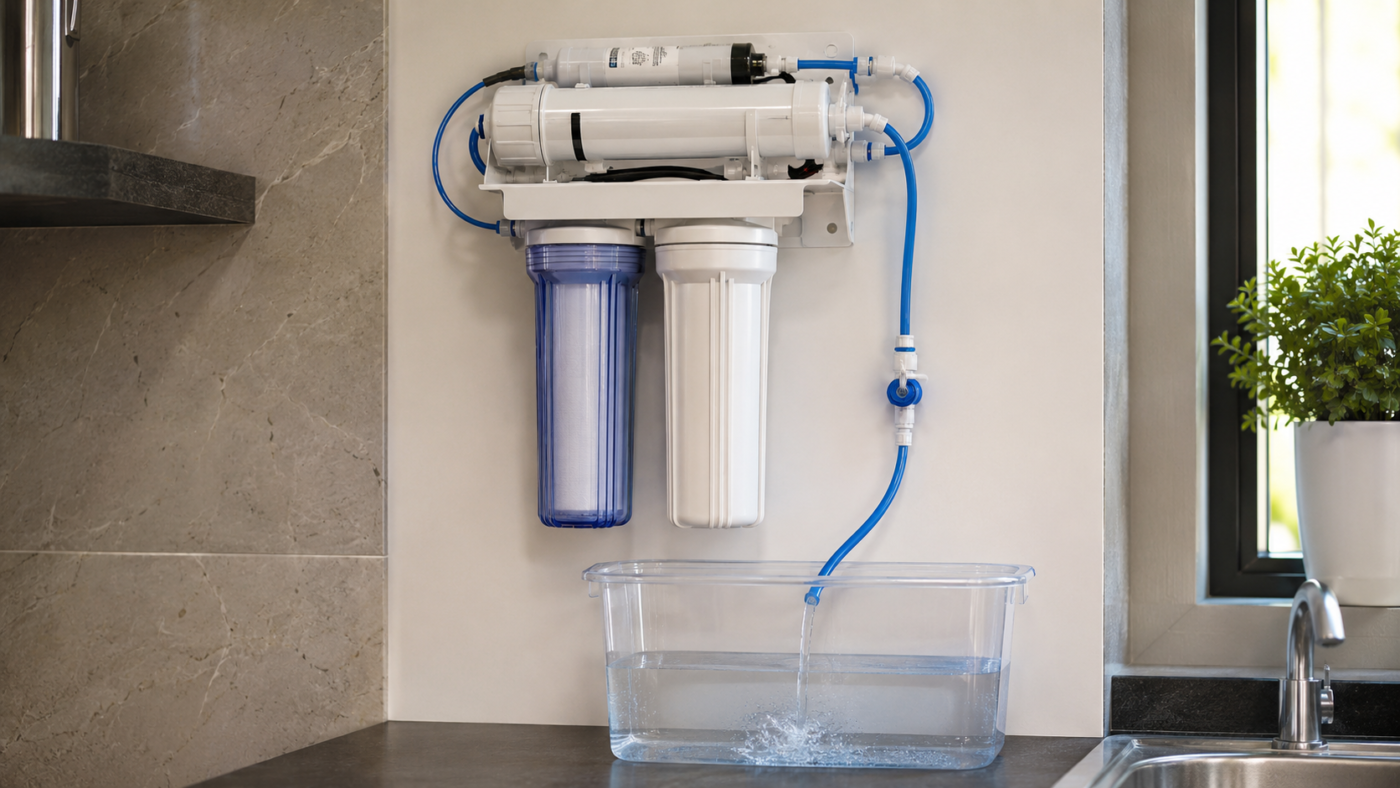
You do a water change and the readings do not come out as you expected. At the next change the picture is different again. The same volume, the same method, the same products — but the starting point shifts a little every time. The problem may not be in the practice but in the input: the content of mains water changes with the area and the period. Aquarium pure water is an approach whose starting point is exactly that: a source water you can control.
In this guide the subject is taken up within a single frame: water preparation technology. We explain what reverse osmosis does, when deionisation comes in, how conductivity is followed, when the consumables are renewed and how the system is sized.
This content deals with water preparation technology. Aquarium water parameters, the setting up of a tank and the care of livestock fall outside its scope; on those subjects an aquarium specialist, species-specific sources and your supplier should be consulted.
Why Is Treated Water Preferred in an Aquarium?
In aquarium practice the content of the water is wanted controllable. So water largely cleared of dissolved solids is preferred as a starting point; the values wanted are then added to that water in a controlled way. In that way every preparation starts from the same point.
The logic of the approach is repeatability. If one of the inputs in a preparation process is variable, predicting the result becomes difficult.
Mains water is produced to the criteria set out in the relevant regulations and is inspected regularly. But its content can differ with the area, the season and the conditions of the plumbing. In aquarium practice that variability becomes something that makes the calculation harder.
So many practitioners prefer to work from a known starting point. Once the dissolved load in the water is lowered, every component added becomes measurable and repeatable.
That is exactly the aim of an aquarium pure water build: to keep the input constant. Which values to target falls outside the scope of this content and is settled by the practitioner’s own sources.
What Is in Mains Water?
Mains water can contain the calcium and magnesium that give hardness, the total dissolved solids load, chlorine residue, and components such as nitrate and phosphate. The amount of those components changes from area to area and with the season; so the content is established by a local analysis.
The aim in this section is not to speak against mains water but to show its variability. In different cities of the same country, and even in different districts, the profile can differ markedly.
The headings most often assessed in an analysis are these:
Hardness
It shows the amount of calcium and magnesium; it differs markedly by region.
Conductivity / TDS
It reflects the total dissolved solids load; it reports a quantity, not a list of contents.
Chlorine Residue
It is present to protect the water along the distribution line; the amount changes with the line.
Nitrate
It is one of the parameters assessed in an analysis; it differs with regional influences.
Phosphate
It is among the dissolved components; the amount can change with the source.
Silicate
It is one of the dissolved components found in some sources.
No numerical value is given in this content; because the values are specific to the area and generalising would mislead. The profile of your own water is established only by a local analysis.
For a general frame on dissolved minerals being naturally present in water and their amount changing by region, see the US Geological Survey’s water hardness resource can be consulted.
We covered what a dissolved solids measurement tells you, and what it does not show, in our TDS article, and the source of chlorine and the methods of removing it in our article on chlorine in water.
How Does Reverse Osmosis Change the Content of Water?
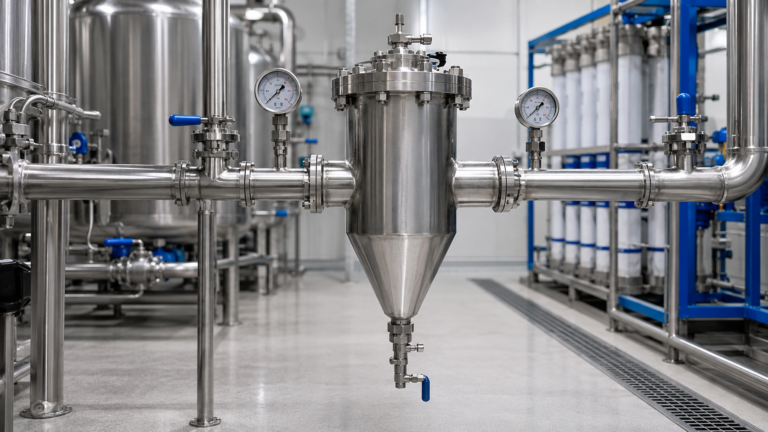
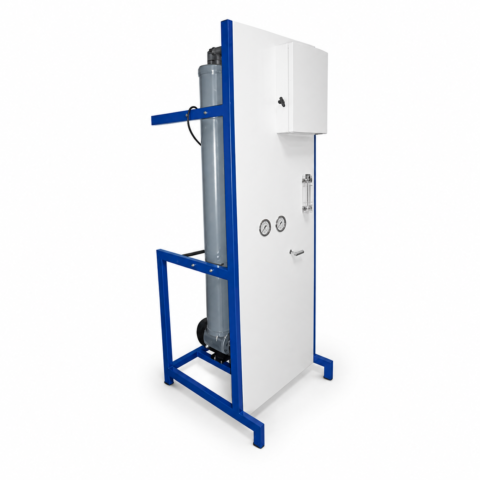
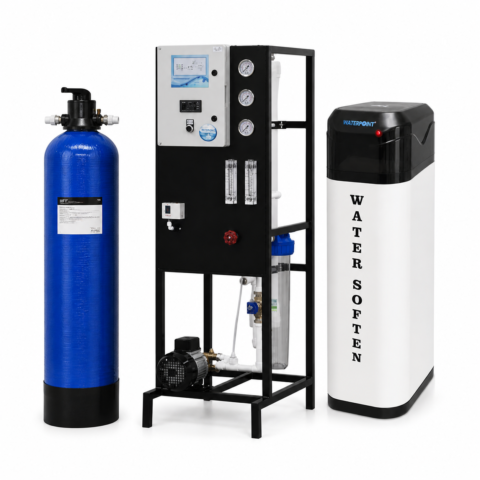
A reverse osmosis membrane separates water into two streams under pressure. In the water passing the membrane the dissolved solids load is lowered by up to 99%; the part that cannot pass goes to the drain as concentrate. In that way a starting water with markedly reduced conductivity is obtained at the outlet.
That is the main treatment stage of the system and it sits at the centre of the chain.
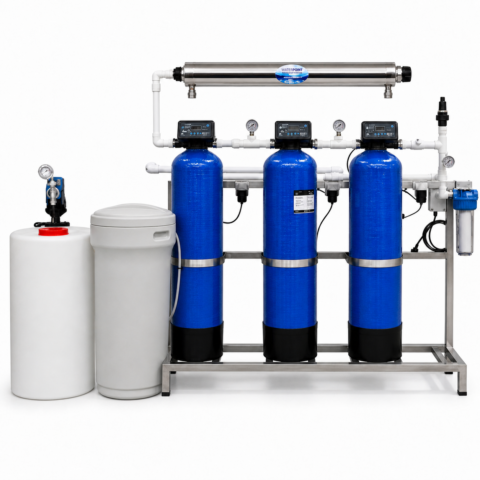
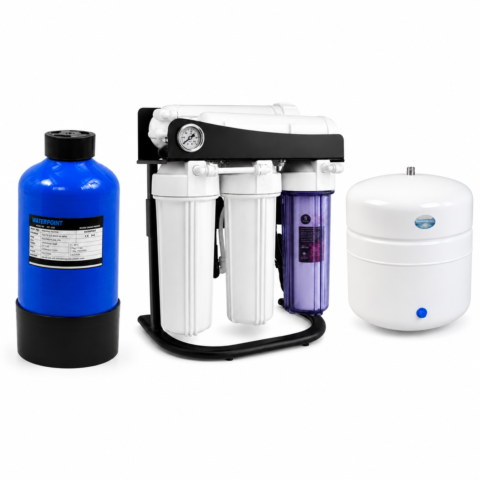
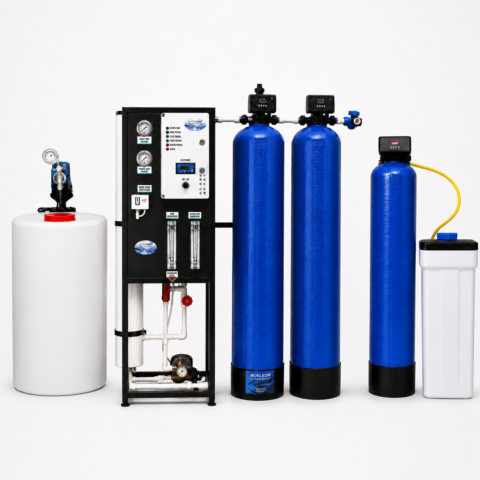
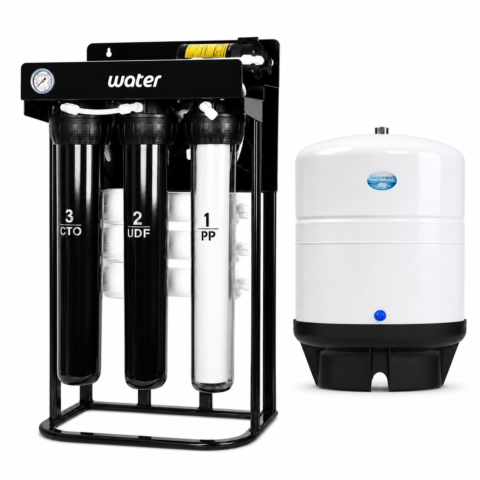
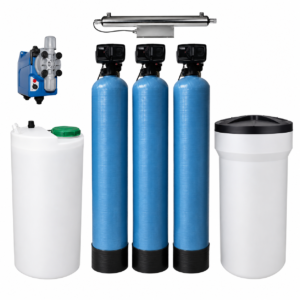
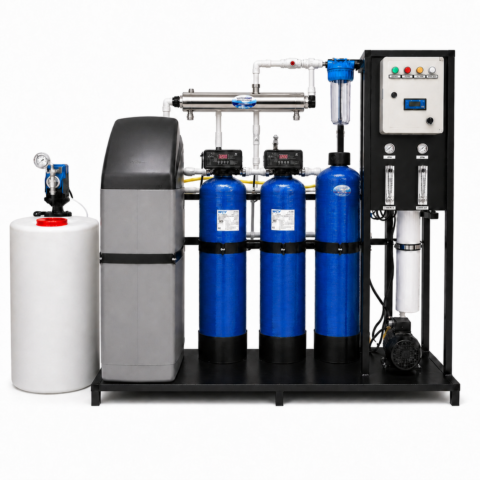
A typical build runs in this order:
Sediment Filter
It holds particles; it protects the stages behind it.
Activated Carbon
It reduces the chlorine and organic load; it protects the membrane.
Membrane
It separates the dissolved load to a large extent.
Deionisation
If needed, it holds the trace ions that remain.
The second stage is especially important. Chlorine is a component that can do permanent damage to the structure of a membrane; so the carbon stage is positioned ahead of the membrane and has to be renewed on time.
We covered how the membrane works, why the two streams form and why its structure is sensitive in our how reverse osmosis works article; we do not go deeper into the technology here.
In an aquarium pure water build, reverse osmosis forms the basis of most applications; whether an extra stage is needed depends on the conductivity targeted.
Is RO Enough, or Is Deionisation Needed?
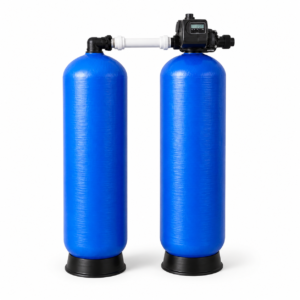
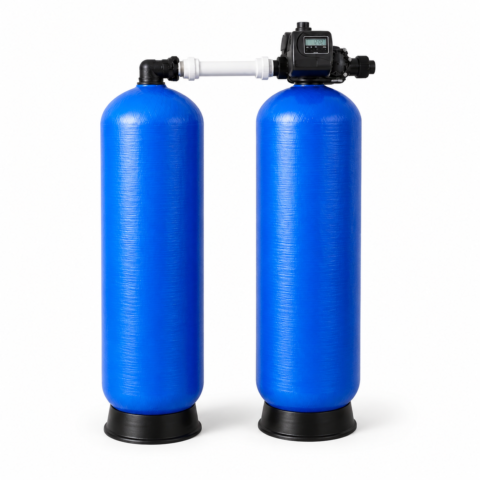
At the membrane outlet the dissolved load falls greatly; but trace amounts of ions remain. If a lower conductivity is targeted, a deionisation stage with mixed-bed resin is added. That stage is not an alternative to RO but its continuation.
The decision is made on the value targeted. The two stages take on different jobs and work together.
It lowers the main load
It separates the greater part of the dissolved solids and forms the main treatment stage of the system.
- It lowers the dissolved load by up to 99%
- It produces a concentrate stream
- It depends on the pre-filters
- In most applications it is the main stage
It holds the remaining ions
A mixed-bed resin bed holds the trace ions passing the membrane and lowers the conductivity further still.
- It is positioned as the final stage
- It comes in after the RO
- It is renewed when the resin capacity is used up
- It is watched by following the conductivity
The order matters. If the deionisation stage is applied directly to mains water the resin uses up its capacity very quickly. With the RO positioned ahead, the greater part of the load has already been taken and the resin works for far longer.
We explained the technical side of deionisation in detail in our deionised water article. In practice, deionised pure water systems are used for that stage, and when the time comes to renew the bed, mixed bed pure water resin is the usual choice.
Which stage is needed depends on the target. And what that target should be is settled by the practitioner’s own sources and the guidance of an aquarium specialist.
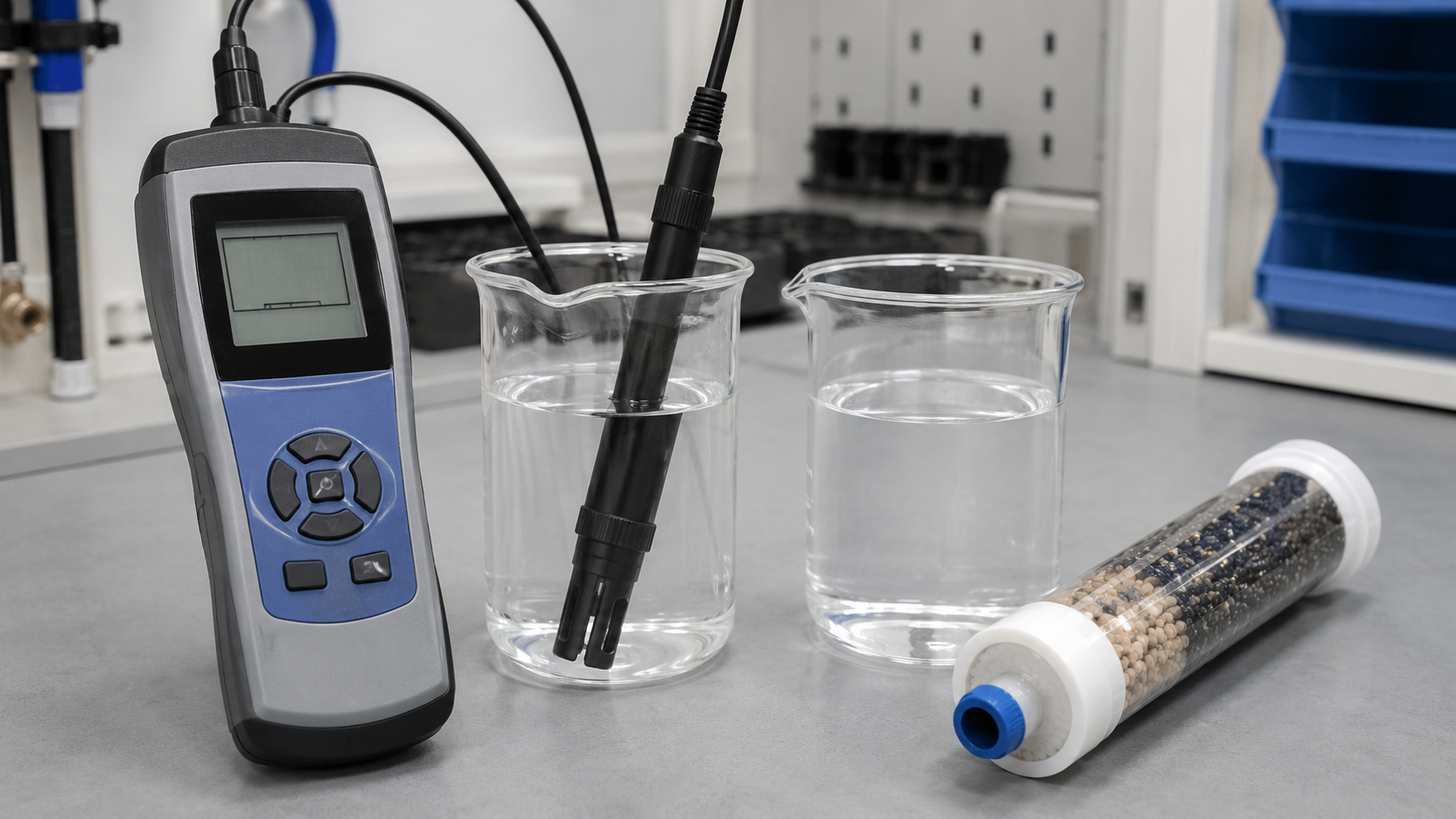
Conductivity Measurement and Following It
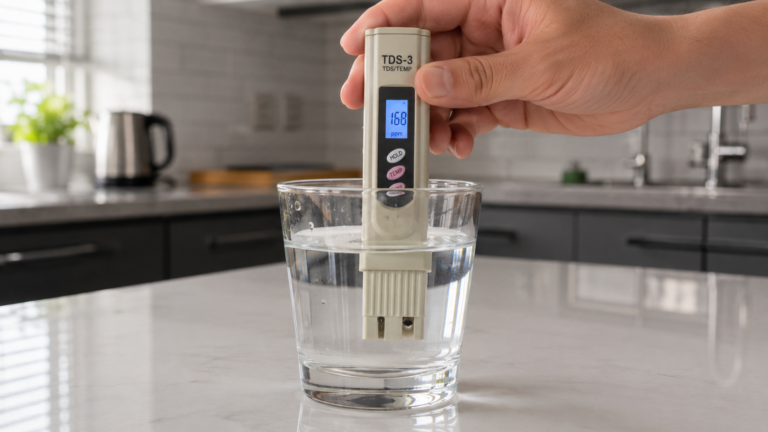
The conductivity of the water produced is measured regularly; that is the most practical way of confirming the system is working correctly. A rise in the value generally shows that the membrane has tired or that the resin bed has used up its capacity.
That is the heading at the centre of the discipline of preparation. Without measurement, a fall in the performance of the system is only noticed in the results; with measurement it can be seen in advance.
A practical method for following is this: at every preparation the value of both the incoming and the outgoing water is recorded. The difference between the two values shows how much work the system is doing.
| The Observation | Likely Cause | What Should Be Done |
|---|---|---|
| The outlet value is rising by degrees | The membrane may be tired | The state of the membrane is assessed |
| The value rose suddenly | The resin may have used up its capacity | The mixed bed is renewed |
| Production has slowed | The pre-filters may have saturated | The stages are checked |
| Production fell and the value rose together | Membrane performance may have dropped | The pre-filter and the membrane are assessed together |
| The inlet value changed | The mains profile may have shifted with the season | Following continues, the life of the stages is reviewed |
| The value is steady | The system is working in the expected range | Routine following continues |
For the measurement a practical meter can be used. Those instruments show the total dissolved solids load in the water; they do not state which substances are present. We explained what the measurement tells you in our TDS article.
Keeping a record is the most valuable part of following. When the date, the inlet value and the outlet value are noted, when the stages will be renewed rests on data rather than guesswork.
In an aquarium pure water build, measurement is the system’s only real indicator. When the value of the water produced is followed regularly, a loss of performance is noticed early and the preparation process is not interrupted.
When Do the Membrane and the Resin Get Changed?
The time to change is settled not by the calendar but by the measurement. A rise in the outlet conductivity and a fall in the rate of production are the main indicators. Renewing the pre-filters on time protects the membrane; holding the chlorine at the carbon stage in particular is critical.
The life of the consumables changes with the quality of the incoming water and the amount of use; so giving a fixed period would not be right.
Every component has its own indicator:
Sediment Filter
A rise in the resistance to flow and a slowing of production show that renewal is needed.
Activated Carbon
When its capacity is used up the chlorine reaches the membrane; renewing it on time is critical.
Membrane
A gradual rise in the outlet value and a fall in the rate of production are assessed.
Mixed-Bed Resin
A sudden rise in the outlet value shows that the bed has used up its capacity.
The carbon stage has a special importance. Chlorine can do permanent damage to the structure of the membrane; when the stage saturates that protection disappears. So renewing the carbon should not be put off.
We covered how activated carbon works and why it depends on contact time in our activated carbon filter article, and the structure of the membrane and the mechanism by which it tires in our membrane filter article.
When the time comes to renew, for the pre-stages a staged filter sets, and on the membrane side the standard-size membrane modules are used.
The System Build: Domestic Type or Larger?
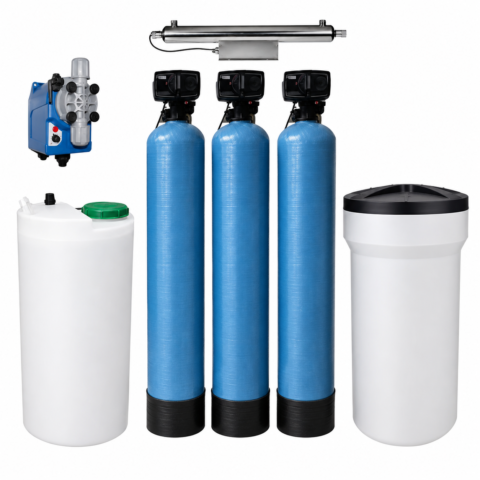
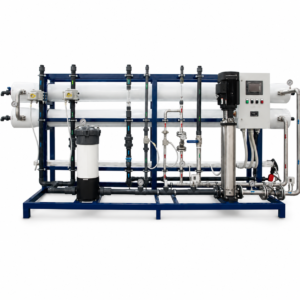
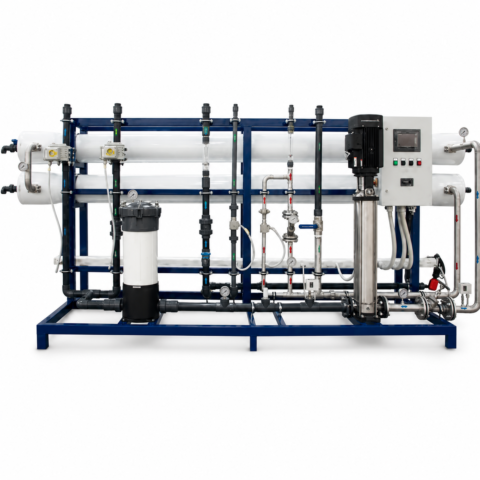
The build is settled by the amount of water prepared, how often water changes are made and the possibility of storage. In small volumes a domestic-type system can be enough, while a build with a tank is preferred when more water has to be prepared regularly.
What decides is not how much water is needed at one time but how often that need repeats.
The headings assessed are these:
- The amount prepared: How much water has to be produced each time is the basic input.
- The frequency of changes: How often the preparation repeats settles the scale of the build.
- Storage: It balances the time between producing and using.
- Space: Room is needed for the system and, where there is one, the storage vessel.
- Pressure: Suitable pressure is needed for the membrane to work efficiently.
- The drain connection: The discharge of the concentrate stream has to be planned.
The third item is the heading that makes the most difference in practice. Reverse osmosis systems produce water not instantly but over time; storage eases the timing of the preparation.
The exact capacity is settled by the user’s preparation routine; so giving a numerical target here would not be right. The scaling is done with the data on the amount prepared and the frequency.
Waste Water and Efficiency
As reverse osmosis works it produces two streams: the treated water passing the membrane and the concentrate that cannot pass. That stream going to the drain is part of the working principle of the system and keeps the membrane surface clean. Its ratio is affected by the pressure and the quality of the incoming water.
That subject is one of the headings on which users setting up a system for the first time ask the most questions. The short answer: the concentrate stream is normal and necessary.
The membrane separates the water in two and has to send the dissolved solids it holds somewhere. If that stream is cut off, the concentration at the surface rises quickly and the membrane blocks in a short time.
The factors affecting the ratio are these:
The Inlet Pressure
When the pressure falls production drops; the ratio is affected badly.
The Load of the Incoming Water
As the dissolved solids load rises, the resistance the membrane has to overcome rises with it.
The Water Temperature
In cold water the permeability of the membrane falls; production slows.
The State of the Membrane
A tired module lowers production and spoils the ratio.
We took the subject up in detail in a separate article; you can read about the mechanism and the ways of improving it in our waste water ratio article.
We covered pressure diagnosis and the role of the pump in our pressure and pumps article. On low-pressure lines a pump build markedly improves both production and efficiency.
Storing the Water Produced
The prepared water should be stored in a clean, closed vessel suited to the purpose. Using it within a short time is preferred to keeping it standing for long. Measuring the conductivity again before use confirms the storage process.
Storage is the link in the discipline of preparation that is most often skipped. Water produced correctly can lose its quality as a starting point when it is kept in unsuitable conditions.
The headings to watch are these:
-
Use a Suitable Vessel
A clean, closed vessel suited to the purpose is preferred. It matters that the vessel has not been used before for a different purpose.
-
Keep the Lid Closed
In a vessel left open, outside influences can come into play. The vessel should be kept closed when not in use.
-
Do Not Keep It Long
Using the prepared water within a short time is preferred. The longer it stands, the harder control becomes.
-
Measure Before Use
The conductivity of the water in the vessel is measured again before use; that is the confirmation of the storage.
-
Clean the Vessel Regularly
The storage vessel is cleaned periodically. A build-up of residue can affect later preparations.
-
Keep Records
When the date of preparation and the value measured are noted, the process becomes traceable.
The fourth step is especially valuable. If the value of the water in the vessel differs from the value at the moment of production, either the storage conditions or the vessel itself should be reviewed.
The storage vessel is expected to be of a material suitable for contact with food and water. Vessels used before for a different purpose should not be preferred; the risk of residue can affect the character of the prepared water.
Let’s establish the system that suits the conductivity you target
To assess which stages are needed for your preparation routine and your target value, you can look through the options.
See the Pure Water SystemsWhere Should You Start?
The process rests on three basic decisions: analysing the mains water, settling the target conductivity and choosing the system to suit it. What that target value should be is the subject not of water preparation technology but of aquarium practice.
The right order is this: first you know what the input is, then you define what the output should be, and only then the system is chosen to those two pieces of data.
The steps work like this:
-
Measure Your Mains Water
The conductivity value of the incoming water is established. That value directly affects how much work the system will do and the life of the consumables.
-
Make the Target Value Clear
Which conductivity value is being targeted is established. That target is defined by the requirement of your aquarium practice.
-
Choose the Stage Build
Is reverse osmosis enough, or is deionisation needed too? The decision is made on the target value.
-
Settle the Scale
The amount prepared and the frequency define the scale of the system and the need for storage.
-
Set Up a Following Routine
A routine of measuring and recording is set up; renewing the consumables is planned on that data.
The second step is the limit of this content and that needs stating plainly.
Aquarium water parameters, the setting of target values, the setting up of a tank and the care of livestock fall outside the scope of this content. On those subjects an aquarium specialist, species-specific sources and your supplier should be consulted.
This content deals only with water preparation technology — the treatment stages, following the measurement, renewing the consumables and the system build.
That line in fact makes the work easier: the water preparation side is handled with measurement, the practice side with specialist guidance. Neither field stands in for the other.
Water Point Su Arıtma Teknolojileri operates from Esenyurt, İstanbul under its founder Ali Genç, with more than 20 years of experience in the sector.
Warranty
Units, valves, pumps and tanks carry a 2-year warranty and taps a 1-year warranty. Filters, membranes, resin and salt are consumables and fall outside the warranty.
The Distinction Between Consumables and Spare Parts
Filters, membranes, resin and salt are consumables; valves, pumps and tanks are durable spare parts.
Delivery
Products in stock are dispatched within 1–3 working days; products not in stock are ordered in and the lead time confirmed. Free shipping applies across Türkiye.
Scope of Installation
The unit is delivered ready to install; the inlet and outlet connections are made. The plumbing labour and materials are the customer’s responsibility. Where a valve setting is needed, free support is given over a video call.
Contact
For orders and information by phone, 0850 304 95 25; to speak to a specialist, the 0536 729 99 52 WhatsApp line and [email protected] can be used.
Frequently Asked Questions
Which value should I target for aquarium pure water?
Settling the target value falls outside the scope of this content; it changes with your practice. On that subject it is right to consult an aquarium specialist and species-specific sources. What can be done on the water preparation side is to choose the stage build that suits the target settled.
Is reverse osmosis enough on its own?
At the membrane outlet the dissolved load falls greatly but trace amounts of ions remain. If a lower conductivity is targeted, a deionisation stage with mixed-bed resin is added. The decision is made on the value targeted.
Can mains water not be used directly?
Mains water is produced and inspected to the criteria set out in the relevant regulations. But its content can change with the area and the season; because that variability makes the calculation harder in aquarium practice, a controlled starting water can be preferred. The decision on practice is yours.
When should I change the membrane?
There is no fixed period; the measurement settles the change. A gradual rise in the outlet conductivity and a fall in the rate of production are the main indicators. Renewing the pre-filters on time, the carbon stage in particular, directly affects the life of the membrane.
When is the resin renewed?
When the mixed bed uses up its capacity the outlet conductivity rises markedly. That is the clearest indicator of the time to renew. When the measurement is made regularly there is room to act before the value begins to rise.
The unit sends water to the drain — is that normal?
Yes. As reverse osmosis works it produces a concentrate stream, and that stream keeps the membrane surface clean; it is part of the working principle. Its ratio is affected by the pressure, the load of the incoming water and the state of the membrane. But if the flow never stops, the system should be checked.
How long can I store the water I produce?
Using it within a short time is preferred. Regular preparation is advised rather than long standing. The vessel should be kept clean and closed, and the conductivity should be measured again before use; that confirms the storage process.
What capacity of system is needed?
The capacity is settled by assessing together the amount produced at each preparation, the frequency of preparation and the possibility of storage. In small volumes a domestic-type build can be enough, while a build with a tank is preferred when more water is needed regularly.
Is a measuring instrument essential?
Measurement is the most practical way of confirming the system is working correctly. Without an instrument, when the consumables are to be renewed rests on guesswork. Regular measurement and recording both show a loss of performance early and make the preparation process predictable.
Conclusion
The aim of the aquarium pure water approach is simple: to fix the input. Because the content of mains water can change with the area and the season, a starting water with its dissolved load lowered makes the preparation repeatable. On the technology side the chain is clear — the sediment filter holds the particles, the activated carbon protects the membrane by reducing the chlorine load, reverse osmosis lowers the dissolved load by up to 99% and, if needed, the mixed-bed resin takes the trace ions that remain. And the only thing that shows the system is working correctly is the measurement: a rise in the outlet conductivity shows the time to renew the membrane or the resin. Storage needs discipline too; a clean closed vessel, a short wait and a measurement before use. What the target value should be falls outside the scope of this content and is settled by consulting an aquarium specialist.
Get in touch for a build to suit the conductivity you target
Products in stock are shipped within 1-3 working days; free shipping applies Türkiye-wide. For choosing a suitable system and consumables you can reach us on 0850 304 95 25, to speak to a specialist on the 0536 729 99 52 WhatsApp line, or at [email protected].
Discover the Solution That Suits You