
Separator Filter vs Bag Filter: Which Pre-Stage, When
The water coming from the well looks clear; and yet the cartridge filters block within weeks, the pump is under constant strain and the membrane loses its performance far earlier than expected. The maintenance items pile on top of one another and the cost becomes unpredictable. The shared cause of that picture is usually one thing: coarse particles are entering the system without being separated out at all. A separator filter is a pre-separation unit used to close exactly that gap.
In this article we take up how a separator filter works, what it separates and what it does not. Then we compare it with the bag filter heading by heading, and explain which is preferred when and how the two are used in sequence.
What Is a Separator Filter and How Does It Work?
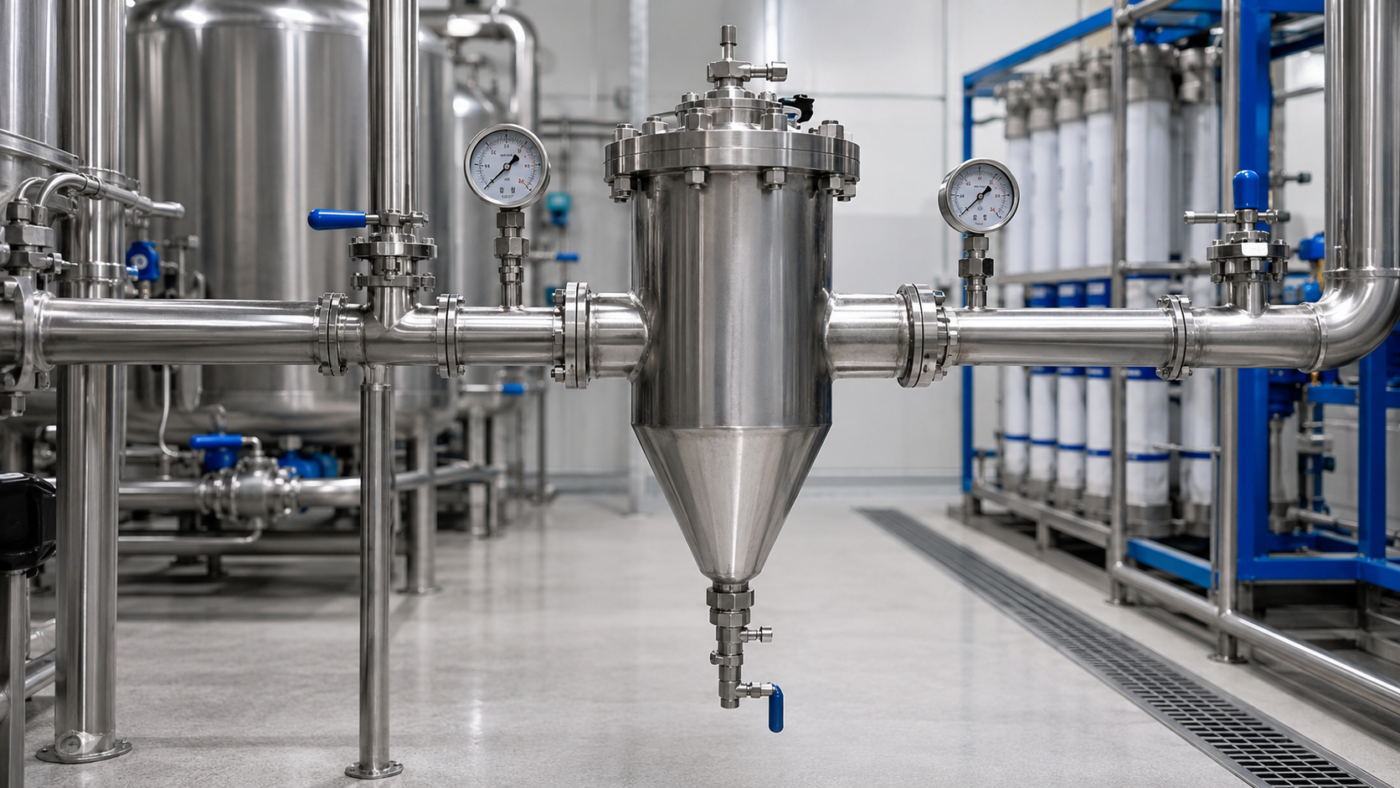
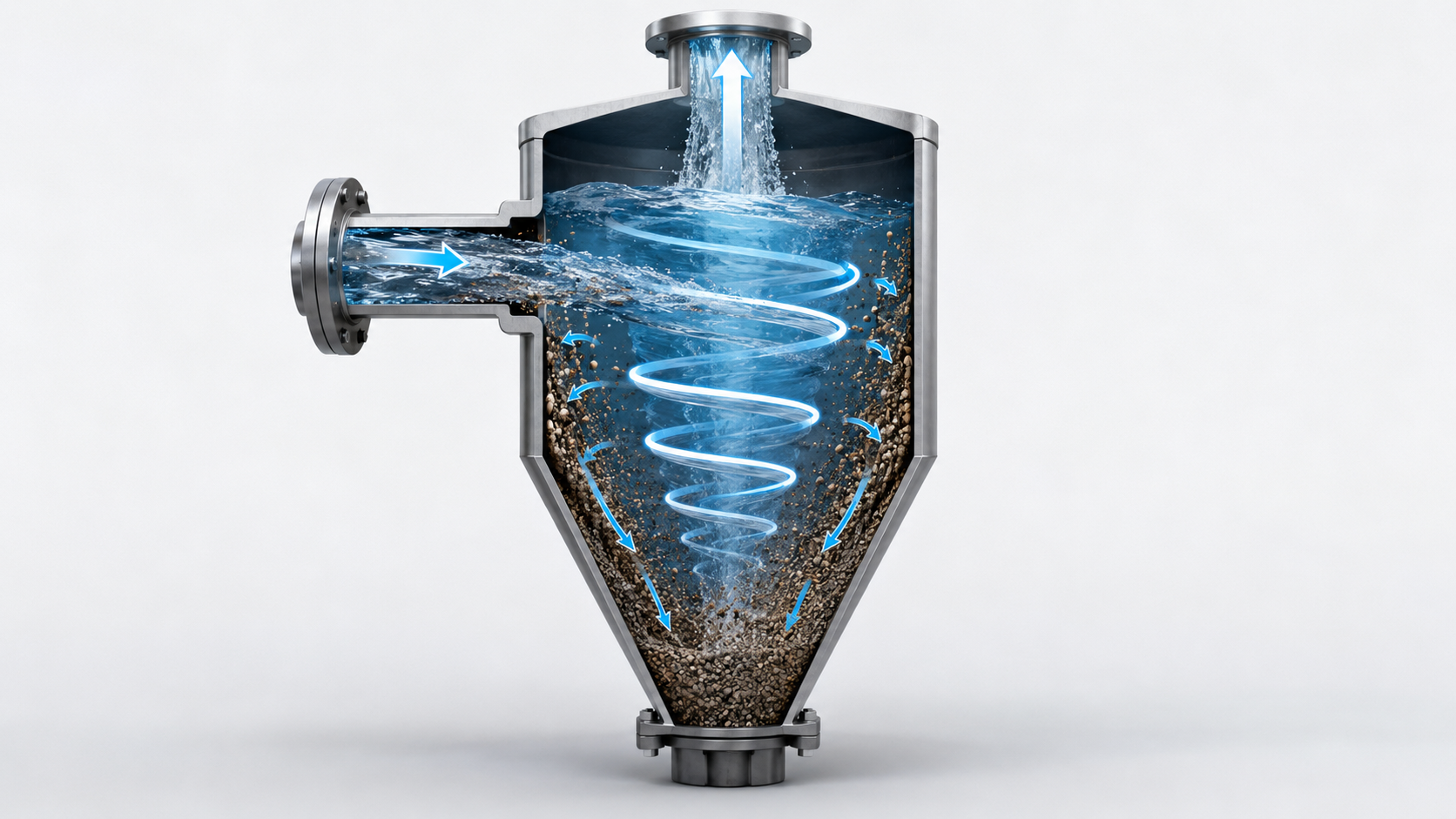
A separator filter is a mechanical pre-separation unit that spins the water inside its body and separates the particles heavier than water by centrifugal effect. The sand and sediment separated out settle into the chamber at the base of the body, while the cleaned water carries on into the system through the top outlet. The particles collected are discharged through the drain valve.
The working principle is not a straining process; that is the point most often confused. There is no screen or porous material inside the unit holding the water back.
The water enters the body tangentially and starts to spin inside it. That spinning motion applies an outward force to the particles heavier than water. The particles move towards the wall of the body and travel downwards into the collection chamber at the base.
At the centre, the water now cleared moves upwards and carries on into the system through the outlet. Two streams are formed in that way: the water going into the system and the particles collecting at the base.
A separator filter therefore contains no consumable. The particles held collect not in a cartridge but at the base of the body and are discharged regularly.
Centrifugal Separation — The Separator
The water spins inside the body; particles heavier than water are thrown outwards and settle to the base. Because no straining is done, no consumable is used, and the solids collected are discharged.
Straining — The Bag Filter
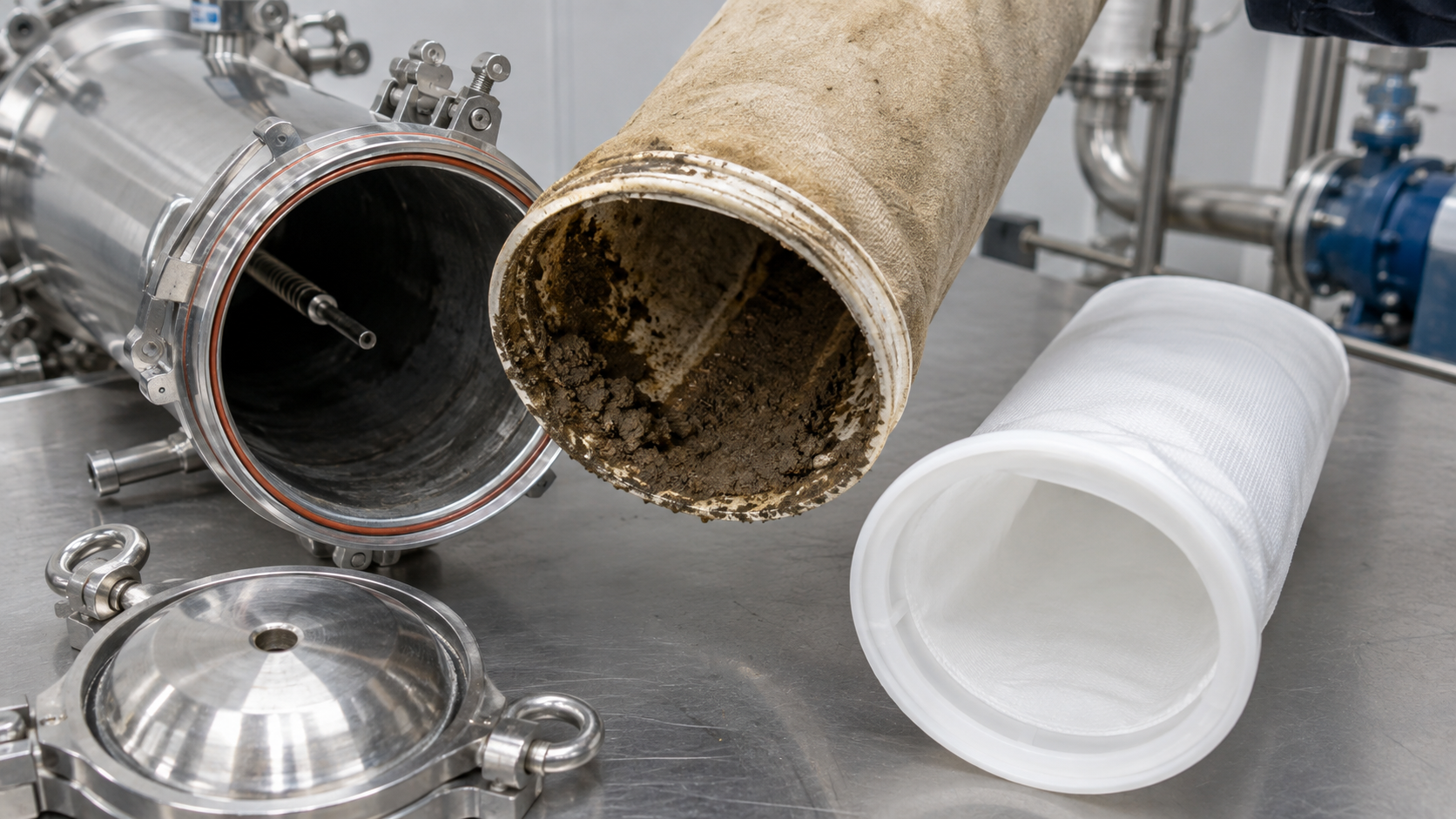
The water passes through the bag; the particles are held on the surface and in the weave of the bag. When the bag saturates it is replaced; that is a consumable.
Why Is a Pre-Separation Stage Needed?
When sand, gravel and coarse sediment reach the main systems, they fill the cartridges quickly, put a load on the pump and wear the membrane and resin surfaces mechanically. A pre-separation stage removes those particles from the system at the very start and so protects every stage behind it.
The basic logic of a treatment chain is to move from coarse to fine. Every stage protects the one after it; when that order is broken, the most expensive components wear first.
What happens where no pre-separation is done is this:
The Cartridges Fill Quickly
The coarse particle load saturates the stages in a short time; the consumables spend rises.
The Pump Is Strained
The rising resistance to flow pushes the pump into running constantly at a high load.
The Membrane Wears
Particles reaching the surface lead to mechanical wear and fouling.
The Resin Is Fouled
Sediment reaching the softening bed lowers the efficiency of the bed.
Valves and Nozzles
Blocking and wear are seen in narrow-bore parts.
Unplanned Stoppages
As maintenance grows more frequent the system stays out of service for longer.
The third card is the most decisive in terms of cost. A relatively low-cost pre-separation unit protects a far more valuable component for years. We took up why the membrane is so sensitive and how its surface wears in our membrane filter article.
On plants using well water that stage is all but essential. We examined which problem in well water is handled by which stage in our treatment stages for well water.
The general framework of filtration stages and the coarse-to-fine chain logic are taken up in the technical literature too; the Pennsylvania state environmental agency conventional filtration training module explains that approach in a general framework.
What Does a Separator Filter Separate?
This unit separates only the solid particles heavier than water: sand, silt, coarse sediment and particles of rust. Because the separation rests entirely on a difference in density, it has no effect on components in solution in the water. That distinction is decisive for setting the right expectation.
The principle itself already defines that limit. A centrifugal effect only works on a substance denser than water. A component in solution has no density of its own; it moves along with the water.
The types of particle it separates are these:
- Sand and gravel: The most common and heaviest group of particles in well water.
- Silt and coarse sediment: Granular material from underground and surface sources.
- Particles of rust: Metal particles breaking away from old plumbing.
- Pieces of scale: Hard residue breaking away from deposits inside the pipe.
- Heavy sediment: Solids markedly denser than water.
That list draws the field of the unit clearly. A separator filter separates that group effectively; the headings outside it are the work of different stages.
Two factors affect the efficiency of separation: the density and the size of the particle. Heavy and coarse particles are separated easily, while a different stage is needed for light and very fine suspended matter.
How Does a Bag Filter Work?
In a bag filter the water is passed through a bag placed inside the body. The particles are held on the surface and in the weave of the bag while the cleaned water leaves the body. When the bag saturates it is replaced; so it is a stage that contains a consumable.
The principle is direct straining. The weave of the bag the water passes through forms a barrier; the particles that cannot pass through the weave collect inside.
That is the basic point where it differs from the separator: here the separation rests not on a difference in density but on a physical barrier. And that lets it cover a different range of particles.
The working character of a bag filter is defined by these headings:
Direct Straining
The water passes through the bag; the particles that cannot pass through the weave are held.
A Variable Particle Range
It can hold particles of low density and finer ones too.
A Consumable
The bag is renewed when it saturates; that makes a regular expense.
The Pressure Difference
As the bag fills, the inlet-to-outlet pressure difference rises; that is the indicator to follow.
Visual Inspection
When the bag is taken out, the material held can be seen directly.
A Compact Body
It gives a high particle-holding capacity in a relatively small volume.
Changing the bag is a simple operation in operating terms; but when it is not done regularly the flow is restricted and the system pressure falls. So the monitoring is carried out through the pressure difference.
The Difference Between a Separator Filter and a Bag Filter
The two units work on different principles. The separator separates the particles heavier than water by centrifugal effect and contains no consumable; the solids collected are discharged. The bag filter strains, and the saturated bag is replaced periodically. That difference settles the operating load and the field of use.
The table below compares the two units heading by heading:
| Criterion | A Separator Filter | A Bag Filter |
|---|---|---|
| The working principle | Separation by centrifugal effect | Direct straining |
| The particles it holds | Heavier than water, coarse and granular | A wider range of sizes |
| Consumables | None | The bag is changed periodically |
| How it is discharged | Emptying through the base valve | Taking out and renewing the bag |
| Behaviour of flow | The solids held do not restrict the flow directly | Resistance rises as the bag fills |
| Maintenance load | Regular discharging is needed | Changing the bag and tracking stock are needed |
| Fluctuating load | It suits a continuously high sand load | It is practical at a variable and low load |
| The indicator to follow | How full the chamber is | The inlet-to-outlet pressure difference |
The “consumable” row in that table is the most decisive in terms of operating cost. When a bag filter is used on a well with a high sand load, the bag is changed very often; that creates both spending and labour.
The “behaviour of flow” row matters operationally. In a separator the solids held collect at the base and do not narrow the path of flow directly; in a bag filter the resistance rises as it fills and the system pressure is affected.
At a coarse and continuous load
On sources with a high sand load, it is a stage expected to run continuously without a consumables spend.
- It contains no consumable
- It meets a high sand load
- It is emptied by discharging
- It sits at the very start of the chain
At a variable and fine load
On lines where the particle load is low or variable, it is a stage covering a wider range of sizes.
- It holds finer particles
- It works with a compact body
- It calls for the bag to be changed
- It is followed through the pressure difference
That comparison is not a ranking of superiority. The two units address different problems; which one suits is established by the type of particle, the load and the flow.
Which Is Used When?
On wells where the sand load is high and continuous, the separator is preferred; because it runs without a consumable its operating load is low. On lines where the particle load is variable or finer, a bag filter is used. Where the load is both high and varied, the two units are built in sequence.
The decision is made with three questions: how coarse are the particles, how heavy is the load, and how continuous is it?
The typical scenarios separate out like this:
| Situation | The Leading Solution | The Reason |
|---|---|---|
| Heavy sand is coming from the well | The Separator | It gives continuous separation without a consumables spend |
| The particles are fine and light | A bag filter | The centrifugal effect is limited on light particles |
| The load varies with the season | A bag filter | It adapts to a variable load |
| There is both a coarse and a fine load | A separator plus a bag | The coarse load is separated and the remaining fine load strained |
| High flow, continuous running | The Separator | It works without restricting the flow |
| A short period, low flow | A bag filter | It is a compact and practical answer |
The fourth row is the build met with most often in practice. The separator takes the coarse load and markedly reduces the amount of particles reaching the bag; and that lowers how often the bag is changed.
That pair is common on irrigation and greenhouse sites; the particle load has to be reduced in stages to protect the drip lines. We took the subject up in our irrigation water treatment article; for greenhouse applications you can look at the greenhouse water treatment systems can be consulted.
On production plants, pre-separation is assessed for protecting the process line. We took up the general framework in our process water article.
Its Relationship With the Sand Filter
The separator is the coarsest stage; a bed-type sand filter is the next step, holding finer particles. The right order runs from coarse to fine: first centrifugal separation, then bed filtration, then the cartridge stages, and advanced treatment last.
Those two units are not alternatives to one another; they are different links in the same chain. When they are confused, either the coarse load reaches the bed or an unnecessary stage is added.
A typical chain is built like this:
The Separator
Sand and coarse sediment are separated by centrifugal effect and collect at the base.
Bed Filtration
Finer suspended matter is held inside the bed.
The Cartridge Stages
The remaining particles and the sensory load are dealt with.
Advanced Treatment
Separate stages come into play for hardness and dissolved solids.
We took up how bed filtration works, the logic of backwashing and when it is preferred in our sand filter article; we do not go into the detail of the bed here.
On sources with a high particle load, automatic backwash units are preferred; the industrial automatic sand systems used for that need make the step after the separator.
Breaking the order produces this result in practice: when coarse sand reaches the bed directly, the surface of the bed blocks quickly and the backwash grows more frequent. With a separator filter positioned in front, that load largely disappears.
What Does a Separator Filter Not Remove?
This unit removes none of the components in solution in the water. It has no effect on hardness, chlorine, odour, the dissolved solids load or metal ions. Those headings call for separate stages such as softening, activated carbon or reverse osmosis.
This section was written to prevent buying with the wrong expectation. The field of the unit is clear and its limits are just as clear.
It works on this side
- Sand and gravel
- Silt and coarse sediment
- Particles of rust and scale
- Solids heavier than water
It does not work on this side
- Hardness (calcium, magnesium)
- Chlorine, odour and taste components
- Dissolved solids load
- Metal ions in solution
The right-hand column is the list to know before buying. A plant with a limescale problem that fits a separator filter and expects the problem to be solved will get no result; removing hardness is the work of an entirely different stage.
In the same way activated carbon is needed for chlorine-related taste and odour, and reverse osmosis for the dissolved solids load. Those stages do not take the place of pre-separation, and pre-separation does not take theirs.
This unit is a pre-separation stage; it sits at the start of the treatment chain and protects the stages behind it. It does not change the chemical content of the water. Which stages are needed is established from the water analysis and the purpose of use.
Maintenance and Operation
On a separator, maintenance consists of discharging the collection chamber at the base regularly. On a bag filter the bag has to be changed periodically. Both units are followed through the inlet-to-outlet pressure difference; the frequency is set by the particle load.
The maintenance character of the two units differs markedly, and that difference bears directly on planning the operation.
-
Empty the Drain Valve Regularly
The solids collecting in the separator are discharged through the base valve. The frequency is set by the particle load; on sources with a high sand load it is done more often.
-
Watch How Full the Chamber Is
When the chamber fills, the efficiency of separation can fall. So discharging should be tied to a routine, with a calendar used rather than observation.
-
Follow the Pressure Difference
The difference between inlet and outlet is the most practical data showing the state of the system. A rise in the difference points to saturation on a bag filter.
-
Renew the Bag on Time
A saturated bag restricts the flow and lowers the system pressure. When the change is put off, the stages behind are affected too.
-
Check the Body and the Gaskets
The cover gasket is reviewed while the bag is being changed. A tired gasket leads to leaks.
-
Keep Records
When the discharge and bag change dates are recorded, the period becomes predictable and planning gets easier.
It is not possible to give an exact period; the frequency varies with the particle load of the inlet water and the working flow. The same unit calls for an entirely different maintenance rhythm on a different well.
The drain connection is part of the planning too. The discharge line of the separator should be led to a point where emptying can be done practically; otherwise the operation becomes difficult and gets put off.
Let’s establish the pre-separation unit that suits your line
You can assess your build by looking at the options that suit your particle load and your flow.
See the Industrial SolutionsHow Is the Right Unit Chosen?
Six headings are assessed in the choice: the working flow, the particle load and size range, the connection size, the body material, the discharge and drain access, and the installation space. The exact sizing is done from the water analysis and the working conditions of the line.
A unit sized wrongly produces two different problems: chosen too small, the separation efficiency falls; chosen too large, the flow speed inside the body may not create enough centrifugal effect.
The headings to assess are these:
- The working flow: The unit should be chosen to suit the real flow of the line.
- The particle profile: Whether the load is coarse or fine determines which unit suits.
- The connection size: The inlet and outlet connections must be compatible with the existing line.
- The body material: It should suit the working conditions and the environment of use.
- Access for discharging: Reaching the emptying point and the drain connection should be planned.
- The installation space: Enough room should be left for the unit and for working on it.
In practice the build takes shape around the need. For a coarse and continuous sand load, separator filter systems are preferred, and for a variable and finer particle load, bag filter units.
Water Point Su Arıtma Teknolojileri operates from Esenyurt, İstanbul under its founder Ali Genç, with more than 20 years of experience in the sector.
The Distinction Between Consumables and Spare Parts
Filters, membranes, resin and salt are consumables; valves, pumps and tanks are durable spare parts.
Warranty
Units, valves, pumps and tanks carry a 2-year warranty and taps a 1-year warranty. Filters, membranes, resin and salt are consumables and fall outside the warranty.
Delivery
Products in stock are dispatched within 1–3 working days; products not in stock are ordered in and the lead time confirmed. Free shipping applies across Türkiye.
Scope of Installation
The unit is delivered ready to install; the inlet and outlet connections are made. The plumbing labour and materials are the customer’s responsibility. Where a valve setting is needed, free support is given over a video call.
Contact
For orders and information by phone, 0850 304 95 25; to speak to a specialist, the 0536 729 99 52 WhatsApp line and [email protected] can be used.
Looking at the size of the body alone is misleading when choosing a unit. What is decisive is the match between the flow of the line and the particle profile; so the choice is made from the water analysis and the working conditions.
Frequently Asked Questions
How does a separator filter work?
The water enters the body tangentially and starts to spin. Particles heavier than water move towards the wall of the body by centrifugal effect and settle into the chamber at the base. The cleaned water carries on through the top outlet, and the solids collected are emptied through the drain valve.
Does it have a consumable?
No. Because this unit does no straining, it contains no consumable such as a cartridge or a bag. The particles held collect at the base of the body and are emptied by regular discharging. The maintenance load consists of that discharging.
Does it remove limescale and hardness?
No. This unit separates only the solid particles heavier than water; it has no effect on the components in solution. Softening is needed for hardness, activated carbon for chlorine and odour, and reverse osmosis for the dissolved solids load.
Should I choose a bag filter or a separator?
It depends on the particle profile. On sources where the sand load is high and continuous, the separator comes to the front because it runs without a consumables spend. If the load is fine and variable, a bag filter suits better. Where there is both a coarse and a fine load, the two units are used in sequence.
Can they be used together?
Yes, it is a common build. The separator separates the coarse load and markedly reduces the amount of particles reaching the bag; and that lowers how often the bag is changed. The order is always built from coarse to fine.
Does it take the place of a sand filter?
No, the two are different links in the same chain. The separator is the coarsest stage; a bed-type sand filter holds finer suspended matter. When the separator is positioned in front, the load on the bed falls and the backwash grows less frequent.
How often should it be discharged?
There is no fixed period; the frequency varies with the particle load of the inlet water and the working flow. On sources with a high sand load, emptying is needed more often. The practical approach is to tie the discharging to a routine and record the dates.
Why is the pressure difference followed?
The difference between inlet and outlet is the most practical data showing the state of the system. On a bag filter a rise in the difference points to saturation and shows when it is time to change. That monitoring gives the chance to act before the flow is restricted.
What capacity of unit is needed?
The capacity is established by assessing the working flow of the line, the particle load and size range, and the connection size together. The exact sizing is done from the water analysis and the working conditions; working from the line data rather than choosing from a catalogue is advised.
Conclusion
A separator filter is a mechanical pre-separation unit sitting at the very start of the treatment chain. It spins the water inside its body, separates the particles heavier than water by centrifugal effect and collects them at the base; because it does no straining it contains no consumable, and the solids collected are emptied by discharging. A bag filter works on the principle of direct straining, holds a wider range of sizes, and its saturated bag is replaced periodically. The choice is made on the particle profile: at a high and continuous sand load the separator comes to the front, at a fine and variable load the bag filter; the two can also be built in sequence. Both units deal only with solid particles — separate stages are needed for hardness, chlorine and the dissolved solids load. And the right build starts with an unchanging rule: the chain is always built from coarse to fine.
Let’s establish the unit that suits your flow and your particle load
Products in stock are dispatched within 1–3 working days; free shipping applies across Türkiye. For a pre-separation build that suits your line you can reach us on 0850 304 95 25, on the 0536 729 99 52 WhatsApp line to speak with a specialist, or at [email protected].
Discover the Solution That Suits You