
Why Does a Water Purifier Send Water to Drain? The Waste Water Ratio
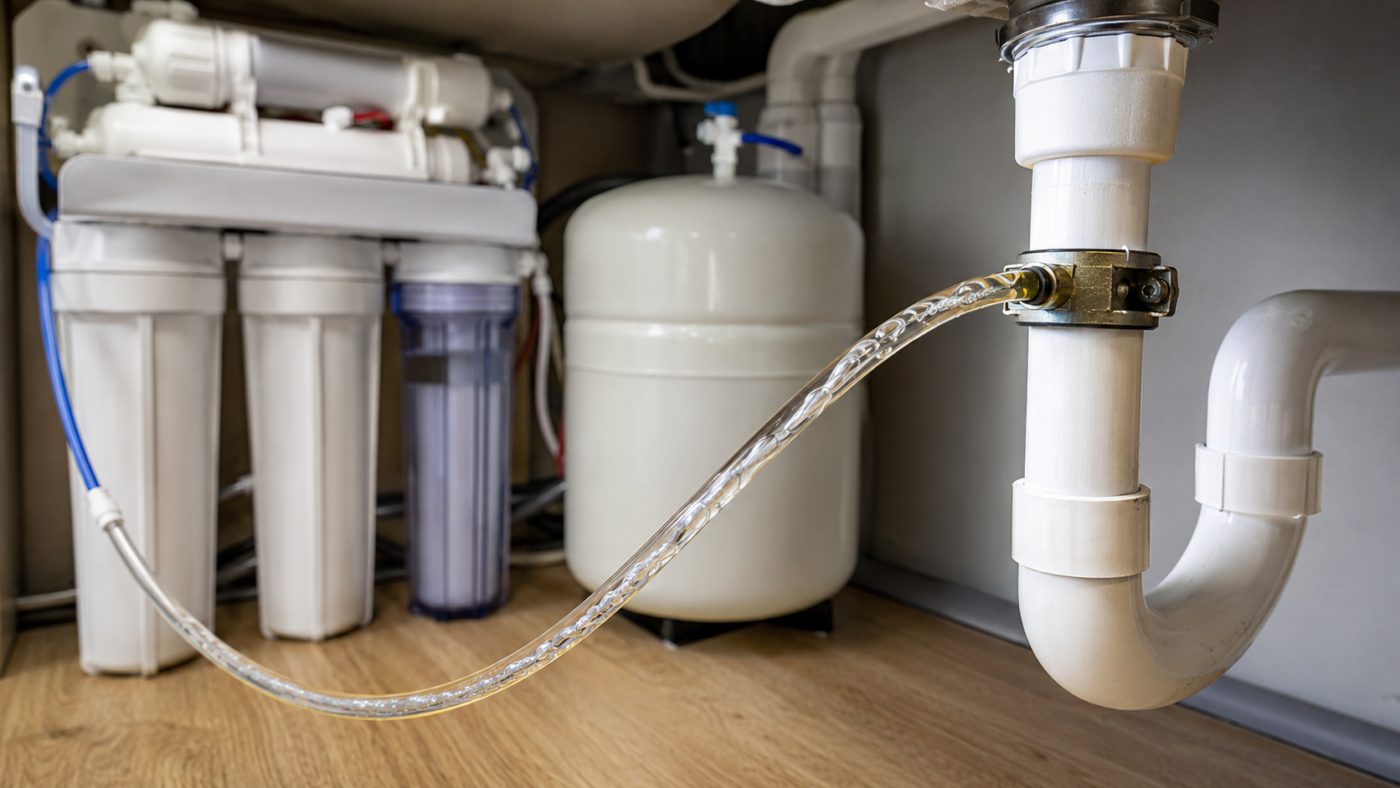
You open the kitchen cupboard and hear water running to the drain. The first thought is usually the same: has the unit broken down, is water being wasted? The worry is understandable, but in most cases nothing is faulty. Reverse osmosis systems produce two separate streams while they work, and one of them goes to drain. The concept that describes the size of that stream is the waste water ratio.
This article takes the subject on honestly. The reality of waste water is not played down: reverse osmosis produces a concentrate stream by the very way it works, and we say so plainly. Nor do we alarm you: the ratio is not fixed, and pressure and maintenance can improve it markedly. We also show, step by step, how to tell normal operation from a genuine fault.
Why Does a Water Purifier Send Water to Drain?
The reverse osmosis membrane splits water into two streams: the treated water that passes through the membrane, and the concentrate that carries the dissolved solids that cannot. The water going to drain is that concentrate. Because the salts building up on the membrane surface have to be swept away continuously, this stream is an inseparable part of how the system works.
The thing to grasp is this: a membrane does not work like a sieve. While it passes water, it has to send the substances it holds back somewhere. If the dissolved solids it retains were left to collect on the surface, the membrane would block within a short time and production would stop altogether.
The concentrate stream does exactly that job. Flowing along the membrane surface, it picks up the salts collecting there and carries them out of the system. The water going to drain is, before it is a waste item, a protection mechanism.
That is why a “reverse osmosis system that produces no waste water at all” is not technically possible. The right question is not “is there waste water” but “waste water ratio at what level, and can it be improved”. The whole of this article is the answer to that second question.
Is Waste Water a Sign of a Fault?
In normal operation waste water is expected and is not a sign of a fault. But this flow occurs while water is being produced; on systems with a storage tank it should stop once the tank is full. A flow that never stops points to a different problem and needs checking.
This distinction is where users get most confused. The two situations sound similar, but technically they are completely different.
| Situation | When It Is Seen | Assessment |
|---|---|---|
| Flow while producing | While the tank fills or the tap is open | Normal operation; it is inherent in how the system works |
| Flow that stops after a short time | It stops when the tank is full | Expected behaviour; there is no problem |
| Intermittent flow | It starts again as water is used | Normal; the system is refilling the tank |
| Flow that never stops | It does not stop even when the tank is full | A check is needed; technical service should assess it |
| Noticeably increased flow | Waste rises while production slows | It may come from pressure, filters or the membrane |
The first three rows of the table describe normal operation. The last two are the ones that need looking into. Being able to tell them apart saves both an unnecessary service call and unnecessary worry.
There is one more detail to watch: waste water ratio can change over time. A system may behave as expected when first installed and the ratio start to slip months later. That change is usually to do with maintenance or with pressure; we take both up in the sections that follow.
How Do the Two Streams Arise in Reverse Osmosis?
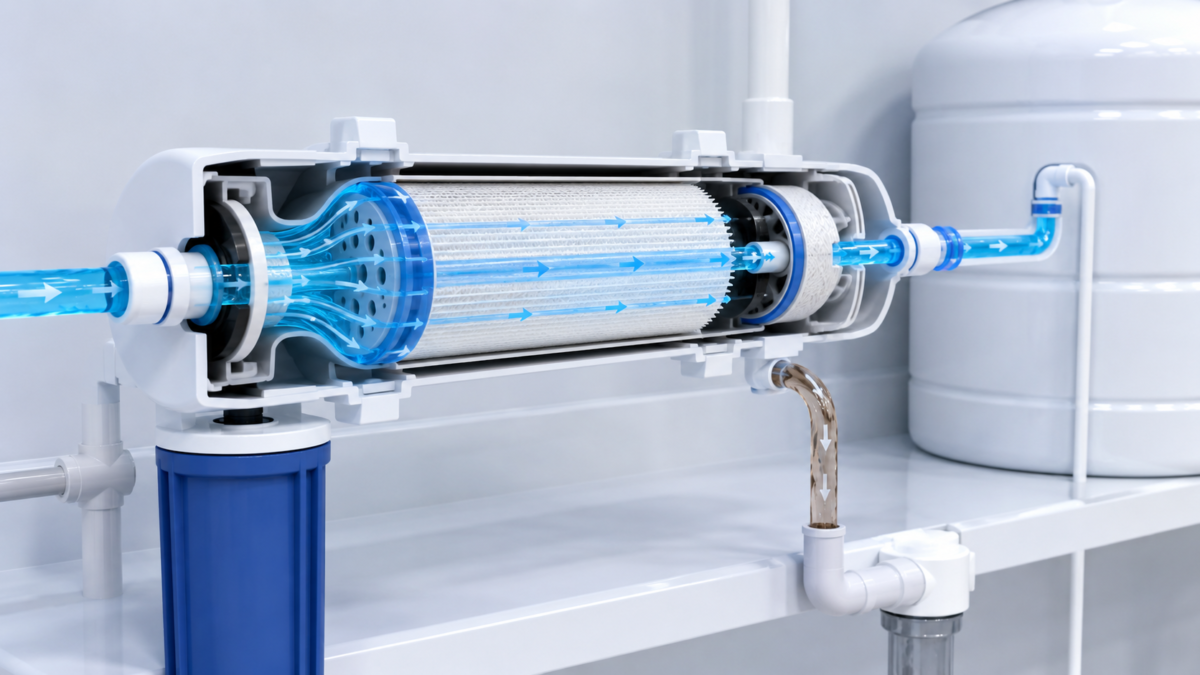
Water sent to the membrane under pressure splits in two. Part of it passes through the membrane layer and heads for the treated water line; the rest carries the dissolved solids that were held back and leaves through the concentrate line. The concentrate is a functional stream that keeps the membrane surface clean and delays fouling.
Picturing the process makes it clearer:
Treated Water
The water that passes the membrane. With its dissolved solids load reduced by up to 99%, it heads for the tank or the tap.
Concentrate (Waste Water)
The water that cannot pass the membrane. Carrying the salts held back, it sweeps the surface and leaves the system through the drain line.
It is worth stressing that this split is a physical necessity. The membrane is a selective barrier; while it passes water, it holds back dissolved solids. What it holds back has to collect somewhere, and that somewhere is the membrane surface. The concentrate stream clears that build-up continuously.
What happens if the stream is cut? The salt concentration at the surface rises quickly, crystals start to form and the membrane blocks within a short time. In system design, therefore, the concentrate line is not an optional component but a compulsory part.
We explained the whole mechanism step by step in our how reverse osmosis works article. We looked at the structure of the membrane and why it is so sensitive in detail in our membrane filter article.
What Does the Waste Water Ratio Mean?
The waste water ratio expresses how much water goes to drain against the treated water produced. The lower the ratio, the more efficiently the system is working; the higher it is, the more water is consumed for the same amount of treated water. The value is not fixed and changes with operating conditions.
The logic of the idea is simple: how many units of water go to drain to produce one unit of treated water? That relationship is the basic indicator of a system’s efficiency, and in the technical literature it is assessed alongside the recovery rate.
Care is needed with numerical values. The ratios in circulation vary widely with system type, design and operating conditions, so presenting a single figure as a universal truth would be misleading.
As an international reference point, the WaterSense programme of the US Environmental Protection Agency looks at under-sink reverse osmosis systems from this angle. According to the programme’s point-of-use reverse osmosis systems resource, conventional under-sink systems can send several times as much water to drain as the treated water they produce, while in more efficient designs that ratio can be brought down markedly.
The information above is a general assessment published by the US EPA under its WaterSense programme; it is not a performance figure for any particular product. A system’s actual waste water ratio is determined by the pressure where it is installed, the inlet water quality and the system design.
What matters to the user, therefore, is not the catalogue figure but the operating conditions of their own system. The waste water ratio gives a different result on the same unit with different pressure and different inlet water quality.
Factors That Affect the Waste Water Ratio
The main factors that set the ratio are: inlet pressure, the dissolved solids load and hardness of the inlet water, water temperature, the condition of the membrane, whether the flow restrictor is the right one, and the overall design of the system. These variables work together; when one of them goes wrong, so does the ratio.
The table below sums up the effect of each factor:
| Factor | Its Effect | Direction |
|---|---|---|
| Inlet pressure | Determines how much water passes the membrane | The lower the pressure, the worse the ratio |
| Dissolved solids load | Raises the resistance the membrane has to overcome | The higher the load, the higher the ratio |
| Hardness | Affects the tendency to scale on the surface | High hardness affects the ratio adversely |
| Water temperature | Affects membrane permeability | Production slows in cold water |
| Membrane condition | A tired module produces less | Ageing upsets the ratio |
| Pre-filters | Determine the pressure reaching the membrane | Blockage raises the ratio |
| Flow restrictor | Sets the volume of the concentrate flow | A mismatched choice upsets the ratio |
| System design | How the stages are arranged and whether the capacity matches | The wrong build affects the ratio permanently |
Most of these factors affect one another. A blocked pre-filter, for example, lowers the pressure reaching the membrane; the fallen pressure then reduces production and raises the waste water ratio value. One neglected service, in other words, shows up at the end of the chain as lost efficiency.
Inlet water quality is decisive too. On water with a high dissolved solids load, the resistance the membrane has to overcome rises, and less treated water is produced at the same pressure. We covered what that measure tells you in our TDS and dissolved solids article.
Temperature, meanwhile, has a seasonal effect. When the inlet water cools in winter, production slows and users read it as “the unit has weakened”. In fact this is temporary and expected behaviour.
How Does Low Pressure Raise the Waste Water Ratio?
Reverse osmosis works on pressure. When the pressure falls, less treated water passes the membrane, while the concentrate flow continues. As a result more water goes to drain for the same amount of treated water and the waste water ratio rises markedly. This is one of the most common causes.
The mechanism is intuitive. The membrane needs a driving force to pass water. When that force is sufficient the water crosses to the other side; when it falls short, most of it heads for the concentrate line.
The source of low pressure falls into two groups. The first is outside the unit: low mains pressure, the height difference on upper floors, or restrictions in the plumbing. The second is inside the unit: blocked pre-filters, a partly closed valve or a crushed hose.
We took up step by step how to tell the two apart and how pressure problems are diagnosed in our pressure and pumps article. The short method is this: if the flow is weak at the other taps in the house too, the problem is on the plumbing side; if only the treatment line is weak, look at the unit.
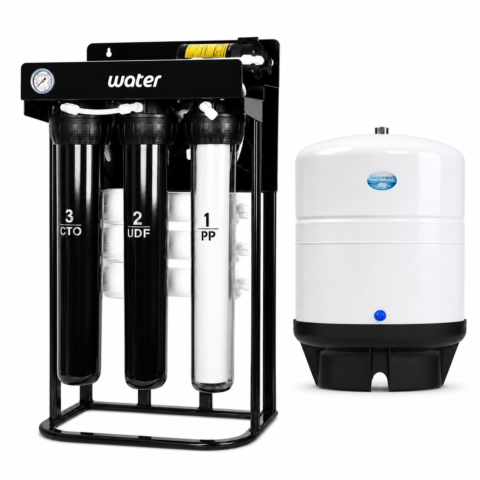
In homes where mains pressure falls short, the answer is a booster pump. Raising the pressure at the inlet of the unit, RO pumps let the membrane work efficiently and improve the waste water ratio value. As well as raising production, a pump is the most direct way of bringing the ratio back into balance.
Fitting a pump involves an electrical connection and work on a pressurised line. It should be carried out by an authorised technical service; attempting it yourself is not recommended.
The Effect of Blocked Filters and a Tired Membrane
Pre-filters fill over time and raise the resistance to flow; that lowers the pressure reaching the membrane and upsets the ratio. A tired membrane, having lost its permeability, reduces production. In both cases the water going to drain looks greater in proportion to the treated water produced.
This section shows the direct relationship between maintenance and efficiency. A filter change is not only about water quality; it also determines how much water the system consumes.
The process advances by degrees, which is why it is hard to notice:
-
The Stages Begin to Fill
The sediment and carbon stages saturate over time; the resistance to flow starts to rise quietly.
-
The Pressure Reaching the Membrane Falls
As resistance rises the pressure at the membrane inlet drops; the driving force weakens.
-
Production Slows
Less water passes the membrane; the tank takes longer to fill.
-
The Ratio Slips
Because the concentrate flow continues while production falls, the share going to drain grows.
-
The User Notices
It is usually at this stage that the complaint “the unit isn’t working like it used to” appears.
The starting point of that chain is maintenance. When the stages are renewed on time the pressure is preserved and the waste water ratio stays at the expected level. We covered how to plan a maintenance routine in our filter change guide; when the time comes, the whole line can be refreshed with a spare filter set suited to the stage layout.
On the membrane side, the telling indicator is the outlet quality. If only production has slowed, the problem is usually in the pre-filters or the pressure; if production has fallen and the reading on the treated water has risen permanently as well, the membrane should be assessed. In domestic systems, the standard-size membrane modules are renewed in that case.
Continuous Flow: When Is There a Problem?
On systems with a storage tank, production and therefore the waste water flow should stop once the tank is full. If the flow never stops, the problem may lie with the shut-off valve, the check valve, the tank air pressure or the flow restrictor. The system should then be assessed by technical service.
This section is for telling a genuine fault from normal operation. The table below matches what you observe with the likely cause:
| Symptom | Likely Cause | What Should Be Done |
|---|---|---|
| Tank full, flow does not stop | The shut-off valve may not be engaging | A technical service check is needed |
| Flow continues while the tap is closed | The check valve may be leaking | Technical service should assess it |
| Tank full but flow weak | The tank air pressure may have dropped | It should be measured by the service |
| Waste flow has risen markedly | The flow restrictor is mismatched or faulty | The system design should be reviewed |
| Production slow, waste normal | Pressure or a blocked filter | The valve, hose and filter age are checked |
| Production low and quality poor | The membrane may be tired | The condition of the membrane should be assessed |
What the user can check runs to looking things over: whether the inlet valve is fully open, whether any hose is crushed, and when the filters were last changed. Everything beyond that — the valve, check valve, tank pressure and flow restrictor — is a job for technical service.
Where the flow never stops, the valve at the inlet of the unit can be closed as a temporary measure; but that is not a solution, only a step to stop losing water until the service arrives. In that scenario the waste water ratio calculation loses its meaning too, because the system may be consuming water without producing any.
If the flow does not stop, have the system checked
You can look at the reverse osmosis solutions to assess problems arising from pressure, the membrane or the system design.
See the Reverse Osmosis SolutionsHow Can the Waste Water Ratio Be Improved?
Improvement comes under six headings: providing a suitable inlet pressure, keeping up with pre-filter maintenance, choosing the capacity to suit the use, designing the system around the water analysis, monitoring the membrane and checking the flow restrictor. When these conditions are met, the ratio moves towards the system’s design range.
The order of the work matters too; start with the easiest and most effective step:
Get the Pressure Right
If the inlet pressure falls short, a pump build is assessed; this has the most direct effect on the ratio.
Keep Up the Maintenance
Pre-filters renewed on time preserve the pressure and keep efficiency at the design level.
Match the Capacity
A capacity suited to the use stops the system being strained constantly and keeps it working in balance.
Design Around the Analysis
Stages suited to the inlet water profile reduce the load on the membrane from the start.
Watch the Membrane
When production speed and outlet quality are followed, ageing is noticed early.
Confirm the Restrictor
A flow restrictor that matches the system keeps the concentrate flow in balance.
Of these six headings, the first two give the quickest results on the user’s side. Once the pressure problem is fixed and maintenance is put on a routine, the waste water ratio improves markedly on most systems.
System design, meanwhile, is a heading settled at the point of purchase. Where the inlet water has a high dissolved solids load, placing suitable stages ahead of the membrane both raises efficiency and extends the life of the module. That build is decided from the result of the water analysis.
To be realistic: waste water ratio cannot be brought to zero. The aim is not to eliminate the ratio but to keep the system within its design range. Promises beyond that are technically unfounded.
Can the Water Going to Drain Be Put to Use?
The concentrate carries more dissolved solids and more hardness than the inlet water. It is therefore not used for drinking or food. Collecting it at household scale is generally impractical; at industrial scale, recovery can be considered as a separate project heading.
Honesty is needed in this section. The concentrate is not “dirty water”; it is a stream in which the dissolved solids of the inlet water are concentrated. That concentration naturally limits where it can be used.
The idea of collecting it at home comes up often. In practice there are several obstacles: the flow is not continuous, managing a collection vessel is a nuisance, and the content of the water varies with the inlet water. In most homes, therefore, collecting it does not repay the effort.
Using the concentrate to water plants is often suggested; but this water carries more dissolved solids and more hardness. Salinity is a decisive parameter in irrigation water. Such use is therefore not recommended without a water analysis and without consulting a specialist in the field.
At industrial scale the picture changes. On high-flow systems the concentrate is a continuous and predictable stream, and that makes recovery engineering possible. Treated through suitable stages, the water can be reused within the plant in processes such as cooling or washing.
We took up separately how industrial recovery is built and which stages it consists of in our wastewater treatment article; at plant scale this is a separate engineering heading.
Frequently Asked Questions
My unit is constantly sending water to drain — is that normal?
Waste water flow while producing is normal. On systems with a storage tank, the flow should stop once the tank is full. If it never stops, the problem may lie with the shut-off valve, the check valve or the tank pressure; the system should then be assessed by technical service.
What is the waste water ratio and how is it calculated?
It expresses how much water goes to drain against the treated water produced. The lower the ratio, the more efficiently the system works. The value is not fixed; it changes with factors such as inlet pressure, dissolved solids load, water temperature and the condition of the membrane.
Is the waste water drinkable?
No, this water is not suitable for drinking or food use. The concentrate is a stream in which the dissolved solids of the inlet water are concentrated, so it is not considered as drinking water.
Can I give the waste water to my plants?
This water carries more dissolved solids and more hardness than the inlet water. Salinity is a decisive parameter in irrigation water and varies with the plant. Such use is therefore not recommended without a water analysis and without consulting a specialist in the field.
How much does waste water affect the bill?
The effect varies with the system’s ratio, the amount of treated water used each day and the tariff. Giving a general figure would not be right. Keeping the pressure suitable and not neglecting maintenance are the two most effective ways of keeping consumption under control.
How is the waste water ratio reduced?
First the inlet pressure is brought to a suitable level; if necessary a pump build is assessed. Then pre-filter maintenance is put on a routine. Choosing the capacity to suit the use and designing the system around the water analysis also improve the ratio directly.
Is there a unit that produces no waste water at all?
On systems working by reverse osmosis the concentrate stream is compulsory; it is what keeps the membrane surface clean. A reverse osmosis system that produces no waste water is therefore not technically possible. The aim is to keep the ratio within the system’s design range.
Why does waste water seem to rise in winter?
Membrane permeability falls in cold water and production slows. Because the concentrate flow continues, the share going to drain looks proportionally larger. This is temporary and expected behaviour; production returns to normal as the temperature rises.
Does fitting a pump improve the ratio?
If the problem really is inadequate pressure, it brings a marked improvement. But where a blocked filter or a tired membrane is involved, a pump masks the real problem rather than solving it. Diagnose first, then decide on a pump.
Conclusion
The water running to the drain is, most of the time, not a fault but the result of how reverse osmosis works. The membrane splits the water in two: part of it goes to use as treated water, and the rest carries away the dissolved solids held back, keeping the membrane surface clean. Without that second stream the system would block within a short time. The waste water ratio, on the other hand, is not a fixed value; inlet pressure, filter maintenance, the condition of the membrane and the system design all determine it directly. The way to improve it is clear too: provide a suitable pressure, keep up the maintenance, match the capacity to the use, and build the system around the water analysis. If the flow never stops, that is a different heading and should be assessed by technical service.
Let’s assess problems arising from pressure, the membrane or the design together
The site survey is free if the unit is purchased from us; where only a survey and measurement are wanted, a survey fee of ₺2,000 applies. To have the efficiency of your system assessed, you can get in touch on 0850 304 95 25 or at [email protected].
Explore the Reverse Osmosis Systems