
Water Dispenser Maintenance: A Routine That Works
The dispenser that has stood in the corner of the office for years is used every day; but nobody takes on its maintenance. No one remembers when its filters were changed, the drip tray is usually full, and even though the taste of the water has changed over time nobody notices. The source of the problem is a simple assumption: that a dispenser is a “fit it, switch it on, forget it” appliance. Yet maintaining a water dispenser is the basic work that keeps the performance of the unit and the quality of the water going.
In this guide we take up which parts of a dispenser call for maintenance, which operations the user can carry out, which fall within the scope of technical service, and how to set up a maintenance plan in a business. The aim is not to create anxiety but to define a regular, workable routine.
Why Is Maintaining a Water Dispenser Necessary?
Maintaining a water dispenser keeps the filters doing their job and the surfaces the water touches clean. Done regularly, the performance of the unit is preserved and the taste and odour of the water stay steady. Neglected, problems such as a change in taste, a drop in flow and a loss of efficiency appear.
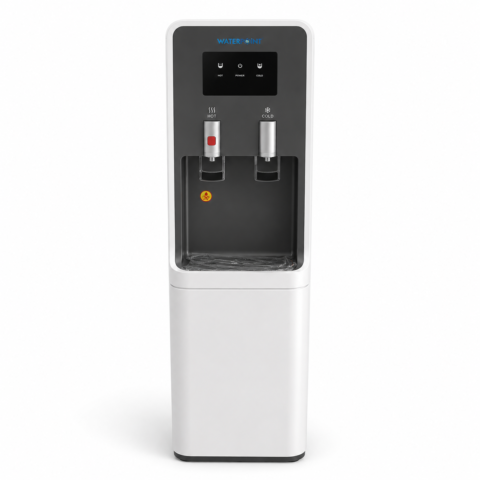
From outside a dispenser looks like a simple appliance. Yet inside it there is a filter line, a reservoir, cooling and heating units and the internal lines the water passes through. Every one of those components is in regular contact with water.
The first aim of maintenance is to preserve performance. When the filters have used up their capacity they stop removing taste and odour; the user usually notices that as “the water tastes different”. The second aim is keeping the surfaces clean; when the parts the water touches are cleaned regularly, hygienic use is maintained.
For a general framework on preserving water quality inside a building, the US Environmental Protection Agency guidance on maintaining water quality in buildings can be consulted; the source stresses the importance of regular maintenance at points of use.
How Do You Clean a Water Dispenser? Step by Step
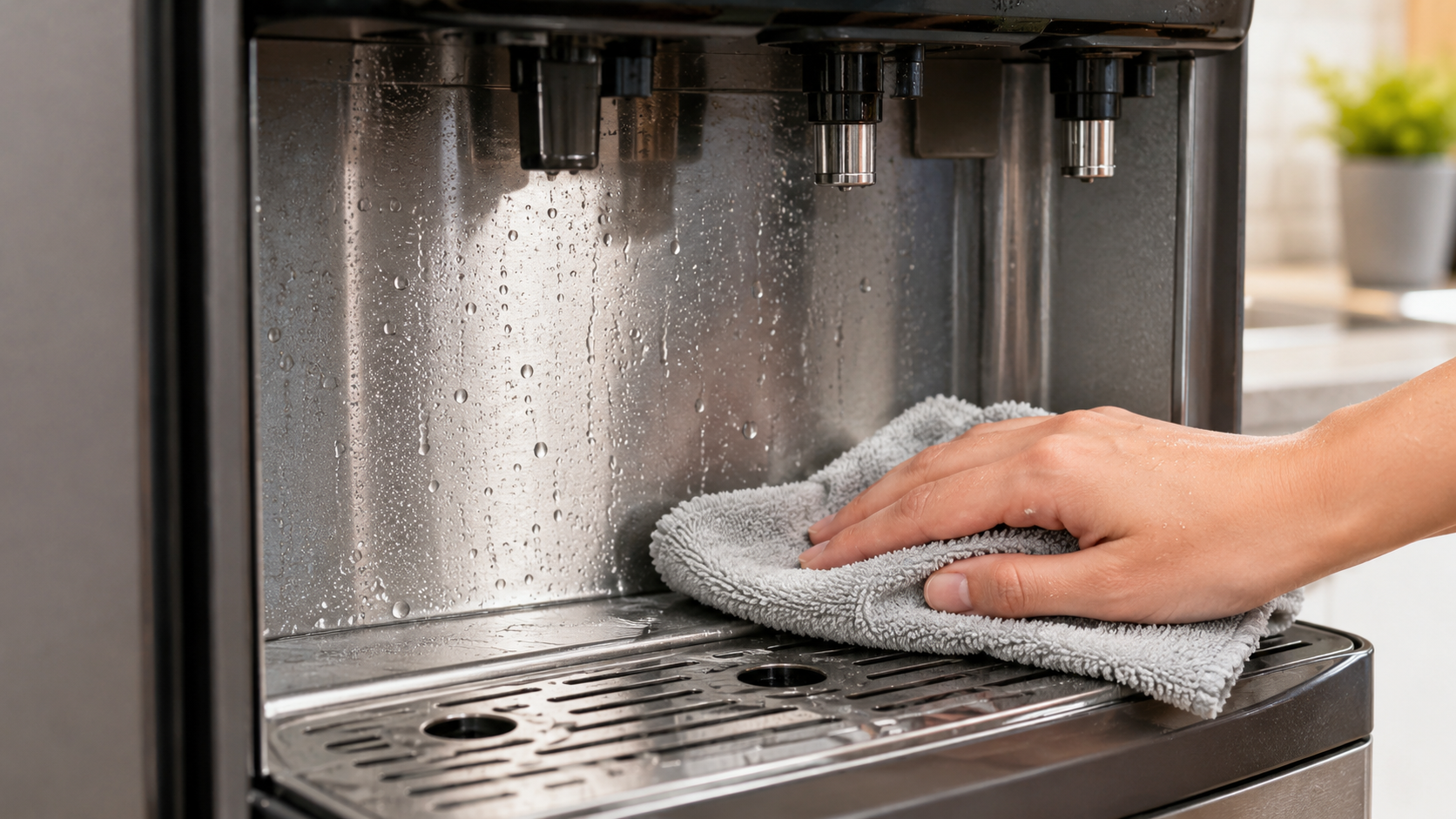
Cleaning a water dispenser takes seven steps: unplug it and shut off the water, let the hot line cool, empty and wash the drip tray, wipe the tap nozzles and the outer surfaces, dust the ventilation grille, then dry the unit and run off the first water. Cleaning the reservoir and the internal lines is a job for technical service.
-
Unplug and shut off the water
On mains-connected models close the inlet valve; on bottled models lift the bottle off.
-
Let the hot line cool
On models with a hot water outlet, start cleaning only after the unit has cooled down.
-
Empty and wash the drip tray
Take out the drip tray, empty the collected water, wash and dry it, then put it back.
-
Clean the tap nozzles
Wipe the nozzle and the area around it with a damp, non-scratching cloth; for cleaning products, follow the user manual.
-
Wipe the body and the panel
Wipe the body with a damp cloth; do not spray water directly onto the panel or the electrical parts.
-
Dust the ventilation grille
Dust on the rear grille lowers the cooler’s efficiency; clean it with a dry brush or cloth.
-
Dry, switch on, run off the first water
Once the unit is completely dry, plug it in, open the water and let the first water run for a while; on filtered models, check the filter change date.
How Do You Clean a Bottled Water Dispenser?
On a bottled dispenser, the neck the bottle sits on and the upper reservoir are the parts the user can reach. When changing the bottle, wipe the neck and the mouth of the bottle with a clean cloth. The inside of the reservoir is cleaned with the method and product described in the manufacturer’s manual; mixtures not mentioned in the manual are not used. After cleaning, the reservoir is rinsed with plenty of water and the first water is run off.
How Do You Clean a Filtered Water Dispenser?
A filtered water dispenser is a closed circuit connected to the mains; the cleaning the user does is limited to the seven steps above. The reservoir and the internal lines are cleaned by technical service together with the filter change. For the models, see our filtered water dispensers page.
The Parts a Dispenser’s Water Touches
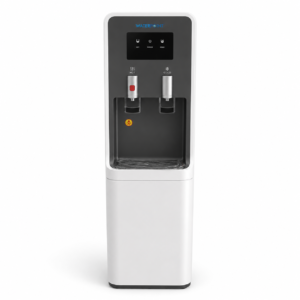
In a dispenser the water passes through six main parts: the inlet line and the filters, the reservoir or tank, the cooling unit, the heating unit, the internal lines, and finally the tap and the drip tray. A maintenance plan should cover those six parts; cleaning only the visible surfaces is not enough.
Knowing the parts explains why maintenance involves different operations:
The Inlet Line and the Filters
On mains-connected models this is the first part the water passes through; the stages do their job here.
The Reservoir / Tank
The water stands here. The longer it stands, the more cleaning matters.
The Cooling Unit
It cools the water; its efficiency is set by the ventilation and cleaning conditions.
The Heating Unit
It feeds the hot water line; it is one of the parts where build-up can form.
The Internal Lines
The connections between the parts; because they call for taking things apart, they are a job for a service engineer.
The Tap and the Drip Tray
The part touched most often; it sits at the centre of the daily routine.
Those parts have different maintenance needs. The tap and the drip tray want daily attention; the filters call for periodic renewal; the internal lines and the reservoir fall within the scope of technical work.
A proper water dispenser maintenance plan observes that distinction. Not confusing what the user can do with what calls for a service engineer protects both the unit and the warranty.
Changing the Filters on a Treated Dispenser
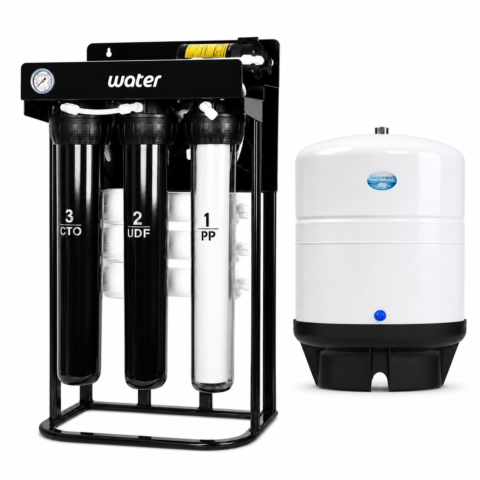
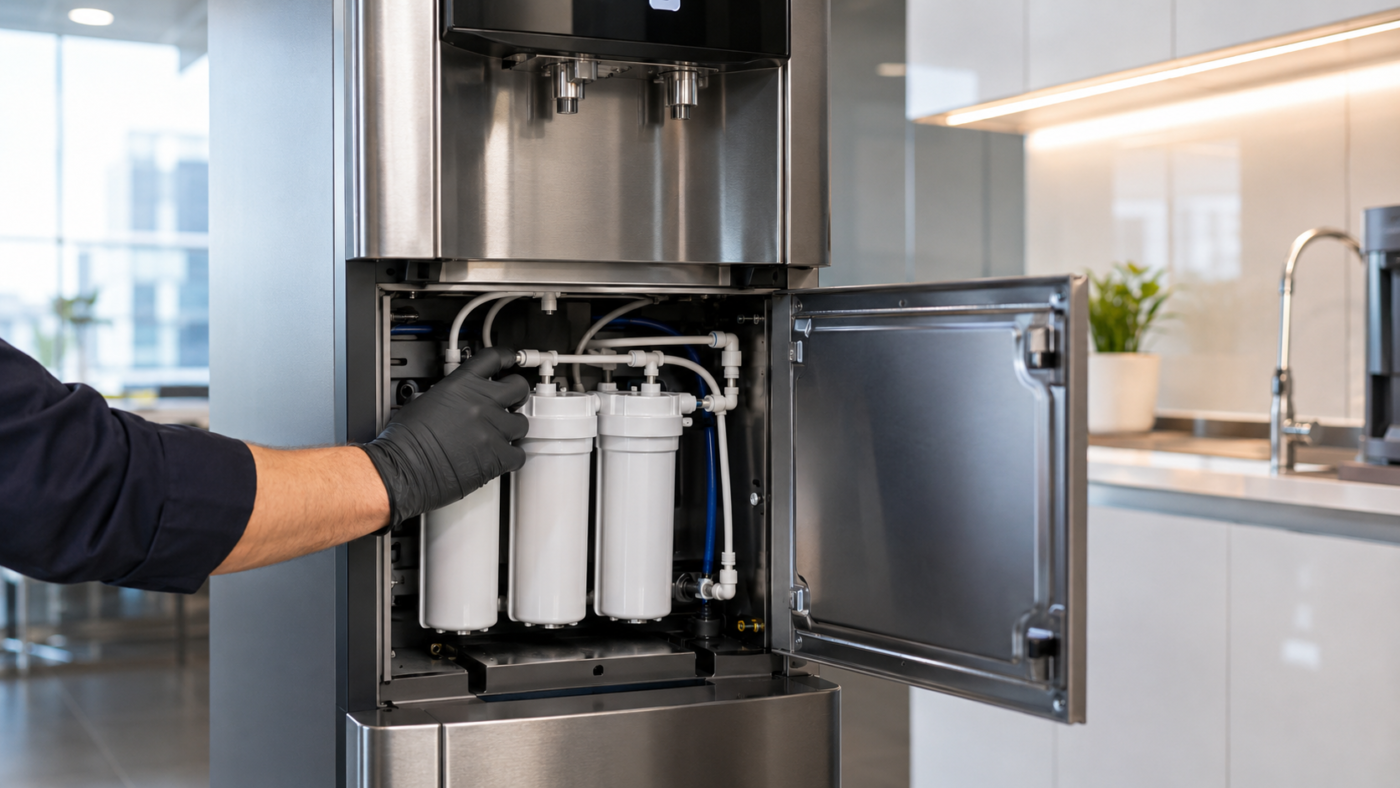
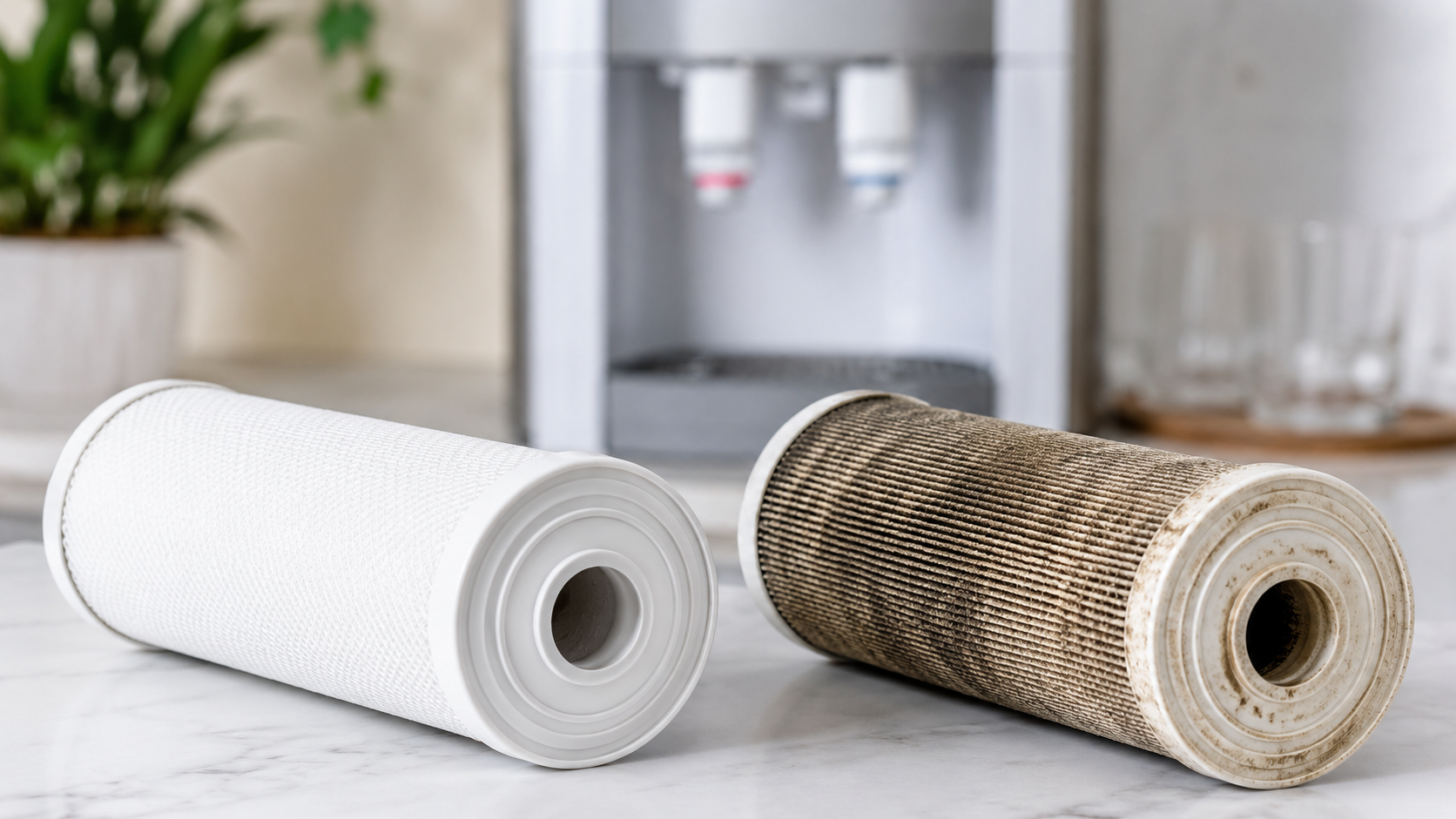
On mains-connected treated models there are sediment, activated carbon and, on some systems, membrane stages. Those stages stop doing their job once they have used up their capacity. The interval for changing varies with the intensity of use and the quality of the inlet water; the period in the unit’s manual should be taken as the basis.
Filters do not show their saturation from outside. The water keeps flowing, the unit looks as though it is working normally; but the stage may no longer be removing taste and odour.
So the monitoring is done with a calendar. The most practical method is to record the date of the change and plan the next period in advance. On office and business dispensers in heavy use that record is more critical still.
We took up in detail how the stages work and how to read the signs for changing them in our filter change guide. When the time comes, a spare filter set suited to the stage layout.
Renewing the filters is the only regular consumable operation in maintaining a water dispenser. Where the other headings are cleaning and checking, that item calls for a change of material.
Why Does Maintenance Matter More With Treated Water?
In mains water there is a residue of chlorine kept up along the distribution line. Because that residue is largely removed after treatment, biological build-up can form further along the line. That is a technical fact and it explains why periodic cleaning should not be neglected.
This section is the most misunderstood part of the subject, so it is worth being measured and clear. Chlorine residue is there in the mains for a purpose: it keeps the water protected along the line. The carbon stage removes that residue and so solves the taste and odour problem.
But the same operation also removes the element that protects the water further along the line. So in the parts after the treatment — the reservoir, the internal lines and the tap — regular cleaning becomes more decisive.
That is not a disadvantage of treatment; it is a natural result of how the system works and is managed with the right maintenance routine. We took up why the chlorine is removed and its effect on taste in our chlorine taste and odour article.
No risk is being exaggerated here. What is being said is this: periodic cleaning of the parts after the treatment is part of the system. When regular maintenance is carried out, that heading is managed by itself and maintaining a water dispenser works as expected.
Cleaning the Tap, the Drip Tray and the Outer Surfaces
The spout, the drip tray and the outer surfaces are the parts touched most often. Those parts are cleaned in daily and weekly routines; the drip tray should be emptied and washed regularly. Before the work the unit should be unplugged and, where necessary, the water inlet closed.
That group is the only area of maintenance the user can carry out alone, and done regularly it makes a marked difference.
A workable routine is set up like this:
A Daily and Weekly Cleaning Routine
- Empty and wash the drip tray
- Wipe the spout and around it with a damp cloth
- Clean the front of the unit and the control panel
- Check the place where glasses are set down
- Look for any dripping on the floor and under the unit
- Observe whether there is any marked change in the flow of water
- Check for dust building up around the rear ventilation
Materials that will scratch the surface should be avoided during cleaning. On which cleaning product to use, the guidance in the unit’s manual should govern; products not stated in the manual should not be chosen.
The drip tray matters in particular. A tray left full both creates a risk of overflowing and, when it is not emptied regularly, becomes a problem for cleanliness. On office dispensers in heavy use that should be part of the daily routine.
- A dispenser is an electrical appliance; it should always be unplugged before cleaning.
- On mains-connected models the water inlet should be closed where necessary.
- On models with a hot water line, the unit should be left to cool.
- Water should not be sprayed directly onto the electrical parts or the panel.
- Cleaning products not stated in the unit’s manual should not be used.
- The plug should not be put back in before the unit is completely dry.
Cleaning the Reservoir and the Internal Lines
Cleaning the reservoir and the internal lines is a technical operation calling for the unit to be taken apart. So it should be done by an authorised technical service. A user attempting it alone can damage the unit, cause a leak and affect the warranty cover.
This is the heading in this article that most needs a clear warning. Cleaning the tap and the outer surfaces and cleaning the internal lines are entirely different in scope.
Work on the internal parts calls for opening the panel of the unit, separating the lines and making the reservoir accessible. At that stage the electrical components, sensors and fittings are exposed; a wrong move can do permanent damage.
The home-made mixture recipes circulating online are not suitable for these units and no such recipe is given here. Cleaning the internal lines and the reservoir should be done by a technical service with suitable methods and products.
The division of work between the user and the service engineer can be summed up like this:
What the User Can Do
- Emptying and washing the drip tray
- Wiping the spout and the outer surfaces
- Removing dust from around the rear ventilation
- Keeping track of the filter change date
- Observing changes in flow and taste
- Checking for dripping under the unit
What Technical Service Will Do
- Cleaning the reservoir and the internal lines
- Renewing the filter stages
- Checking the cooling and heating units
- Checking the connections and the seals
- Commissioning it again after a long pause
- Diagnosing faults and carrying out repairs
That distinction also makes the practical side of maintaining a water dispenser should be made clear from the outset when it is planned. The left column is the daily routine; the right column falls within the scope of periodic service.
Maintaining the Cooling and Heating Units
The efficiency of the cooling unit depends on the cleanliness of the ventilation grille at the back and on where the unit is positioned. When dust builds up, giving off heat becomes harder and energy consumption rises. The unit should be positioned at a suitable distance from the wall, with its ventilation unobstructed.
That heading is the most overlooked part of maintenance. Users focus on the parts the water passes through; yet one of the things that settles the efficiency of the unit is the ventilation at the back.
What to watch is this:
- The ventilation grille: Dust build-up should be cleaned regularly; it directly affects how heat is given off.
- The distance from the wall: The unit should not be pushed against the wall; the clearance stated in the manual should be left.
- Positioning: Points in direct sunlight and near a heat source should be avoided.
- A level floor: The unit should be placed on a level base and vibration prevented.
- The hot water line: Build-up can form in the heating part over time; it is assessed at a service check.
The sign of a loss of efficiency is usually simple: if the water is no longer as cold or as hot as it was, the ventilation and the positioning should be checked first. That check is the most practical step you can take before calling a service engineer.
A cooling unit running constantly at full capacity both uses more energy and tires faster. So cleaning the ventilation should be a fixed item in the water dispenser maintenance routine.
Dispensers Left Unused for a Long Time
Over holidays, seasonal closures or long weekends the water inside a dispenser stands. When bringing it back into service the system should be run for a while, the reservoir emptied and the state of the filters checked. If the period is up, the stages should be renewed before use.
That scenario is common in offices, schools and seasonal businesses in particular. It is the basic reason why a difference in taste and odour is felt in the first water taken after a long break.
The order to follow when commissioning it is this:
-
Flush the Line
On mains-connected models the water standing in the plumbing should be run off for a while. That step clears the standing water from the line.
-
Empty the Reservoir
The water standing inside the unit should be used up completely and the system allowed to fill with fresh water.
-
Check the State of the Filters
Even where it has not been used, the period on the stages may have run. If the time is up they should be renewed before use.
-
Clean the Outer Surfaces
The spout, the drip tray and the outer surfaces should be cleaned before it is brought back into use.
-
Review the Seals
After a long pause the connections should be checked and the unit looked at for any dripping underneath.
-
Call a Service Engineer if Needed
If the closure has been long, or if a difference in taste persists, service support should be taken for cleaning the reservoir and the internal lines.
Standing water changing character is not peculiar to dispensers; a similar mechanism works on systems with storage. We took the subject up in our tank water quality article.
In businesses with a seasonal closure those steps should be turned into an opening procedure. In that way the same checks are applied at the start of every season and maintaining a water dispenser carries on without slipping.
What Happens if Maintenance Is Neglected?
When maintenance slips, the first sign noticed is usually a change in taste and odour. A slowing of the flow and a fall in cooling and heating efficiency can follow. Over the long run the risk of failure rises and biological build-up can form in the parts the water touches.
The signs advance by degrees and each points to a different maintenance item:
| Symptom | Likely Cause | What Should Be Done |
|---|---|---|
| A change in taste and odour | The carbon stage may have saturated | The age of the filters is checked and they are renewed if needed |
| A slowing of the flow | The stages may be blocked | The state of the filters is assessed |
| The water is not cold enough | The ventilation may be obstructed | The rear grille is cleaned and the position checked |
| The water is not hot enough | There may be build-up in the heating part | Technical service should assess it |
| The drip tray overflowing | The tray has not been emptied or there is a leak | The tray is emptied; if it continues, a service engineer is called |
| Damp under the unit | A connection or sealing problem | The water is turned off and a technical service called |
| A difference in taste after a long break | The water may have been standing | The line is flushed and the reservoir emptied |
Most of the signs in that table are solved with simple steps at an early stage. When a problem advances unnoticed, both the scope and the cost of putting it right grow.
We took up the order of diagnosis for odour and taste in a separate article; to tell the source of the problem apart step by step you can look at our odour and taste diagnosis guide.
A Maintenance Plan for Businesses
In areas of heavy use such as offices, cafes, schools and factories, maintenance should not be left to personal initiative. A responsible person should be named, the routine put in writing, the work carried out recorded and periodic service tied to a plan.
The most common reason maintenance slips in businesses is not technical but organisational: the question of who does what, and when, has not been made clear. Work that everyone is responsible for turns in practice into work no one is responsible for.
A workable plan consists of these four headings:
Name a Responsible Person
A person or a team should be defined for the daily routine; the task should be in writing.
Write Down the Routine
The daily and weekly operations should be turned into a short checklist.
Keep Records
Filter change dates and service work should be recorded.
Plan the Service
When periodic maintenance is tied to a calendar, the risk of it slipping disappears.
As the intensity of use rises that plan matters more still. On a business dispenser used all day the filter capacity is used up far faster; so the intervals in the calendar should be set to the intensity of use.
The choice of model affects ease of maintenance too. The stainless steel bodied business dispensers designed for heavy use, the bubbler models preferred in shared areas, and the countertop dispensers used where space is limited are all built for different patterns of use.
We took up the comparison between bottled and mains-connected models in a separate article; if you are at the decision stage you can look at our dispenser comparison piece. And the mains-connected treated dispenser models are assessed by their own stage structure for maintenance planning.
Water Point Su Arıtma Teknolojileri operates from Esenyurt, İstanbul, under its founder Ali Genç, with more than 20 years of experience in the sector. The information below sets out the concrete answers for maintenance planning.
Service Network
For industrial systems there is a service network across Türkiye; for home units service is provided in İstanbul and the neighbouring provinces. Technical service is given for units of all makes, Turkish and foreign.
On-Site Survey
The survey is free if the unit is purchased from us; where only a survey and measurement are wanted, a survey fee of ₺2,000 applies. No charge is made without the customer’s approval.
Warranty
Units, valves, pumps and tanks carry a 2-year warranty and taps a 1-year warranty. Filters, membranes, resin and salt are consumables and fall outside the warranty.
Spare Parts Cover
Filters, membranes, resin and salt are consumables; valves, pumps and tanks are durable spare parts.
Contact
For maintenance and spare part requests, 0850 304 95 25 and [email protected] can be used.
Let’s set up the maintenance plan for your dispenser together
To establish the maintenance interval that suits your intensity of use and your need for replacement filters, you can look at the options.
See the Dispenser SolutionsFrequently Asked Questions
How often should a dispenser be cleaned?
It would not be right to give a fixed period; the frequency is set by the intensity of use. The tap, the drip tray and the outer surfaces are dealt with in the daily and weekly routine. Cleaning the reservoir and the internal lines falls within periodic service; the unit’s manual should govern.
Can I clean the dispenser myself?
The outer surfaces, the spout and the drip tray can be cleaned by the user. The reservoir and the internal lines, because they call for taking things apart, are a job for a technical service. Work attempted alone can damage the unit and affect the warranty cover.
What happens if the filters are not changed?
Once the stages have used up their capacity they stop removing taste and odour. The water keeps flowing but the performance expected is not provided. Blocked stages also slow the flow. The interval for changing is set by the intensity of use and the quality of the inlet water.
There is a smell from the dispenser — what should I do?
Check the age of the filters first; the most common cause is a saturated carbon stage. Then, if the reservoir holds water that has stood a long time, empty it. If the smell continues, a technical service should be called for cleaning the reservoir and the internal lines.
What should I do after a holiday?
Run the line for a while, empty the reservoir and let the system fill with fresh water. Check the period on the filters; even where they have not been used the time may have run. If the closure has been long, it is right to take service support.
The water is not cold enough — what could be the cause?
The first place to check is the rear ventilation. Dust build-up makes giving off heat harder; and if the unit is too close to the wall the ventilation is obstructed. If those checks give no result, the cooling unit should be assessed by a service engineer.
Which cleaning product should I use?
The guidance stated in the unit’s manual should govern. Products not listed in the manual and home-made mixtures are not advised; they can damage the surfaces and the internal components. The suitable method for cleaning the internal lines is applied by a technical service.
Who should take on the maintenance in an office?
A responsible person should be defined for the daily routine and the task put in writing. Periodic work such as filter changes and cleaning the reservoir should be tied to a service plan. Keeping records is the most practical way of preventing things slipping.
Does the unit get damaged if maintenance slips?
Long-term neglect can lead to a drop in flow and a loss of efficiency; and the cooling unit being constantly strained speeds up wear too. A regular routine and periodic service prevent problems of that kind.
Conclusion
Maintaining a water dispenser is a regular piece of work that keeps the performance of the unit and the quality of the water going; it is not complicated but it does not tolerate slipping. The routine has three layers: daily, the tap, the drip tray and the outer surfaces; periodically, the filter stages; and within the scope of technical service, cleaning the reservoir and the internal lines. Because there is no protective chlorine residue in treated water, periodic cleaning becomes more decisive still — that is not a risk but a technical fact to be managed. The efficiency of the cooling unit is preserved by cleaning the ventilation and positioning it correctly. And in businesses the most critical element is not technical but organisational: a responsible person should be named, the routine written down and records kept.
Get in touch for periodic maintenance and replacement filters
The site survey is free if the unit is purchased from us; where only a survey and measurement are wanted, a survey fee of ₺2,000 applies. No charge is made without the approval of the customer. For maintenance planning and spare parts you can reach us on 0850 304 95 25 or at [email protected].
Discover the Solution That Suits You