
Does a Shower Filter Work? What It Removes and What It Does Not
You turn on the shower and a clear smell of chlorine spreads through the room; on the glass screen and the fittings there are white marks that nothing seems to remove. When you start looking into it you come across a small, cheap and easily fitted product. But the marketing promises so much that it becomes hard to understand what it actually does. The aim of this article is clear: a shower filter — what it removes and what it does not, without the hype.
Because this product is praised more than it deserves in the market, an honest assessment prevents buying it with the wrong expectation and the disappointment that follows. Below we set out plainly both where it works and what its limits are. Let us state the most critical fact at the outset: this product does not remove the hardness of water.
What Is a Shower Filter and How Does It Work?
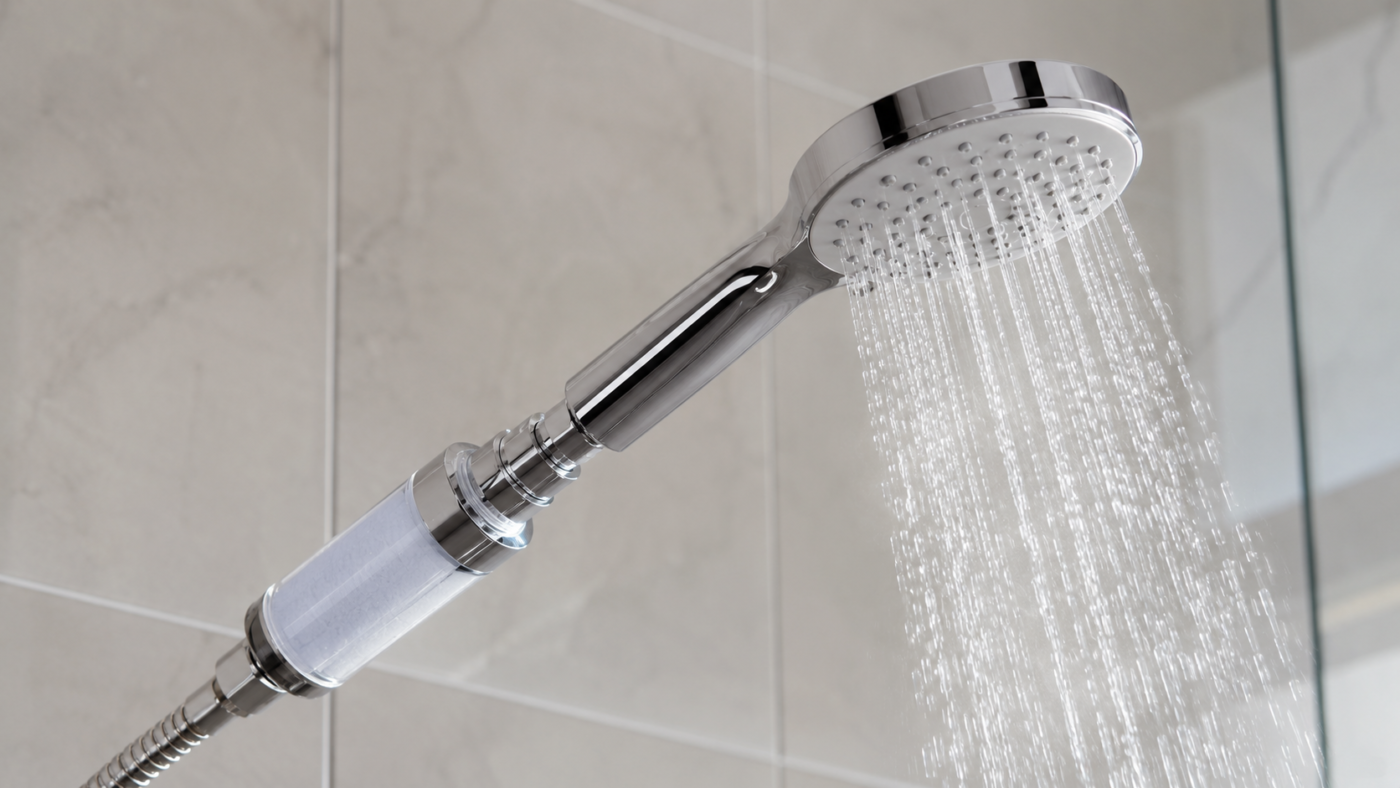
A shower filter is a small point-of-use unit fitted between the shower head and the water line. The filter material inside it aims to hold the chlorine in the water along with particles such as sediment and rust. It is a compact product and is generally fitted without a permanent change to the plumbing.
The working logic is simple: the water passes through the filter body before reaching the shower head. The material inside the body tries to hold the components targeted, and the water left is delivered to the head.
This is a point-of-use solution; that is, it affects only the point where it is fitted. It has no effect at all on the water going to the other taps in the house, the washing machine or the boiler. That distinction matters in setting the right expectation.
The material inside varies with the model; activated carbon and components providing mechanical filtration are generally used together. The first thing to look at in assessing a shower filter is which material is inside and what it targets.
What Can a Shower Filter Remove?
The field in which this product can have an effect is limited and clear: chlorine and chlorine-related odour, sediment and rust particles, and the suspended solids that cause cloudiness. Activated carbon works on the chlorine side while mechanical filtration holds particles. The level of the effect varies with the conditions of use and the inlet water quality.
Chlorine is the most complained-about heading in the shower. With hot water chlorine is perceived more easily, and in a closed bathroom the smell concentrates. The same water can therefore smell slightly in a glass while being clearly noticeable in the shower.
Activated carbon comes in at that point. Thanks to its porous structure it holds chlorine and odour components on its surface; that process is called adsorption. The Alaska state environmental agency’s resource on removing chlorine taste also treats activated carbon based solutions as among the methods recommended for that purpose.
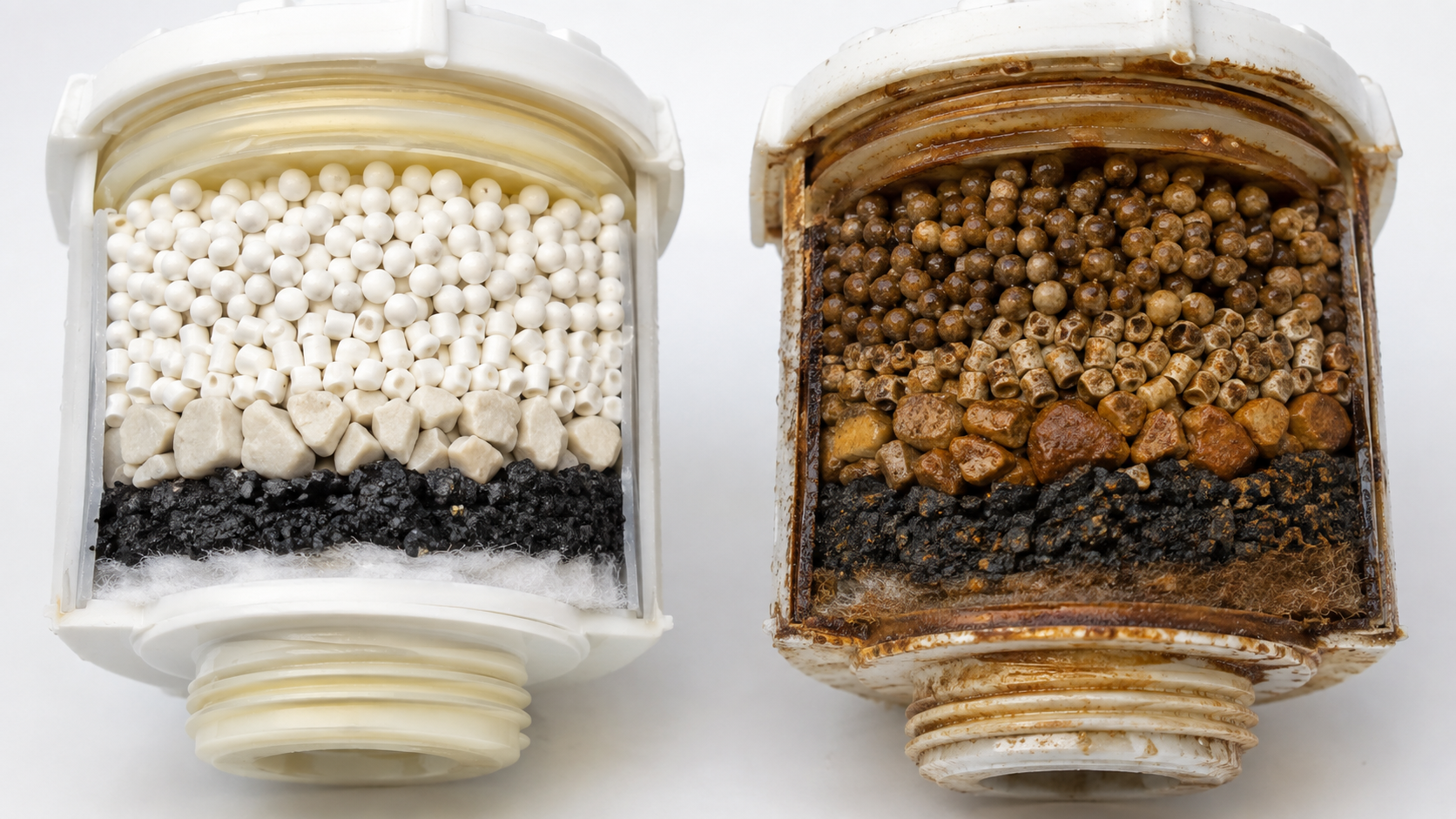
The second field is particles. Rust flakes breaking off old plumbing and sediment carried down the line can be held by mechanical filtration. That is visible to the eye on models with a clear body in particular; the filter material changes colour over time.
The whole subject of chlorine — its source, the difference with chloramine and the methods of removal — is covered in our article on chlorine in water. A shower filter offers an answer to it at point-of-use level.
What Does a Shower Filter Not Remove?
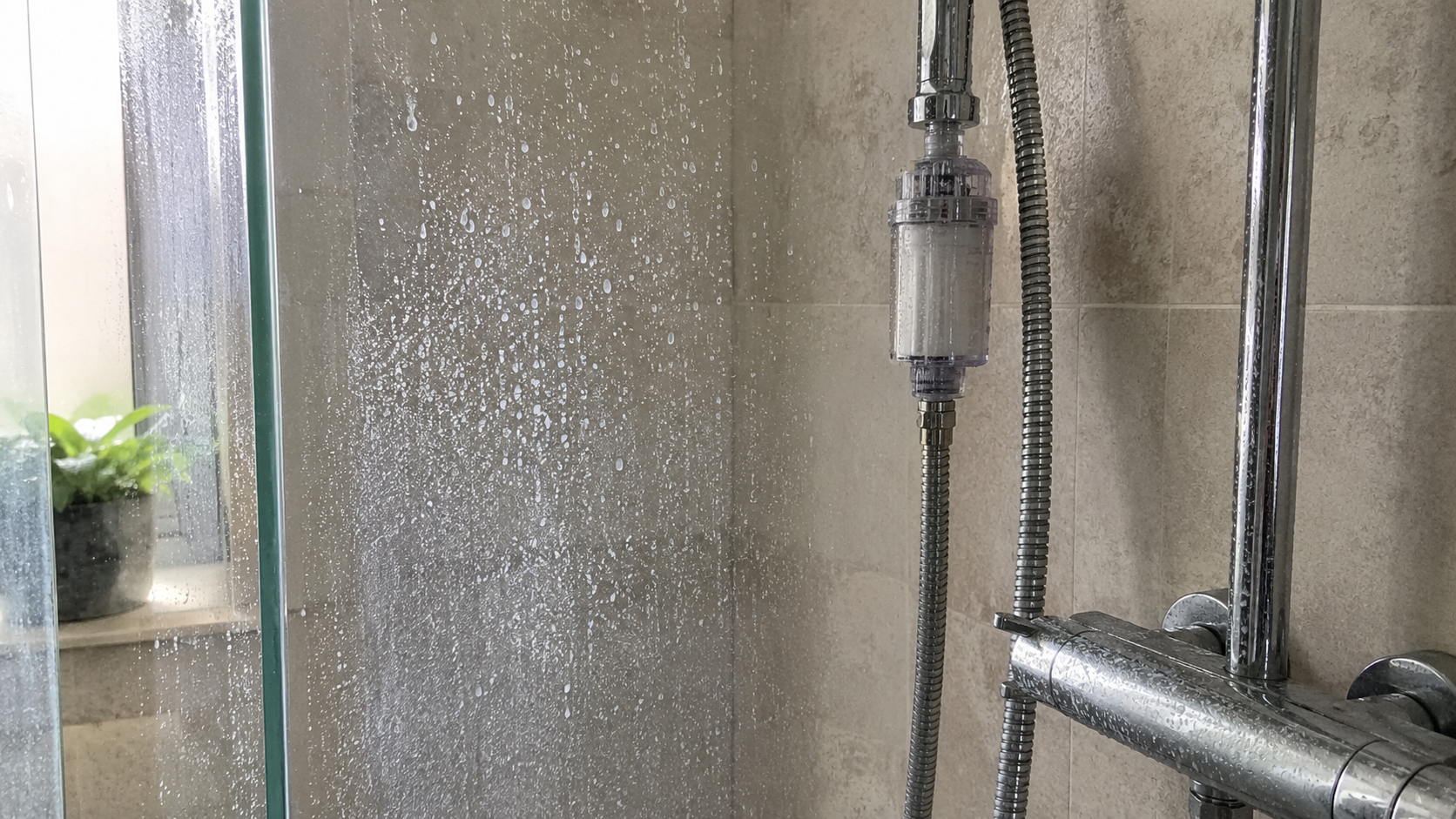
This product does not remove the hardness of water. It does not take the calcium and magnesium ions out of the water; it therefore does not solve a limescale problem. The white marks on fittings, on the glass screen and on surfaces continue. It does not lower the dissolved solids load either, and does not change the mineral profile of the water.
This is the most important section of the article and not a subject to be told indirectly. Removing hardness is done by a process called ion exchange, and that process calls for a resin bed and a system renewed with salt. It is technically impossible for a small cartridge to perform that function.
Let us set it out in two columns so that the comparison is clear:
It works on this side
- Chlorine and chlorine-related odour
- Sediment and rust particles
- Cloudiness from suspended solids
- The sensory effect at the point of use
It does not work on this side
- Hardness and limescale (calcium, magnesium)
- The dissolved solids load (TDS)
- Limescale marks on fittings and glass
- The water at other points in the house
The right-hand column is the list that must be known before buying. A user with a limescale problem who fits a shower filter expecting it to be solved will be disappointed; the product was not designed for that job.
We took up what hardness is and how it is removed in our softening system selection guide. We examined the effect of limescale on equipment and surfaces in our hard water article.
The approach “there are limescale marks in the shower, let me buy a filter” is common but has no technical basis. Limescale marks come from hardness and this product does not remove hardness. The answer to a limescale problem is central softening.
Why Is Contact Time a Limit?
The mechanism by which activated carbon holds chlorine calls for contact time; the water is expected to be in contact with the filter material for long enough. In a shower the water passes quickly and at high flow, and the unit is compact. Performance as high as that of an under-sink system should therefore not be expected.
That is the technical reason explaining the limits of the product, and it should be said honestly. However good the carbon stage, when water passes without enough contact the holding efficiency falls.
In an under-sink system the conditions are different: the stage volume is larger, the flow is slower and the water is in contact with the material for longer. In a shower the flow is high and the unit has to be small.
The expectation therefore has to be set correctly. A shower filter can provide a noticeable reduction at the point of use; but it should not be expected to perform at the same level as a stage on the kitchen line.
We took up how activated carbon works, which factors determine its efficiency and why contact time is critical in our activated carbon filter article.
A shower filter working at high flow in a compact unit has a physically limited contact time. That is not a quality problem but a design condition; it should be borne in mind in assessing the product.
Filter Performance in Hot Water
Shower water is hot, and temperature can affect the behaviour of the filter material. Some materials are designed for particular temperature ranges. The conditions of use stated by the manufacturer therefore have to be followed; use outside those conditions can affect performance and the life of the product.
This heading is an important difference separating kitchen stages from shower units. Under-sink systems are connected to the cold water line; in a shower the water passes through the mixer and moves on hot.
The effect of temperature varies with the material. Some filter components can behave differently in hot water; manufacturers therefore define the working conditions in the manual.
The points to watch in practice are these:
- The manual: The working conditions stated by the manufacturer should be taken as the basis.
- The fitting point: The unit should be fitted in the position the manufacturer intends.
- Excessive temperature: The conditions stated in the manual should not be exceeded.
- Product life: The conditions of use affect how long the cartridge will do its job.
It would not be right to give a numerical temperature range here; that information is specific to the product and appears in the manual. When buying a shower filter, finding that information on the product page or in the manual is also a good sign of the manufacturer’s transparency.
What Do Users Report?
Users most often report a reduction in the smell of chlorine and a change in how the water feels. But that experience varies from person to person and with the character of the water. This article makes no assessment of effects on skin and hair; that is a medical field.
Measured language is needed in this section, because most of the hype in the market is concentrated in exactly this heading.
What can be said is this: the smell of chlorine is a measurable phenomenon and a carbon stage can have an effect on that component. The reduction in smell that users report can be explained by that mechanism.
Assessments beyond that fall into the area of personal experience. Two people using the same product can report different observations, because the character of the inlet water, the habits of use and the level of expectation differ.
This article makes no claims about skin, hair or cosmetic effects. What it takes up is the chlorine and particle content of water and the sensory change at the point of use. If a personal assessment is needed, consulting your doctor is the right course.
That framework does not devalue the product; it simply puts it in the right place. For a user troubled by the smell of chlorine, a shower filter can offer a practical answer. When the expectation is carried beyond that, disappointment is inevitable.
There is a practical method for assessing it: observe the smell of chlorine before fitting the product and after. If you notice a difference the product is doing its job for you; if you do not, the source of your problem is most likely not chlorine.
A Shower Filter or Central Softening?
The two solve different problems and are not alternatives to one another. If the problem is only chlorine and odour, a point-of-use solution is practical and low-cost. Where limescale, hardness and marks on surfaces are involved, central softening is needed; a small unit does not meet that need.
That distinction is the basis of pointing people to the right product. The table below shows which problem is handled by which solution:
| The Problem You Have | A Suitable Solution | Why |
|---|---|---|
| A chlorine smell in the shower | A point-of-use filter | The carbon stage works on the chlorine side |
| Sediment and rust particles | A point-of-use filter | Mechanical filtration holds the particles |
| Limescale marks on fittings and glass | Central softening | Hardness is removed by ion exchange |
| Blocked holes in the shower head | Central softening | The source of the build-up is hardness |
| Soap not foaming | Central softening | Hard water lowers the performance of the product |
| A limescale problem throughout the house | Central softening | The solution has to be built on the main line |
| Both chlorine and limescale | The two together | Different problems call for different stages |
The last row of that table matters: the two solutions do not exclude one another. In a house with a central softening system, if a smell of chlorine is still noticeable in the shower, a shower filter can be used in addition.
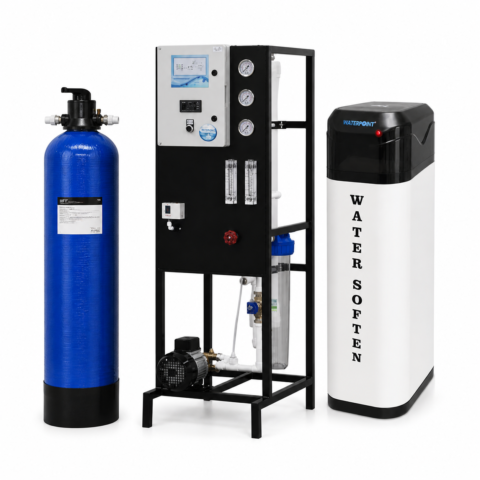
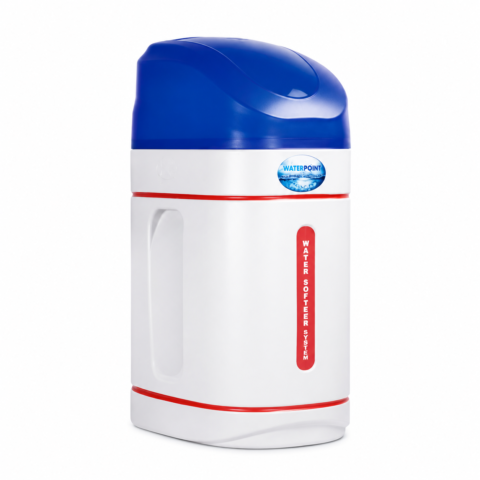
We took up the scope of central solutions and the logic of installation in our building inlet treatment systems article. For those looking for an individual solution at flat scale, compact cabinet softening systems can be considered.
On the point-of-use side the choice of product is simple; solutions such as a filtered shower head can be used without any change to the existing plumbing.
Cartridge Changes and Flow
When the filter material has completed its capacity it stops holding; the water goes on flowing but the effect expected diminishes. Particle build-up can also restrict the flow over time and lower the shower’s flow rate. The change interval varies with the intensity of use and the inlet water quality.
This product is a consumable, not a permanent solution. When the cartridge fills or completes its capacity it has to be renewed.
The signs showing it is time to change are these:
The Smell Is Back
The chlorine smell that had faded becoming noticeable again can show that the carbon capacity is exhausted.
The Flow Has Fallen
A clear weakening of the shower flow can point to particle build-up.
A Change of Colour
On models with a clear body, the material darkening is visible to the eye.
The Period Is Up
Even where there is no sign, the cartridge should be renewed when the recommendation in the manual is reached.
It is not possible to give an exact period; the same cartridge completes its capacity far faster in an area with a high chlorine and particle load. Both the calendar and the signs should therefore be watched.
Flow matters particularly. A blocked unit affects showering comfort directly; when the flow weakens, users generally blame the plumbing or the mixer. Yet the cause is usually a saturated a shower filter cartridge.
We took up in general how to set up a maintenance routine and how to read the signs in our filter change guide; the same logic applies to this product.
Fitting and Compatibility
The unit is generally fitted between the shower hose and the shower head. Fitting is simple and in most cases needs no permanent change to the plumbing. What is decisive is that the thread size matches and that the sealing washer is placed correctly.
Installation is one of the most practical sides of this product. It needs no special tool or technical knowledge; but a few points should be watched.
-
Check the Thread Size
The connection size of the unit has to match your existing shower hose and head. A mismatched size forced into place causes a leak.
-
Remove the Shower Head
The connection between the hose and the head is undone by hand. On a seized connection a method that will not scratch the surface should be used.
-
Fit the Washer
The sealing washer has to seat fully. A washer that has slipped or is missing is the most common cause of a leak.
-
Fit the Unit
The filter body is placed between the hose and the head and tightened by hand. Overtightening can damage the thread.
-
Turn the Water On and Check
The connection points are checked by eye for dripping. If there is a leak, the washer is refitted.
-
Run the First Water Off
In new cartridges there can be residue from the material in the first water; running it off as stated in the manual is recommended.
There is no single standard for compatibility; before buying, therefore, you have to check the connection arrangement of your existing shower set. On some specially designed shower sets it may not be possible to fit a unit in between.
The simplicity of the installation makes this product practical for tenants in particular. Because the plumbing is not touched, it can be taken off and taken away when moving; it leaves no permanent change behind.
Who Is It Sensible For, and Who Is It Not?
It is a sensible choice for people living in areas where the smell of chlorine is noticeable, for tenants who do not want a permanent change to the plumbing, and for those looking for a low-budget answer. It is not suitable for those expecting it to solve a limescale and hardness problem, or for those looking for a solution for the whole house.
This section was written to make the decision clear. Rather than recommending the product to everyone, we state plainly who it suits and who it does not.
Those with a chlorine smell complaint
If the problem comes mainly from chlorine, it can provide a noticeable reduction at the point of use.
Tenants
It needs no permanent change to the plumbing; it can be taken off and taken away when moving.
Those looking for a low-budget answer
It is a much smaller-scale and more practical starting point than a central system.
Those with a sediment and rust problem
Particles coming from old plumbing can be held at the point of use.
Those with a limescale problem
Because hardness is not removed, marks on fittings and glass continue; the answer is central softening.
Those looking for a whole-house solution
It affects only the point where it is fitted; it has no effect on the other taps or on equipment.
Those expecting high performance
Because the contact time is limited, an effect at the level of an under-sink system should not be expected.
Those who do not know their problem
A choice made without knowing the profile of the water rests on guesswork; an analysis comes first.
The last card is the summary of the whole article. A choice made without knowing whether the problem in your water is chlorine or hardness may not end with the right product. How a sample is taken and how a report is read is covered in our water analysis guide.
Water Point Su Arıtma Teknolojileri operates from Esenyurt, İstanbul under its founder Ali Genç, with more than 20 years of experience in the sector.
Survey
The survey is free if the unit is purchased from us; where only a survey and measurement are wanted, a survey fee of ₺2,000 applies. The solution proposed is established from the water analysis.
Warranty
Units, valves, pumps and tanks carry a 2-year warranty and taps a 1-year warranty. Filters, membranes, resin and salt are consumables and fall outside the warranty.
Contact
For your questions, 0850 304 95 25 and [email protected] can be used.
Chlorine or limescale? Choose the right product accordingly
You can look at the options to assess the solution that suits the source of the problem in your water.
See the Treatment SolutionsFrequently Asked Questions
Does a shower filter prevent limescale?
No. This product does not remove the hardness of water; it does not take the calcium and magnesium ions out of it. The limescale marks on fittings, on the glass screen and on surfaces continue. The answer to a limescale problem is a central softening system that lowers hardness at source.
Is the difference really noticeable?
The effect depends on the source of the problem. In water where the smell of chlorine is clear, users report a reduction in that smell. But if the problem comes from hardness, no difference is felt. The practical method is this: compare the smell of chlorine before and after fitting.
How often should it be changed?
There is no fixed period; the change interval varies with the intensity of use and the inlet water quality. The clearest indicators are the smell coming back and a fall in the shower flow. The period in the manual should be taken as the basis and assessed together with the signs.
Does it fit every shower head?
It is generally fitted between the hose and the head; what is decisive is that the thread size matches. On some specially designed shower sets it may not be possible to fit a unit in between. Before buying, therefore, check the connection arrangement of your existing set.
I have a softener — do I still need one?
Because the hardness has already been removed, there is no further need on the limescale side. But if a smell of chlorine is still noticeable in the shower, an extra stage at the point of use can be considered; the two solutions address different problems and can be used together.
Does it have an effect on skin and hair?
This article makes no assessment of effects on skin and hair. Observations on that subject vary from person to person and it is a medical field; if a personal assessment is needed, consulting your doctor is the right course.
My shower flow has fallen — could the filter be the cause?
Yes, it could. Particle build-up can restrict the flow over time. If there is a gradual fall in flow after the unit is fitted, the state of the cartridge should be checked. If the sign persists, the pressure on the plumbing side should be assessed too.
Can it be used with hot water?
Shower water is hot and the behaviour of the filter material can be affected by temperature. The working conditions stated in the manufacturer’s manual should therefore be followed. Use outside those conditions can affect performance and the life of the product.
Does it replace the unit in the kitchen?
No. This product affects only the shower point where it is fitted and was not designed for drinking water quality. A separate treatment stage is needed in the kitchen for drinking and cooking water; the two solutions serve different purposes.
Conclusion
A shower filter is a point-of-use solution with clear limits. It can have an effect on chlorine and chlorine-related odour and on sediment and rust particles; users report a reduction in smell in that area. It does not, on the other hand, remove the hardness of water — it does not take calcium and magnesium out, and so does not remove the limescale marks on fittings and glass. Because the contact time is limited, performance at the level of an under-sink system should not be expected. The right decision follows from that: if your problem is chlorine and odour it is a practical, small-scale answer; if it is limescale and hardness the answer is central softening. Which of the two you need can only be shown by an analysis of your water.
Let’s establish the solution that suits your water together
The survey is free if the unit is purchased from us; where only a survey and measurement are wanted, a survey fee of ₺2,000 applies. The solution proposed is established from the water analysis. To clarify the source of your problem, you can get in touch on 0850 304 95 25 or at [email protected].
Discover the Solution That Suits You