
How Long Does a Water Treatment System Last?
The unit that ran without trouble for years now needs a service call again and again. One part is changed, another fails a few months later, and every time the same question comes up: should I have it repaired or buy a new one? That decision is usually made on feeling — yet it can be settled by looking at a few concrete measures. And for that you first have to understand what the life of a water treatment system depends on.
In this guide we take up the factors that settle the life of a unit, how long each part relatively lasts, the common mistakes that shorten that life and, most importantly, how to make the decision between repair and replacement. The aim is not to steer you towards replacing it but to show honestly which makes sense when.
What Does the Life of a Water Treatment System Depend On?
The life of a water treatment system is not a fixed period. The quality of the inlet water, the pressure the system works at, the intensity of use, the discipline of maintenance and the quality of the components in the unit settle it together. Because of those variables, the same model can run for markedly different periods on two different installations.
What that means in practice is this: the life of a unit is not written on its box. The manufacturer defines a design target; the period actually achieved takes shape according to where that unit is, what water it runs on and how it is run.
So a debate about durability cannot be carried on through the product alone. A good unit wears quickly in bad conditions; and against that, a standard system runs for many years when it is protected.
For a general framework on using and maintaining domestic treatment systems, the US Environmental Protection Agency guide to home water treatment can be consulted; the source stresses the part regular maintenance plays in system performance.
Why Is There No Clear Answer to “How Many Years Will It Last?”
Because what is decisive is not the unit but the conditions of use. A system running on soft mains water and the same model connected to sediment-laden well water age entirely differently. So giving a single number of years would be technically misleading.
Let us make that concrete. Think of two installations: the first is fed by reasonably soft, sediment-free mains water, its pre-filters are renewed on time and its pressure is in the right range. The second is connected to a hard, sediment-laden source, its pre-treatment is inadequate and its maintenance irregular.
The same model, the same components, the same manufacturer. And yet on the second installation the membrane and the valve tire far faster, the cartridges fill often and failures grow markedly more frequent.
So before buying, putting the question “under what conditions will it run” in place of “how many years will it last” is a more accurate approach. The life of a water treatment system is a value shaped by the user from the moment the installation is made.
If a seller gives you an exact number of years, that is a guess. The realistic answer is this: the life of a unit varies with the quality of the inlet water, the working pressure and the discipline of maintenance. Because those three headings can be managed, the life can be managed too.
The Main Factors That Settle the Life of a Unit
There are six main factors: the quality of the inlet water, the working pressure, the intensity of use, the discipline of maintenance, the quality of the installation and the conditions of the surroundings. Each affects a different component; taken together, they show the real rate at which the system ages.
The table below sums up which component each factor affects and how:
| The Threat | The Component It Affects | The Result |
|---|---|---|
| Hardness | The membrane, the valve, heated surfaces | Build-up forms and the efficiency falls |
| Sediment and turbidity | The cartridges and the membrane | The stages fill quickly and the surface fouls |
| Chlorine | The membrane and the resin | A risk of permanent structural damage arises |
| Iron | The membrane, the resin, the cartridges | The surface is coated and the performance falls permanently |
| The working pressure | The connections, the body, the membrane | Low pressure costs efficiency, high pressure creates strain |
| The intensity of use | All the consumable components | The interval for renewal shortens |
| The discipline of maintenance | The whole chain | Slipping creates wear right down the chain |
| The quality of the installation | The connections and the hoses | A risk of leaks and early fatigue |
| The conditions of the surroundings | The body, the gaskets, the hoses | Damp, heat and frost tire the material |
The most critical row in that table is the one for chlorine, because its effect cannot be undone. Once the carbon stage saturates, chlorine reaches the membrane and wears the structure permanently. That is the most expensive consequence of maintenance slipping.
The conditions of the surroundings are often overlooked. On a system running in a damp cabinet or a cold basement, the gaskets and the hoses age faster. In positions where there is a risk of frost, structural damage can occur.
What those six factors have in common is that they can be managed. None of them is fate; with the right build and regular maintenance the life of a water treatment system can be extended markedly.
How Long Does Each Part of the Unit Last?
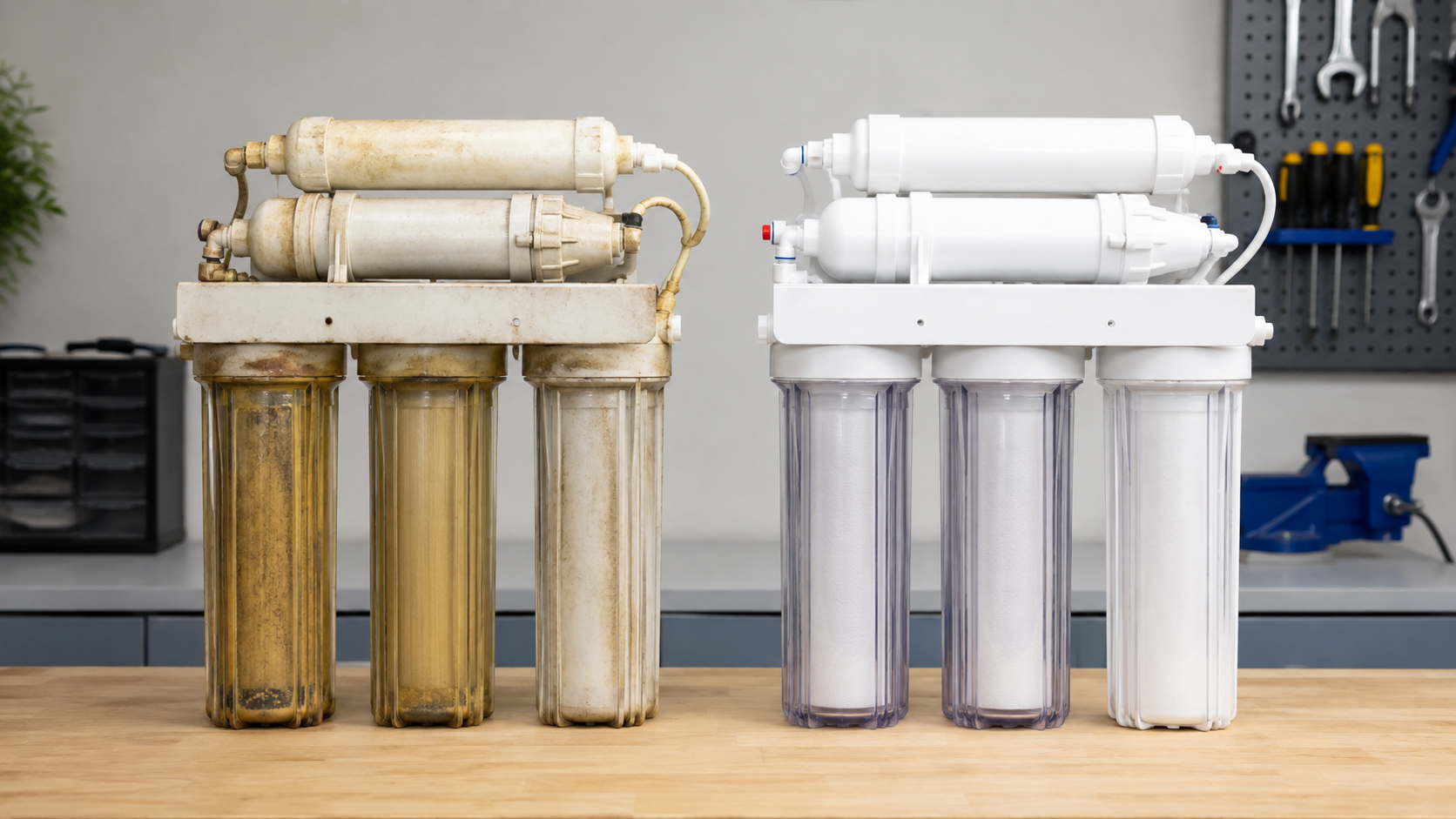
The components age at different rates. Cartridge filters are the group renewed most often; the membrane is changed at longer intervals. The pump and the valve call for attention over the medium term; the tank and the body generally serve longest. That is an order, not a set of exact periods.
The graphic below shows the relative durability of the components. The lengths of the bars express not a period but a position relative to one another:
Cartridge Filters
The group renewed most often. The sediment and carbon stages are changed periodically; they are in the consumables category.
Membrane
It is renewed at far longer intervals than the cartridges. Its life depends largely on the pre-filters being changed on time.
Pump
It can call for attention over the medium term. The working conditions and the pressure balance bear directly on its life.
The Valve and the Connections
It is long-lived, but the gaskets and moving parts can call for renewal over time.
The Tank and the Body
Generally the components that serve longest. A problem arising in that group is a sign about the general state of the system.
The practical value of that order is this: when a fault occurs, knowing which group it is in sets the direction of the decision. A renewal in the consumables group is routine maintenance; a problem arising in the body and tank group calls for a different assessment.
We took up in detail when the cartridge stages are renewed and how the signs are read in our filter change guide; we do not go into the consumables period in this article. And we set out the structure of the membrane and why it depends on the pre-filters in our membrane filter article.
The Most Common Mistakes That Shorten the Life
The most common mistakes are these: delaying a filter change, running without pre-filters, using the system at an unsuitable pressure, running it dry, using incompatible spare parts and leaving a system unused for a long time without maintenance. All of them are preventable.
What those mistakes have in common is that their consequences appear with a delay. None of them creates a fault at once; the effects build up, and by the time they are noticed a component has usually been damaged.
| The Mistake | What Happens | The Result |
|---|---|---|
| Delaying a filter change | The stages saturate and chlorine gets through | The membrane is worn permanently |
| Running without pre-filters | Sediment reaches the membrane directly | The surface fouls and the output falls |
| An unsuitable pressure | Low pressure costs efficiency, high pressure creates strain | Leaks at the connections, early fatigue |
| Running it dry | The pump is left without water | Permanent damage can occur to the pump |
| Incompatible spare parts | A mismatch of size and connection | Leaks and a loss of performance |
| Leaving it without maintenance for a long time | Water stands inside the system | The stages and the tank are affected adversely |
| A faulty installation | The connections are not fully seated | An unnoticed leak and damage |
The first item on that list is the mistake producing the most expensive consequence. When a relatively low-cost cartridge is not renewed, the membrane, a far more valuable component, is damaged. That is the single most decisive decision for the life of a water treatment system.
Incompatible spare parts are often overlooked too. When a cartridge that does not quite fit is forced into place it tires the gasket and leads to a leak. A short-term saving can end in the body having to be replaced.
How Does a Maintenance Routine Extend the Life?
Regular maintenance prevents big failures with small interventions. Renewing the stages on time, checking the connections and for leaks, following the pressure and checking the tank are the basic headings. The period varies from unit to unit; the interval stated in the manual should be taken as the basis.
The effect of maintenance works down the chain. A pre-filter renewed on time does not only do its own job; it protects the membrane, keeps the pressure in balance and prevents the pump being strained unnecessarily.
The checks to be made regularly are these:
-
Renew the Stages on Time
The period varies with the unit and the quality of the inlet water; the interval in the manual should be taken as the basis. Delaying affects the whole chain.
-
Check the Connections
Inspect the connection points inside the cabinet by eye now and then. A dry floor lets a leak be noticed early.
-
Follow the Flow and the Pressure
A change in the rate of production is the first sign that something in the system has changed. We took up the approach to diagnosis in a separate article.
-
Watch the State of the Tank
The flow from the tap weakening after a short time points to the tank side; the check is carried out by a technical service engineer.
-
Keep Records
Note the dates of changes and the work carried out. That record is the most reliable way of planning the next maintenance.
We took up the diagnosis of pressure and the role of the pump in detail in our pressure article; we do not repeat it here. And when the time for renewal comes, the whole line can be refreshed with a spare filter set suited to the stage layout.
The cost of maintenance is usually exaggerated. Yet the spend on planned maintenance is markedly below the cost of an unplanned failure; and the time the system is out of action disappears too.
How Does Water Quality Affect the Life of a Unit?
The quality of the inlet water is the strongest factor settling the life. On a system running on hard, sediment-laden water without pre-treatment, the membrane and the valve wear quickly. On installations using well or tank water, pre-filtration is not a choice but a necessity.
That heading is the most concrete counterpart of the main-factors table. A unit treats whatever it is given; the harder the water it is given, the faster the wear.
The four parameters that affect it most are these:
Hardness
It creates build-up on heated surfaces and surfaces under pressure; the efficiency falls.
Sediment
It fills the cartridges quickly and blocks the membrane surface mechanically.
Chlorine
When the carbon stage saturates it reaches the membrane; the damage is permanent.
Iron
It coats the surfaces; it cannot be removed entirely by regeneration or cleaning.
On installations using well and tank water the picture is more marked still. The particle load on those sources is generally high and varies with the season. We took up the role of bed-type filtration in our sand filter article.
The starting point of the answer is a measurement. Without knowing the profile of the water, which pre-treatment stages are needed cannot be established. We set out how to take a sample in our water analysis guide.
Pre-treatment built correctly gives the single greatest improvement there is to the life of a water treatment system on its own. Relatively low-cost protective stages protect far more valuable components for years.
Repair or Replace? A Guide to Deciding
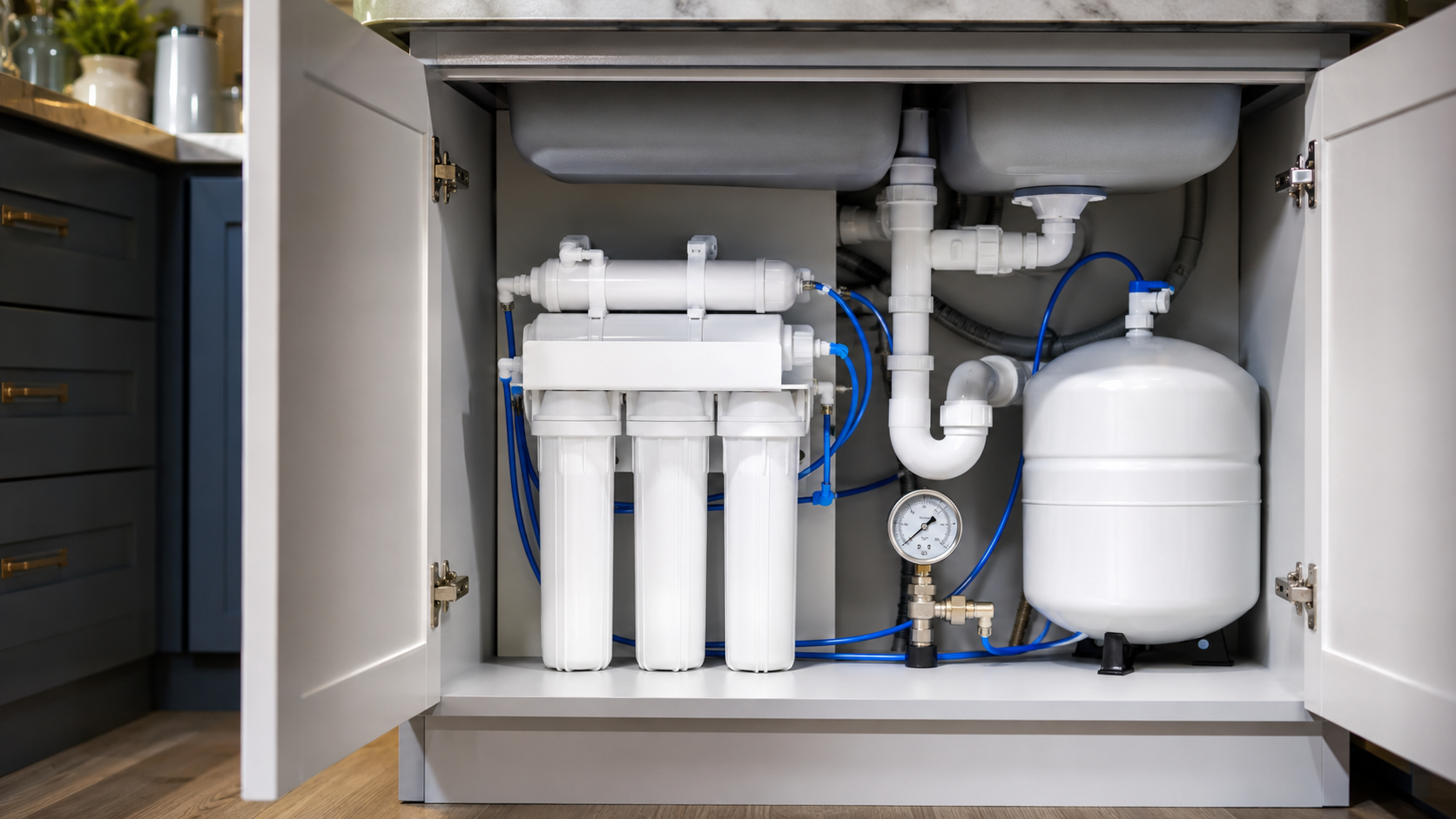
A fault in a single component is generally solved by repair and needs no replacement. Against that, more than one main component finishing in the same period, compatible spare parts not being available, ageing on the body or tank side and repeated leaks are all signs pointing towards replacement.
The aim of this section is not to push you in one direction but to make the decision measurable. The two columns below show which situation points which way:
Repair Usually Makes Sense
- A single component has failed
- Compatible spare parts can easily be supplied
- The body, the tank and the connections are sound
- The system has had regular maintenance before
- The fault is happening for the first time
- The unit meets your need in use
Replacement Should Be Considered
- More than one main component has finished in the same period
- Compatible spare parts cannot be supplied
- There are signs of ageing on the body or the tank
- Leaks are recurring at different points
- The capacity does not meet the present need
- The repair items have piled up on top of one another
In the situations in the left column, replacement is not advised; repair is both more economical and the more correct choice. With a single membrane or pump change the system can carry on working for years.
The right column tells a different story. The item “spare parts cannot be supplied” is decisive on its own: even when a unit is technically sound, if its parts cannot be obtained it becomes unusable.
It helps to work out the total cost when deciding: the repair items, the possible faults to come and the time the system is out of action should be weighed together. We took up the cost items in detail in our price guide.
Not every fault calls for replacement. A unit with a sound body, which has been maintained and whose spare parts can be found, can be repaired and used for a long time. Replacement should only come onto the agenda when the measures above appear together.
Why Is Continuity of Spare Parts Part of the Life?
The life of a unit is limited not only by the durability of its components but by whether those components can be supplied. A system for which compatible parts cannot be found becomes unusable even when it is technically sound. Using standard-size cartridges markedly lowers that risk.
That is the least discussed but most decisive dimension of the debate about life. The running of a unit depends on consumables; when the consumables cannot be found, the running stops too.
The main factors that settle the risk are these:
- Standard sizing: On systems using common cartridge sizes, supply is easy.
- The range of parts: Not only the filter but the membrane, the valve, the pump and the tank should be available.
- Continuity of supply: The part being available years later is what decides.
- Compatibility information: Being able to identify the part suited to the unit model matters.
So the question to ask at the buying stage is not only “how many years will it last” but “will its parts be available years from now”. We took up all the assessment criteria in our unit assessment framework.
In short: the life of a water treatment system when it is worked out, access to parts is part of the equation. A sound unit is counted as having finished its life the moment it can no longer be supported.
The Criteria Affecting Life When Buying a New Unit
If the decision to replace has been made, four headings come to the front for life: the quality of the components inside, ease of access to service, the warranty cover and the range of spare parts. Those four settle whether the unit can be supported over its working life.
Component quality directly affects durability; which membrane and which valve are used should be something you can ask about. We took that heading up in detail in our component guide.
Water Point Su Arıtma Teknolojileri operates from Esenyurt, İstanbul under its founder Ali Genç, with more than 20 years of experience in the sector. The information below is the concrete counterpart of the headings taken up in this article.
Warranty
Units, valves, pumps and tanks carry a 2-year warranty and taps a 1-year warranty. Filters, membranes, resin and salt are consumables and fall outside the warranty.
Access to Service
For industrial systems there is a service network across Türkiye; for home units service is provided in İstanbul and the neighbouring provinces. Technical service is given for units of all makes, Turkish and foreign.
Spare Parts Cover
Filters, membranes, resin and salt are consumables; valves, pumps and tanks are durable spare parts.
Assessing the Condition
The survey is free if the unit is purchased from us; where only a survey and measurement are wanted, a survey fee of ₺2,000 applies. No charge is made without the customer’s approval.
Contact
For your questions, 0850 304 95 25 and [email protected] can be used.
Giving brand-independent service matters for users who want to weigh up the option of repair too. If your existing unit is of a different make, its condition can still be assessed; replacement should only come onto the agenda when it is genuinely needed.
Let’s assess the condition of your unit
Before deciding between repair and replacement, you can look at the present state of the system and the spare parts options.
See the Solutions and Spare PartsFrequently Asked Questions
How many years will my unit last?
It would not be right to give a fixed period. The life is settled by the quality of the inlet water, the working pressure, the intensity of use, the discipline of maintenance and the quality of the components together. The same model can run for markedly different periods on two different installations.
Can an old unit be repaired?
In most cases yes. If a single component has failed, the body and the tank are sound and compatible spare parts can be supplied, repair is both economical and the right choice. Replacement comes onto the agenda in situations such as more than one main component finishing in the same period.
Does changing the membrane count as renewing the unit?
No. Changing the membrane is a maintenance operation; the other components of the unit carry on with their own ageing. But because the membrane directly settles the treatment performance, when it is renewed the outlet quality of the system returns to its design level.
What happens if I do not use it for a long time?
The water inside the system stands and the stages and the tank can be affected adversely. When bringing it back into service the line should be run for a while, the tank emptied and the interval on the filters checked. Even where it has not been used, the period on the stages may have run.
What should I do once the warranty has ended?
The warranty ending does not mean the life of the unit has ended. When regular maintenance is kept up, the system carries on working for a long time. In the event of a fault, the condition can be assessed and the repair and replacement options compared.
How much does letting maintenance slip affect it?
The effect works down the chain. A saturated carbon stage lets chlorine through and the membrane is worn permanently; blocked stages lower the pressure and strain the pump. So letting maintenance slip is a decision that directly affects the most expensive components.
Is using cheap spare parts a problem?
What is decisive is not price but compatibility. A part whose size and connection structure do not fit tires the gasket when it is forced into place and leads to a leak. Using a part suited to the unit model matters for the life of the system.
How do I know the unit is ageing?
The signs are generally seen together: leaks recurring at different points, component failures one after another, traces of ageing on the body and the connections. A single fault is not a sign of ageing; the cumulative picture should be assessed.
Does pre-treatment really extend the life?
Yes, it is the single most decisive improvement. When factors such as sediment and chlorine are removed before they reach the membrane, the most valuable components are protected. On installations using well and tank water in particular, pre-filtration is not a choice but a necessity.
Conclusion
The life of a water treatment system is not a period written on the box but a result shaped by the conditions of use. The quality of the inlet water, the working pressure, the intensity of use, the discipline of maintenance and the quality of the components settle that result together. The components age at different rates: the cartridges most often, the membrane at longer intervals, and the tank and body serve longest. Most of the mistakes that shorten the life are preventable; and the one producing the most expensive consequence is delaying a filter change. The answer to repair or replace is clear too: a fault in a single component is generally solved by repair; replacement only comes onto the agenda where more than one main component has finished, parts cannot be found, or there is ageing on the body side.
Repair or replace? Let us assess the condition first
The site survey is free if the unit is purchased from us; where only a survey and measurement are wanted, a survey fee of ₺2,000 applies. No charge is made without the approval of the customer. For the condition of your unit and the spare parts options you can reach us on 0850 304 95 25 or at [email protected].
Discover the Solution That Suits You