
What Is Wastewater Treatment? A Guide for Industrial Plants
Production is growing, the lines are running faster and water consumption exceeds last year’s every year. In the same period the discharge load rises, inspections become more frequent and the water bill stops being an item you can ignore. Those three pressures arrive at most plants at once and meet under a single heading: wastewater treatment. The subject is no longer only an obligation; it is a matter of cost, continuity and corporate reputation.
In this guide we take up the wastewater treatment process in a conceptual framework: why it is needed, which stages it consists of, why industrial wastewater differs from domestic wastewater, and how a solution made for a plant is established. The aim is not to offer an engineering handbook but to let you define your need and ask the right questions.
What Is Wastewater Treatment?
Wastewater treatment is the freeing of water contaminated by production or use from the contaminants in it, bringing it to a discharge standard or to a quality fit for reuse. The process consists of physical, chemical and biological stages. Which stages are needed is established from the content of the wastewater and the outlet quality aimed for.
The two aims in that definition should be separated. The first is discharge: the water is treated so that it meets the conditions set out in the relevant regulations and released to the receiving environment or the sewer. The second is recovery: the treated water is brought to a quality that can be reused in the plant.
Those two aims call for different depths of treatment. For discharge, reaching a defined threshold is enough, while for reuse the water has to meet the requirements of the process. The first question of a wastewater treatment project is therefore this: where will the treated water go?
One point should be made at the outset: there is no standard product in this field. Every plant’s wastewater carries the mark of its production process. Even the wastewater of two factories in the same sector can differ. The solution is therefore not chosen from a catalogue but engineered.
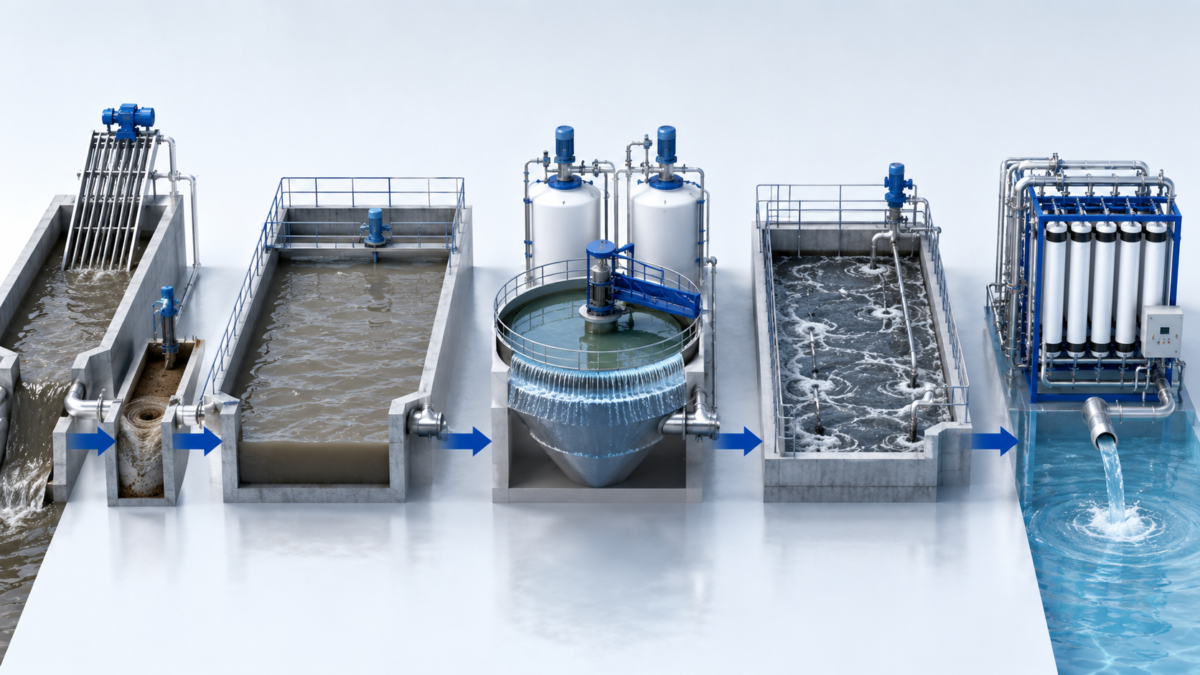
In outline, the wastewater treatment process runs in five steps, each taken up in its own section below:
-
Characterisation
Flow and content are measured; the data decide every stage that follows.
-
Physical treatment
Screens, grit and grease removal, balancing and settling take out the coarse load.
-
Chemical treatment
pH adjustment, coagulation and flocculation turn fine particles into flocs that settle.
-
Biological treatment
Microorganisms break down the degradable organic load.
-
Advanced treatment and sludge
Filtration and membranes prepare water for reuse; the separated sludge is dewatered and disposed of.
Why Is Wastewater Treatment Needed?
There are three basic reasons: legal obligations and discharge permits, the rising cost of water and corporate sustainability expectations; environmental responsibility is the common ground of all three. These headings are becoming ever more connected; wastewater treatment is becoming part of business strategy rather than merely a compliance requirement.
The legal dimension is the first motivation for most plants. Discharge conditions and permit processes are defined by the field of activity and the region; the plant is expected to produce an outlet water that meets those conditions.
Discharge limits, permit processes and obligations are set by the relevant regulations and the local authority; they vary with the sector, the receiving environment and the location of the plant. This article offers a technical framework; assessment for a particular plant and the management of official processes should be carried out with the competent authorities and specialists in the field.
The second reason is economic and grows in weight every year. Water is no longer an unlimited and cheap input. As the cost of mains water rises, reusing treated water turns directly into a saving.
The third is corporate expectations. In businesses that export and supply large customers, environmental performance has become part of audit and reporting processes. The presence of a wastewater treatment infrastructure is a concrete indicator in those processes.
International frameworks on industrial wastewater management reflect that whole-picture approach too; the US Environmental Protection Agency’s industrial wastewater resource offers a general perspective on how plants handle discharge management.
The Difference Between Domestic and Industrial Wastewater
Domestic wastewater has a relatively predictable content and consists largely of organic load. Industrial wastewater changes completely with the sector: dye and colour in textiles, a high organic load in food, heavy metals in metal plating, and special components in chemicals. There is therefore no single solution.
The difference sets the treatment strategy from the outset. In wastewater of a domestic character, biological treatment is usually at the centre; in industrial wastewater it is necessary first to establish which group of contaminants dominates.
Predictable content
It consists largely of organic load and suspended solids; the content is relatively stable.
- Organic load dominates
- The flow varies with the daily rhythm
- Biological treatment is at the centre
- The variety of contaminants is limited
It varies with the sector
It carries the mark of the production process; the content and flow can differ even from shift to shift.
- The contaminant profile is specific to the sector
- The flow and the load fluctuate
- Multiple stages may be needed
- Characterisation is essential
Making the sectoral differences concrete makes the subject clearer:
Textiles
Colour from dyes, a high organic load and variable pH come to the fore.
Food and Beverage
A high organic load, fats and greases and suspended solids dominate.
Metal Plating
Heavy metal content and an acidic or alkaline character are decisive.
Chemicals
Process-specific components and a variable contaminant profile are seen.
Automotive
Contaminants from oil, paint and surface treatment are present together.
Paper
Fibres, suspended solids and a heavy organic load stand out.
That table explains why no off-the-shelf solution can be offered. A wastewater treatment build can only be designed once the plant’s real wastewater profile is known. And that brings us to the next heading.
Characterisation: It All Starts with Analysis
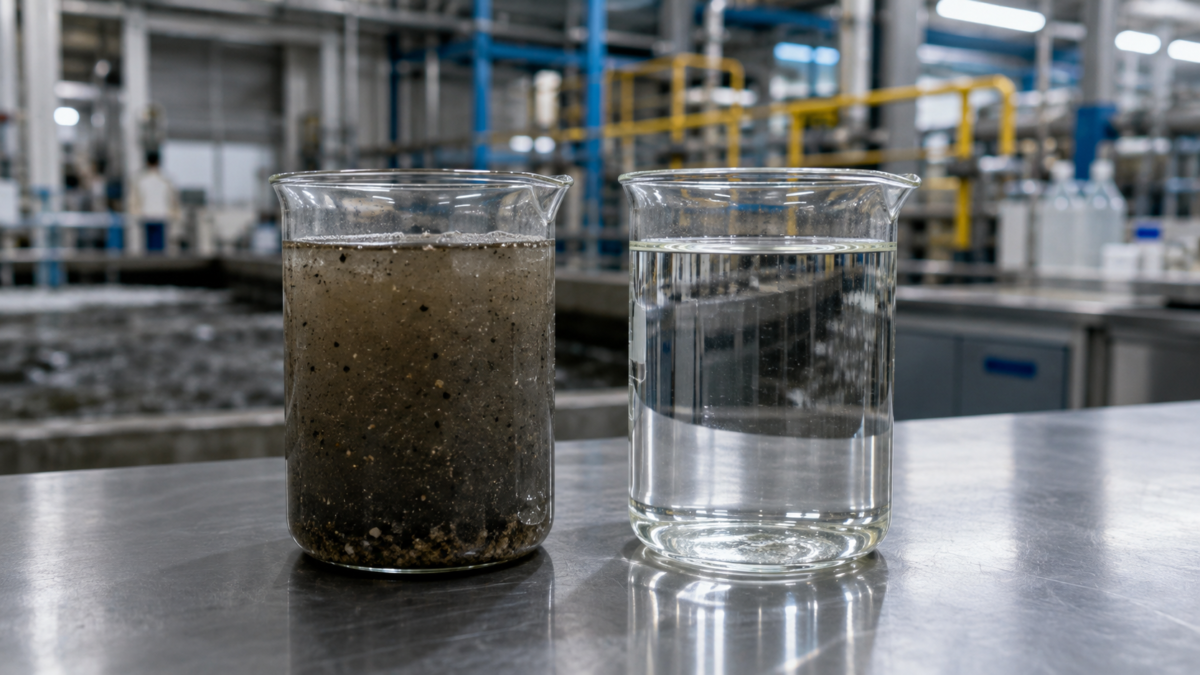
Wastewater characterisation is establishing the profile of the water by measuring its content and its flow. Flow, COD, BOD, suspended solids, fats and greases, pH, conductivity and heavy metals are assessed. Each parameter points to a different stage; without that data no system can be designed.
Characterisation is the diagnostic stage of a wastewater treatment project. Not a single sample but samples taken on different shifts and in different production conditions are assessed, because the content of industrial wastewater can change even within a day.
The main parameters assessed and what they point to are these:
| Parameter | What It Shows | The Stage It Points To |
|---|---|---|
| Flow | The daily and instantaneous volume of wastewater | The sizing of the whole system |
| COD | The load of chemically oxidisable matter | The chemical and biological stages |
| BOD | The biologically degradable organic load | Biological treatment |
| Suspended solids | The solids load carried in the water | Physical treatment, settling |
| Fats and greases | Oily components that separate at the surface | A grease trap, pre-treatment |
| pH | An acidic or alkaline character | Chemical conditioning |
| Conductivity | The dissolved salt and ion load | Advanced treatment, recovery |
| Heavy metals | The presence of metallic contaminants | Chemical precipitation |
The numerical values of these parameters vary across a very wide range with the sector and the process; it would not be right to give threshold values here. The assessment is made with an accredited laboratory report and a survey of the plant. We took up the logic of sampling and reading a report in our water analysis guide.
A heading often skipped in characterisation is flow fluctuation. Even where the total daily volume looks reasonable, the high flow arising at particular hours of production can strain the system. Balancing capacity is therefore planned at an early stage of the design.
Physical Treatment: The First Barrier
Physical treatment is the mechanical separation of coarse contamination from wastewater. Screens separate large solids, grit chambers settleable particles, and grease traps the oily components at the surface. A balancing tank regulates the flow; settling lowers the suspended solids load.
This stage is the first and most robust link in the chain. Its job is not only cleaning but protecting the sensitive stages behind it. When physical treatment is skipped, the chemical and biological stages tire within a short time.
Screen
Large solids and foreign objects are separated and the pumps protected.
Grit Chamber
Heavy, settleable particles are separated; wear on equipment is reduced.
Grease Trap
Oil and grease collecting at the surface are skimmed off and removed from the system.
Balancing
Fluctuations in flow and load are regulated; the stages that follow run steadily.
Settling
Suspended solids are settled out and separated from the water; the sludge is collected.
The balancing tank is the quiet hero of the system in most plants. Shift changes, cleaning periods and batch transitions in production change both the flow and the content of the wastewater abruptly. Balancing smooths that fluctuation and keeps treatment performance steady.
On the coarse particle side, different equipment comes into play; solutions such as separator filter systems are used to separate heavy solids at the head of the line. We took up the technical basis of filtration in our sand filter article.
The Chemical Treatment Stage
Chemical treatment consists of pH adjustment, coagulation and flocculation. With suitable chemicals, very small particles that will not settle are brought together and turned into settleable masses. They are then separated from the water by settling. The chemical to be used and the dosage are established by laboratory trials against the character of the wastewater.
The logic of that stage is “making the invisible visible”. Colloidal particles suspended in water do not settle on their own; because of the charges repelling one another they stay in suspension. Coagulation neutralises that charge, and flocculation grows the small flocs formed until they can settle.
pH adjustment is a precondition of the whole process. The efficiency of chemical reactions depends largely on the pH of the water; dosing carried out without the right range does not give the result expected. Chemicals used for that purpose, such as liquid caustic soda, are widely preferred in adjusting pH.
On wastewater containing heavy metals the chemical stage becomes more critical still; in suitable conditions the metals are precipitated and separated from the water. But no firm recipe can be given here.
The choice of chemical and the dosage are outside the scope of this article. The right chemical and dose are established by laboratory-scale trials (jar tests and the like) against the character of the wastewater. The wrong dosage both lowers treatment efficiency and needlessly increases the amount of sludge.
The Biological Treatment Stage
Biological treatment is the removal of the degradable organic load in wastewater by microorganisms. Working in controlled conditions, that living system uses the organic matter as food and markedly lowers the load. It is a central stage in food-related and domestic-character wastewater.
Chemical treatment is a reaction; biological treatment is an ecosystem. That distinction changes the approach to operation too. For the microorganisms to work, a suitable temperature, oxygen and nutrient balance is needed; when those conditions are upset, the system slows or stops.
The points to watch in operating the biological stage are these:
- Continuity: Because the system is alive, sudden stops and shock loads upset its performance.
- Shock loads: A sudden high concentration adversely affects the biological balance.
- Toxic components: Some industrial contaminants can be inhibitory to microorganisms.
- Dependence on pre-treatment: Without removing fats and suspended solids, the biological stage does not work efficiently.
- Balance: The nutrient balance and the operating parameters should be monitored regularly.
Biological treatment is therefore not suitable for every wastewater. On wastewater containing heavy metals or inhibitory components, the chemical stage comes first; the biological stage only makes sense once suitable conditions are in place. In a wastewater treatment chain, the order of the stages is as decisive as the choices.
Let’s establish the build that suits your plant’s wastewater profile
You can look at the solutions to clarify which stages you need from your characterisation result and your discharge target.
See the Wastewater SolutionsAdvanced Treatment and Water Recovery
Advanced treatment takes treated water beyond discharge level and makes it fit for reuse. Filtration, ultrafiltration and reverse osmosis are used for that purpose. Recovery lowers both fresh water consumption and the discharge load at the same time and contributes directly to the economics of the business.
That stage turns wastewater treatment from a cost item into a value-producing process. The treated water is no longer a flow to be “got rid of” but a resource returned to the plant.
The recovery chain generally advances in stages. Suspended structures are removed first; membrane technologies then come into play. Holding back the particle and colloidal load, the ultrafiltration stage protects the membrane behind it and secures the continuity of the system.
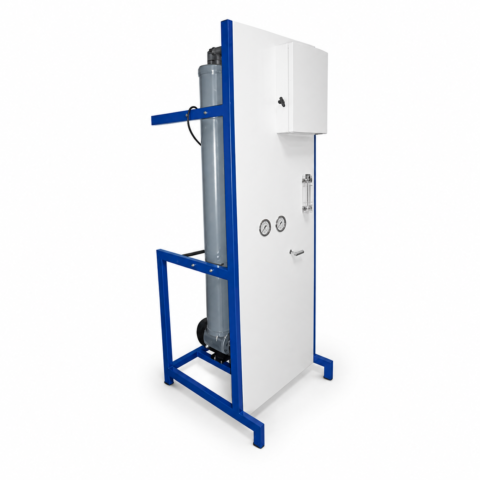
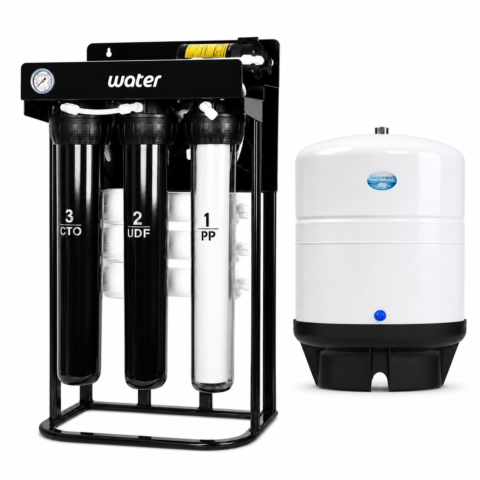
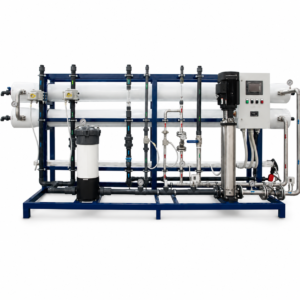
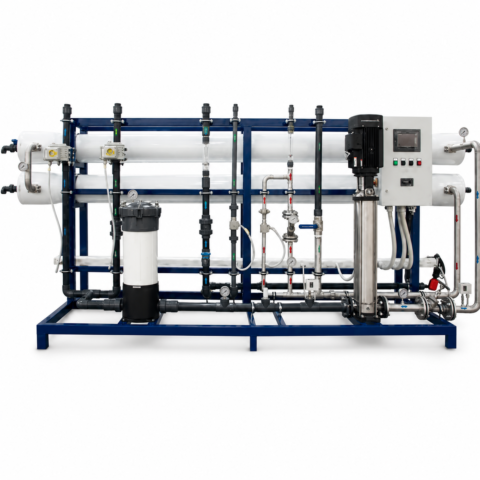
Where the dissolved salt load has to be lowered, reverse osmosis comes in. Used on high-flow installations, high-capacity reverse osmosis systems brings the recovered water to a quality that meets the requirements of the process.
Where can the recovered water be used? That depends on the quality reached and what the process expects. Cooling water, washing lines and garden irrigation are common uses. For water entering production directly the quality standard expected rises; we took that subject up separately in our process water article.
Recovery brings a gain on two fronts: the cost of buying fresh water falls and the volume of water discharged is reduced. That double effect markedly changes the payback calculation of a wastewater treatment investment.
Sludge Management
The contaminants separated from the water during treatment are collected as sludge. That sludge has to be dewatered and disposed of in line with the regulations. Sludge management is a significant item of running cost and should be planned from the outset when the system is designed.
Sludge is the inevitable output of wastewater treatment. Every contaminant separated from the water has to go somewhere, and that creates a solid or semi-solid flow. Often left in second place at the design stage, this heading comes quickly to the fore in operation.
Sludge management has three basic steps:
-
Thickening
The proportion of water in the sludge is reduced and the volume lowered; the load on the following steps is eased.
-
Dewatering
Water is removed further by mechanical equipment; a transportable and storable form is obtained.
-
Disposal
The sludge formed is disposed of by the methods set out in the relevant regulations and through authorised organisations.
The most important factor affecting the amount of sludge is the dosing approach in chemical treatment. Beyond a point, excess dosing does not raise treatment efficiency but markedly increases the volume of sludge. That shows directly in the cost of disposal.
A well-designed wastewater treatment system is therefore assessed not only by its outlet water quality but by the amount of sludge it produces. The two criteria have to be optimised together; focusing on one alone raises the total cost.
How Is the Right Solution Established for Your Plant?
The solution is established by five pieces of data: the wastewater characterisation, the flow and fluctuation profile, the discharge or recovery target, the space available and the operating capacity. No design can be made before those headings are clear. Because every plant is different, the process is always run on a survey and project basis.
A sound project runs in this order. First a survey is made; the production process, the points of water use and the sources of wastewater are examined on site. Samples are then taken for characterisation and analysed. In the third step the target is clarified: discharge, recovery, or both?
In the fourth step the stage build is created; which stages will be installed in which order is established. In the fifth step the space, the infrastructure and the level of automation are assessed. Finally the operating capacity is discussed: who will run the system, and with what knowledge?
That last heading is often overlooked but is decisive. A system designed perfectly in technical terms does not give the result expected if it cannot be operated. The level of automation should therefore be planned to match the plant’s technical staffing.
Incomplete Characterisation
A design based on a single sample cannot meet fluctuating loads.
The Wrong Target
When discharge and recovery targets are confused, the capacity is chosen wrongly.
No Balancing
If flow fluctuation is not managed, the stages run unsteadily.
An Operating Gap
If the team to run the system is not planned, performance falls over time.
A comprehensive wastewater treatment solution is therefore not a product but a project. The stages, the capacity and the automation are brought together according to the plant’s production structure. That approach ensures both that the investment is scaled correctly and that it can be operated over the long term.
Frequently Asked Questions
Is wastewater treatment compulsory for every plant?
The obligations vary with the field of activity, the character of the wastewater and the location of the plant. Discharge conditions are set by the relevant regulations and the local authority; an assessment specific to the plant is needed. The process should therefore be run together with the competent authorities.
How do I know which stages I need?
Wastewater characterisation establishes that. The flow, organic load, suspended solids, fats, pH and any heavy metal content are measured. The results set out which stages are needed and in which order; the design rests on that data.
Can I buy a standard package system?
Because the content of industrial wastewater varies from plant to plant, an off-the-shelf solution is not recommended. Even the wastewater of two factories in the same sector can differ. The right result comes from a project-based design resting on a survey and characterisation. Where the wastewater is domestic in character, such as sewage from an estate, a hotel or a construction site, a containerised packaged wastewater treatment plant sized from the flow can be the practical answer.
Can I reuse the treated water?
That is possible with advanced treatment stages. Using filtration, ultrafiltration and reverse osmosis, water can be brought to a quality fit for reuse. Where it can be used depends on the quality reached and the requirements of the process.
What happens to the sludge and how is it disposed of?
The sludge formed is first thickened, then dewatered to reduce its volume. Disposal is carried out by the methods set out in the relevant regulations and through authorised organisations. Sludge management is a significant item of running cost and should be planned from the outset.
Is biological treatment suitable for every wastewater?
No. The biological stage is effective on wastewater containing a degradable organic load. On wastewater containing heavy metals or inhibitory components a chemical stage is needed first; otherwise the biological system cannot perform as expected.
What should the first step be for an investment decision?
A survey and characterisation. The production process should be examined on site, the points where wastewater forms identified, and samples taken in different conditions. Budgeting and capacity planning done without that data will not be realistic.
What is the difference between water treatment and wastewater treatment?
Water treatment prepares incoming water for a use: drinking, a production process or a boiler. Wastewater treatment deals with the water after use, bringing it to a discharge standard or to a quality fit for reuse. At many plants the two meet, because recovered wastewater can be fed back into the industrial water treatment line.
Conclusion
Wastewater treatment today is not only a compliance requirement; it is an infrastructure decision touching cost, continuity and corporate reputation at once. Because industrial wastewater carries the mark of the production process, it is different at every plant; there is therefore no off-the-shelf solution. The right route is clear — a survey and characterisation first, then clarifying the target (discharge or recovery), then building the physical, chemical, biological and, where needed, advanced treatment stages in the right order. Sludge management and operating capacity are inseparable parts of the design. Approached in that framework, the system stops being a cost item and becomes an investment that lowers water consumption and secures the continuity of production.
Let’s plan characterisation and a survey for your plant
To engineer a solution suited to your wastewater profile, your flow and your targets, you can get in touch with the Water Point expert team.
Discover the Industrial Solutions