
What Is Antiscalant? The Chemical That Protects a Membrane from Scale
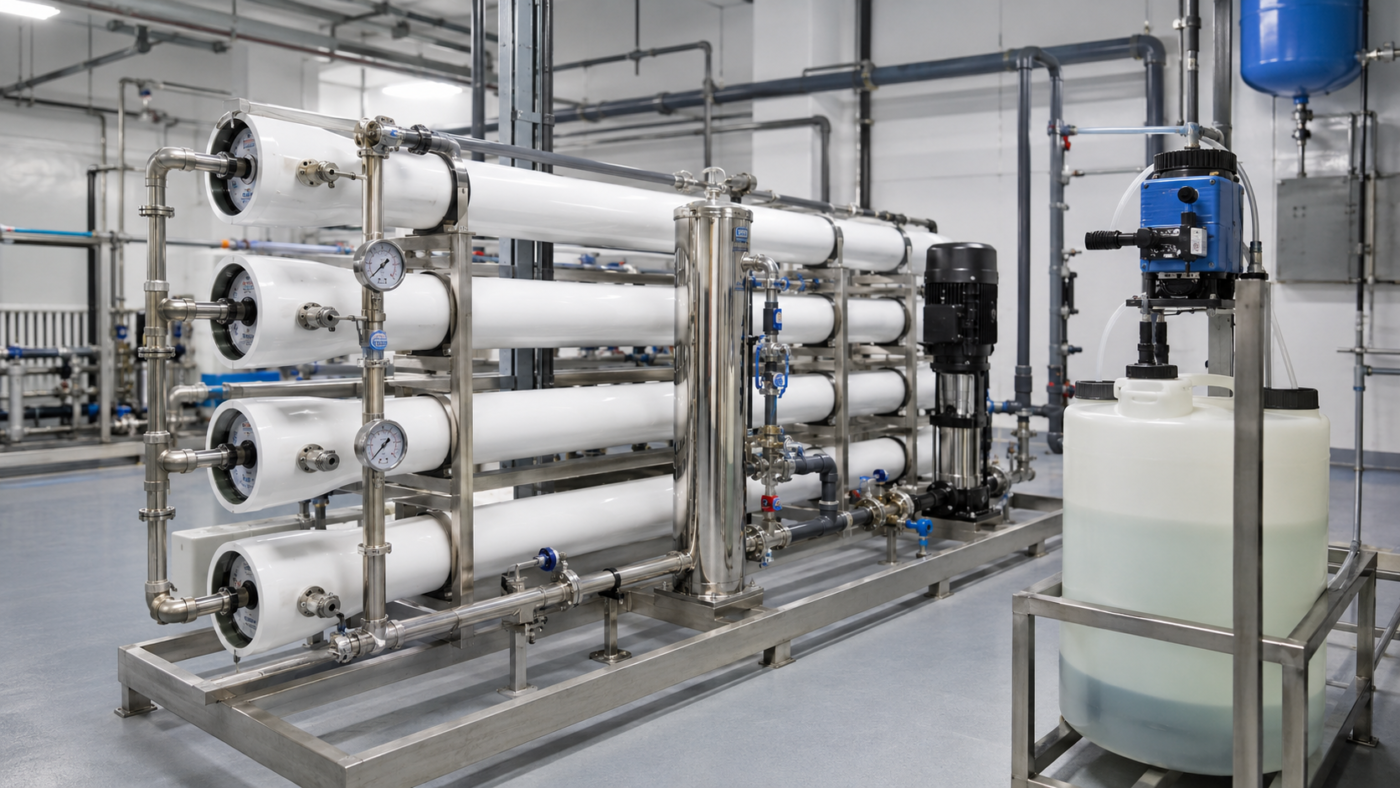
The system was commissioned a few months ago; the first weeks passed without trouble. Then the treated water flow began to fall away, the working pressure rose and the intervals between chemical cleanings grew shorter and shorter. In the end the membranes were replaced before they had reached their expected life and an unplanned item appeared in the budget. Behind that scenario there is usually one thing missing: antiscalant was never dosed, or was dosed wrongly.
In this guide we take up how scaling forms, by what mechanism antiscalant chemicals delay that process, what they solve and what they do not, and the effect of the right dosage on membrane life, in a technical but readable framework.
What Is Antiscalant and What Does It Do?
Antiscalant is a chemical additive that delays the build-up of limescale and salts on the membrane surface in reverse osmosis systems. Dosed before the membrane, it stops the dissolved salts crystallising and sticking to the surface. It thereby slows the loss of efficiency, reduces the frequency of cleaning and extends membrane life.
Its name says exactly what it does: “scale” is the crust and “anti” is against it. It is a scale inhibitor. But there is a critical distinction here — the chemical does not take limescale out of the water; it only delays its precipitating and attaching to the surface.
That distinction is decisive to understanding the whole subject. An antiscalant application does not change the mineral content of the water. Calcium and magnesium stay in it; what changes is the behaviour of those ions. Because crystal formation is delayed, the minerals leave the system with the concentrate flow before precipitating.
In industrial reverse osmosis systems this is positioned not as a consumable but as a protection strategy. The membrane is the most valuable component of the system; chemical protection delays one of the main mechanisms that wears it out.
How Does Scaling Form?
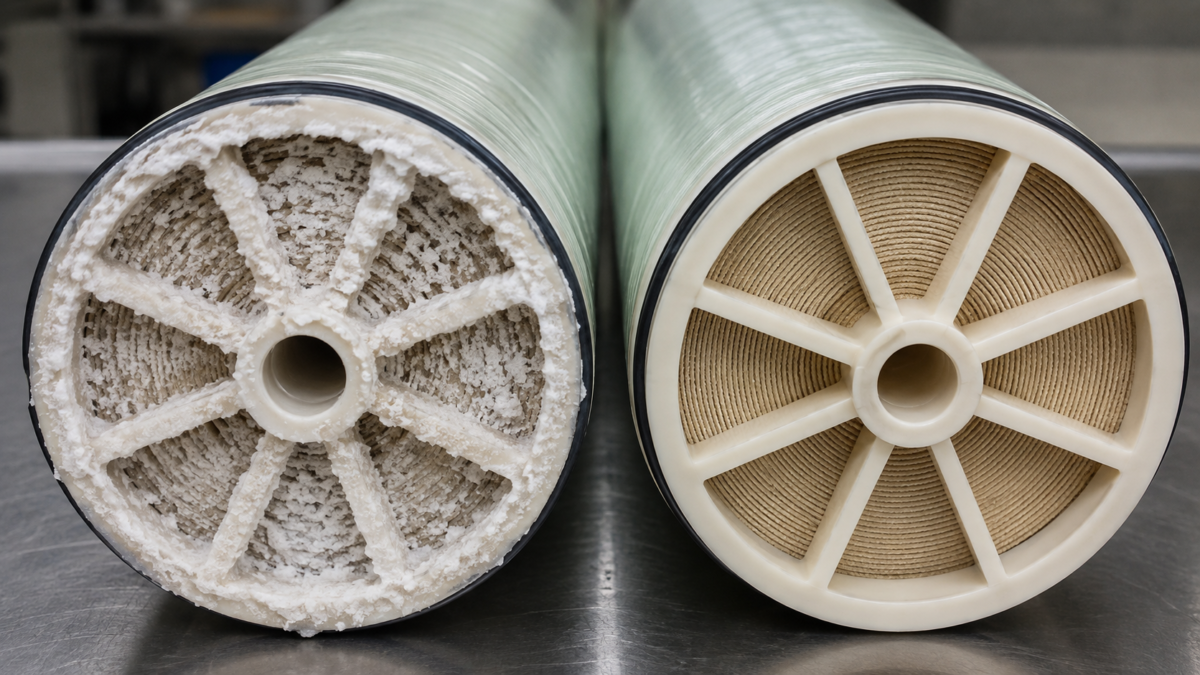
In reverse osmosis, as water passes the membrane, the dissolved salts left on the concentrate side become steadily more concentrated. At a certain point the solubility limit is exceeded and the salts start to crystallise. The crystals attach to the membrane surface and form a hard crust; that is called scaling.
To understand the mechanism it helps to look at how the system works. The membrane passes water and holds back dissolved substances. That means the water left on the concentrate side becomes a little more concentrated at every moment; as the water falls, the amount of salt stays the same.
That concentration does not go on for ever. Every compound has a solubility limit; once it is exceeded, the substance can no longer stay in the water and turns solid. Crystals form first as microscopic nuclei, then grow and bond together.
The membrane surface is an ideal ground for that process. Concentration is at its highest in the region close to the surface; the crystals forming there attach and build a hard layer. Once it has settled, removing that layer is far harder than delaying its formation.
That is why antiscalant application is not a solution that cleans off a crust that has formed but a measure that delays its forming. We set out the general framework of membrane technology in our membrane filter article.
The Damage Scaling Does to a System
Scaling produces six clear results: a fall in treated water flow, a rise in working pressure, higher energy consumption, more frequent chemical cleaning, poorer outlet quality and early membrane replacement. As that picture advances, the membrane loses its performance before it has completed its expected working life.
The most insidious thing about the damage is that it advances gradually. The system does not stop suddenly one day; it strains a little more each week. Businesses generally record it as “it has slowed a bit” and do nothing until the problem grows.
| Symptom | The Cause | The Effect on the Business |
|---|---|---|
| A fall in treated water flow | The crust on the surface makes passage harder | The production target cannot be met |
| A rise in working pressure | The system delivers the same flow by straining | The pump and equipment tire more |
| Higher energy consumption | High pressure demands more power | The running cost rises markedly |
| Frequent chemical cleaning | The build-up has to be removed regularly | Downtime and chemical costs rise |
| Falling outlet quality | The surface layer lowers separation efficiency | Process water quality falls below target |
| Early membrane replacement | Repeated cleaning and build-up tire it | An unplanned, high cost appears |
The last row of that table sums up the economics of the subject. The membrane is the most expensive component of a reverse osmosis system, and scaling is one of the main things that shortens its life. A relatively low-cost antiscalant application protects that expensive component.
Chemical cleaning is not entirely harmless either. Every cleaning cycle wears the membrane surface a little; more frequent cleaning shortens its life directly. The problem is therefore not only the cost of cleaning but the cleaning itself.
How Does Antiscalant Work?
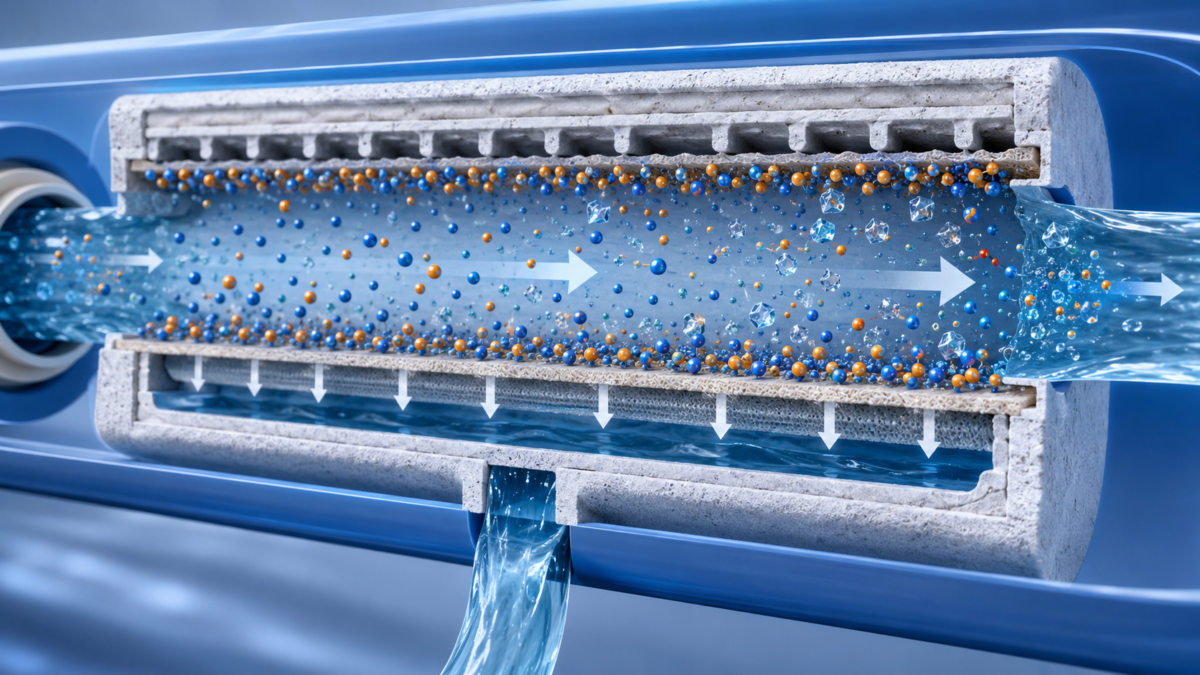
The mechanism works in three ways: it delays crystal nucleation, it stops the crystals that form from growing, and it keeps the particles apart so that they stay dispersed. The scale is thereby carried out of the system with the concentrate flow before it can stick to the membrane surface.
The first mechanism buys time. Crystal formation begins with the appearance of the first nucleus; the chemical additive delays that nucleation stage. In that time the water moves along the membrane and leaves the system through the concentrate line.
The second mechanism limits growth. If nucleation does take place, the crystal is stopped from growing. Structures that stay small never reach the mass needed to attach to the surface and are carried away with the flow.
The third mechanism is dispersion. The particles that form stay separate instead of bonding and clumping together. Dispersed particles cannot form a hard layer; they stay suspended and leave with the concentrate.
When those three effects work together, an antiscalant application also allows the system to run at higher recovery rates. For a technical framework on scale control in reverse osmosis systems, the US Bureau of Reclamation’s desalination research report takes up scale management in membrane systems in detail.
This chemical does not eliminate scaling entirely; it delays its formation and keeps it at a manageable level. The system still needs regular monitoring and periodic cleaning.
Which Types of Scale Is It Effective Against?
Antiscalant is used against the scale formed by sparingly soluble compounds. Calcium carbonate, calcium sulphate, barium and strontium sulphate and silica-based deposits are in that group. Which compound dominates is established by a water analysis, and the product is chosen accordingly.
Every type of scale behaves differently and calls for a different chemical approach. There is therefore no single product on the market; formulations differ according to the compound targeted.
Calcium Carbonate
The most common type of scale; it comes to the fore on water of high hardness.
Calcium Sulphate
Seen on sources high in sulphate; it forms a hard and stubborn layer.
Barium and Strontium
Compounds that can precipitate even at low concentrations and are hard to control.
Silica
It builds up by a different mechanism and can call for a special formulation.
Iron Compounds
Oxidised iron forms deposits on the surface and makes the problem worse.
Mixed Structures
Most waters contain more than one compound; the build is made accordingly.
The only way of establishing which compound dominates is a raw water analysis. Without measuring hardness, sulphate, barium, silica and iron content, the right product cannot be chosen. We took up the logic of sampling and reading a report in our water analysis guide.
Choosing an antiscalant from the analysis result directly determines the success of the application. A product aimed at the wrong target does not provide the protection expected and the problem continues.
What Does Antiscalant Not Solve?
This chemical is effective against scaling only. It provides no protection against sediment, colloids, organic contamination or biological fouling. Nor does it prevent chlorine damage. Those problems call for pre-filtration, activated carbon and suitable pre-treatment stages.
This section corrects a common false expectation. Some businesses take chemical dosing for “general protection” and save on pre-treatment. Yet there is more than one mechanism threatening the membrane, and each calls for a different measure.
| The Threat | Antiscalant | The Measure Needed |
|---|---|---|
| Scaling | It delays it | Suitable chemical dosing |
| Sediment and suspended solids | It is ineffective | Pre-filtration, a sand bed |
| Colloidal contamination | It is ineffective | Fine filtration, ultrafiltration |
| Organic contamination | It is ineffective | An activated carbon stage |
| Biological fouling | It is ineffective | Suitable pre-treatment and a cleaning programme |
| Chlorine damage | It does not prevent it | Activated carbon (essential protection) |
Chlorine damage is irreversible and this chemical offers no protection against it whatsoever. The carbon stage before the membrane is the only defence against chlorine; it should be renewed before it saturates.
We took up in detail how the protection on the chlorine side works in our activated carbon filter article. On the particle side pre-filtration is in play; we explained the role of the sand bed in our sand filter article.
In short, an antiscalant application does not replace pre-treatment; it complements it. Every link in the chain is positioned against a different threat, and when one is missing the membrane is left exposed on that side.
Why Is the Right Dosage Critical?
Too little does not provide the protection expected and scaling advances anyway. Too much is wasteful and in some conditions can create a further risk of fouling. The right amount is established from the raw water analysis and the system’s recovery rate, in line with the manufacturer’s instructions.
Dosage is the most technical heading in this application and cannot be managed by guesswork. The factors determining the amount are these:
- Raw water content: Hardness, sulphate, barium and silica levels are directly decisive.
- Recovery rate: The higher the proportion of water the system produces, the more concentrated the concentrate becomes.
- Temperature: Solubility behaviour changes with temperature; the dosage is adjusted accordingly.
- pH value: The tendency of some compounds to precipitate depends on pH.
- System design: The membrane array and the flow regime are taken into account.
The calculation bringing those variables together is generally run with projection software supplied by the manufacturer. It would not be right to give a numerical dosage here; it is calculated separately for every system.
The consequence of too little is clear: no protection is provided and scaling goes on advancing. The business thinks it is using a chemical but gets no result. Too much creates a different problem; as well as the unnecessary cost, in some conditions the chemical itself can become a source of fouling.
An antiscalant dosage is therefore a parameter calculated at installation and reviewed as the water analysis changes. On sources that vary with the season it should be reassessed periodically.
The Difference Between Antiscalant and Water Softening
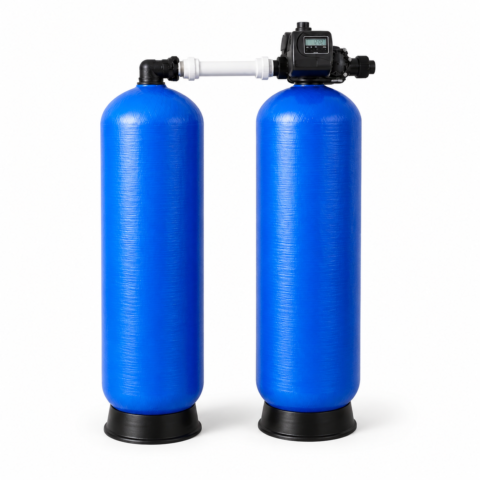
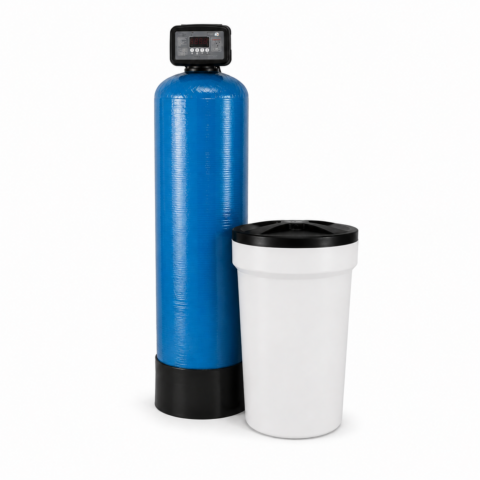
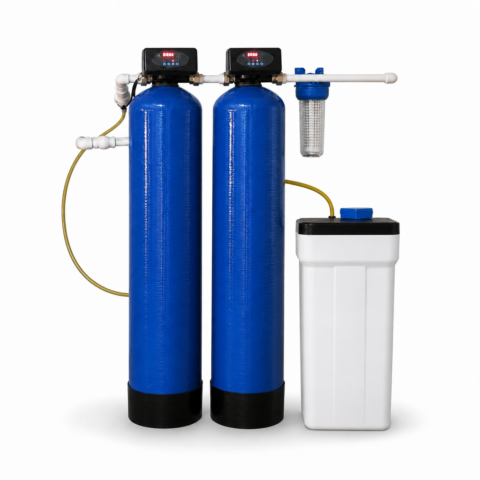
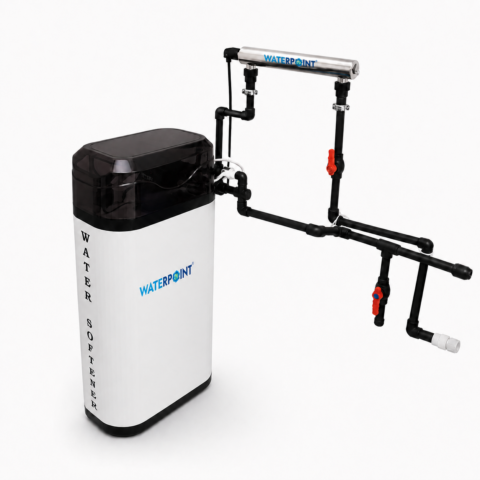
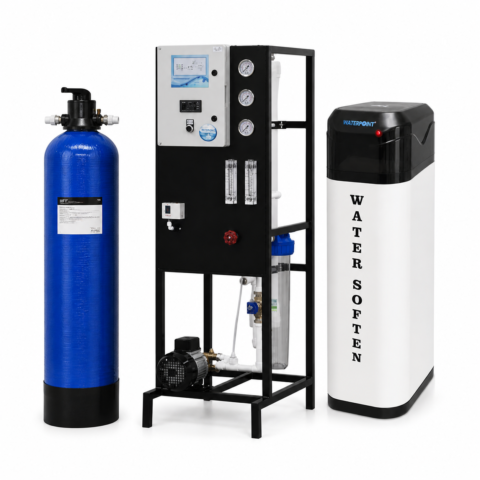
Water softening removes hardness ions from the water physically. Antiscalant does not remove the ions; it only delays their precipitating. Softening provides more certain protection but requires salt, regeneration and waste water. The chemical approach calls for far less infrastructure.
The two methods work on different logic and come to the fore in different scenarios:
It removes the ion from the water
Calcium and magnesium are held on resin by ion exchange; the water is genuinely softened.
- Hardness is removed at source
- Certain and predictable protection
- It requires salt and regeneration
- It creates a need for waste water and infrastructure
It delays precipitation
The ions stay in the water but are stopped from crystallising and attaching to the surface.
- A simple dosing setup is enough
- No salt or regeneration is needed
- There is a continuous chemical consumption
- It calls for precision in dosage
Which is preferred? That depends on the scale of the system, the character of the water and the operating conditions. At very high hardness softening gives a more certain result, while at moderate levels chemical protection can be adequate and more practical. We took up the selection criteria on the softening side in our softening system selection guide.
Using both together is common too. In some plants the hardness is first lowered with an industrial softening system and chemical protection is then brought in for the remaining risk. That pairing is preferred in systems aiming at high recovery in particular.
The decision should always be made together with the water analysis and the system design. What your process water quality target is also affects it; we took the subject up separately in our process water article.
The Dosing System and Its Application
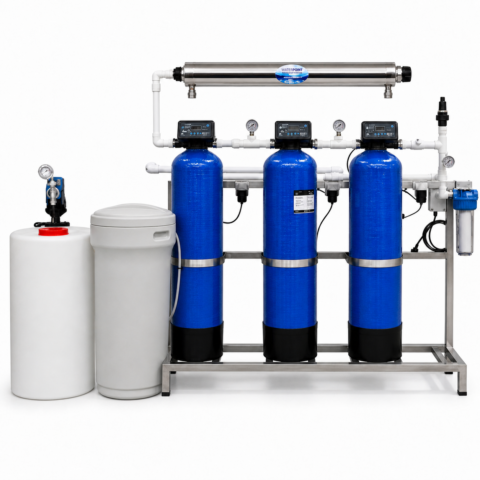
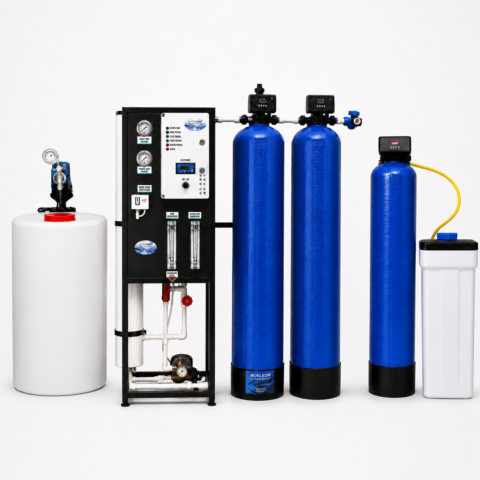
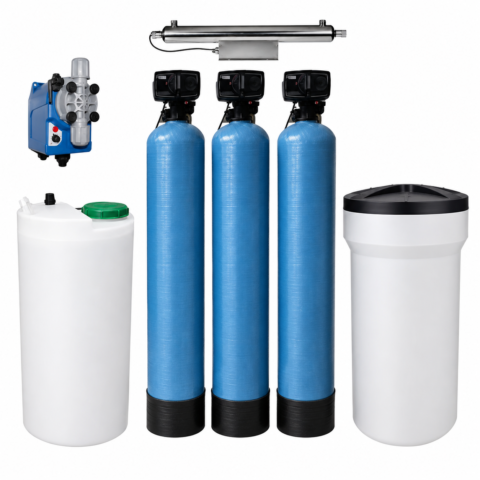
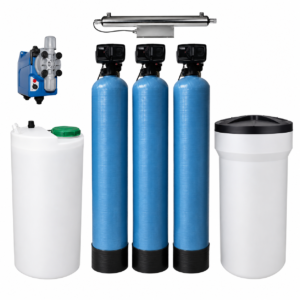
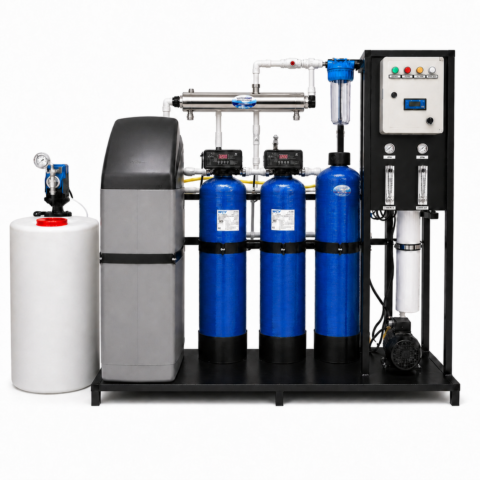
The chemical is fed into the line from a tank by a dosing pump. The right point is after pre-filtration and before the high-pressure pump. The chemical thereby mixes evenly into the water before reaching the membrane. When the system is stopped, the membrane has to be flushed.
A typical dosing arrangement is positioned in this order:
Pre-Filtration
Sediment and particles are held back; the line is fed with clean water.
Activated Carbon
Chlorine is removed; the membrane is protected from chemical damage.
Dosing
The chemical is fed into the line by the dosing pump and mixes into the water.
High Pressure
The water is raised to the pressure the membrane needs.
Membrane
Separation takes place; the risk of scaling is kept under control.
The choice of dosing point is not accidental. The chemical has to mix fully into the water before reaching the membrane; it is therefore dosed before the pressure pump but after the pre-treatment stages. Dosing before pre-filtration can lead to part of the chemical being held in the filters.
Stopping the system calls for a separate procedure. On long shutdowns, concentrated water is left on the concentrate side inside the membrane; the risk of scaling then rises. The membrane therefore has to be flushed properly before a shutdown.
The success of an antiscalant application depends as much on the dosing equipment working correctly as on the quality of the chemical. A blocked injector or a stalled pump leaves the system exposed while everyone believes it is protected.
This is an industrial application. Dosing chemicals by the user is not recommended on domestic water purifiers. The application should be carried out by a technical team and in line with the manufacturer’s instructions.
What Should Be Watched in Operation?
Regular water analysis, monitoring pressure and flow, chemical stock management and safety measures are the basic headings. When the character of the raw water changes, the dosage should be reviewed. In using chemicals, the manufacturer’s safety data sheet (SDS) must be followed and suitable protective equipment used.
Operating discipline determines whether this application is sustainable. The steps to follow are these:
-
Periodic water analysis
The character of raw water can change with the season; the dosage should be reassessed against that change.
-
Monitoring pressure and flow
Watching the pressure difference between stages and the production flow catches a loss of performance early.
-
Checking the dosing pump
That the pump is running, the injector is not blocked and there is chemical in the tank should be confirmed regularly.
-
Stock and storage
The chemical should be stored in the conditions stated by the manufacturer and in suitable closed containers.
-
Safety measures
Protective equipment such as gloves and goggles should be used, and the instructions in the safety data sheet followed.
-
Keeping records
Dosage settings, analysis results and cleaning dates should be recorded.
Keeping records is often skipped but is the most valuable tool over the long term. How the pressure and flow data move over time shows clearly whether scaling is advancing. Without that data, spotting a loss of performance is left to instinct.
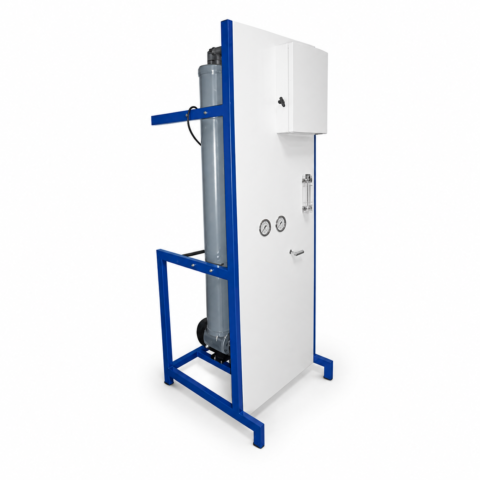
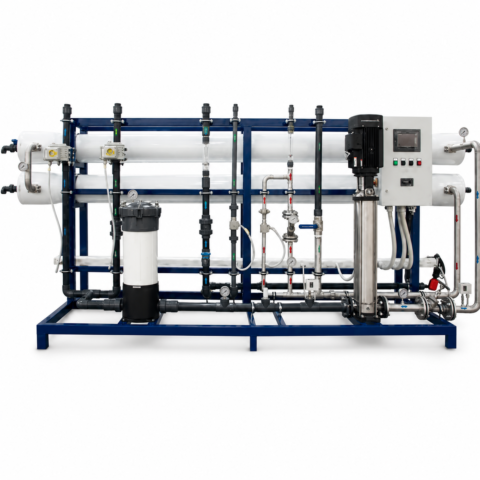
On high-capacity systems that monitoring is usually tied to automation. For plants wanting to assess the system as a whole, high-capacity reverse osmosis systems is engineered together with the dosing and monitoring infrastructure.
On the consumables side, continuity matters. Running out of chemical means the protection stops too. Antiscalant supply should therefore be included in the stock plan and kept uninterrupted.
Let’s establish the chemical and the dosage that suit your system
You can look at the options to plan the right product and dosing build from your raw water analysis and your recovery rate.
See the Scale Inhibitor SolutionsFrequently Asked Questions
Is using antiscalant compulsory?
Whether it is necessary depends on the character of the water and the system design. Protection is needed on sources of high hardness and a high tendency to precipitate, or in systems aiming at high recovery. The decision is made from the raw water analysis and a projection calculation.
Does it take limescale out of the water?
No. The chemical does not remove hardness ions from the water; it only delays their crystallising and attaching to the membrane surface. The ions stay in the water and leave the system with the concentrate flow. Plants wanting to remove hardness install a softening stage.
Can I set the dosage myself?
It is not recommended. The dosage is calculated by assessing the raw water content, the recovery rate, the temperature and the system design together. The manufacturer’s instructions and the projection output should be taken as the basis. Too little provides no protection, too much creates waste and further risk.
Does it prevent biological fouling too?
No. This chemical is effective against scaling only. Biological fouling, organic contamination and colloidal blockage call for suitable pre-treatment stages and a separate cleaning programme.
Can I use it in my domestic unit?
This is an industrial application, and dosing chemicals by the user is not recommended on domestic units. In domestic systems, protection comes from renewing the pre-filter stages on time.
What happens when the chemical runs out?
The protection stops and scaling starts to advance. The effect is not seen immediately; within a few weeks it shows as rising pressure and falling flow. Continuity of stock should therefore be part of the operating plan.
Would using the chemical instead of cleaning the membrane be enough?
No, the two are not alternatives. Chemical protection delays formation; cleaning removes build-up that has formed. In good operation the two are planned together, but the protection markedly reduces how often cleaning is needed.
Conclusion
One of the most common causes of lost performance in reverse osmosis systems is scaling, and its effect advances quietly: first the flow falls, then the pressure rises, then cleaning becomes more frequent and the membrane fails to complete its expected life. An antiscalant application delays that chain at source; it does not take the ions out of the water but stops them crystallising and attaching to the surface. Its limit is clear — it offers no protection against sediment, organic contamination, biological fouling or chlorine damage; those are the job of pre-filtration and the carbon stage. The right result depends on three conditions: a product chosen from the raw water analysis, a dosage calculated for the system design, and regular monitoring. With those three in place, a relatively small consumable cost protects the most expensive component of the system for years.
Let’s plan the right protection build from your raw water analysis
For a product choice and dosing build suited to your system’s recovery rate and the character of your water, you can get in touch with the Water Point expert team.
Discover the Industrial Solutions