
Pure Water for Window Cleaning: Spot-Free Glass and Building Faces

The team cleans the whole face of the office block in the morning. When the work is done the glass looks spotless; but towards noon, when the sun hits it, white marks appear on the surface. The client complains, the team goes back up the same face and the result is no different. In that cycle the problem is not the cleaning method or the staff — it is the water used. Pure water for window cleaning was developed to solve exactly that problem.
In this guide we take up how water spotting forms, why wiping does not remove it, and how rinsing with low-conductivity water changes the result. We also explain in the language of the business which water quality is needed, why softening alone is not enough, and how the system is sized.
Why Do Windows Stay Marked When They Dry?
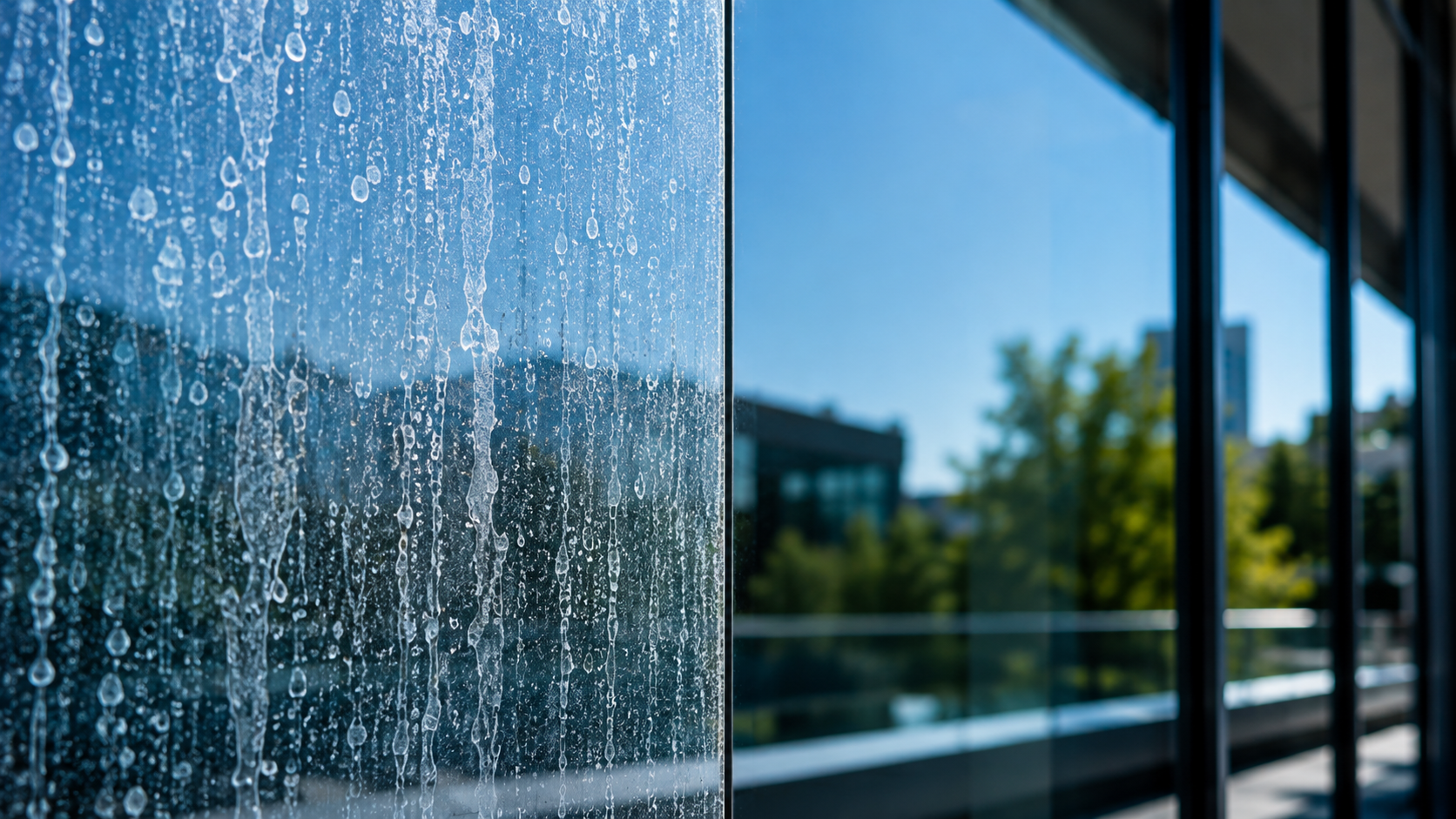
When water evaporates on a surface, the minerals dissolved in it stay on the glass and leave a white mark as it dries. That mark is not a cleaning error but a result of the content of the water. Treated water with a reduced dissolved solids load leaves no such residue behind when it dries.
The mechanism is simple and entirely physical. As a drop of water on the glass evaporates, only the water molecules go into the air; the calcium, magnesium and other dissolved components in it stay on the surface.
However carefully the cleaning is done, therefore, if the water used for rinsing contains minerals the result is the same. Once drying is complete the mark becomes visible.
The mineral content of water varies from area to area. For a technical framework on the idea of hardness, the US Geological Survey’s water hardness resource can be consulted; the resource sets out that the dissolved minerals in water occur naturally and that the amounts differ by area.
That finding is the starting point of the pure water for window cleaning approach: the problem is not on the surface but in the water applied to it.
How Does Water Spotting Form?
The drop attaches to the surface and begins to evaporate. As the water falls, the mineral concentration in it rises; when the drop has dried completely, the minerals stay on the surface as a ring or a mark. Because sun and wind accelerate evaporation, the mark forms more clearly.
Picturing the process makes it clearer:
Rinsing with Water Containing Minerals
As the drop evaporates the minerals stay on the surface. Once drying is complete, white rings and marks become visible; in the sun the effect is more pronounced.
Rinsing with Treated Water
Water with a reduced dissolved solids load leaves no residue behind when it evaporates. The surface dries on its own and no mark forms.
What that difference means for the business is clear: in the first scenario the team has to go back to the same surface, in the second the job is finished in one pass.
There are also conditions that make a mark more visible. Faces in direct sun, windy weather and hot surfaces all accelerate evaporation, and that leaves a denser mineral mark.
Surfaces other than glass get their share of the effect too. The same mineral residue builds up on aluminium and composite cladding, on stainless railings and on frame profiles. A pure water for window cleaning application is therefore an approach covering the whole face of the building.
Why Are Detergent and Wiping Not Enough on Their Own?
Wiping spreads the water on the surface but does not remove the minerals in it. When the thin film of water left behind dries, the mark forms again. On upper floors and wide faces it is also practically impossible to wipe every surface; that makes the problem permanent.
The logic of the traditional method is this: take the water off the surface as fast and as completely as possible. That approach works; but it depends on two conditions — being able to reach the surface and being able to take off all the water.
In practice those two conditions are often not met:
Limits of Access
On upper floors and wide faces, physical access to every surface may not be possible.
The Thin Film Left Behind
Even in the most careful wiping, a thin film of water is left on the surface and leaves a mark as it dries.
Edges and Corners
Water collecting at the frame edges can run down later and leave a mark on the surface.
Fast Drying
In sunny, windy weather the water can dry before the wiping is finished.
Chemical Residue
Detergent that is not rinsed off enough can leave a separate mark on the surface.
The Cost in Time
Wiping every surface separately lengthens the team’s time markedly.
That table shows why the problem has to be solved not with the method but with the input. Wiping cannot stop the mineral staying on the surface; it only spreads it.
The same logic applies in a different sector. The source of the marks left after drying in car washing is the same; we took the subject up separately in our car wash water treatment article. The focus of this piece is glass and building faces.
How Is Pure Water Used in Window Cleaning?
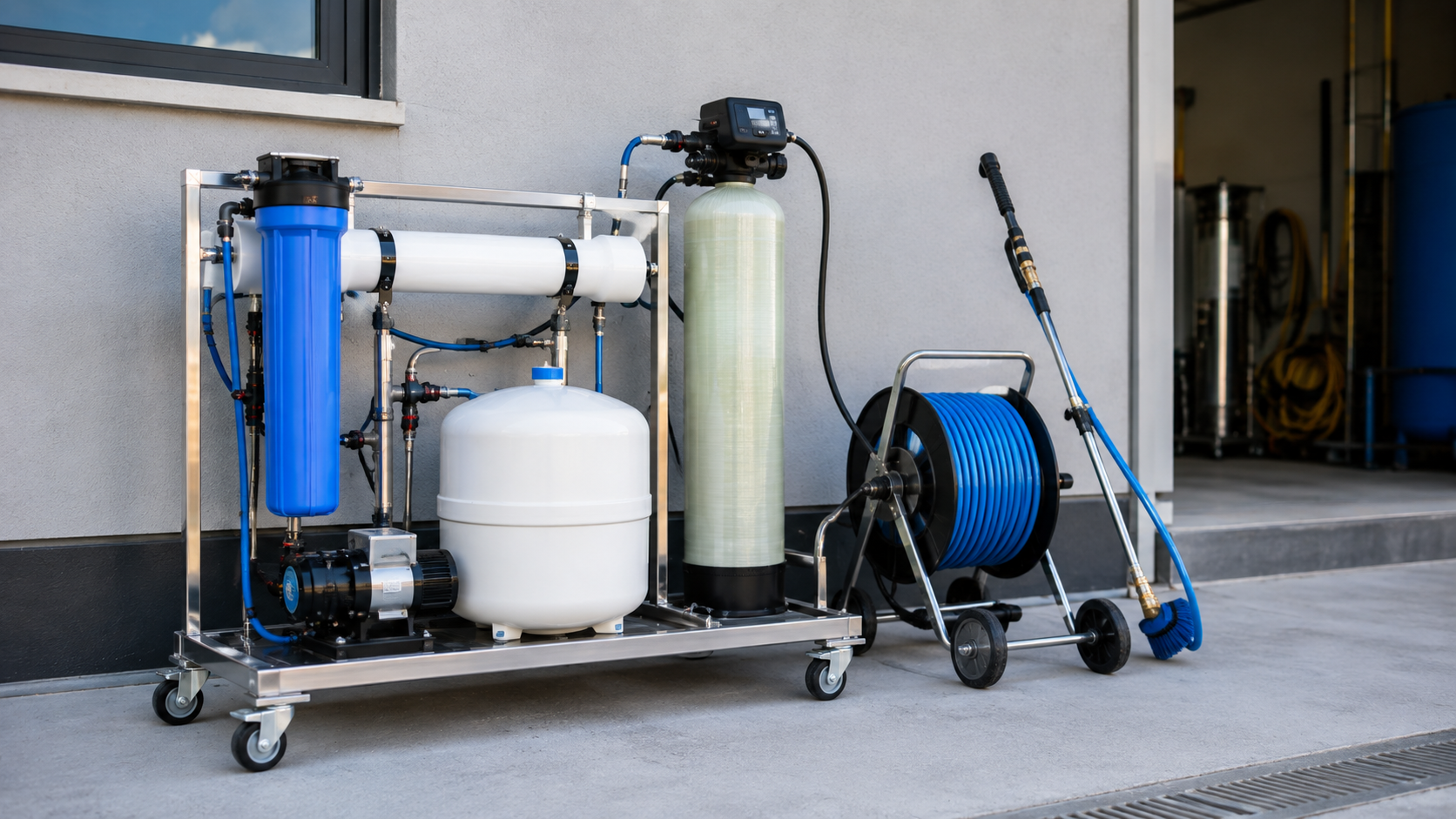
The treated water is applied to the surface through a telescopic brush pole system. The brush releases the dirt mechanically while the running water rinses the surface. The surface is then left to dry on its own; because the dissolved solids load in the water has been reduced, there is no need for a wiping step.
The logic of the application differs from the traditional method on one basic point: the aim here is not to take the water off the surface but to rinse with water that leaves no mark behind.
The process runs in these steps:
-
The Water Is Treated
Mains water is passed through the system and its dissolved solids load reduced. The outlet quality directly determines the result of the application.
-
The Surface Is Brushed
The dirt on the surface is released mechanically by the brush at the end of the telescopic pole. The water goes on flowing through the brush at the same time.
-
It Is Rinsed with Plenty of Water
The released dirt and residue are carried off the surface with treated water. The rinse has to be thorough.
-
The Surface Dries on Its Own
The water left behind evaporates and, containing no minerals, leaves no mark. There is no need for a wiping step.
The fourth step is the clearest difference of the method. The team can move on to the next section without drying the surface, and that markedly shortens the workflow on wide faces.
On the system side the installation can be made in two ways. In a fixed installation the treatment unit sits inside the site and is fed from the line. In a mobile installation the unit is carried on a vehicle; that approach is preferred by teams working at different sites.
What is decisive in both builds is the same: the quality of the outlet water. Pure water for window cleaning The result of the application depends directly on that quality.
Which Water Quality Is Needed?
The aim in the application is for the conductivity of the water to be as low as possible. Conductivity is the indicator of the dissolved ion load in water and is directly related to whether it leaves a mark. Reverse osmosis and deionisation are therefore used together in most builds.
Conductivity is the basic parameter followed in this application. When the value rises there are more dissolved ions in the water, and that raises the risk of a mark after drying.
It would not be right to give a numerical target here; the quality needed is established from the profile of the inlet water and the expectations of the application. We took up what the measurement tells you and what it does not in our dissolved solids and conductivity article.
Two stages generally work together to reach the quality target:
It lowers the main load
The membrane separates up to 99% of the dissolved substances. It is the main treatment stage of the system and markedly reduces the load before deionisation.
It holds the remaining ions
The resin bed holds the trace ions that pass the membrane and lowers the conductivity further. It is positioned as the final stage and delivers the target quality.
We took up how the membrane works and what it separates in our how reverse osmosis works article. We explained the technical side of deionisation in detail in our deionised water article; we are not repeating the technology here.
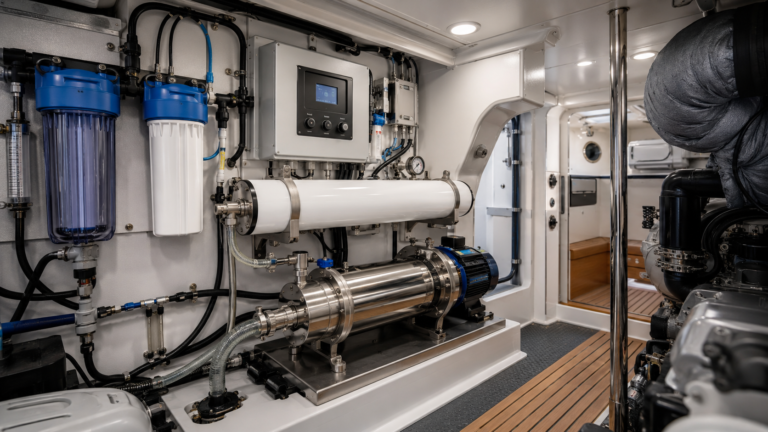
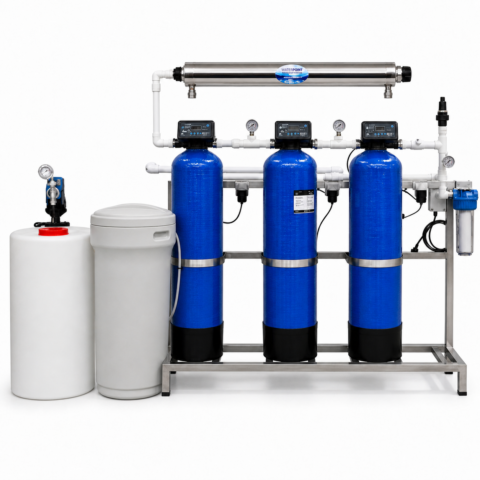
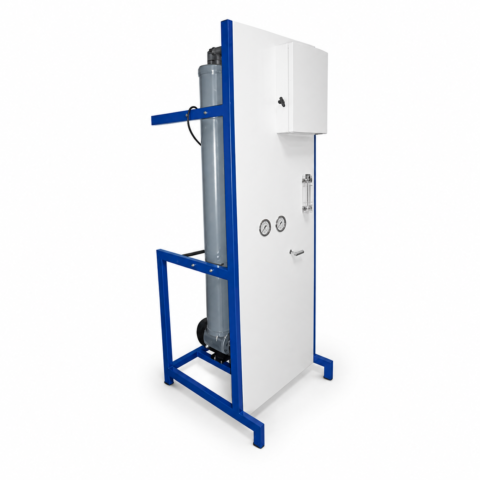
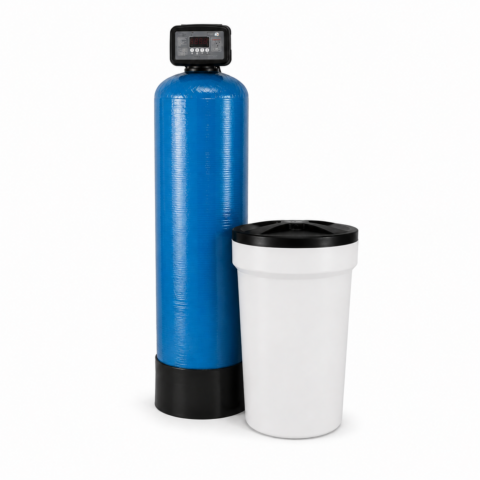
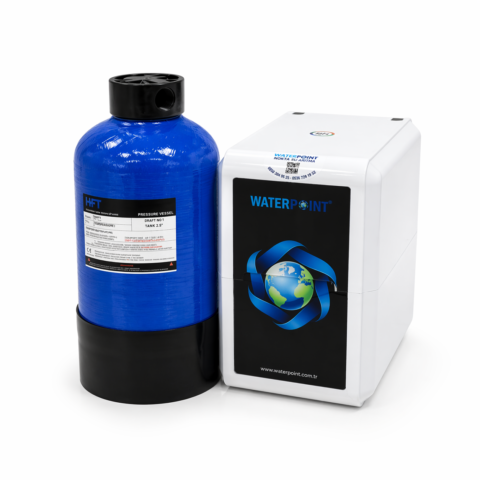
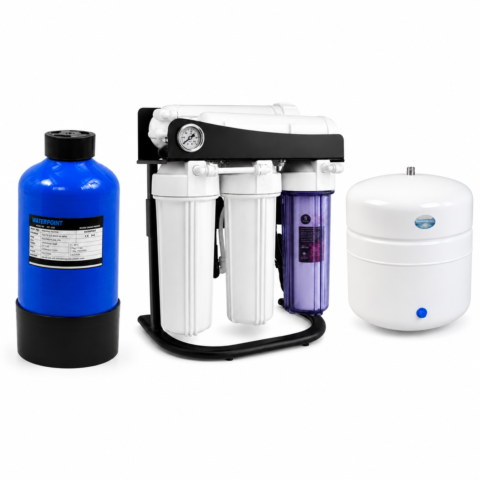
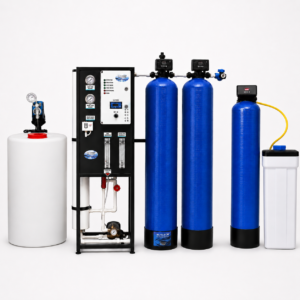
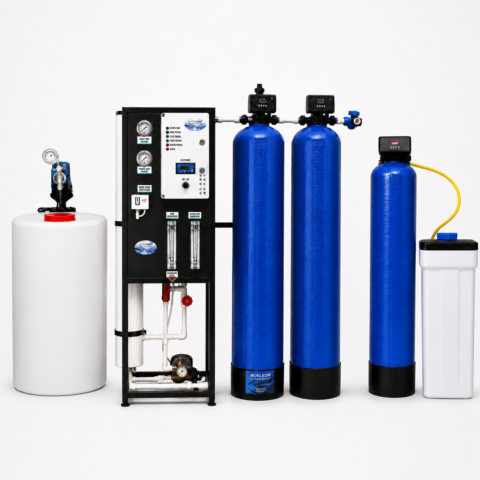
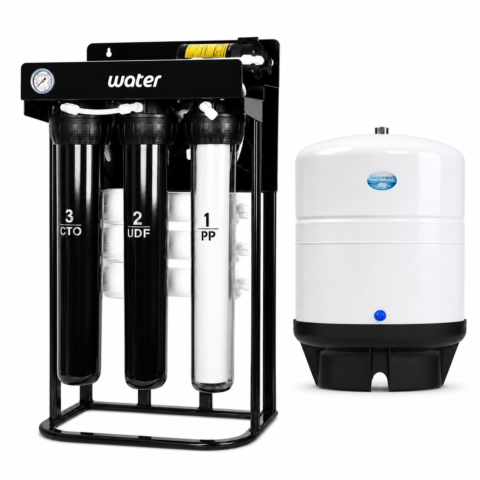
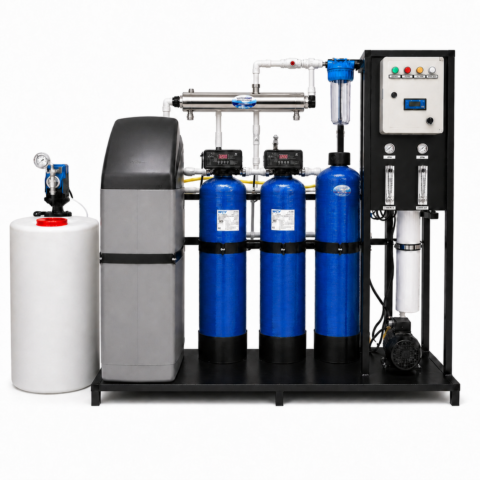
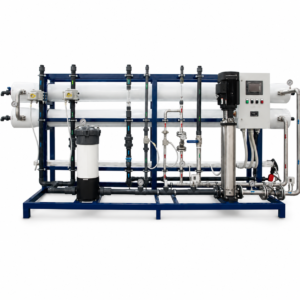
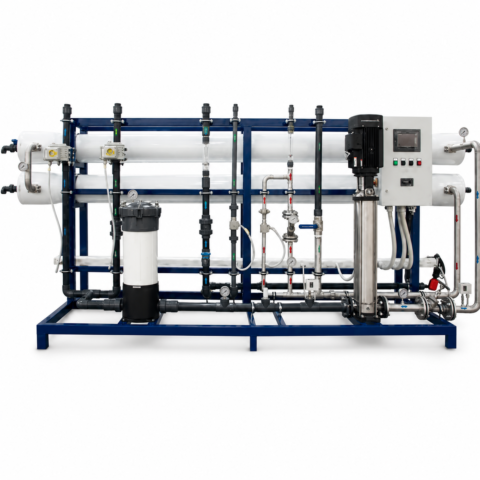
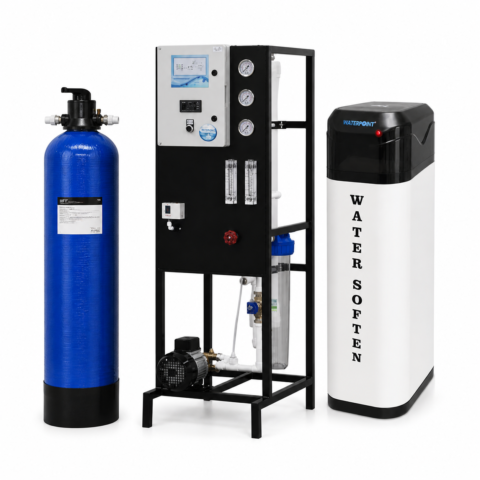
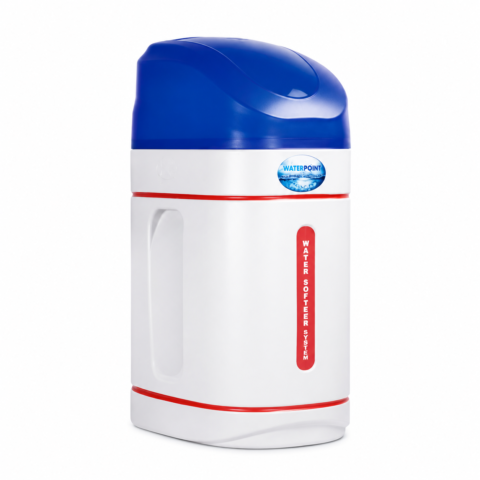
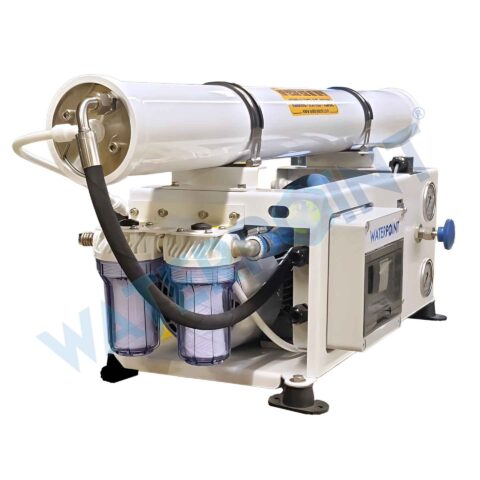
The equipment used in the application is built around those two stages too. For the main treatment, high-capacity reverse osmosis systems are used, and for the final stage, deionised pure water systems.
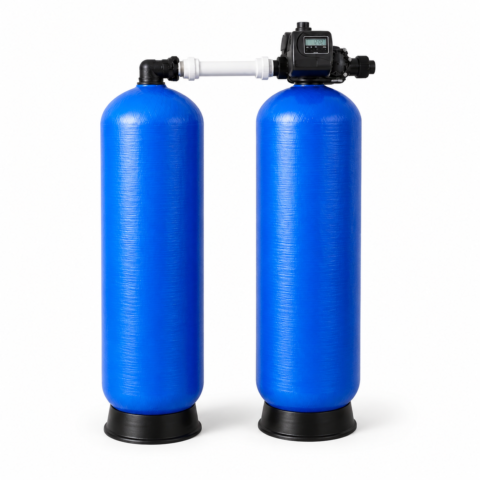
On the resin side, mixed bed products are used; when the time to renew comes, the bed is refreshed with mixed bed pure water resin.
Is Softening Enough?
No. Softening exchanges the calcium and magnesium ions that give hardness for sodium; but the dissolved solids load remains in the water. That water still leaves a mark when it dries. A spot-free result calls for the conductivity to be lowered, and that is a different stage.
This is the most common misdirection in the application. The “there is a limescale problem, let us fit a softener” approach is right for protecting equipment; but it is not enough for the aim of leaving no mark on a surface.
The difference between the stages can be summed up as follows:
| Stage | What It Does | The Result on Glass |
|---|---|---|
| Softening | It exchanges hardness ions for sodium | The dissolved load remains; marks go on forming |
| Reverse osmosis | It separates up to 99% of the dissolved substances | Marks are markedly reduced |
| Deionisation | It holds the remaining trace ions | The spot-free result aimed for is achieved |
| Pre-filtration | It holds sediment and particles | No direct effect; it protects the stages behind it |
| Activated carbon | It reduces the chlorine and organic load | No direct effect; it protects the membrane |
The first row of that table is the summary of this section. Softening does not meet the aim of this application; but it is not left out either — as the maintenance section shows, it takes on the job of protecting the membrane.
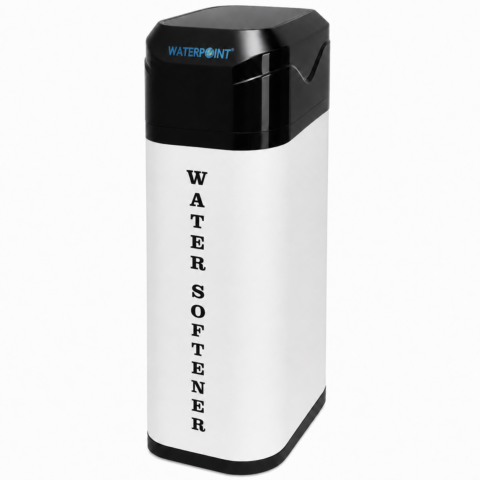
We took up how softening works and which criteria it is chosen on softening selection guide.
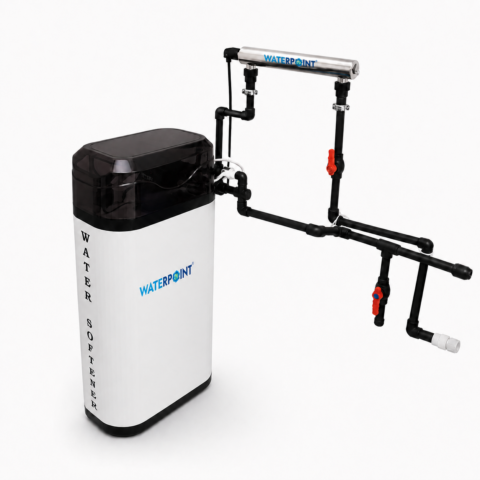
Softening and pure water production are not alternatives to one another. Softening handles hardness and protects the membrane; the stages that lower conductivity produce the water that leaves no mark on a surface. Pure water for window cleaning In a build they generally work together on the same line.
The Advantage on Upper Floors and Building Faces
Because the work can be done from the ground with a telescopic pole, the need for scaffolding and platforms can be reduced on some surfaces. Because the wiping step disappears, the time taken on wide faces is shorter. Conditions for working at height are always established in line with the relevant health and safety regulations and an expert assessment.
Measured language is needed in this section. The method can reduce the need for access on some surfaces; but it cannot be claimed to offer a solution valid for every building face.
The effects of the application on site are these:
Working from the Ground
A telescopic pole can give access from the ground to surfaces at certain heights.
A Shorter Working Time
Because there is no wiping step, the team can leave the surface and move to the next section.
Less Repeat Work
Because no mark forms, the need to return to the same surface a second time disappears.
The Set-Up Load
On some surfaces the need to set up platforms and scaffolding can be reduced.
The Whole Face
Glass, frames and cladding can be rinsed in the same pass.
Easier Planning
When the working time is predictable, planning the site becomes clearer.
This article gives no advice on methods of working at height. The method of access, the choice of equipment and the safety measures should be established in line with the relevant health and safety regulations and an expert assessment. Every building face is assessed on its own conditions.
The limits of the method should be stated too. A telescopic pole gives access up to a certain height; beyond that, different solutions are assessed. Extra work may also be needed on surfaces with heavy contamination or sticky residue.
The Effect on Chemical Use
When working with treated water, the need for detergent can be reduced in many applications; part of the dirt is released by mechanical brushing and plenty of rinsing. No chemical residue is left on the surface either, because the rinse water leaves no mark behind.
The size of that effect varies with how dirty the surface is and with the application; it would not be right to promise a percentage here.
What the change on the chemical side means for the business comes under two headings. The first is the change in consumables; the second is that no residue is left on the surface after rinsing.
The second heading matters particularly. In the traditional method, detergent that is not rinsed off enough can leave a separate mark on the surface, adding a problem on top of the mineral mark. Rinsing thoroughly with treated water removes that risk.
There is a simplification on the team’s side too: when the amount of chemical carried falls, site logistics get lighter. That is a practical gain for teams working over wide areas.
Which products are used on which surface is outside the scope of this article; that assessment should be made in line with the manufacturer’s information for the products you use. What is taken up here is only the water side of the pure water for window cleaning application.
How Is the System Sized?
In sizing, the surface area cleaned each day, the number of teams working, whether use is mobile or fixed, the storage tank required and the hardness and dissolved solids load of the inlet water are assessed together. The final capacity is engineered from the water analysis.
Sizing in this application depends on two variables: how much water will be consumed and how much load the inlet water carries. The second is often overlooked; yet a system of the same capacity performs differently on different inlet water profiles.
The headings to assess are these:
-
Have the Inlet Water Analysed
The hardness and dissolved solids load directly determine both the stage build of the system and the consumables it uses.
-
Work Out the Daily Surface Area
How much building face is cleaned on an average day is the basic input for the amount of water needed.
-
Establish the Number of Teams
How many teams work at the same time? Simultaneous use defines the peak demand.
-
Decide Between Mobile and Fixed
A vehicle-mounted build is assessed for teams working at different sites, a fixed installation for those working at a single location.
-
Plan the Storage Requirement
The tank capacity is established to balance the rates of production and consumption; on site work that is a critical heading.
-
Confirm the Infrastructure
The equipment layout, the power supply, the drain connection and the filling point are settled in advance.
The fifth step is decisive for site teams in particular. The system produces continuously; but the team consumes heavily on site. The tank capacity balances those two rates.
We took up the general logic of a capacity calculation and what to watch for at business scale in our industrial-type system selection guide. The final capacity is always engineered from the inlet water analysis and the daily surface area.
Maintenance and Continuity of Operation
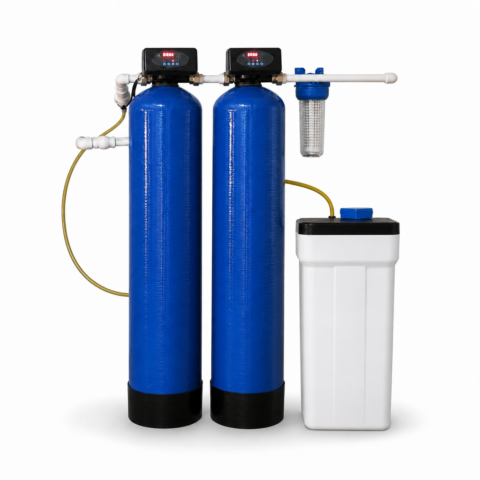
The continuity of the system depends on three headings: renewing the pre-filtration on time, monitoring membrane performance and following the resin bed. Where the inlet water is hard, a pre-softening stage protects the membrane and makes consumable use predictable.
In this application maintenance directly affects the quality of the output. When the resin tires the conductivity rises and marks start to appear on surfaces; that means doing the job again.
The headings to follow are these:
- Outlet conductivity: The most direct indicator of the application; it should be monitored regularly.
- Pre-filtration: The sediment and carbon stages are renewed when saturated; they protect the membrane.
- The state of the membrane: Changes in the production rate and the outlet quality are monitored.
- The resin bed: It is renewed when it has completed its capacity; the outlet conductivity shows that.
- Pre-softening: On hard inlet water it reduces the scaling load on the membrane.
- Following the salt: Where there is pre-softening, the salt level is checked regularly.
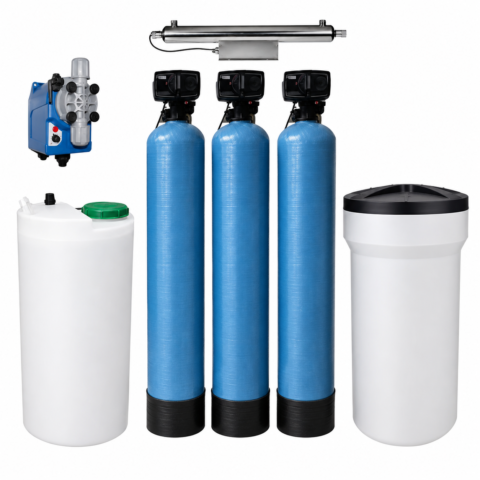
The fifth item is the most decisive economically. Where pre-softening is not used on hard inlet water, the membrane tires faster and the resin bed saturates far sooner. Used for that purpose, industrial softening systems keeps consumable use under control.
We took up the structure of the membrane and the mechanism of ageing in our membrane filter article, and the working principle of resin and the factors determining its life in our resin article.
Water Point Su Arıtma Teknolojileri operates from Esenyurt, İstanbul under its founder Ali Genç, with more than 20 years of experience in the sector.
Survey
The survey is free if the unit is purchased from us; where only a survey and measurement are wanted, a survey fee of ₺2,000 applies. The solution proposed is established from the water analysis.
Service Network
For industrial systems there is a service network across Türkiye; for home units service is provided in İstanbul and the neighbouring provinces such as Kocaeli and Tekirdağ.
Warranty
Units, valves, pumps and tanks carry a 2-year warranty and taps a 1-year warranty. Filters, membranes, resin and salt are consumables and fall outside the warranty.
Spare Parts Cover
Filters, membranes, resin and salt are consumables; valves, pumps and tanks are durable spare parts.
Contact
For survey and engineering requests, 0850 304 95 25 and [email protected] can be used.
Let’s establish the capacity and the stages for your business
You can look at the solutions to assess a system suited to your inlet water analysis and your daily surface area.
See the Pure Water SystemsFrequently Asked Questions
Is there really no need to wipe with pure water?
That is the logic of the application. Because water with a reduced dissolved solids load leaves no residue behind when it dries, the surface is left to dry on its own. What is decisive is the quality of the outlet water and rinsing thoroughly.
Can the system be moved?
The installation can be built either fixed or mobile. A vehicle-mounted installation is preferred for teams working at different sites, while businesses working at a single location have a fixed installation. The decision follows the pattern of work.
Is softening enough?
No. Softening exchanges the hardness ions but the dissolved solids load remains in the water; that water still leaves a mark when it dries. A spot-free result calls for stages that lower the conductivity. Softening, though, is valuable as a first stage protecting the membrane.
Which capacity is needed?
The capacity is established by assessing the surface area cleaned each day, the number of teams, simultaneous use and the load of the inlet water together. It would not be right to give an exact figure; the system is engineered from the water analysis.
When is the membrane changed?
There is no fixed period. The decisive indicators are a fall in the production rate and a decline in the outlet quality. Renewing the pre-filtration on time and using pre-softening on hard inlet water support the module serving for its expected life.
How is the outlet quality followed?
The most direct method is measuring the outlet conductivity regularly. When the value starts to rise, the resin bed has usually completed its capacity. That monitoring gives the chance to act before marks appear on a surface.
Can it be applied to every building face?
The method can be used on glass, frame and cladding surfaces. But a telescopic pole gives access up to a certain height; beyond that, different solutions are assessed. The method of access is established in line with the relevant health and safety regulations and an expert assessment.
Does it work on heavy contamination too?
The method rests on releasing the dirt mechanically with a brush and rinsing thoroughly. On heavy contamination such as sticky residue, paint and building debris, extra work may be needed. The method to be used should then be assessed according to the type of surface.
Can mains water be used directly?
Mains water contains dissolved minerals and leaves a mark on a surface when it dries. It is therefore not used directly in this application; the conductivity has to be lowered for the result aimed for. The stages needed are established from the inlet water analysis.
Conclusion
The pure water approach to window cleaning is less a change of method than a change of input. The mark on the surface comes not from a cleaning error but from the dissolved minerals in the water; the water evaporates and the minerals stay on the surface. Wiping does not remove those minerals, it only spreads them — and on upper floors it is practically impossible to wipe every surface. The answer is to rinse with water of reduced conductivity and leave the surface to dry on its own. Softening does not meet that aim on its own; reverse osmosis lowers the main load and deionisation holds the remaining ions. Once the build is complete, the team does not return to the same surface a second time. And the right order is clear: an inlet water analysis first, then capacity from the daily surface area and the number of teams, then regular maintenance and monitoring of conductivity.
Let’s engineer the system that suits your site together
The survey is free if the unit is purchased from us; where only a survey and measurement are wanted, a survey fee of ₺2,000 applies. The solution proposed is established from the water analysis. For a capacity suited to your daily surface area and your pattern of work, you can get in touch on 0850 304 95 25 or at [email protected].
Discover the Solution That Suits You