
Farm Water Treatment: Livestock and Agricultural Businesses
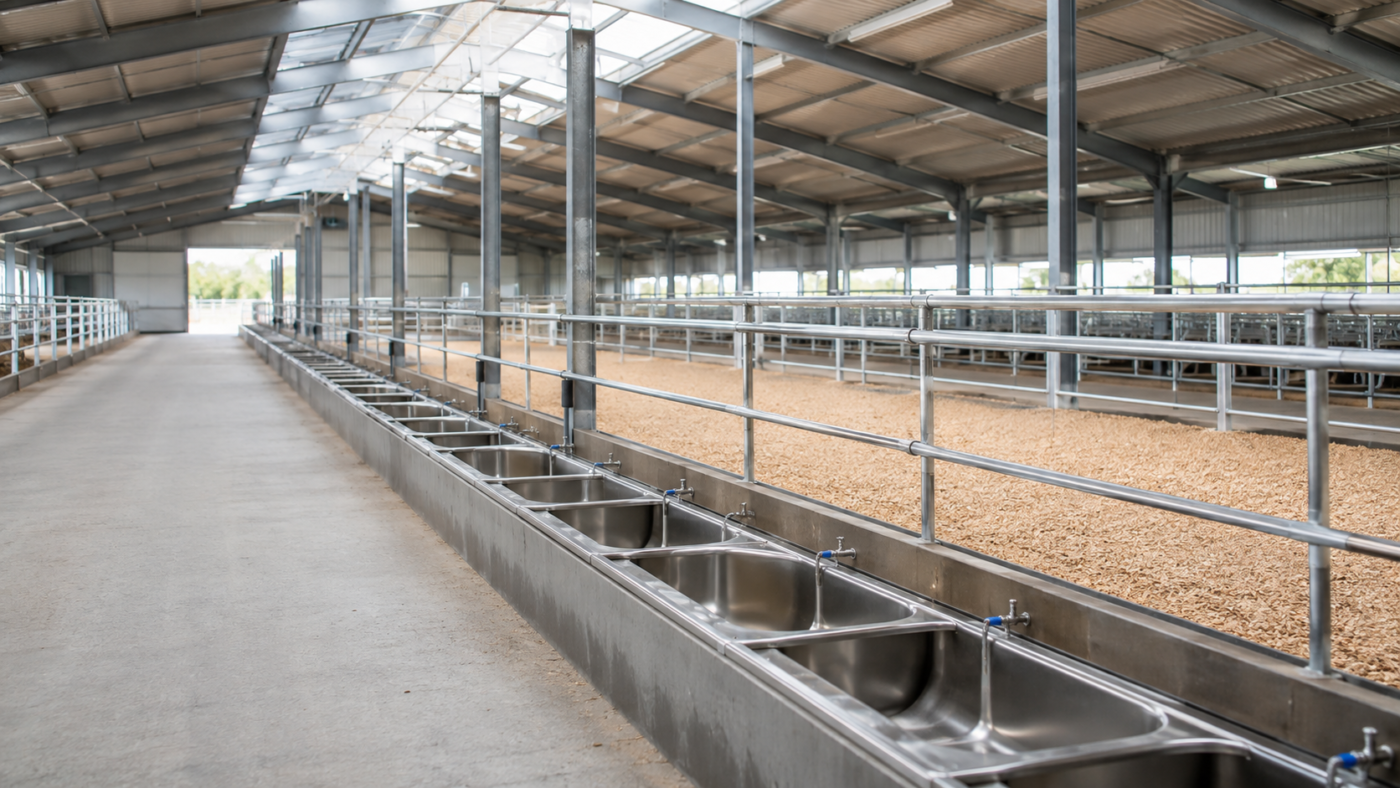
The drinker lines block constantly and the staff have to take the nipples off every week. Build-up forms on the equipment surfaces in the milking parlour and the hot water line heats up later than it should. And the water from the well changes with the season; cloudy in spring, of a different character in summer. Those three pictures are taken up separately; yet they hang on a shared variable. The water feeding every line of the business is most often seen as something that is simply “there” — farm water treatment is a subject that appears in exactly that gap.
In this guide the subject is taken up within a single frame: water quality, equipment and plumbing. We explain which parameters are assessed in an analysis, what happens on the drinker lines and in the milking equipment, which stages come in and how the capacity is planned.
This content deals with water quality, equipment and plumbing. Assessments to do with animal feeding and herd management fall outside its scope and belong to a veterinary surgeon and an animal science specialist. Whether the water is suitable for its purpose of use is established by the relevant regulations and an accredited laboratory analysis.
Why Is Water Quality Taken Up Separately on a Farm?
On farms the water generally comes from a well or a surface source and feeds more than one section over a single line: the drinking lines, the milking unit, the cooling equipment, the washing lines and general use. So water quality is directly decisive in terms of equipment and plumbing.
That is the basic difference between a business in a city and a farm. In a plant connected to the mains the source side is managed centrally, while on a farm watching and treating the source is entirely the responsibility of the business.
The second difference is scale. On a farm water consumption runs all day and peaks at certain hours. The drinker lines work continuously, the milking programme concentrates at fixed hours, and the washing operations repeat after every milking.
The third difference is the variability of the source. The profile of well and surface waters can differ with the season; and that means a one-off build is not enough.
When those three elements come together, farm water treatment planning turns into an infrastructure exercise rather than the choice of a single unit.
Where Does Farm Water Come From?
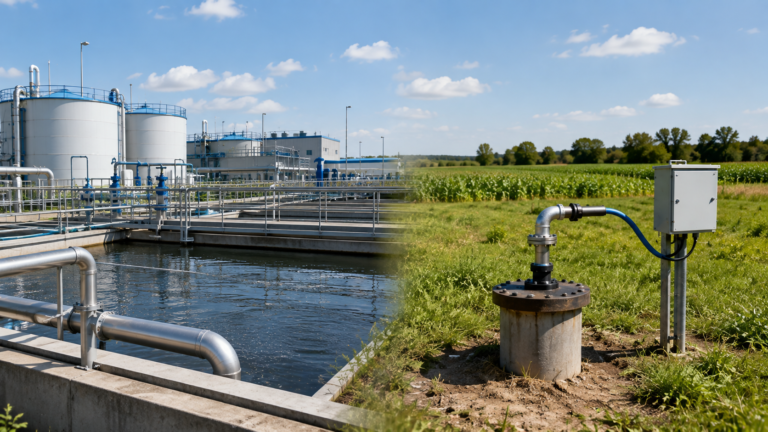
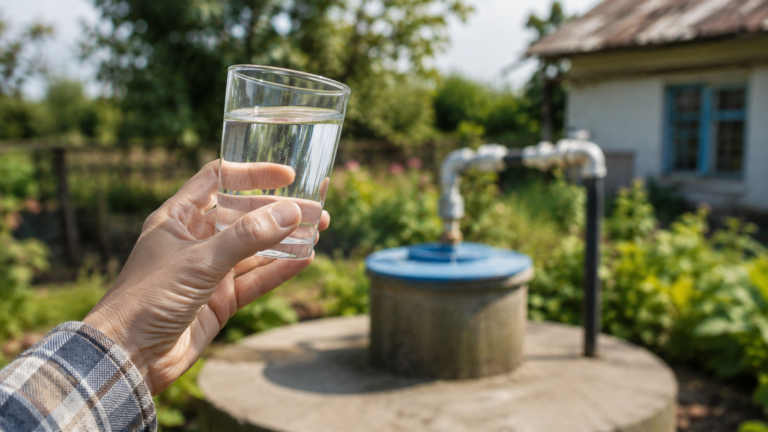
On farms the source is generally a well, a natural spring or surface water; in many businesses a tank goes with them. The basic difference from the mains is that the responsibility for watching the quality, and treating it where needed, lies entirely with the business.
The type of source directly settles the scope of the build. The same stages are not needed on every farm.
Well Water
The content changes with the geology. Headings such as sediment, iron and manganese come up often.
Spring Water
The flow and the profile can fluctuate with the season; it needs regular following.
Surface Water
Turbidity and particle load can change markedly with the rainfall.
Use With a Tank
It provides a buffer against interruption; the standing time and the conditions in the tank are taken up separately.
We covered how mains and well sources differ, and why the responsibility changes, in our source comparison article; we do not go deeper into the subject here.
Whatever the source, the process starts from the same place: the analysis. A farm water treatment build cannot be sized correctly without knowing the profile of the source.
Another practical point: on many farms more than one source is used together. In that case which source feeds which line should be defined clearly and the lines kept from mixing with each other.
The Parameters Looked At in an Analysis
In a farm water analysis the main parameters assessed are these: hardness, conductivity and the dissolved solids load, sediment and turbidity, iron and manganese, nitrate, sulphate and the microbiological load. Each one shows a different subject; the assessment is made against the relevant regulations and an accredited laboratory report.
Knowing the parameters lets you understand what you are looking at when the report reaches you. The cards below explain briefly what each heading is; they carry no limit values.
Hardness
It shows the calcium and magnesium content; it relates to the tendency to build up on heated surfaces.
Conductivity / TDS
It reflects the total dissolved solids load; it reports a quantity, not a list of contents.
Turbidity
It shows the load of suspended solids; it defines the degree of filtration needed.
Iron and Manganese
It is the source of colour, staining and build-up problems; it is often seen in well water.
Nitrate
It is one of the parameters assessed in an analysis; it reflects agricultural and waste-related influences.
Sulphate
It is among the components of the dissolved ion profile; it is linked with taste and plumbing behaviour.
Microbiological Load
It requires a separate sample and a laboratory analysis; it is not visible and leaves no sensory trace.
pH
It shows the acidic or alkaline tendency of the water; it affects corrosion and precipitation behaviour.
The numerical limit values for those parameters are defined in the relevant regulations; it would not be right to give figures here. Every parameter is also assessed not on its own but within the report as a whole.
For a general frame on how water quality is handled in livestock businesses, Penn State Extension’s water quality in livestock resource can be looked at. That source offers a general approach; it does not stand in place of the regulations in Türkiye, and the local assessment is made by an accredited laboratory report and the authorised bodies.
We took up step by step how to take a sample, which parameters should be requested and how to read the report in our water analysis guide. It should also be noted that on farms a separate sample is needed for the microbiological load.
Blockage in Drinker and Nipple Lines
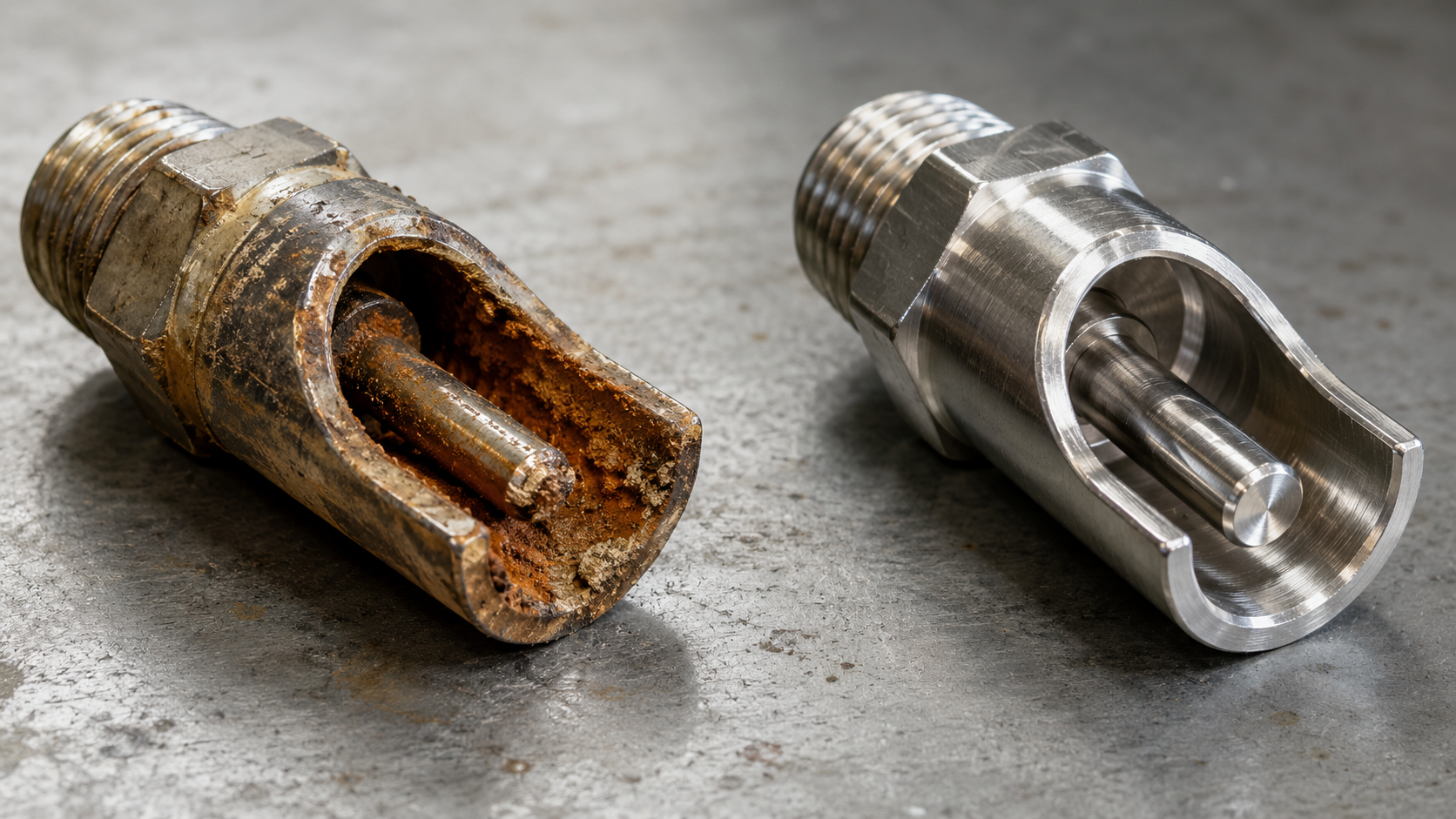
Sediment, sand and iron-related build-up in the water collect in the nipples and the drinkers. In those narrow-bore parts the build-up restricts the flow and calls for frequent cleaning of the line. The result is a rising labour load and line maintenance turning into an item that demands continuity.
That is the most visible technical problem on farms and the one that costs the most time. Nipples are of small bore by design; and that leaves them open to particle build-up.
The points affected and their consequences are these:
The Nipple Tips
Build-up in the narrow-bore mechanism restricts the flow and can lead to sticking.
The Drinker Bowls
Sediment builds up at the bottom; the frequency of cleaning rises markedly.
The Line Pipes
The layer building up on the inner wall narrows the bore and creates a loss of pressure.
Floats and Valves
Build-up on moving parts can lead to a loss of function.
Pressure Reducers
Blockage in the regulators on the line spoils the distribution.
The Labour Load
Repeated cleaning takes an important part of the staff’s time.
Iron-related build-up is a separate heading and is met often in well water. We covered the different forms of iron and which stage handles them in detail in our article on iron in water.
And on the sediment side bed filtration comes in. We explained how that stage works and the logic of backwashing in our sand filter article.
A farm water treatment is a build in which those two stages are the headings that directly reduce the maintenance load on the drinker lines.
When the staff time given over to cleaning the drinker line is measured, it comes out higher than expected in most businesses. That time is a concrete item to take into account when assessing the return on a pre-treatment stage.
Limescale in Heating, Cooling and Milking Equipment
The components that give hardness precipitate on heated surfaces and form scale. The milking unit’s washing line, the cooling tank, the hot water systems and the boilers are open to that effect. The build-up lowers heat transfer, raises energy consumption and increases the frequency of failures and maintenance.
The milking parlour is the section of the farm most sensitive to water quality. There the water is both heated and in constant contact with equipment surfaces.
The main equipment affected is this:
| Equipment | What Happens | What It Means for the Business |
|---|---|---|
| The hot water system | A layer forms on the heating surface | Heating takes longer, energy consumption rises |
| Boiler / water heater | The heat transfer surfaces are coated | Fuel consumption and the frequency of maintenance rise |
| The washing line | Build-up collects in the nozzles and the channels | The distribution is spoiled, cleaning becomes harder |
| The cooling tank | Residue can form on the internal surfaces | The cleaning load and chemical consumption rise |
| The pipe runs | The bore narrows on the inner wall | A loss of pressure and a fall in flow are seen |
| Valves and fittings | Build-up forms on moving surfaces | A risk of leaking and loss of function arises |
We took up the mechanism of limescale on heat transfer and how it advances in equipment in a separate article; the technical background is what hard water does to equipment.
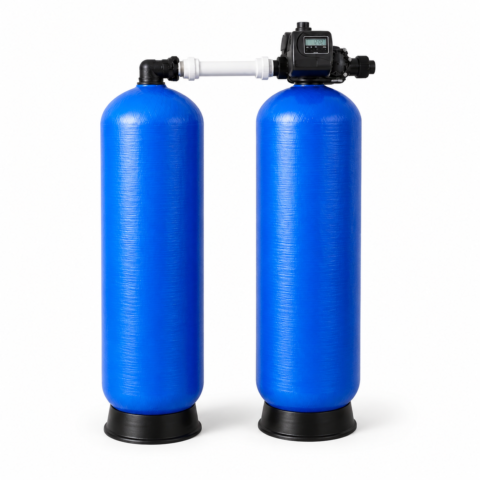
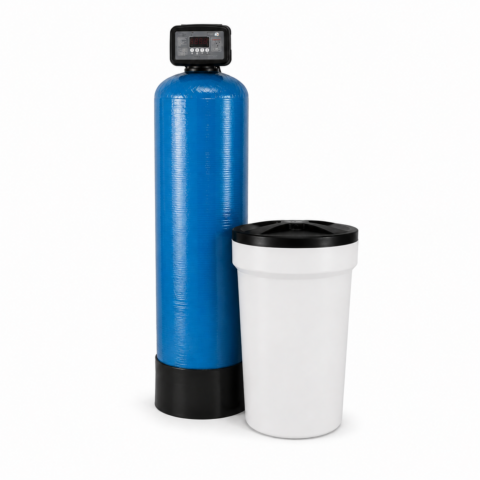
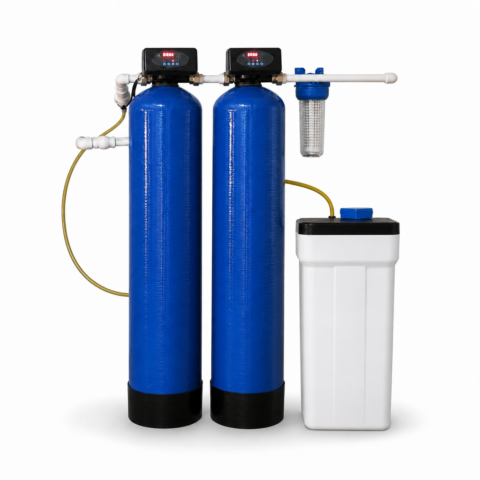
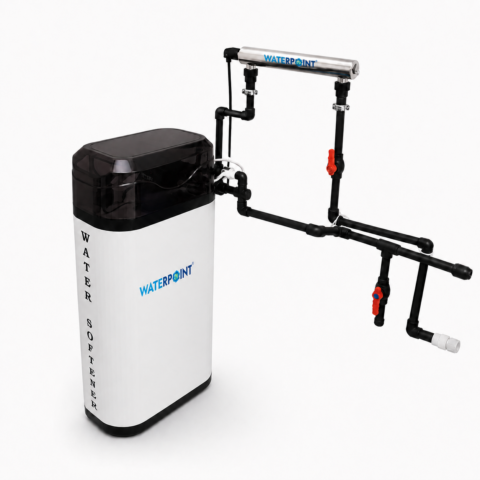
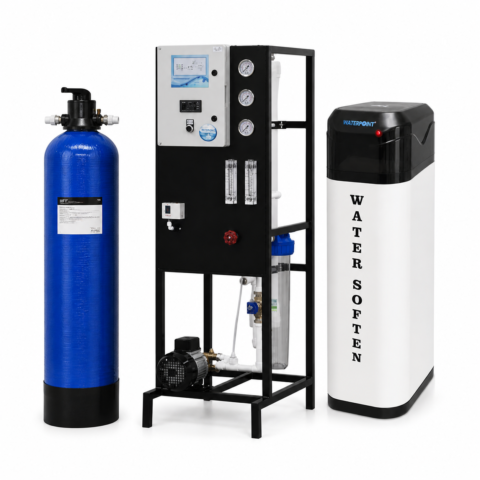
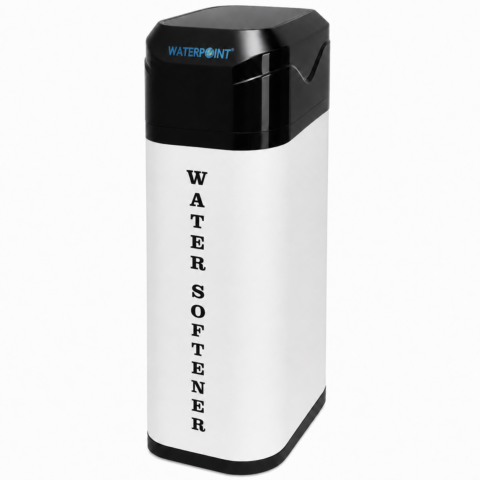
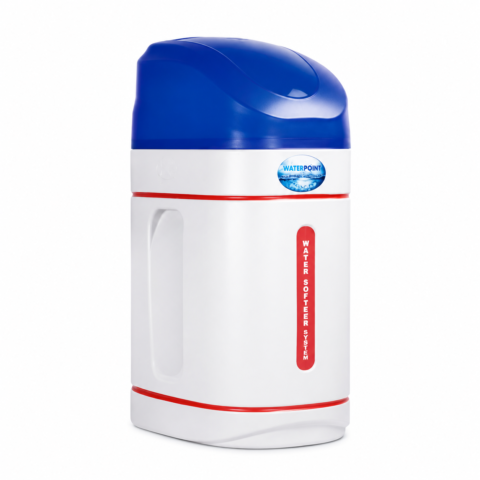
On the answer side the softening stage comes in. When the ions that give hardness are removed at the source, there is no load left to build up on the heated surfaces. For needs on that scale industrial softening systems are used and the capacity is settled by the consumption of the business.
Cleaning routines reduce the build-up already there; but as long as the feed water does not change, the build-up forms again. So cleaning is a maintenance operation, while handling the hardness at the source is a measure.
Washing and Hygiene Lines
In hard water some of the active components of cleaning chemicals interact with the hardness ions. In that case more product may be needed for the expected result. And mineral residue can be seen on the surfaces after rinsing, and the cleaning load rises.
Washing the parlour and the equipment is one of the most frequently repeated operations on a farm. Because it is carried out after every milking the effects build up quickly too.
Two separate effects are involved. The first is on the chemical side: the hardness ions in the water bind some of the active components of the cleaning product, and the bound part does not do its job.
The second is on the residue side. When the water left on the surface after washing dries, the minerals in it stay behind. That residue both forms a visible trace and can affect the state of the surface.
On the operator’s side the response to that is raising the dose. When the expected result is not obtained the amount of chemical is raised, that turns into a habit and consumption quietly rises. In a farm water treatment build that item directly affects the operating cost.
The cleaning products to be used and the dosing fall outside the scope of this content; that assessment should be made in line with the product maker’s information and the business’s own application plan.
The Microbiological Load and Raw Water
In well and surface waters the microbiological load can vary with the season; rainfall and environmental conditions can affect that profile. If that heading is found in the analysis, a UV (ultraviolet) treatment stage is added to the line. That stage is always positioned after the filtration.
That heading is a subject businesses using raw water should follow regularly. Because it is not visible and leaves no sensory trace, it is found only by an analysis.
There are two conditions for an ultraviolet stage to work. The first is that the water be clear; turbidity prevents the light travelling effectively. The second is the state of the lamp and the quartz sleeve.
So the order matters: the ultraviolet stage is positioned not at the head of the chain but after the filtration. Otherwise the particle load limits the performance of the stage.
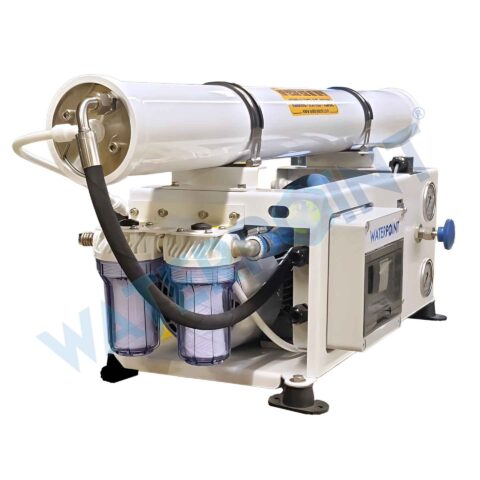
We covered how the method works, and what it does and does not do, in our ultraviolet treatment article; we do not go deeper into the subject here. In builds on a business scale, industrial ultraviolet units are positioned on the line.
In businesses using raw water an analysis is not a one-off operation. Changes of season, periods of heavy rainfall and a new activity starting nearby are all situations that call for the analysis to be repeated.
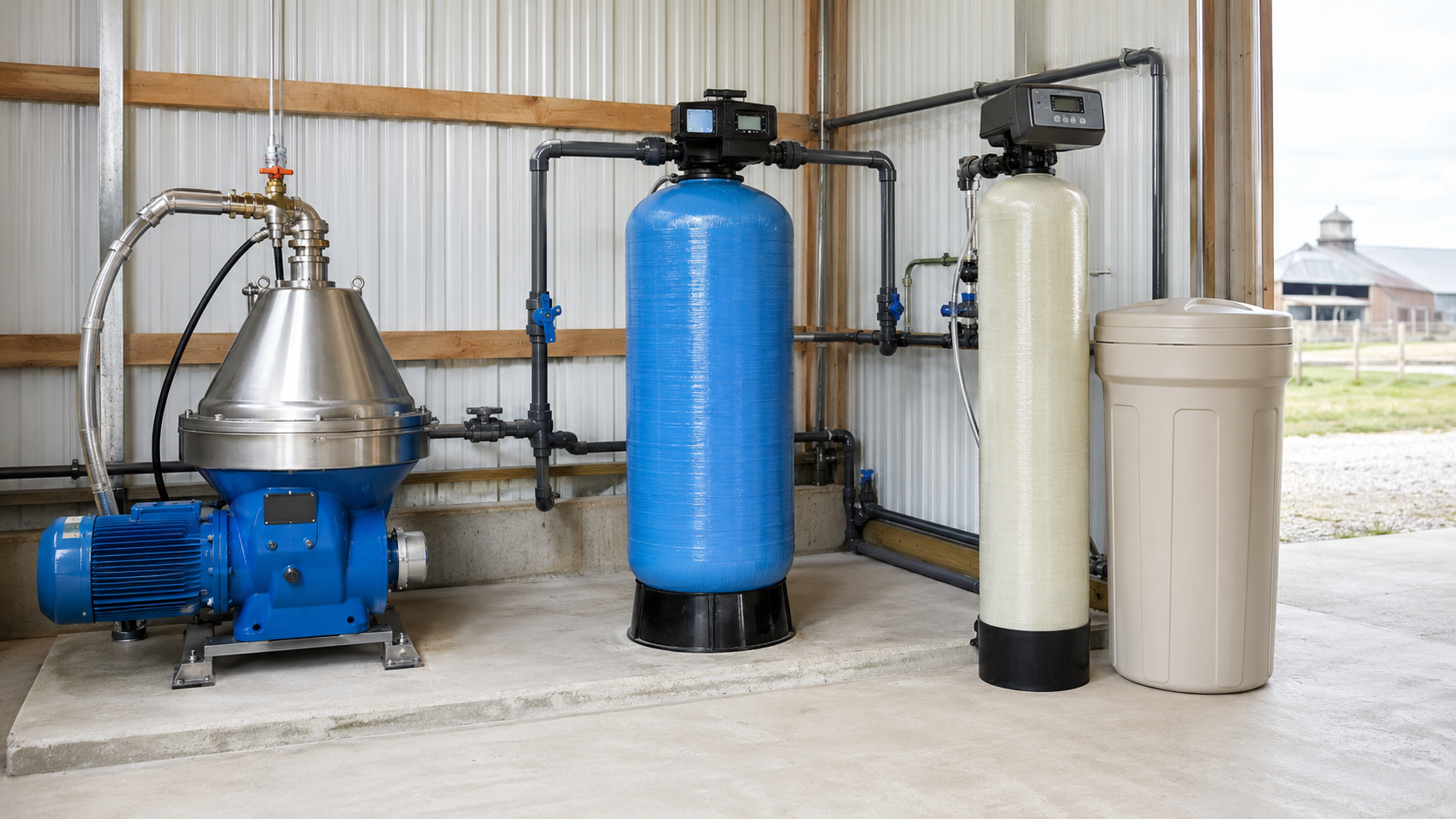
Which Stages Are Used in a Farm Water Treatment Build?
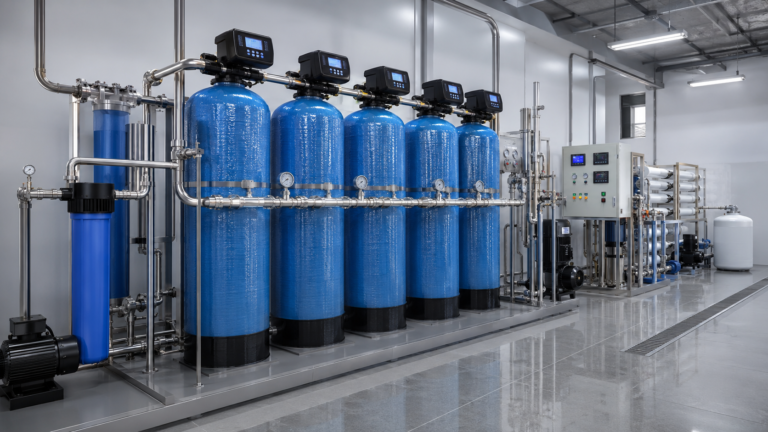
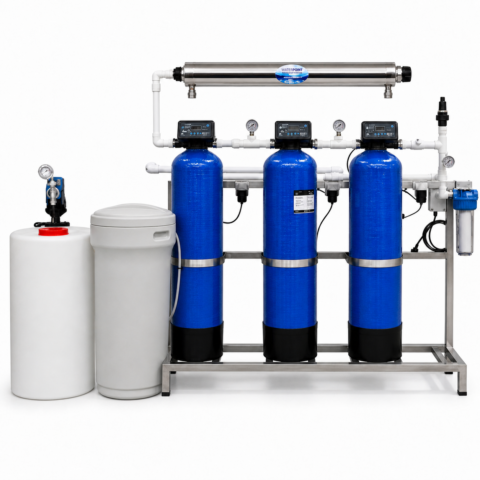
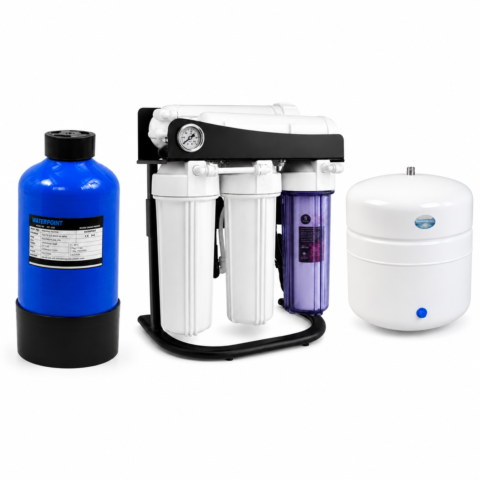
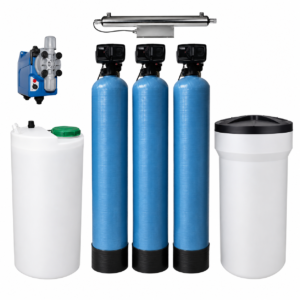
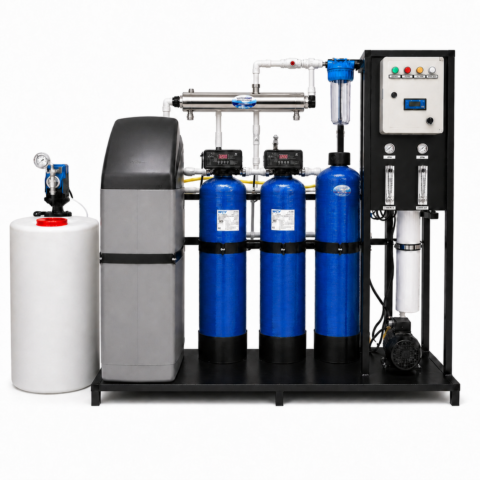
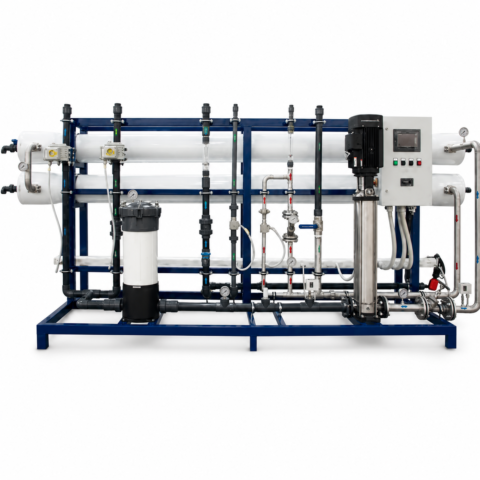
A typical build runs in this order: coarse separation, sand or multimedia filtration, iron removal if needed, softening where there is hardness, and UV (ultraviolet) treatment if the analysis calls for it. Which stages are needed is settled by the result of the water analysis.
The chain is always built from coarse to fine. Every stage protects the next; when the order is broken the most valuable components wear at the front.
Coarse Separation
Sand and coarse sediment are separated by centrifugal effect and collect at the base.
Bed Filtration
Finer suspended matter is held inside the bed.
Iron Removal
If the analysis calls for it, filtration with oxidation comes in.
Softening
The hardness is removed; build-up on heated surfaces is prevented.
UV Treatment
If needed it is positioned as the final stage.
The table below matches the problem identified with the right stage:
| What the Analysis Shows | The Stage That Handles It | The Result It Gives |
|---|---|---|
| Sand and coarse sediment | Separator / coarse separation | It separates the heavy particles and protects the line |
| Turbidity, suspended solids | Sand or multimedia filtration | It holds the fine particles |
| Iron and manganese | Filtration with oxidation | Holds the metals that turn to solid form |
| Hardness | Water softening | Prevents build-up on heated surfaces |
| Microbiological load | UV (ultraviolet) treatment | Reduces microbiological risks |
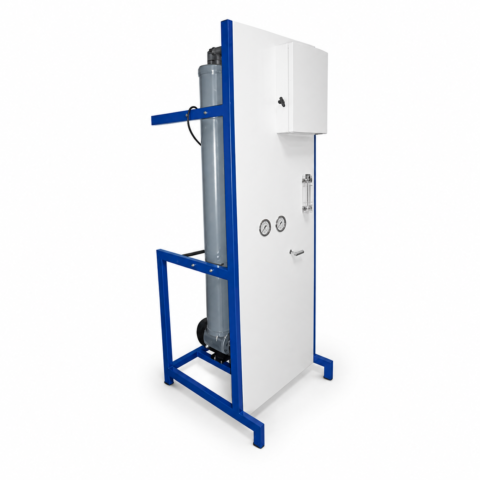
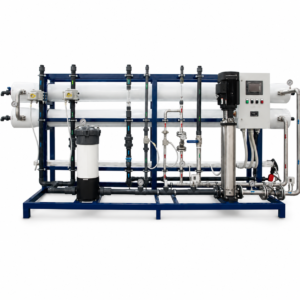
| High dissolved solids | Reverse osmosis | It lowers the dissolved load by up to 99% |
The first link of the chain is critically important in wells with a high sand load. We explained how units working on the centrifugal principle operate in our separator filter article; in practice separator filter systems are positioned at the head of the chain.
And on the bed filtration side, units with automatic backwashing are preferred for sources with a high particle load; the industrial automatic sand systems used for that need forms the second step.
We examined in detail which problem in well water is handled by which stage in our article on treatment stages for well water.
Irrigation lines and drippers have their own technical requirements and are a separate heading. We covered the crop production side in our irrigation water treatment article; the focus of this article is livestock and the plumbing lines.
Capacity and Continuity
In sizing, the number of animals, the milking programme, the seasonal difference in consumption and the simultaneous use at peak hours are assessed together. On a farm the tolerance for interruption is low; so storage and redundancy are part of the build. The exact capacity is settled by the water analysis and the profile of the business.
On a farm consumption is not spread evenly. At milking hours and in hot periods demand rises markedly; the system should be chosen to that peak.
The headings assessed are these:
-
Set Out the Number of Animals and the Housing Structure
As much as the total number, how the animals are spread across the housing and how the lines are fed are decisive too.
-
Define the Milking Programme
How many milkings a day and at what hours? That programme shows when the peak demand will form.
-
Add the Washing Cycle
The washing carried out after every milking creates intense consumption in a short time and is included in the calculation.
-
Assess the Seasonal Difference
In hot periods consumption can rise markedly. The system should be assessed against summer conditions.
-
Establish the Tolerance for Interruption
Which lines cannot tolerate an interruption? That question defines the need for storage and redundancy.
-
Confirm the Infrastructure
The layout of the equipment, the drain connection, the power supply, access for salt and room to work on the units are all clarified in advance.
The fifth step is especially important. When softening systems go into regeneration, untreated water can pass into the line in a single-tank build. On lines that cannot tolerate an interruption, twin-tank builds are assessed.
Storage provides a second buffer. It balances the rate of production against the rate of consumption and reduces the risk of the system not keeping up at peak hours. In a farm water treatment project the tank capacity is calculated together with the treatment capacity.
The exact values are specific to the business; so giving a numerical target here would not be right. The capacity is settled by a site survey against the water analysis and the profile of the business.
Let’s establish the stages that suit your farm’s lines
To make clear which stages are needed for your water analysis, your number of animals and your milking programme, you can look through the solutions.
See the Well Water SolutionsThe Maintenance Plan and the Line Between Fields
The continuity of the system depends on the discipline of maintenance: renewing the filter stages, following the salt on the softening side, watching the backwash cycle and periodic checks. That following should be tied to a written plan and a named person responsible.
The most common reason maintenance slips on farms is not technical but organisational. Even where the system has been built correctly, the expected performance is not obtained when the following is left to no one.
The headings to be watched regularly are these:
- The salt level: When the salt runs out at the softening stage the system cannot renew itself.
- The filter stages: They are renewed at saturation; the period changes with the quality of the incoming water.
- Backwashing: In bed filtration it is checked that the cycle is working properly.
- Following the pressure: The pressure difference between stages is an early indicator of blockage.
- The ultraviolet stage: Where there is one, the state of the lamp and the quartz sleeve is checked regularly.
- Repeating the analysis: The profile of the source can change with the season; the following continues.
- The record: The operations carried out and their dates are kept in writing.
Here a line needs stating plainly. This content and these builds cover the water quality, equipment and plumbing side.
Animal health, feeding and the assessment of yield fall outside the scope of this content and belong to a veterinary surgeon and an animal science specialist. When taking decisions on those subjects the relevant specialist must be consulted.
Whether the water is suitable for its purpose of use is established by the relevant regulations and an accredited laboratory analysis. No assessment is made on that subject in this content.
That line also shows how the right decision is reached: the water side is handled with measurement, the animal side with a specialist assessment. Neither field stands in for the other.
Water Point Su Arıtma Teknolojileri operates from Esenyurt, İstanbul under its founder Ali Genç, with more than 20 years of experience in the sector.
Service Network
For industrial systems there is a service network across Türkiye; for home units service is provided in İstanbul and the neighbouring provinces such as Kocaeli and Tekirdağ. Technical service is given for all domestic and foreign makes of unit.
Warranty
Units, valves, pumps and tanks carry a 2-year warranty and taps a 1-year warranty. Filters, membranes, resin and salt are consumables and fall outside the warranty.
On-Site Survey
The survey is free if the unit is purchased from us; where only a survey and measurement are wanted, a survey fee of ₺2,000 applies.
Delivery
Products in stock are dispatched within 1–3 working days; products not in stock are ordered in and the lead time confirmed. Free shipping applies across Türkiye.
Scope of Installation
The unit is delivered ready to install; the inlet and outlet connections are made. The plumbing labour and materials are the customer’s responsibility. Where a valve setting is needed, free support is given over a video call.
Contact
For orders and information by phone, 0850 304 95 25; to speak to a specialist, the 0536 729 99 52 WhatsApp line and [email protected] can be used.
Frequently Asked Questions
Can well water be given to animals?
That question cannot be answered by a water analysis alone. Whether water is suitable for its purpose of use is established by the relevant regulations and an accredited laboratory analysis; the assessment on the animal side belongs to a veterinary surgeon and an animal science specialist. The right path is to have the analysis done and to assess the result together with the relevant specialist.
My drinker lines keep blocking — what could be the reason?
The most common reasons are build-up from sediment, sand and iron. Because nipples are of narrow bore they are affected quickly by that build-up. The answer is separating the particles before they reach the line; coarse separation and bed filtration take on that job. The exact cause is established by an analysis.
Which stages does my farm need?
Giving a firm list would not be right; the build is settled by the source and the analysis result. The typical chain starts with coarse separation; then bed filtration, iron removal if needed, softening where there is hardness, and UV (ultraviolet) treatment if the analysis calls for it are added.
How is the capacity worked out?
The number of animals, the spread across the housing, the milking programme, the washing cycle and the seasonal difference in consumption are assessed together. The system is chosen not to the daily average but to the peak-hour demand. The exact capacity is settled by a site survey against the water analysis and the profile of the business.
How often should the analysis be repeated?
Giving a fixed period would not be right. Because the profile of well and surface waters can change with the season, regular following is advised. And periods of heavy rainfall, a new activity nearby, and confirmation after a system is commissioned all call for the analysis to be repeated.
How is limescale build-up in the milking parlour prevented?
A lasting result is obtained by lowering the hardness at the source. Cleaning routines reduce the build-up already there, but as long as the feed water does not change the build-up forms again. So cleaning is a maintenance operation, while softening is a measure.
What is done for lines that cannot tolerate an interruption?
When softening systems go into regeneration, untreated water can pass into the line in a single-tank build. On lines where an interruption is not accepted, twin-tank builds are assessed. And storage provides a second buffer at peak hours.
Should the irrigation line be fed from the same system?
Irrigation lines and drippers have their own technical requirements and are a separate heading. In most businesses separating the irrigation line lowers both the investment and the operating cost. The crop production side is taken up in a separate article.
How much space does the system take?
The space needed changes with the capacity, the number of stages and the number of lines. Besides the tank bodies, room should be left for service access, reaching the salt, the drain connection and the electrical supply. The exact layout is planned during the site survey.
Conclusion
Planning farm water treatment is an infrastructure exercise that feeds the whole business. The water generally comes from a well or a surface source; the drinking lines, the milking unit, the cooling and the washing lines are fed from the same source. So while sediment and iron create build-up on the drinker lines, hardness leads to scaling on heated surfaces and a rise in chemical consumption. The chain of answers is built from coarse to fine: coarse separation, bed filtration, iron removal if needed, softening where there is hardness, and UV (ultraviolet) treatment if the analysis calls for it. The capacity is chosen not to the daily average but to the peak-hour demand; on lines that cannot tolerate an interruption, redundancy is part of the design. And last, a line: this content covers the water, equipment and plumbing side — the assessment on the animal side belongs to a veterinary surgeon and an animal science specialist.
Let’s set out the stage plan for your business together
The site survey is free if the unit is purchased from us; if only a survey and measurement are wanted, a survey fee of ₺2,000 applies. For a build suited to your source and the profile of your business you can reach us on 0850 304 95 25, to speak to a specialist on the 0536 729 99 52 WhatsApp line, or at [email protected].
Discover the Solution That Suits You