
What Is Process Water? Scaling, Corrosion and Quality
In production, water is usually counted as an input that is “already there”. You open the valve, it flows, it does the job. And yet there is the unexplained drop in boiler efficiency, the unplanned stop at the cooling tower, the surface defects appearing on a coating line and the product quality moving from batch to batch. Behind those pictures there is often the same cause: the quality of the process water being used. The unseen mineral and ion load in the water leaves its mark quietly at every point on the production line.
In this guide we take the idea of process water up with an engineer’s eye: what it means, why it differs from drinking water, what problems it creates and which treatment stage solves which problem. By the end of the article you will recognise the water-related risks at your own plant and know how the right system is engineered.
What Is Process Water?
Process water is the water used in production processes, serving as a raw material component, a heating or cooling fluid, a washing and rinsing medium or a carrier. Its quality is set by the requirement of the process it is used in. Meeting the drinking water standard does not mean it is fit for industrial use.
Water does not do a single job at a plant. In the boiler it turns to steam, in the cooling tower it carries heat, on the wash line it cleans surfaces, and in some sectors it goes directly into the product. Every one of those jobs demands a different property from the water; so there is no single definition of “good water”.
That is the heart of the idea of process water: water is not an auxiliary material but a production input. Just as the properties of a raw material are controlled, the properties of the water should be defined and monitored. Once that view is taken, most water-related problems can be prevented before they appear.
In practice, managing process water can be reduced to three questions: what job is the water used for? What level of quality does that job call for? Does the existing source meet that level? The answers to those three questions make up the water strategy of the plant.
The Difference Between Process Water and Drinking Water
Drinking water is defined so as to be safe for human consumption; process water is defined so as not to damage the equipment and the product it is used with. A water that can be drunk may carry high hardness or conductivity, and that creates a risk of scaling in the boiler and of corrosion in the line.
That distinction corrects the misconception met with most often in the field. The assumption “the mains water is drunk, so it will cause no problem in production” is technically wrong. Drinking water standards are health-focused; industrial parameters such as scaling, corrosion and conductivity are not the main subject of that framework.
Focused on human consumption
It is defined through safety and health parameters.
- Microbiological safety is the priority
- The mineral content is within an acceptable range
- Taste and odour are assessed
- Hardness sets no technical limit
Focused on equipment and product
It is defined by the tolerance of the process and the equipment.
- Hardness and conductivity are critical parameters
- Dissolved gases create a corrosion risk
- Silica and iron form deposits
- The target quality varies with the application
A concrete example makes the table clear: a mains water entirely suitable for drinking but high in hardness forms a layer of limescale in a short time when it is fed to a steam boiler. The same water causes no problem at all when it is drunk. So a process water assessment is made on an entirely different scale.
So the first thing to do at a plant is to have the existing source analysed for industrial parameters. Hardness, conductivity, silica, iron and dissolved gas content are the real indicators of process water quality.
Why Does Every Plant Need a Different Quality?
The quality needed varies with the sector, the equipment and the purpose the water is used for. A steam boiler calls for high purity, while a more flexible quality may be enough on a wash line. In water that goes into the product itself, purity standards rise to their highest. Different quality classes can be needed even within one plant.
It is ordinary for more than one water quality to be used in the same factory. In a food plant the water that goes into the product does not have to be to the same standard as the water used to wash the floor; that would create unnecessary cost. The right approach is to feed every point of use to its own need.
The typical need profiles by point of use separate out like this:
The Steam Boiler
It is the point with the lowest tolerance for hardness and dissolved solids; as the pressure rises the requirement tightens.
The Cooling Tower
Because the water circulates continuously the minerals concentrate; scaling control comes first.
The Wash Line
Hardness and mineral control are needed for a rinse that leaves no marks.
A Product Component
Where water goes directly into the product, the highest purity standard applies.
That variety takes managing process water out of the realm of “buying a unit” and turns it into a design problem. Investments made without establishing which point gets water of which quality either fall short or cost more than they should.
Scaling: A Quiet Loss of Efficiency
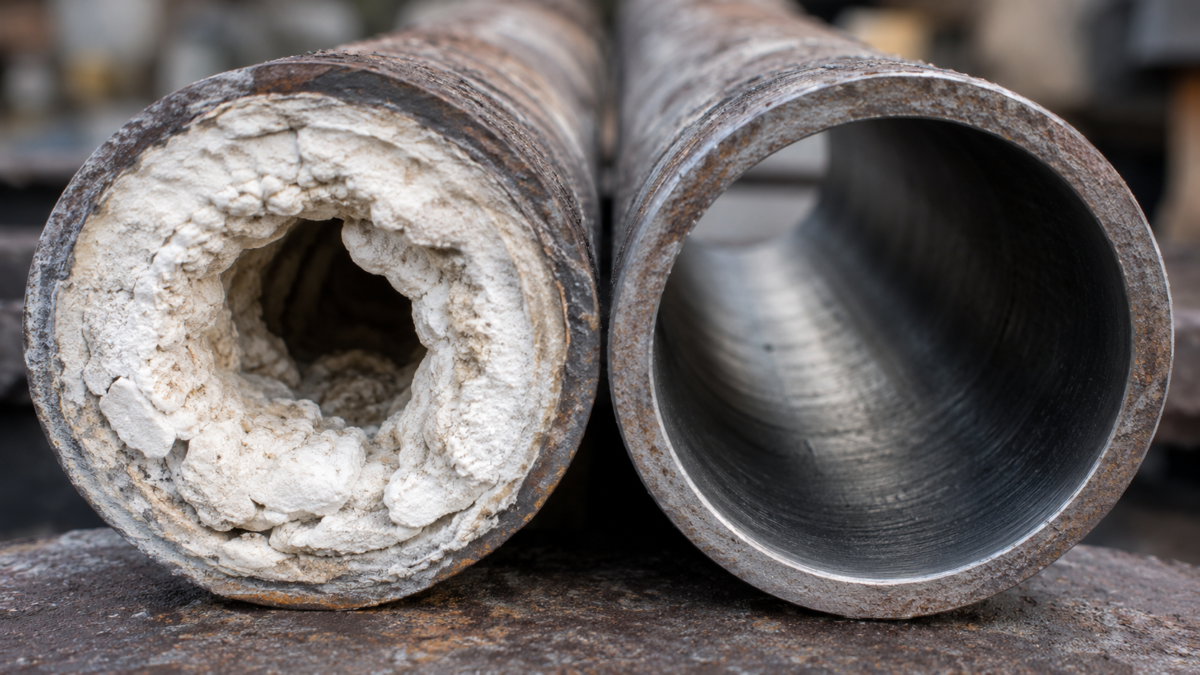
Scaling is the calcium and magnesium in water precipitating on heated surfaces and forming a solid layer. That layer blocks heat transfer, raises energy consumption and shortens the life of equipment. It is one of the most common and most costly problems caused by process water.
The most dangerous thing about scaling is that it advances not as a sudden failure but as a gradual loss of efficiency. The boiler keeps running, the cooling tower does its job; but both begin doing the same work while spending more energy. The bill rises, and the cause goes unnoticed for a long time.
Technically a layer of limescale behaves like insulation. That layer, coming between the heating surface and the water, makes the passage of heat into the water harder. The system runs longer and at a higher load to reach the target temperature. At the same time local overheating points can form on the metal surface, and that prepares the ground for material fatigue.
The source of scaling is clear: hardness. So in process water treatment, hardness control is usually the first and basic link in the chain. We took up how hardness is measured and which solutions suit in our softening system selection guide.
As scaling advances, the cost of cleaning rises too. A measure taken on the water side at an early stage is far more economical than the mechanical or chemical cleaning needed later. Process water control is not a maintenance item but a preventive strategy.
Corrosion and Material Damage
Corrosion is the wear that occurs on metal surfaces because of gases dissolved in the water, unbalanced water chemistry and high conductivity. It leads to thinning of the pipe wall, pitting and perforation. Unlike scaling it advances more insidiously and is generally not noticed until a leak appears.
Corrosion has three main triggers. The first is dissolved oxygen; it starts electrochemical wear on the metal surface and causes serious damage in closed circuits in particular. The second is the chemical balance of the water; a water tending to be acidic prevents the protective layer forming. The third is conductivity; as the dissolved ion load rises, the electrochemical processes speed up.
Conductivity holds a special place in managing process water, because it is an indicator both for corrosion and for deposits. We took up in detail what that idea says and how it is interpreted in our dissolved solids and TDS article.
The cost of corrosion is not limited to the pipe or equipment replaced. Corrosion products breaking away from the system are carried round the circuit, form deposits at other points and lead to secondary problems. So corrosion control is not a single-component problem but a whole-system process water matter.
Dissolved Oxygen
It starts pitting-type corrosion on the metal surface; it is a critical risk in closed circuits.
Unbalanced Chemistry
It prevents the protective layer forming and speeds up the wear.
High Conductivity
The dissolved ion load speeds up the electrochemical processes.
Corrosion Products
Carried round the system, they create deposits and blockages at other points.
Boiler Feed Water and Steam Lines
Boiler feed water is the group calling for the most sensitive quality within process water. Hardness leads to boiler scale, dissolved oxygen to corrosion, and a high dissolved solids load to carry-over with the steam. So softening and, where needed, advanced treatment stages become essential.
In steam production the water evaporates continuously and the minerals in it stay in the boiler. That concentrating effect turns even a small mineral load in the inlet water into a serious build-up over time. So the tolerance in boiler feed water is far narrower than in other uses.
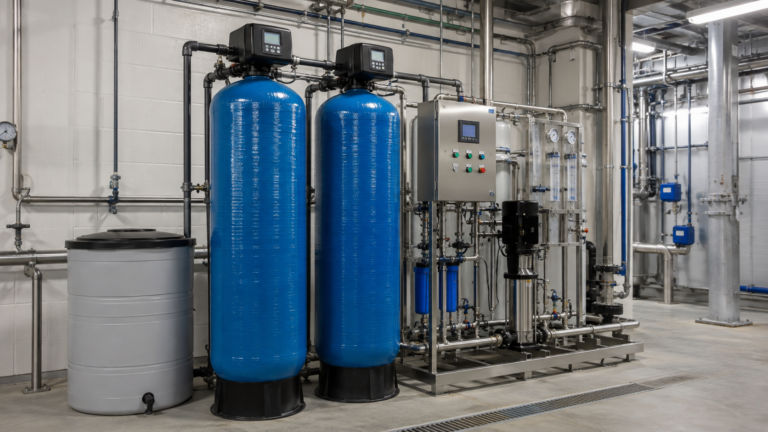
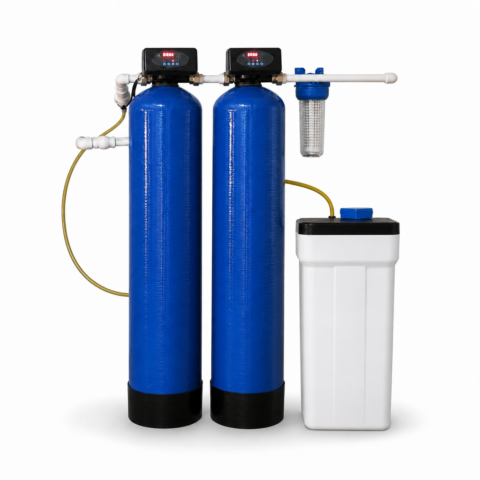
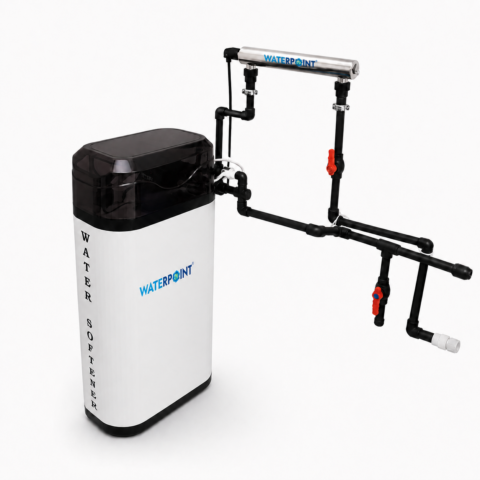
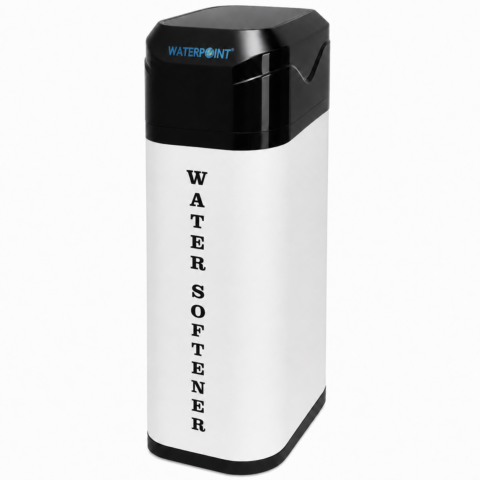
In low-pressure systems a softening stage generally makes the basic answer; once the hardness is removed, the main cause of boiler scale disappears. Built for that purpose, industrial softening systems are the first link in a boiler protection strategy.
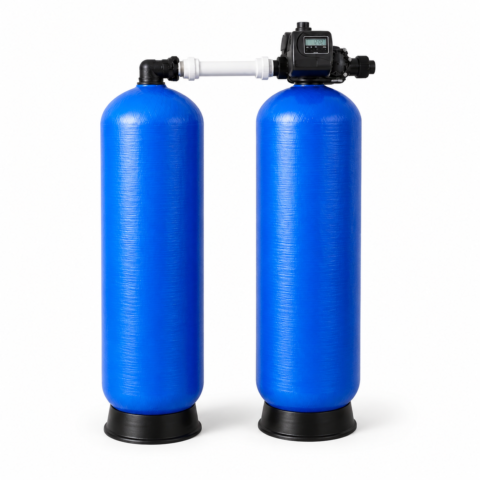
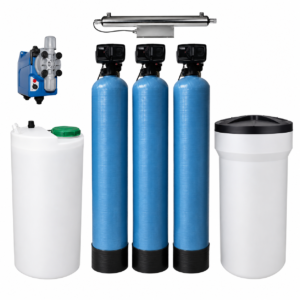
At plants running without a break another requirement arises: no hard water should pass into the line while the softening system is in regeneration. So in businesses in continuous production, twin-tank tandem systems are preferred; while one tank is being renewed the other carries on working.
As the pressure rises, softening alone is not enough; the mineral and conductivity load has to be brought down as well. That is where reverse osmosis and deionisation come in. So a process water build deepens in stages according to the working class of the boiler.
Cooling Water and Circulating Systems
Because cooling water circulates continuously, the minerals concentrate over time. Evaporation reduces the water while the dissolved substances stay in the system, and that raises the risk of scaling and deposits. Correct pre-treatment and control of the feed water preserve the efficiency of circulating systems.
In open-circuit cooling towers the mechanism works like this: the water takes up heat, part of it evaporates and cools inside the tower, and it returns to the circuit. Because the water that evaporates leaves in pure form, the mineral concentration in the water left behind rises continuously. When that concentration is not managed, scaling advances quickly in the pipework and the exchangers.
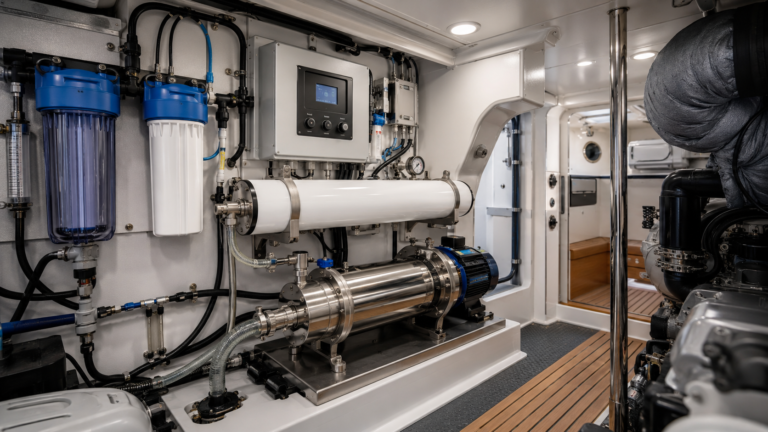
The second risk in circulating systems is biological growth. Warm water in contact with air can make a suitable environment for microbiological development. That both lowers heat transfer and leads to blockages in the system. Where necessary, solutions such as UV (ultraviolet) treatment are added to the build to reduce microbiological risks.
On the cooling side the quality of the feed water is decisive. A feed water high in hardness and mineral load enlarges the load entering the tower from the start. So in managing process water the cooling line is a point to be taken as seriously as the boiler.
Applications That Bear Directly on Product Quality
In some sectors water is directly a component of the product or touches the final surface. Food and drink, cosmetics, chemicals and coating and paint are in that group. In those applications a fluctuation in process water quality shows up directly in the product as a change in taste, an unstable formulation or a surface defect.
In those fields water is not an auxiliary fluid but a raw material. So when water quality is not controlled, the same recipe starts producing different results. The effects by sector can be summed up like this:
| The Sector | The Role of the Water | The Effect of a Quality Problem |
|---|---|---|
| Food and Beverage | A product component and washing | A change in taste, cloudiness, limescale on equipment |
| Cosmetics | The main component of the formulation | Unstable emulsions, a loss of shelf life |
| Chemicals | The reaction medium | A deviation in yield, unwanted by-products |
| Coating and Paint | Surface preparation and rinsing | Marks, poor adhesion, surface defects |
| Electronics | The final rinse | Ion residue and a risk of circuit failure |
At plants in this group the quality needed rises above an ordinary process water level and comes close to the pure water class. We examined in detail which sector calls for which level of purity in our uses of pure water article.
Built for needs at that level, industrial deionised pure water systems secure repeatability in product quality by bringing the conductivity to its lowest level. The critical point here is establishing the purity needed correctly; purity higher than necessary means an unnecessary investment, and purity that is too low means a risk to quality.
Let’s establish the water quality that suits your production together
To plan which stages are needed for the points of use at your plant, you can look at the industrial solutions.
See the Industrial SolutionsThe Stages Used in Process Water Treatment
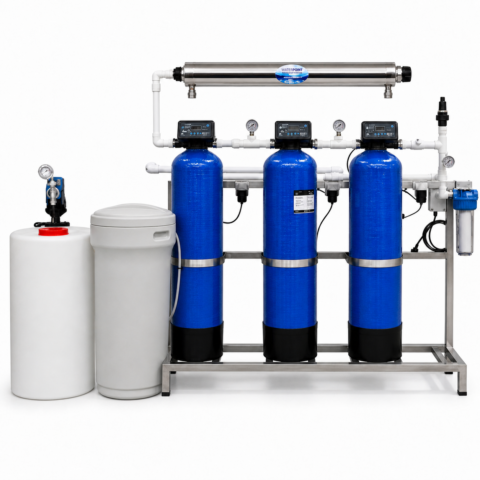
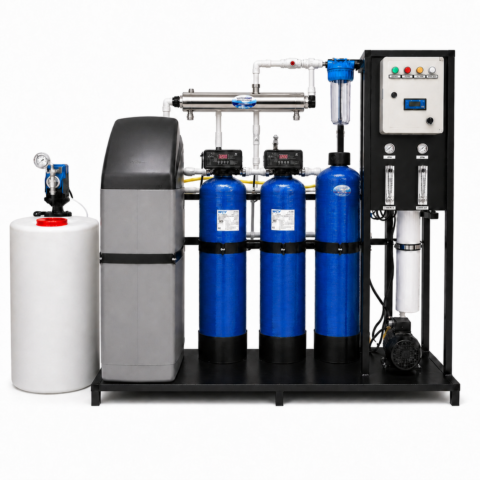
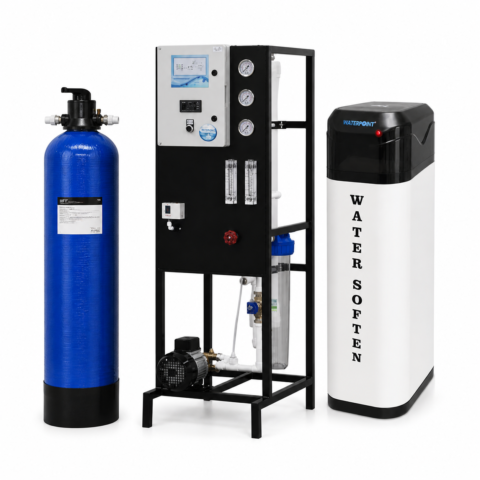
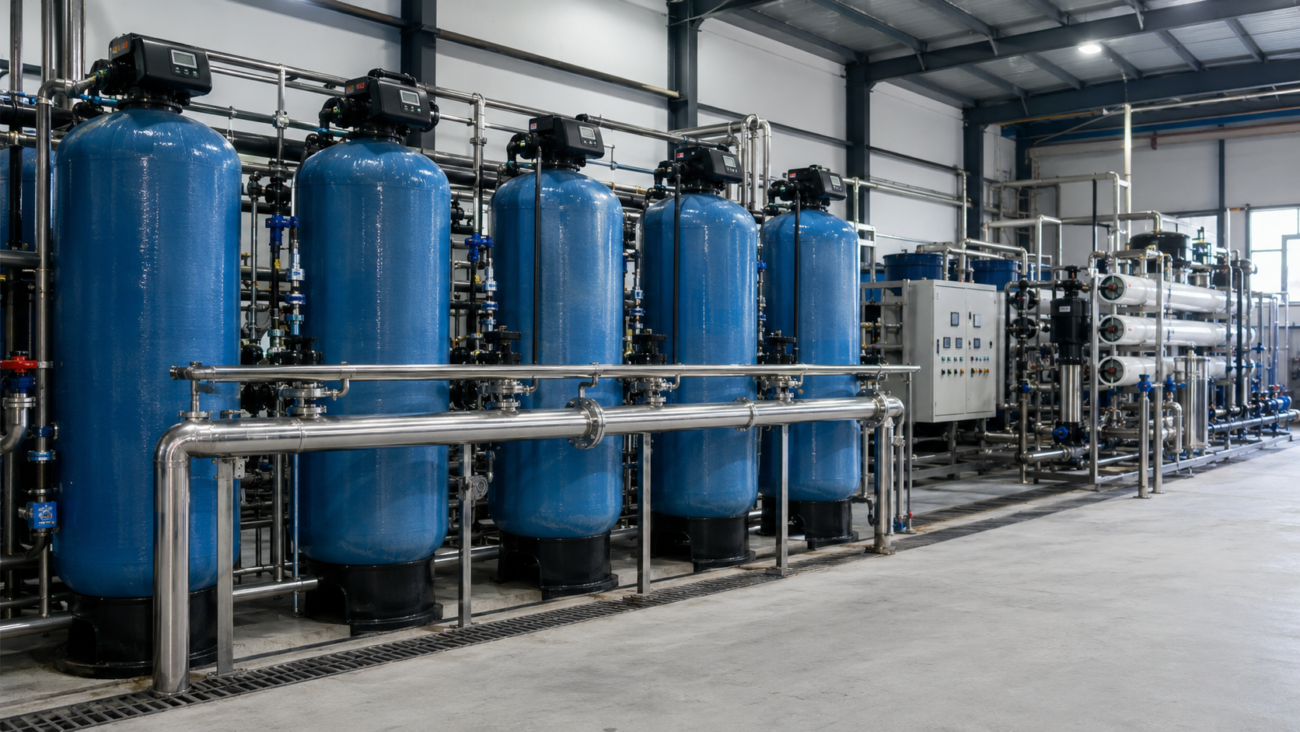
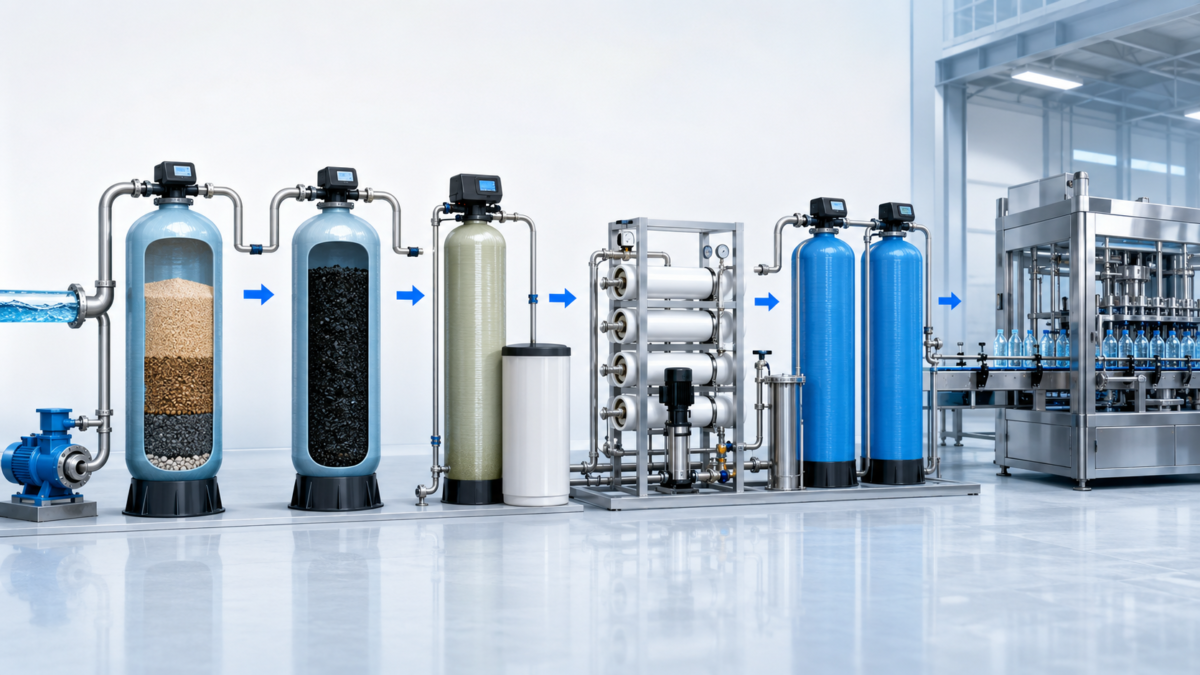
Process water treatment works in stages: pre-filtration holds the sediment, activated carbon removes the chlorine and organic load, softening lowers the hardness, reverse osmosis separates the dissolved substances, and deionisation brings the conductivity to a minimum. Which stages are needed is established from the water analysis and the target quality.
Each stage targets a particular problem and protects the next one. The table below sums up which problem is solved by which stage:
| Problem | The Stage | What It Gives |
|---|---|---|
| Sediment, sand, cloudiness | Pre-filtration | It protects the sensitive stages and prevents blocking |
| Chlorine, odour, organic load | Activated carbon | It protects the membrane and corrects the sensory quality |
| Hardness and scaling | Softening | It prevents boiler scale and preserves heat efficiency |
| High conductivity and TDS | Reverse osmosis | Lowers the dissolved load by up to 99% |
| Trace ion residue | Deionisation | It brings the conductivity to its lowest level |
| Microbiological load | UV (ultraviolet) treatment | Reduces microbiological risks |
Pre-filtration is the unseen but most decisive link in the chain. On sources with a high particle load, sand filters with automatic backwashing come into play and extend the life of every stage behind them. Where chlorine and an organic load are involved, industrial carbon units take on the protective job.
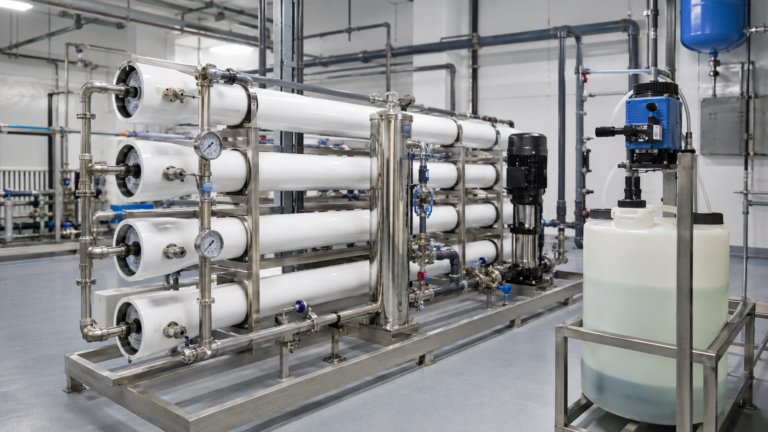
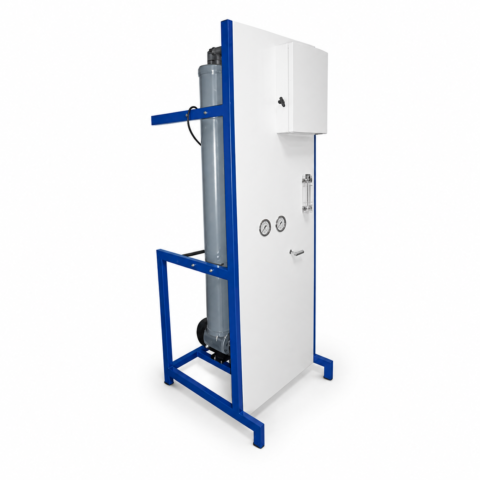
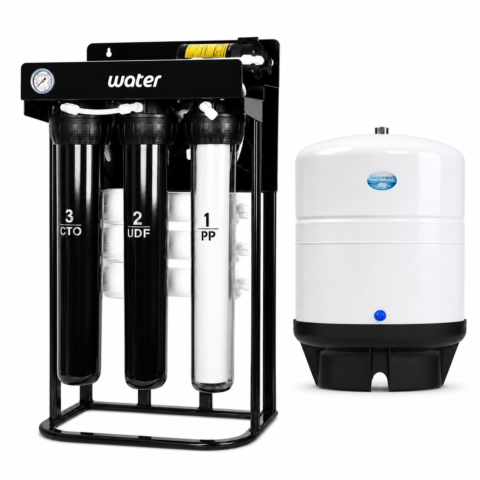
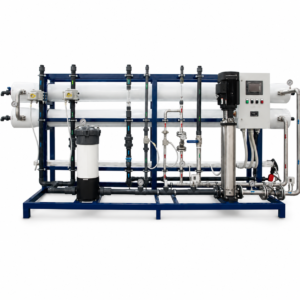
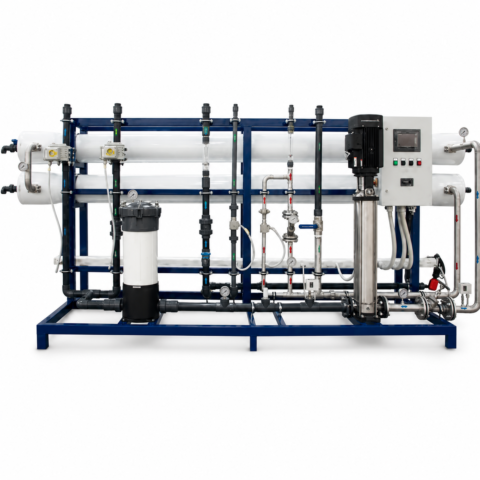
At high-flow plants a reverse osmosis stage is built in to bring the mineral load down as a whole; at that scale high-capacity reverse osmosis systems are sized to the flow of the plant. In that way the process water is carried to the quality aimed for in stages.
The order of the stages matters at least as much as the choice. A reverse osmosis unit whose pre-treatment is skipped blocks in a short time; a membrane running without a carbon stage is damaged by chlorine. A process water line should be designed as a whole.
How Is a System Engineered for Your Plant?
The engineering is done by assessing the water analysis, the flow requirement, the daily hours of operation, the target quality, the installation space and the level of automation together. Without those data, the choice of capacity and stages rests on guesswork. The right process water system is not a standard product but a design specific to the plant.
The process runs in six steps, and every step makes the input to the next:
-
Water analysis
The profile of the source is worked out by measuring hardness, conductivity, silica, iron, turbidity and microbiological load.
-
A map of the points of use
The boiler, cooling, washing and product lines are listed separately; a target quality is defined for each.
-
Flow and the pattern of operation
The instantaneous and daily consumption and the shift arrangement are established; the need for uninterrupted running is clarified.
-
Building the stages
The analysis and the target quality are matched to establish which stages will be installed and in what order.
-
Space and infrastructure
The layout, the drainage, the power supply and access for service are checked and the installation plan drawn up.
-
Automation and monitoring
The level of continuous monitoring and automatic control is set by the discipline of the operation.
None of those steps should be skipped, because each affects the others. A softening system chosen without establishing the need for uninterrupted running, for instance, can interrupt production during regeneration. In the same way a choice made without checking the space conditions creates extra cost at the installation stage.
For a general framework on managing industrial water quality, the US Environmental Protection Agency document on water quality considerations at commercial and industrial facilities stresses that plants should take up their water quality equipment by equipment and process by process.
In the end the right process water system is not a unit chosen from a catalogue but an engineering solution that starts with an analysis, is built around the points of use and is adapted to the conditions of the operation. Planning those steps with a single contact, from analysis to commissioning, keeps the process predictable.
The Importance of Monitoring and Continuity
Once the system is installed, continuity depends on monitoring. Following the hardness, conductivity and pressure values regularly shows a loss of performance early and prevents unplanned stops. Managing process water is not a one-off investment but an operating discipline calling for continuity.
The installation is not the end of the process but the beginning. Resins saturate, membranes tire, filter beds block. Because those changes are gradual, they are only noticed through regular measurement. A system that is not monitored looks one day as though it has “suddenly” gone wrong; yet the signals have been there for months.
A monitoring programme is set up under three headings. The first is outlet quality: hardness is followed at the softening outlet and conductivity at the reverse osmosis outlet. The second is the pressure difference; the pressure loss between stages is the earliest indicator of blocking. The third is the consumables calendar: the renewal periods for resin, membranes and filters are run to a plan.
When that discipline is in place, the process water system turns into an unseen but reliable part of the plant’s infrastructure. When it is not, even the best designed system stops producing the performance expected over time.
Frequently Asked Questions
Are process water and drinking water the same thing?
No. Drinking water is defined with a focus on safety for human consumption; process water is defined by the requirements of the equipment and the product. A water that can be drunk may carry high hardness or conductivity and can create a risk of scaling and corrosion in a boiler.
Which stages does my plant need, and how is that established?
It always starts with a water analysis. The hardness, conductivity, silica, iron and turbidity values are measured; then the target quality of the points of use is defined. When those two are matched, which stages are needed and in what order becomes clear.
Are scaling and corrosion solved by the same measure?
No, they call for different approaches. Scaling comes from hardness and is controlled by softening. Corrosion has to do with dissolved gases and the balance of the water chemistry; it calls for separate measures such as deaeration and conditioning. The two have to be managed together.
Does every point of use want water of the same quality?
No. Boiler feed water has the narrowest tolerance, while a more flexible quality may be enough on a wash line. In water that goes into the product the purity standard rises to its highest. So more than one quality class can be used together at a plant.
What should be done once the system is installed?
Regular monitoring is essential. The outlet quality, the pressure difference between stages and the consumables calendar should all be followed. When those three headings are monitored, a loss of performance is noticed early and the risk of an unplanned stop falls markedly.
How should the investment cost be assessed?
Not only the initial investment but the total operating cost should be worked out. When the loss of energy, the life of the equipment, the maintenance spend and the cost of unplanned stops are weighed together, the return on a correctly built process water system emerges clearly.
If my existing system falls short, do I have to replace it entirely?
Not always. In most cases the target quality can be reached by adding the missing stages to the existing line or by revising the capacity. The right decision is made with an up-to-date water analysis and an assessment of the existing equipment.
Conclusion
In production, water is an unseen risk item as long as it is not controlled. Scaling quietly lowers heat efficiency, corrosion shortens the life of equipment, and fluctuations in quality show up directly in the product. The shared source of all those problems is process water quality, and the answer lies in the same place. The right approach is clear: analyse the water first, then define the target quality of every point of use, then build the stages that suit those targets in the right order, and finally secure continuity by monitoring the system regularly. Taken up that way, process water stops being a cost item and becomes an infrastructure that protects energy efficiency, product quality and continuity of production together.
Let’s plan a water analysis and a site survey for your plant
To engineer a system to suit your points of use, your flow and your target quality, from analysis to commissioning, you can get in touch with the Water Point expert team.
Industrial Water Treatment Solutions