Does a Limescale Filter Stop Limescale? 5 Solutions for the Shower, White Goods and Home Inlet
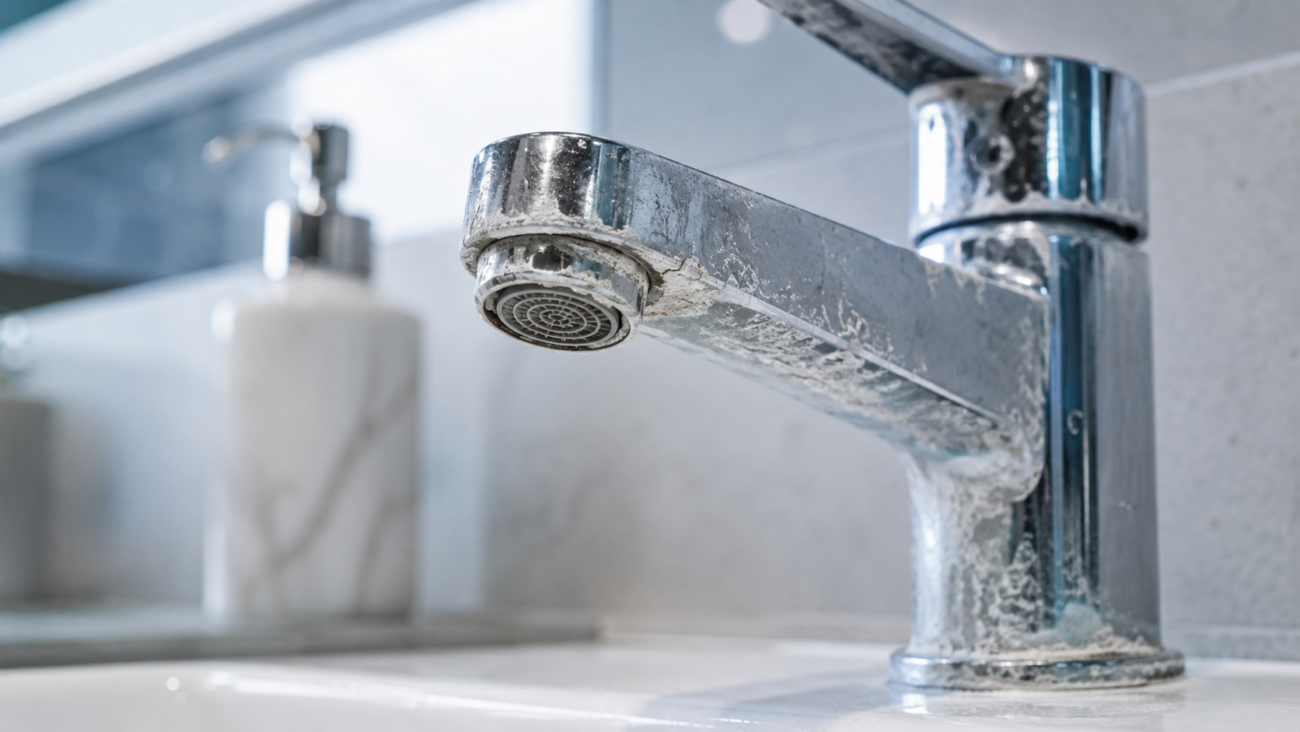
The white layer at the bottom of the kettle, the marks left by drops drying on the shower screen, a combi boiler that grows sluggish over time… Most people who see these signs make the same search: limescale filter. Yet the products sold under that name are not a single technology. Some add a very small amount of a substance to the water, some hold back only chlorine and sediment, and some genuinely lower the hardness of the water. In this article we compare five solutions by what they do and what they cannot do, and explain which one suits a combi boiler, a washing machine or dishwasher, the shower and the flat inlet.
Our approach rests on measurement: the effect of a solution on limescale is established by measuring the hardness of the water before and after treatment. A product that does not lower hardness can still do a particular job, but the result to expect from it is different. If that distinction is made at the outset, neither money nor time is wasted.
What Is a Limescale Filter?
Limescale filter is the common name for products used against limescale in water. The products known by that name work on different principles: anti-scale filter cartridges that dose polyphosphate, shower and tap filters that hold back chlorine and sediment, magnetic or electronic devices, water softeners working by ion exchange, and reverse osmosis units for drinking water. Of these, only ion exchange and reverse osmosis lower the hardness of the water measurably.
Limescale forms when the calcium and magnesium dissolved in water turn solid on a surface as the water heats up or evaporates. Two different things can therefore be expected of a limescale filter: to take those ions out of the water, that is, to lower the hardness; or to delay the build-up while the ions stay in the water.
Solutions in the first group give a result that can be measured in an analysis. In the second group the hardness value does not change; the effect depends on the composition of the water, the temperature and the conditions of use. Knowing which group a product belongs to before you buy prevents a wrong expectation from the start.
Aims to delay the build-up
Calcium and magnesium stay in the water; the product tries to influence the way limescale builds up on the surface.
- Polyphosphate cartridge
- Shower and tap filter
- Magnetic and electronic device
Takes the scale-forming ions out of the water
The result is confirmed by measuring the hardness in samples taken before and after treatment.
- Water softener (ion exchange)
- Reverse osmosis unit (drinking water)
Measure First: How Hard Is Your Water?
The size of a limescale problem is measured by the hardness of the water. In Türkiye hardness is usually expressed in French degrees (°fH); 1 °fH corresponds to 10 mg of calcium carbonate per litre. A preliminary measurement can be made at home with a practical test kit; where a system investment is involved, a laboratory analysis is the basis.
A product chosen without measuring the hardness is a decision taken without knowing the real size of the problem. The same product may look adequate on water of low hardness and fall short within a short time on water of high hardness.
For a first idea, a water hardness test kit can be used; within a few minutes it shows which hardness range your water falls in. If you need to convert between units (°fH, °dH), 1 °dH is roughly 1.8 °fH. We explained the units and the signs of hard water in detail in our water hardness guide.
Along with the measurement, note where limescale is causing trouble. Limescale is seen most on heated surfaces (the combi boiler heat exchanger, the water heater, the washing machine heating element, the kettle) and on surfaces where water evaporates (the shower screen, the tap spout, the aerator). Dissolved carbonate in heated water precipitates as calcium carbonate and clings to the surface.
Types of Limescale Filter: 5 Solutions Side by Side
Although the five solutions often share the name “limescale filter”, their working principles, their effect on hardness and their maintenance needs differ. A solution that is enough to protect a single appliance is not the same as one that protects the combi boiler, the plumbing and the white goods together.
The table below compares the five solutions heading by heading:
| Solution | How does it work? | Effect on hardness | Typical place of use | Maintenance |
|---|---|---|---|---|
| Polyphosphate cartridge | The polyphosphate in the cartridge dissolves slowly in the water and aims to delay the formation of scale in heated water | Unchanged | Combi boiler, water heater, washing machine and dishwasher inlet | The cartridge is renewed as the crystals run down |
| Shower and tap filter | Holds back chlorine and sediment with media such as sediment, activated carbon or KDF (copper-zinc granules) | Unchanged | Shower head, basin tap | The cartridge is changed according to how heavily it is used |
| Magnetic and electronic device | Applies a magnetic field or an electrical signal to the pipework | Unchanged | Pipework | Limited |
| Water softener | A resin bed holds calcium and magnesium and releases sodium in their place | Falls measurably | Flat and building inlet; the whole installation | Salt top-ups and periodic checks |
| Reverse osmosis unit | A semi-permeable membrane separates most of the dissolved salts from the water | Falls at the drinking water tap | Drinking water, tea and coffee in the kitchen | Filter and membrane replacement |
1. Polyphosphate Cartridge: the Anti-Scale Filter
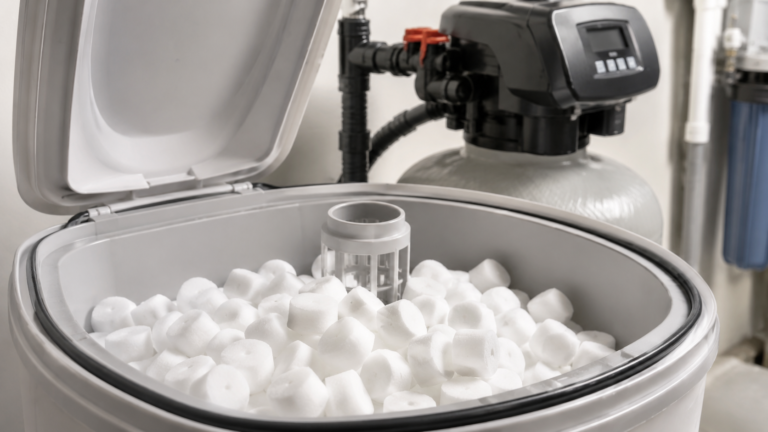
Most products sold as an “anti-scale filter” carry polyphosphate as white crystals or beads inside a clear housing. As water passes through the cartridge, a very small amount of these crystals dissolves. The aim is to delay calcium and magnesium turning into scale on a heated surface.
This product does not take calcium and magnesium out of the water; the hardness measured at the cartridge outlet is the same as at the inlet. Its effect falls at high temperatures and ends completely when the crystals are used up, so the housing is checked regularly and the cartridge is renewed at the interval the manufacturer recommends.
Polyphosphate cartridges are usually fitted to the feed line of a combi boiler, a water heater, a washing machine or a dishwasher. A cartridge whose manufacturer does not state clearly that it is suitable for drinking water should not be fitted on a drinking water line.
2. Shower and Tap Filters
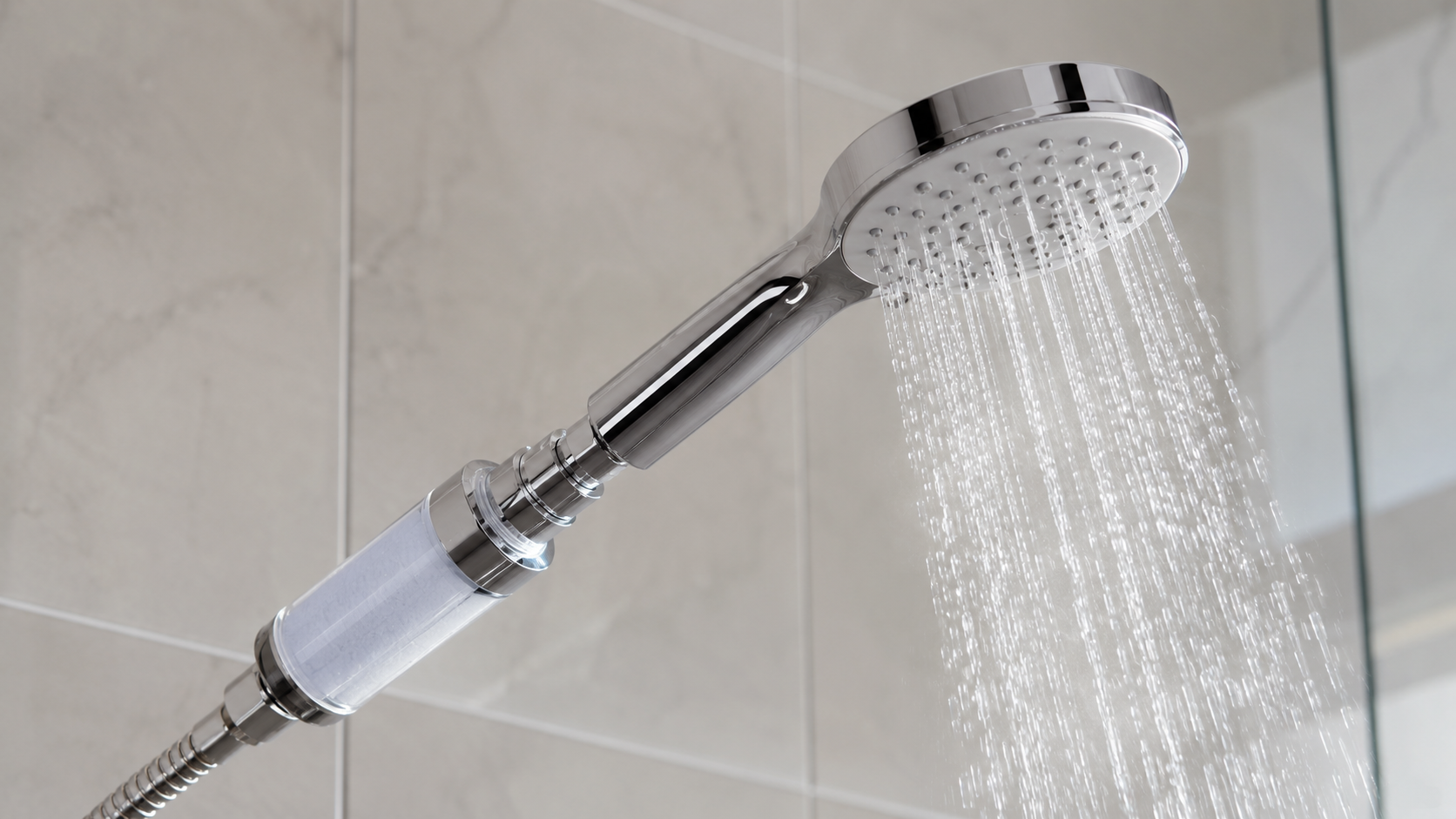
Most products searched for as a “shower head with a limescale filter” carry cartridges that reduce chlorine and fine sediment with media such as sediment, activated carbon or KDF. Water passes through the cartridge in only a few seconds; in that time no ion exchange takes place that could hold back calcium and magnesium.
As a result, a shower filter does not lower the hardness of the water and does not remove limescale marks on the shower screen. It can make a difference to chlorine odour and sediment. Our own mineral filter shower head belongs to this group too: it is designed for chlorine and fine sediment and does not remove hardness. The subject is covered in detail in our article does a shower filter work?
3. Magnetic and Electronic Devices
Fitted to the pipework, these devices apply a magnetic field or an electrical signal and aim to change the way limescale clings to surfaces. They do not change the composition of the water; the hardness is the same in samples taken before and after the device.
Independent assessments reach different conclusions about their effect on build-up, and there is no agreed standard method of measurement. We took these products up in detail in our article on limescale prevention devices.
4. Water Softener
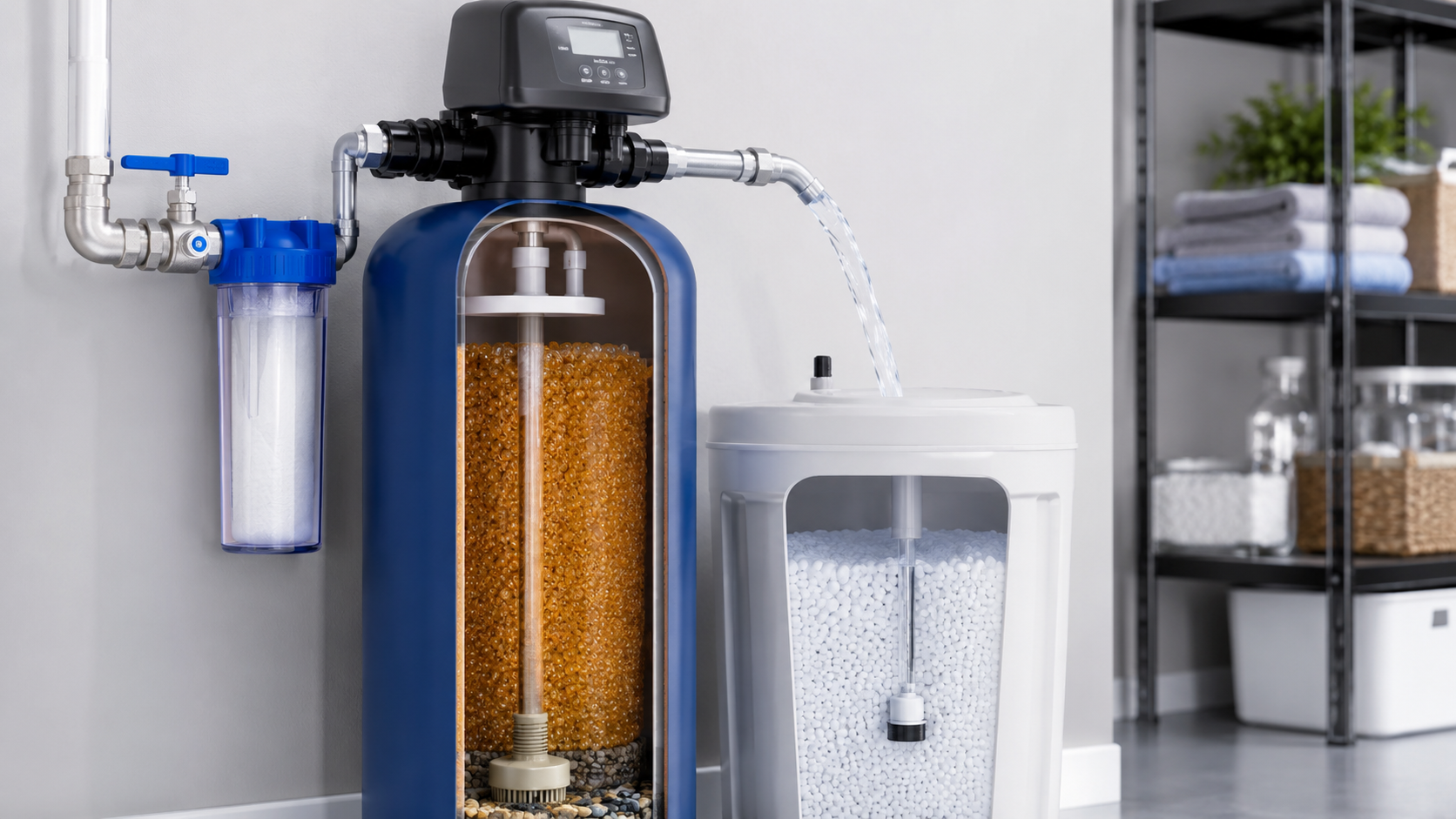
A water softener works by ion exchange in a resin bed: it holds calcium and magnesium and releases sodium in their place. The hardness of the outlet water falls measurably. When the resin is saturated it is renewed with brine; this process is called regeneration and is explained step by step in our regeneration guide.
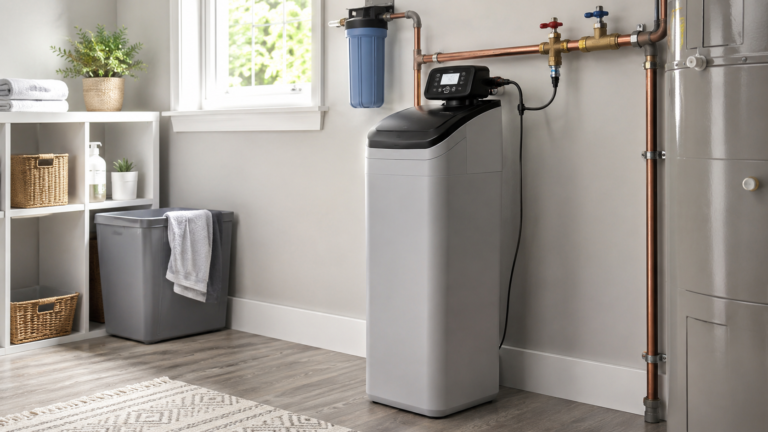
Installed at the flat or building inlet, it protects the combi boiler, the plumbing, the shower and the white goods together. Installation needs a drain connection, a power supply for the valve and salt top-ups. For models and capacity options, see our water softener prices page.
5. Reverse Osmosis: for Drinking Water
In a reverse osmosis unit, water is passed through a semi-permeable membrane and most of the dissolved salts are separated out. Calcium and magnesium are among them; this is why the layer of limescale in tea brewed with the treated water, and in a kettle used to boil it, falls markedly.
This solution feeds only the drinking water tap in the kitchen; it is not used for the combi boiler, the shower or the washing machine. You can find the options for the kitchen on our water purifier page.
Combi Boiler, Machines, Shower: Which Solution Where?
The right solution depends on where limescale is causing trouble. To protect a single appliance, a cartridge fitted at that appliance’s inlet may be enough. If the combi boiler, the plumbing, the shower and the white goods need protecting together, the hardness has to be lowered at the inlet.
Combi Boiler and Water Heater
Scale building up in a combi boiler’s heat exchanger weakens heat transfer, so more fuel is burnt to reach the same temperature. A polyphosphate cartridge fitted at the boiler inlet is a common measure. However, if the boiler manufacturer defines a hardness limit for the feed water in the user manual, that value can only be met with a solution that lowers hardness. We described the effect of limescale on heaters in our article on hard water and white goods.
Washing Machine and Dishwasher
Most dishwashers have a built-in water softener and run on dishwasher salt; the hardness setting in the user manual should be made to the measured value of your water. In a washing machine, limescale builds up most on the heating element. Anti-scale filter cartridges that fit on the inlet hose are sold for these machines; because they do not change the hardness, the detergent dose is still set according to hardness.
Shower, Mixer Tap and Shower Screen
The white marks seen on the shower screen and on the surface of the mixer tap are the calcium and magnesium left behind by drying drops. Because a shower filter does not hold these ions back, it does not prevent the marks. For the marks to fall lastingly, the hardness has to be lowered at the inlet. Periodic cleaning of the aerator on the tap spout, meanwhile, stops the flow narrowing.
Flat and Building Inlet
The technical answer to a search for a “limescale filter for the flat inlet” is a water softener installed at the inlet. The whole line after that point receives soft water. Compact cabinet models are used for a single flat, and large-volume systems at the inlet of an estate or an apartment block. The options are on our whole house and building inlet systems page; the details of an installation at building scale are in our article on the central water softening system.
Teapot, Kettle and Coffee Machine
On the drinking water side, limescale is seen most in the teapot and the kettle. With water drawn from a reverse osmosis unit in the kitchen, that build-up falls markedly. The limescale filters that coffee machine and jug manufacturers supply mostly carry a mixture of a small amount of ion exchange resin and activated carbon; their capacity is limited to a number of litres and they need changing at the interval the manufacturer states.
The decision table below is a summary guide for matching the problem with the right solution:
| The problem you see | Suitable solution | Why? |
|---|---|---|
| Limescale only in the combi boiler or water heater | A polyphosphate cartridge at the appliance inlet; softening if the manual sets a hardness limit | The feed to a single appliance is protected |
| Scale on the washing machine heating element | An anti-scale filter on the inlet hose, or softening at the inlet | The cartridge delays build-up; softening lowers hardness |
| Marks on the shower screen and mixer tap | A water softener at the flat inlet | The marks are formed by the calcium and magnesium that stay in the water |
| Chlorine odour in the shower | A shower filter | Chlorine and sediment are held back in the cartridge |
| Limescale throughout the combi boiler, plumbing and white goods | A water softener at the flat or building inlet | The whole line receives soft water |
| Limescale in the teapot and kettle | A reverse osmosis unit in the kitchen | Dissolved salts in the drinking water are reduced |
How to Choose a Limescale Filter: 5 Steps
The right limescale filter is settled by the answers to five questions: how hard is the water, which point is to be protected, how much is used each day, are the installation conditions suitable, and what will the annual running cost be. Followed in that order, the gap between expectation and result disappears.
-
Measure the hardness
Make a preliminary measurement with a test kit; for a system investment, ask for a laboratory analysis. The decision is built on that figure.
-
Decide which point to protect
A single appliance, only the shower, or the whole installation? The appliance inlet is chosen for a single point, the flat inlet for the whole home.
-
Work out consumption and flow rate
In softening, the resin volume is chosen according to daily consumption and hardness. The calculation is set out in detail in our article on how to choose a water softener.
-
Check the installation conditions
Softening needs a drain connection, a socket for the valve and a space suitable for salt top-ups. For cartridges, room on the line is enough.
-
Compare the running costs
Work out cartridge renewal, salt and maintenance costs on an annual basis. The purchase price on its own is not a criterion for the decision.
For a product offered as a “limescale filter”, put these questions to the seller: What is its effect on hardness, and how was it measured? After how many litres or months is the cartridge used up? If it is to be used on drinking water, is its suitability for that stated in writing? Every question that does not get a clear answer is a sign to lower your expectations.
Maintenance: Cartridges, Salt and Cleaning
Every solution has a maintenance schedule. Polyphosphate and shower filter cartridges lose their effect once they are used up; a water softener needs salt top-ups and periodic checks. No filter undoes old build-up that has already formed; existing limescale is cleaned off separately.
- Polyphosphate cartridge: Renewed when the crystal level in the clear housing has fallen or when the period stated by the manufacturer has passed.
- Shower and tap filter: Cartridge life varies with the chlorine and sediment load of the water; a spent cartridge brings no benefit.
- Water softener: The salt tank is checked regularly and filled with suitable salt. We covered the choice of salt in our article on water softening salt. The hardness of the outlet water is measured with a test kit at intervals.
- Existing build-up: Limescale that has already formed in a combi boiler heat exchanger, on a heating element or on fittings is removed by cleaning in line with the appliance manual; this step should be considered before a new solution is brought into service.
Tackle limescale at its source
Look at the solutions that lower hardness at the inlet, and choose the capacity according to the hardness of your water and your daily consumption.
Explore the Water SoftenersWater Point Su Arıtma Teknolojileri operates from Esenyurt, İstanbul, under its founder Ali Genç, with more than 20 years of experience in the sector.
Site Survey
The site survey is free if the unit is purchased from us; if only a site survey and measurement are requested, a site survey fee of 2,000 TL applies.
Warranty
Units, valves, pumps and tanks carry a 2-year warranty and taps a 1-year warranty. Filters, membranes, resin and salt are consumables and fall outside the warranty.
Service Area
For home units, service is provided in İstanbul and the neighbouring provinces; for industrial systems, across Türkiye.
Frequently Asked Questions
Does a limescale filter stop limescale completely?
It depends on the product. A polyphosphate cartridge, a shower filter and a magnetic device do not take calcium and magnesium out of the water; the hardness value stays the same. The solutions that lower hardness measurably are an ion exchange water softener and, for drinking water, reverse osmosis.
Can an anti-scale filter be used on drinking water?
Polyphosphate cartridges are usually sold for the feed to combi boilers, water heaters and white goods. A cartridge whose manufacturer does not state clearly that it is suitable for drinking water should not be fitted on a drinking water line. For limescale in drinking water, a reverse osmosis unit is used.
Does a shower head with a limescale filter work?
These heads mostly reduce chlorine and fine sediment. Because water passes through the cartridge in a few seconds, the hardness does not fall; the limescale marks on the shower screen and the mixer tap carry on. To reduce the marks, the hardness has to be lowered at the inlet.
Which limescale filter suits a combi boiler?
A polyphosphate cartridge fitted at the boiler inlet aims to delay build-up. If the boiler manufacturer defines a hardness limit for the feed water, that limit is met with a water softener that lowers hardness. Checking the user manual is the right place to start.
Can a limescale filter be fitted to a washing machine?
Yes. Anti-scale filter cartridges that fit on the inlet hose are sold for this purpose and aim to delay build-up on the heating element. Because the hardness does not change, the detergent dose still needs setting according to hardness.
How often does a limescale filter need changing?
With cartridge products the period depends on the hardness of the water and on consumption; the interval stated by the manufacturer is the basis, and with a polyphosphate cartridge the crystal level is followed by eye. A water softener has no cartridge; the resin is renewed with salt and the salt tank is filled regularly.
Can a limescale filter be fitted at the flat inlet?
The right solution for the flat inlet is a water softener; from that point on, the combi boiler, the plumbing, the shower and the white goods receive soft water. Installation needs a drain connection, a socket and an accessible space for salt top-ups.
What is the difference between a water softener and a limescale filter?
Cartridge-type limescale filters do not change the composition of the water and are aimed at protecting a single point. A water softener takes calcium and magnesium out of the water by ion exchange; the result is confirmed by a hardness measurement, and installed at the inlet it covers the whole line.
Conclusion
A limescale filter is not a single product but the common name for solutions that work on different principles. A polyphosphate cartridge, a shower filter and a magnetic device do not change the hardness of the water; they aim to delay build-up at a particular point or to reduce chlorine and sediment. The solutions that lower hardness measurably are an ion exchange water softener and, for drinking water, reverse osmosis. For the right choice, measure the hardness first, then decide which point you want to protect: for a single appliance an inlet cartridge may be enough; to protect the combi boiler, the plumbing, the shower and the white goods together, the hardness has to be lowered at the inlet.
Have your water measured and choose the solution for your goal
The site survey is free if the unit is purchased from us; if only a site survey and measurement are requested, a site survey fee of 2,000 TL applies. For information and orders you can reach us on 0850 304 95 25, speak to a specialist on our WhatsApp line 0536 729 99 52, or write to [email protected].
Explore the Whole House and Building Inlet Solutions