




















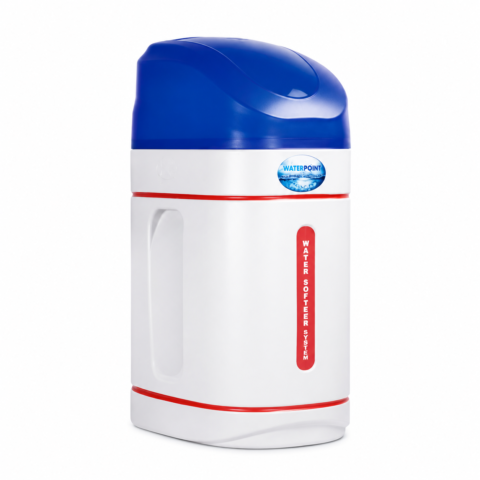


Water Softening Salt: Type, Purity and the Salt Bridge
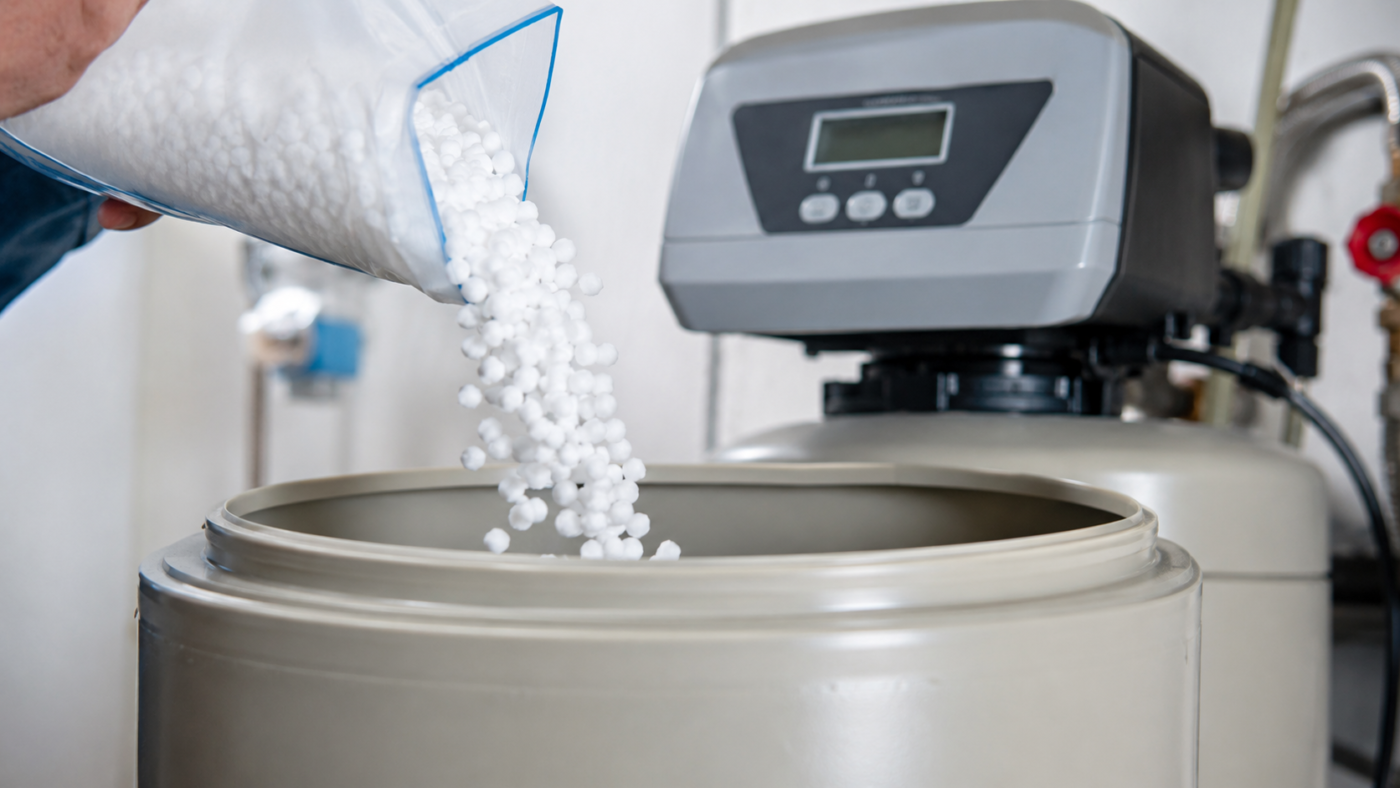
Salt is added regularly and the tank looks full; and yet white marks start reappearing on the taps. Or the salt runs out far faster than expected. And sometimes the salt in the tank hardens like stone and will not break when you press it. What those three scenarios have in common is this: water softening salt has been treated as a material you “top up and forget” in the system.
Yet the salt is the component that makes a softening system work, and its type, purity, consumption and storage conditions all show up directly in the performance of the system. In this guide we take up what the salt does, why one type is preferred over another, what settles the consumption and the common problems met with inside the tank.
What Does Water Softening Salt Do?
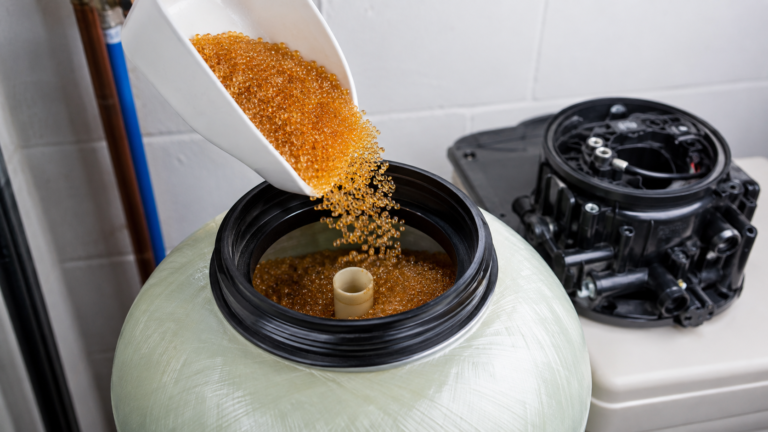
Water softening salt makes the brine needed to renew resin that has reached saturation. The salt is not used to be mixed into the water but to make the resin usable again. The brine prepared is passed through the resin; the hardness ions held are released and sent to the drain.
The logic of the system rests on an exchange. The resin beads hold the calcium and magnesium passing through the water and release sodium in return. Over time the holding capacity of the resin fills and the exchange comes to a stop.
And that is where the salt comes in. The concentrated brine prepared in the brine tank is passed through the resin bed and strips the ions held out of place. The bed is loaded with sodium again and carries on working.
Water softening salt is therefore not an additive but the material that renews the resin. The continuity of the system depends entirely on the presence and the quality of that material; when the salt runs out, the softening stops too.
We took up how the cycle works — backwash, brine draw and rinse steps included — in a separate article; for the details see regeneration cycle article. The subject of this piece is not the cycle but the material that makes that cycle possible.
Does the Salt Make the Water Salty?
No. The salt does not go directly into the water you use; the brine is passed through the resin only during regeneration and is discharged from the system when the work is done. Even so, as a result of the ion exchange there is a certain amount of sodium in softened water; that is a natural consequence of the working principle of the method.
This is the heading users misunderstand most often. Because salt is added to a tank, it is thought that the water will become salty; yet the two flows are separate from one another.
During normal running the water passes through the resin bed and does not touch the brine tank. The brine comes into play only during the regeneration cycle, completes its job and is sent to the drain. The system is then rinsed and returns to service.
As a natural result of the ion exchange there is sodium in softened water, because sodium is released in place of the calcium and magnesium held. That is a technical fact and no health assessment is being made here.
Because of that distinction, softening systems are installed to protect the plumbing and the equipment. Where drinking water quality is the aim, a separate treatment line in the kitchen is preferred. For the general framework of ion exchange softening systems, the US Environmental Protection Agency cation exchange water softeners resource can be consulted.
Why Is Table Salt Not Used?
Kitchen salt contains additives intended for food use and can leave undissolved residue. That residue collects in the bottom of the brine tank and can block the injector and the valve channels. So only salt made for this purpose should be used in softening systems.
The difference between the two products comes less from the salt itself than from the other components in it. Table salt can contain anti-caking agents and food supplements; none of those are components you want in a brine tank.
The consequences that follow are these:
Build-Up in the Bottom of the Tank
Undissolved residue collects at the bottom and leads to sludge.
A Blocked Injector
The narrow injector channels can block with residue; the brine cannot be drawn.
Valve Problems
Residue reaching the internal surfaces of the valve can affect its working adversely.
Frequent Cleaning
Cleaning the tank becomes unnecessarily frequent; the operating load rises.
In short, a choice that looks like a saving turns into maintenance and repair costs in a short time. So only products made for this application should be used as water softening salt; a suitable treatment salt protects both the tank and the valve.
Why Does the Purity of the Salt Matter?
Purity settles how much of the salt turns into brine. Products of low purity leave undissolved residue; that residue collects in the bottom of the tank, raises how often it has to be cleaned and creates a risk of failure. Salt of high purity dissolves without leaving marked residue behind.
Purity is the most technical heading in choosing salt and is stated on the packaging. It would not be right to give a numerical threshold here; what is decisive is using a product suited to the level of purity the unit manufacturer recommends.
The problem residue creates comes by degrees. It goes unnoticed in the first months; the layer at the bottom thickens over time and past a certain point starts to affect the preparation of the brine.
That build-up has a second effect too: when the tank needs cleaning, the job becomes harder. A hardened layer at the bottom makes emptying and cleaning the tank a laborious business.
So price should not be the only measure in choosing salt. The saving made on a product of low purity comes back as rising cleaning and possible repair costs.
The Difference Between Tablet and Granular Salt
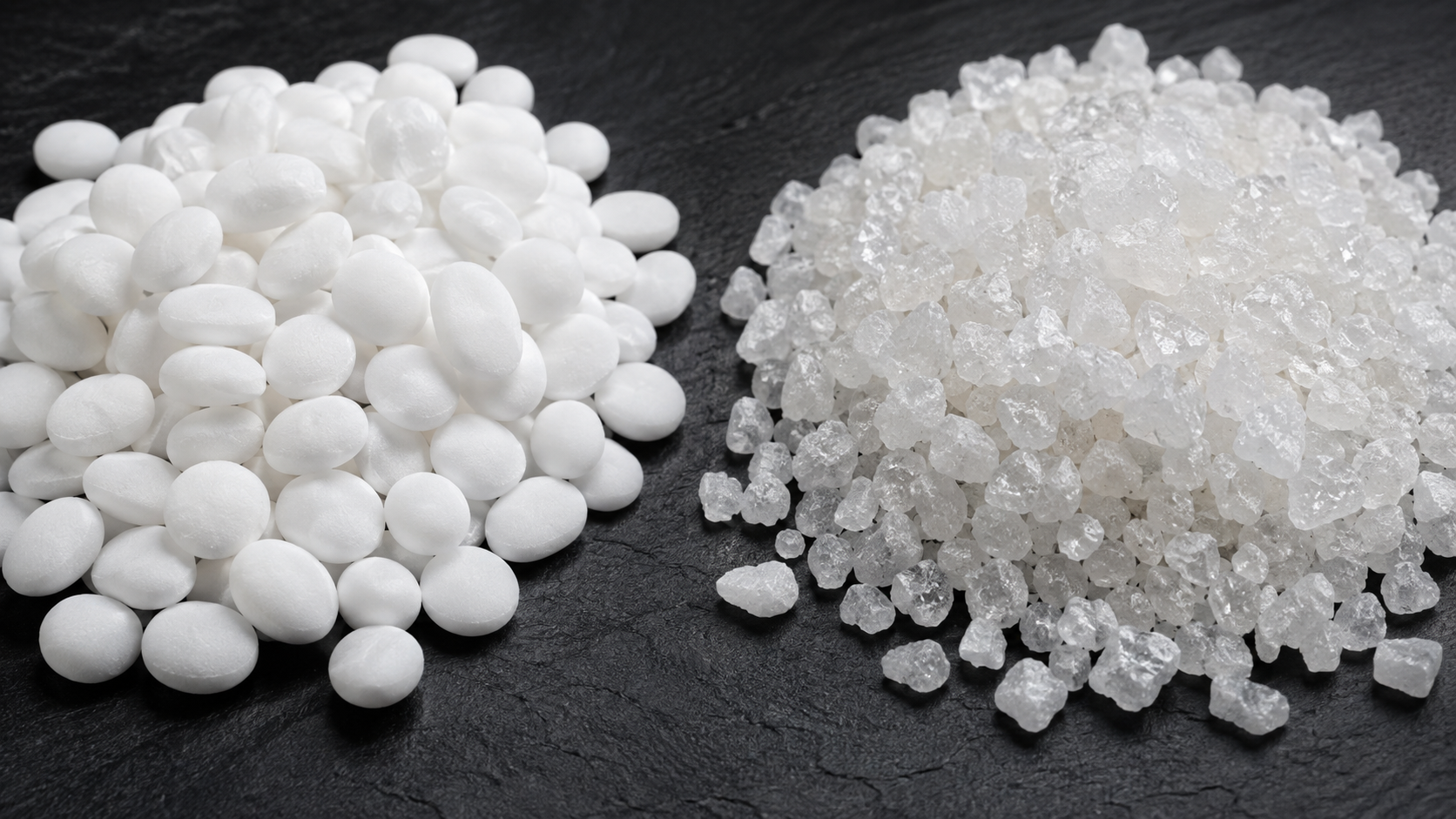
Because the tablet form is pressed and evenly shaped, it generally leaves less residue and the risk of bridging is low. The granular form is finer in structure and is preferred on particular systems. Which form is used is settled by the recommendation of the unit manufacturer.
The comparison of the two forms runs like this:
A pressed form
It is made as evenly shaped tablets; it settles evenly inside the tank.
- It generally leaves less residue
- The risk of bridging is low
- It creates no voids inside the tank
- It is common on domestic systems
A grained form
It is made of finer grains; it is used on builds calling for quick dissolution.
- Its surface area is wider
- It is more prone to caking with damp
- It is preferred on particular types of system
- The storage conditions are more critical
What is decisive in the choice is not the user’s preference but the structure of the unit. Some systems are designed for the tablet form; when a different form is used, the brine may not be prepared as expected.
Another important rule is not to mix. Products of different types and purities sitting together in the same tank make the behaviour of dissolution unpredictable and can speed up caking.
When choosing water softening salt, therefore, the unit’s manual should be checked first. If the manual specifies a form, that form should be used.
What Settles Salt Consumption?
Four factors settle the consumption: the hardness of the water, the daily water use, the capacity of the unit and the type of valve. As the hardness rises and the consumption grows, regeneration becomes more frequent; and that raises the use of salt. Because flow-controlled systems work to the real consumption, they remove the unnecessary cycle.
The type of valve is the heading that makes the most difference in that equation. A time-controlled system starts the cycle when the set period comes round, independently of the consumption. Even in a period when little water has been used, regeneration is carried out and salt is spent for nothing.
On flow-controlled systems the water passing through the meter is measured and the cycle is triggered only when the need actually arises. That structure makes a marked difference in households with variable consumption and in seasonal use in particular. Working on that logic, flow-controlled softening systems make salt consumption proportional to the use.
The other factors should not be overlooked either:
- Water hardness: As the hardness rises the resin saturates faster and the cycle becomes more frequent.
- Daily consumption: As the amount of water used rises, the total ion load grows.
- The capacity of the unit: A system chosen at too small a capacity regenerates more often.
- The settings: A hardness value entered wrongly can lead to an unnecessary cycle.
It is not possible to give an exact amount of consumption; that value varies with the hardness, the consumption and the capacity of the unit. The information in the unit’s manual should be taken as the basis.
If you do not know your hardness, the calculation cannot be made either. We set out how to take a sample in our water analysis guide, and the criteria for choosing a capacity in our softening selection guide.
If the salt is running out faster than expected, the settings of the unit should be checked first. A hardness value entered wrongly or an unsuitable regeneration period can raise water softening salt consumption unnecessarily.
What Is a Salt Bridge and How Do You Spot It?
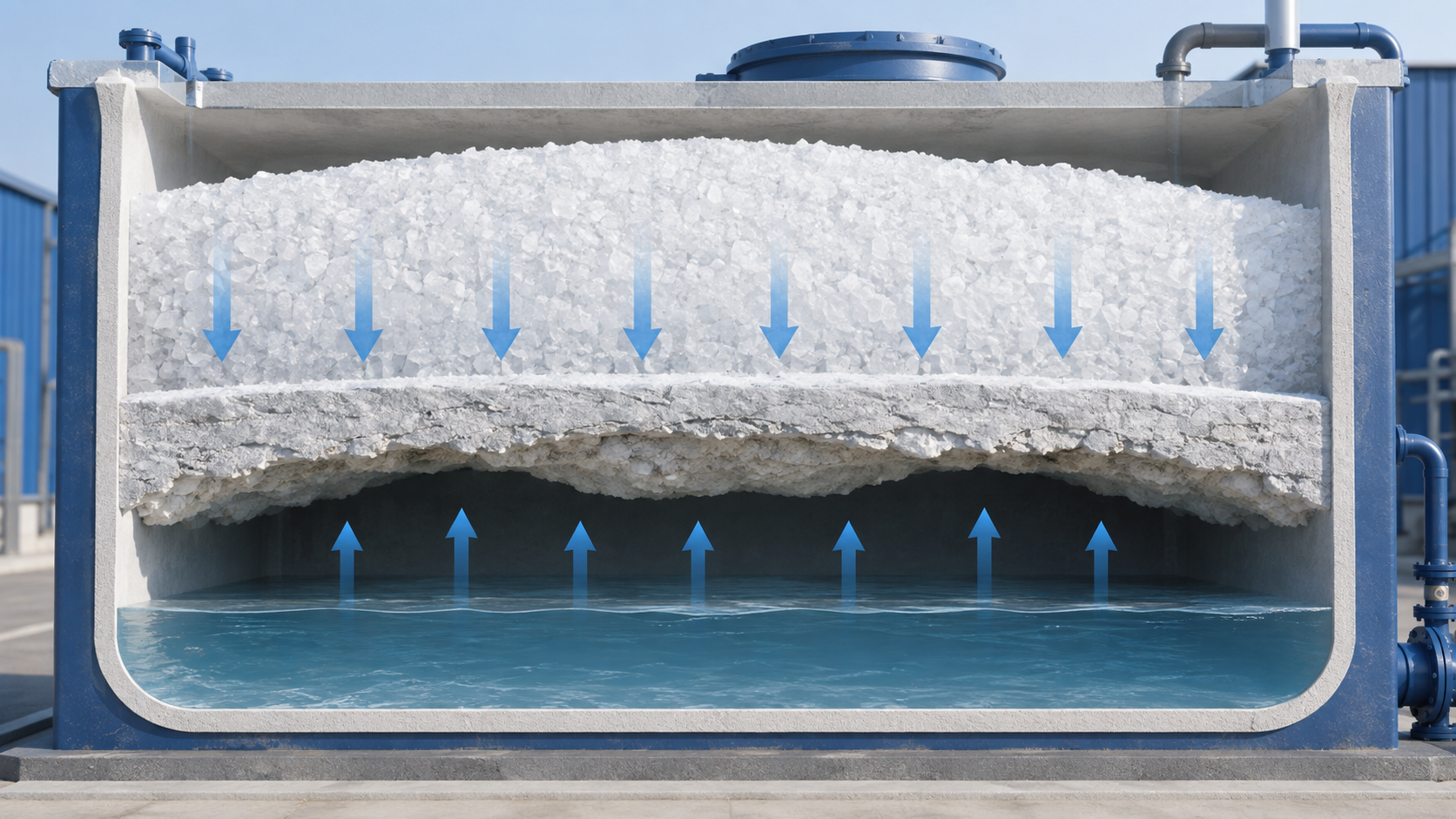
A salt bridge is the salt inside the tank hardening into a crust with a void left beneath it. Because the crust stays where it is, the tank looks full; but as the salt is not touching the water, no brine forms. The result is that the system cannot regenerate and the water hardens again.
That is the most deceptive of the salt-related problems. The user looks at the tank, sees the salt and looks for the problem elsewhere. Yet the salt that can be seen is not doing its job.
Picturing the situation makes it clear:
The Normal State
The layer of salt reaches the bottom and touches the water beneath it. Brine forms and the regeneration happens as expected.
A Salt Bridge Has Formed
The hardened crust stays suspended and a void forms beneath it. Because the salt does not touch the water, no brine can be prepared; the system cannot regenerate.
The main causes of bridging are damp, a high ambient temperature, salt left standing for a long time without being topped up, and products of low purity. Mixing different types of salt raises the risk too.
The signs are these:
- The salt is not going down: If the level has looked the same for weeks, a crust may have formed.
- The water has hardened: Signs of limescale have returned even though the tank looks full.
- The surface is hard: When you press gently on the salt you feel a hard, unbroken layer.
- A hollow sound: Tapping the crust gives a sound suggesting there is a void beneath it.
The crust has to be broken carefully. It is broken by pressing down from above with a long-handled, blunt tool, without damaging the tank wall or the internal parts. Hard, sharp tools should not be used and no weight should be put on the tank.
Inside the brine tank there is a draw tube and a float assembly. Those parts should not be damaged while the crust is broken. If the crust does not break easily, or if you are not sure where the internal parts are, a technical service should be called rather than forcing it.
Water Collecting in the Salt Tank and Other Problems
More water than expected in the tank, salt not dissolving, or sludge at the bottom all point to different causes. Among them are a fault in drawing the brine, a blocked injector, using salt of low purity and problems arising from the valve. Most call for a technical assessment.
The table below matches what you observe with a likely cause:
| Symptom | Likely Cause | What Should Be Done |
|---|---|---|
| There is too much water in the tank | The brine may not have been drawn | The injector and the valve are checked by a service engineer |
| The salt is not going down | A salt bridge may have formed | The crust is broken carefully; if it continues, a service engineer is called |
| Sludge at the bottom | Salt of low purity may have been used | The tank is cleaned and a suitable salt used |
| The salt is running out very fast | It may come from the settings or the type of valve | The hardness setting and the regeneration period are reviewed |
| No regeneration is taking place | A valve setting or fault may be involved | Technical service should assess it |
| The water has hardened but the salt is full | No brine may be forming | The bridge is checked, then a service engineer is called |
The checks a user can make are limited: looking at the salt level, checking whether the surface is hard, and looking for any visible build-up in the tank. Work on the injector, the valve and the draw assembly falls within the scope of technical service.
Cleaning the tank is a separate operation. When the layer at the bottom becomes marked, the tank has to be emptied and cleaned; but the position of the internal parts has to be preserved during that work. Where you cannot be sure, service support should be taken.
How Is Salt Added and Stored?
Topping up should be done before the tank empties completely; adding when the level falls reduces the risk of bridging. The packaging should be kept closed and away from damp. Products of different types and purities should not be mixed in the same tank.
The right practice runs in these steps:
-
Check the Level Regularly
Open the tank lid and check the level by eye. Rather than waiting for the salt to run out completely, top it up regularly.
-
Check How Hard the Surface Is
Press gently on the surface before topping up. If you feel a hard, unbroken layer, consider the possibility of bridging.
-
Use the Same Type of Product
Add a product of the same type and purity as the salt already there. Mixing different forms can upset the behaviour of dissolution.
-
Close the Lid
The tank lid should be closed fully after topping up. A lid left open lets in damp and outside influences.
-
Store the Packaging Closed
An opened pack should be closed at the mouth and kept in a dry place. Damp is the main factor that speeds up caking.
-
Raise It Off the Floor
During storage the packs should not be in direct contact with a damp floor; that preserves the structure of the product.
Storage conditions are treated as unimportant by most users; yet a significant share of bridging problems starts at the storage stage. A product that has taken up damp shows a markedly greater tendency to cake once it is put into the tank.
One more practical point: topping up before the tank empties completely not only prevents bridging but also removes the risk of the system being left without salt. When the salt runs out, regeneration cannot be carried out and the water hardens.
How Is the Right Salt Chosen?
Six measures are taken as the basis in the choice: the type the unit manufacturer recommends, the purity of the product, the integrity of the packaging, being able to obtain it regularly, consistency of form and suitable storage. When those are in place, the system is protected and the maintenance becomes predictable.
The first measure is beyond dispute: the unit’s manual. If a form or a level of purity is defined in the manual, that is directly binding. Going outside the manual can affect the warranty cover too.
The headings to assess are these:
The Manufacturer’s Recommendation
The type and level of purity stated in the manual should be taken as the basis.
Purity
Products that leave no residue protect the tank and the valve and reduce how often cleaning is needed.
The Integrity of the Packaging
Torn packaging or packaging that has taken up damp carries a risk of caking.
Continuity of Supply
A product that can be obtained regularly prevents the maintenance slipping.
Consistency of Form
Using the same type at every top-up preserves the behaviour of dissolution.
Somewhere to Store It
A dry storage area keeps the structure of the product intact.
Continuity of supply is critical for businesses in particular. When the salt runs out the system cannot soften; and that means limescale problems returning in a short time. We took up the effect of limescale on equipment in our hard water article.
Finally the resin side is worth a reminder too: the salt renews the resin, but the resin itself tires over time. We took up the structure of the material and the factors that settle its life in our resin article; when it has to be renewed, a suitable cation resin is used.
Let’s establish the salt that suits your unit
To choose a product of the right form and purity for your type of system, you can look at the options.
See the Treatment SaltFrequently Asked Questions
Can I use table salt?
It is not advised. Kitchen salt contains additives intended for food use and can leave undissolved residue. That residue collects in the bottom of the tank and can block the injector and the valve channels. Only products made for this purpose should be used.
What happens when the salt runs out?
No brine can be prepared and the resin cannot be renewed. The system carries on working but does not soften; the water hardens again and signs of limescale return in a short time. So the level should be checked regularly.
How often should salt be added?
There is no fixed period; the frequency varies with the hardness of the water, the daily consumption, the capacity of the unit and the type of valve. The right approach is to top up regularly before the tank empties completely. The information in the unit’s manual should be taken as the basis.
Can softened water be drunk?
Softening is a process aimed at lowering the hardness of water; drinking water quality is not the aim of that stage. The dissolved solids load is largely preserved and only the hardness-forming components change. A separate treatment line is generally preferred for drinking and kitchen use.
How is the salt tank cleaned?
When the layer at the bottom becomes marked, the tank is emptied and cleaned. But inside the tank there is a draw tube and a float assembly; those parts should not be damaged. Where you cannot be sure, the work should be done by a technical service.
The salt is not going down — what could be the cause?
The most common cause is a salt bridge. The hardened crust stays suspended, a void forms beneath it and the salt does not touch the water. The tank looks full but no brine can be prepared. The crust should be broken carefully; if the problem continues, a service engineer should be called.
Should I use tablet or granular salt?
The decision is made from the structure of the unit. The tablet form generally leaves less residue and the risk of bridging is low; the granular form is preferred on particular systems. If a form is defined in the manual, that form should be used.
Can I mix different salts?
It is not advised. Products of different types and purities sitting together in the same tank make the behaviour of dissolution unpredictable and can speed up caking. Using the same type of product at every top-up is safer for the system.
The salt is running out faster than expected — is that normal?
Consumption varies with the hardness and the use; but where there is an unexpected rise, the settings should be checked. A hardness value entered wrongly or an unsuitable regeneration period can raise the consumption. On time-controlled systems an unnecessary cycle is a cause too.
Conclusion
Water softening salt is a far more decisive component in a system than it appears. Its job is not to make the water salty but to form the brine that will renew resin that has reached saturation; when the work is done that brine is discharged from the system. Three headings matter for the right result: the right type, sufficient purity and regular topping up. Because of the additives it contains, table salt leaves residue in the tank; and products of low purity create a risk of build-up at the bottom and of blocking. In a salt bridge, the problem met with most often, the tank looks full but no brine can be prepared — so the hardness of the surface should be checked as well as the level. And the consumption is settled by the hardness, the use, the capacity and the type of valve together; for the exact amount the unit’s manual governs.
Get in touch for the right salt and maintenance support
The site survey is free if the unit is purchased from us; for a survey and measurement only, a survey fee of ₺2,000 applies. For the type of salt that suits your unit and for maintenance planning you can reach us on 0850 304 95 25 or at [email protected].
Discover the Softening Solutions