
Hospital Water Treatment: Planning the Technical Lines
There are three separate items on the technical manager’s desk: the autoclave is failing more often than expected, the laboratory is reporting inconsistency in results, and the chemical consumption of the laundry is climbing a little every month. Three different units, three different service firms, three separate budget lines. And behind that picture there is usually one shared variable, which is where hospital water treatment comes up at exactly this point.
This guide focuses on the technical infrastructure of the plant. The subject is not care processes or clinical applications; it is the water itself, as an operating condition for the equipment. We take up which line calls for which level of quality, how the stages are built, and how line-by-line planning affects both the investment and the running cost. The starting point of a hospital water treatment project is that same distinction.
Why Is Water Quality Handled Separately in Healthcare Facilities?
In healthcare facilities water is both an operating condition for the technical equipment and part of the infrastructure of the building. The quality requirement is not defined with a single standard for the whole facility; it varies by line. The assessment of suitability is made with the relevant regulations and accredited laboratory analysis.
In a healthcare facility water takes on jobs that differ widely from one another. On one line it is the input to steam production, on another it becomes a component of the analysis process, and on a third it carries the cleaning and laundry operation. Those jobs do not have the same expectations.
That is what sets it apart from other commercial buildings. In an office block water is largely used for a single purpose, while in a healthcare facility the same main line feeds units with different quality targets. So hospital water treatment planning is not a choice of equipment but an exercise in mapping the lines.
The second determining factor is continuity. The facility runs without a break; a stoppage on the technical lines affects more than one unit at the same time. That carries the subject of redundancy into the centre of the design.
This article covers the technical lines and equipment water; it makes no assessment about clinical applications and contains no promise. The suitability of water for its intended use is established by the relevant regulations and accredited laboratory analysis; the facility quality system is what governs.
The Different Lines Where Water Is Used in a Facility
In a healthcare facility water is used mainly on these lines: autoclave and steam feed, laboratory and analysis, the kitchen, the laundry, the heating and cooling circuits, and general utility water. Every line has a different expectation, so quality targets are defined line by line.
Knowing the lines is the first step in planning. The groups below show the main areas of use met with in a typical facility:
Autoclave and Steam
Because the water evaporates, the minerals stay inside the equipment. The quality of the feed water is directly decisive here.
Laboratory
Analysis processes call for water of low conductivity. It is among the lines with the highest quality expectation in the facility.
The Kitchen
On cooking, drinks and dishwashing equipment, hardness-related build-up and chemical consumption come to the fore.
Laundry
Limescale build-up on heated surfaces and the performance of the chemicals are the decisive headings.
Heating and Cooling
In boiler and cooling circuits, scaling affects heat transfer and energy consumption.
General Utility Water
Wet areas and general plumbing; the expectation is relatively low and sediment control is the priority.
Those six groups make up the map on which a hospital water treatment build rests. When a separate quality target is defined for each group, the technical need is met and an unnecessary investment in capacity is avoided.
We took up the general idea of industrial process water — including the boiler, cooling and corrosion headings — in a separate article; for the technical framework you can look at our process water article.
Dialysis water is a separate field subject to its own specific regulations and is outside the scope of this article. The requirements for that line are assessed only by the relevant regulations and by a specialist in the subject.
Autoclave and Steam Feed Water
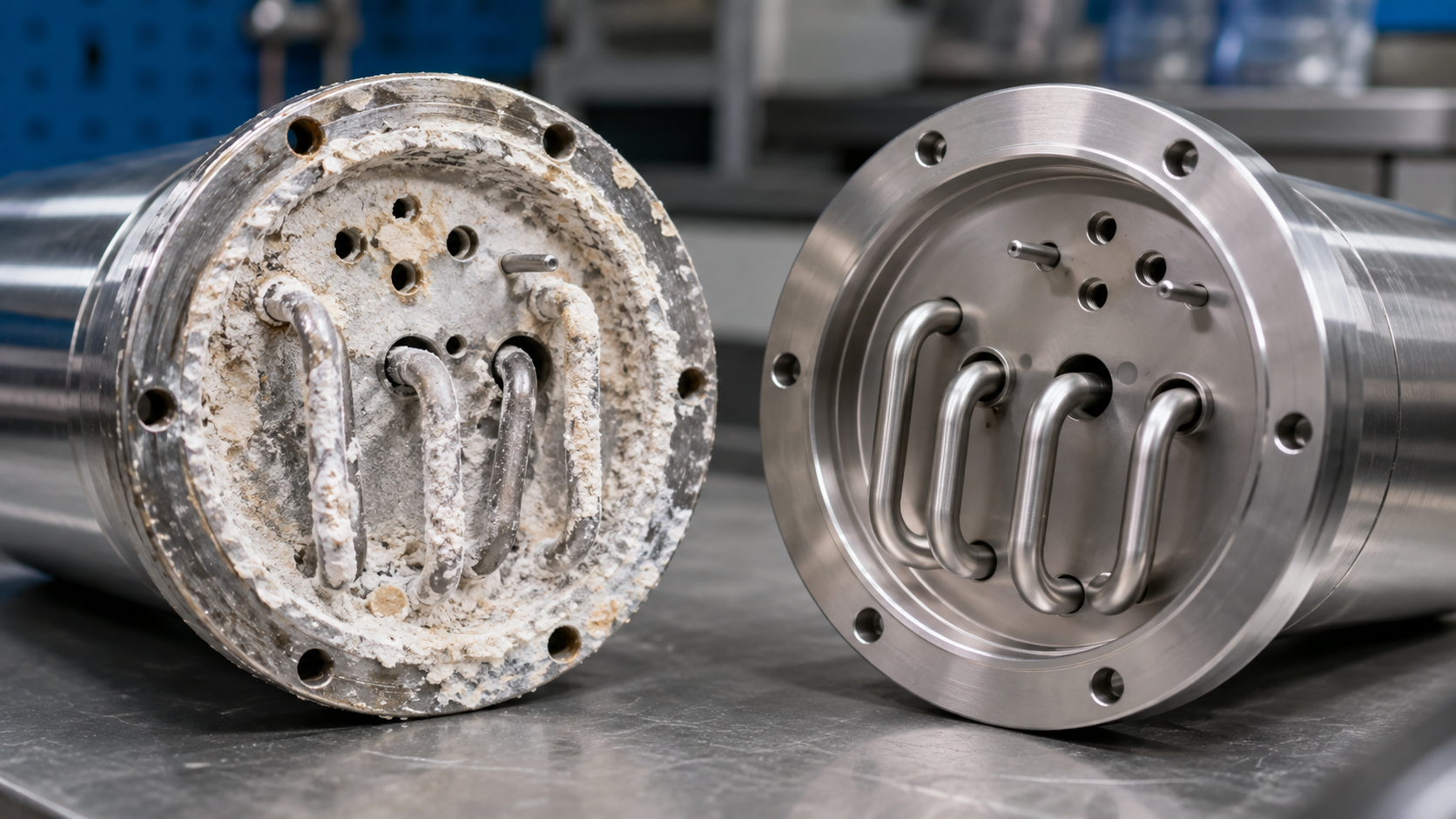
In steam production the water evaporates completely; the minerals in it stay inside the equipment and form scale. That build-up lowers heat transfer, raises energy consumption and increases the frequency of faults and maintenance. So the hardness of the feed water is brought under control.
This is the line most sensitive to water quality. On the other lines water passes through and some of it leaves the system; in steam-producing equipment the water changes phase and the minerals stay behind. The rate of build-up is markedly higher for that reason.
For a technical manager the consequences are concrete:
Loss of Heat Transfer
The layer forming on the surface behaves like insulation; reaching the target conditions takes longer.
A Rising Energy Spend
Longer running is needed for the same result; consumption goes up.
More Frequent Maintenance
Descaling turns into a recurring expense and creates downtime.
Early Failure
Heating elements and narrow-bore channels are put under strain; wear speeds up.
Unplanned Stoppages
When a piece of equipment goes out of service, more than one unit is affected at the same time.
Warranty Conditions
Manufacturers define conditions for the feed water; the manual is what governs.
The last card matters in particular. Manufacturers of autoclave and steam equipment define requirements for the feed water in their manuals. When a hospital water treatment build is planned, those requirements should be collected and the quality target set accordingly.
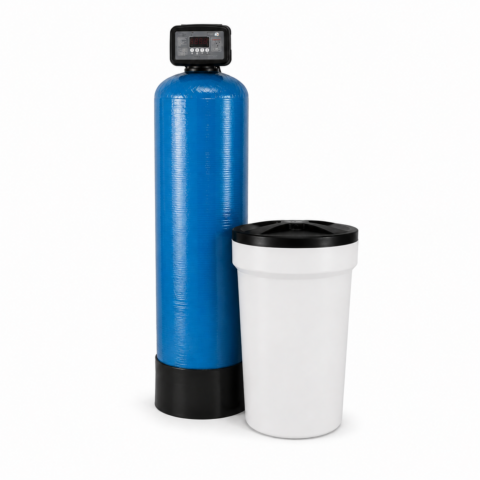
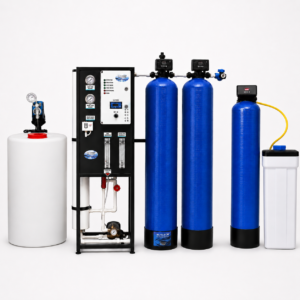
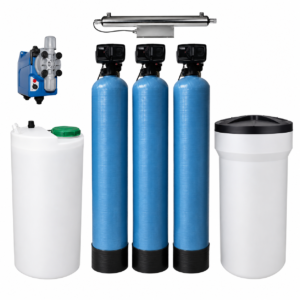
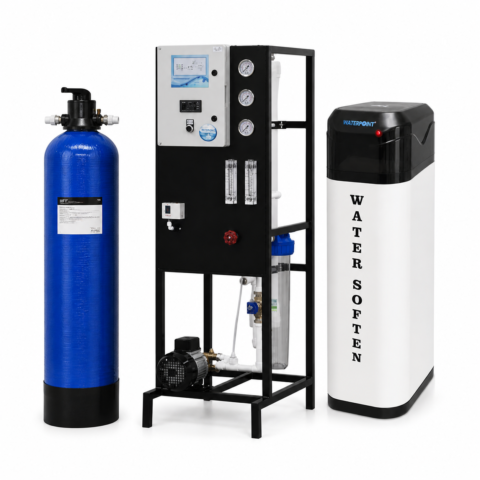
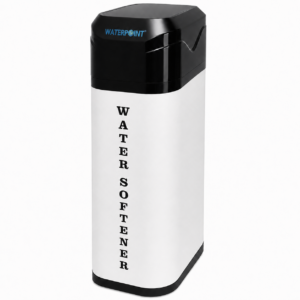
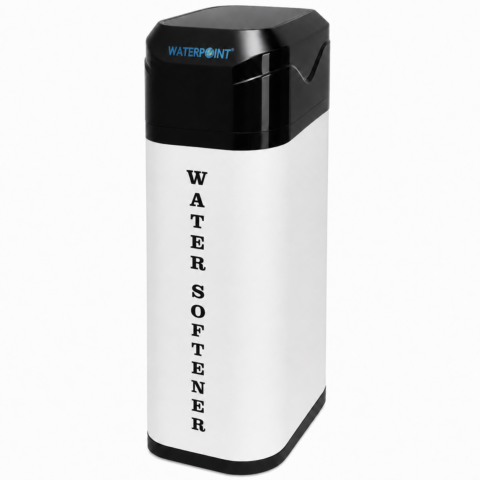
In practice a softening stage is generally installed for this line; where the quality expectation is higher, advanced treatment is added. For needs at that scale industrial softening systems are used, and the capacity is set by the steam requirement of the facility.
Laboratory and Analysis Water
Laboratory processes call for water with a low dissolved ion load; conductivity is the basic parameter followed on this line. In practice reverse osmosis takes down the main load and deionisation holds the trace ions that remain. The level of quality needed is defined by the requirements of the equipment manufacturer and of the laboratory’s own methods.
This is among the parts of the facility with the highest quality expectation. The water used in analysis processes is an input affecting the repeatability of results, so the quality target is defined clearly and monitored.
The build is generally in two stages. The reverse osmosis membrane separates most of the dissolved substances, at rates of up to 99%; a resin bed then brings the conductivity down further. When those two stages work together, the quality aimed for is achieved.
We took up in which fields pure water is used, and why, in our uses of pure water article. We explained the technical side of deionisation in our deionised water article; we do not repeat the technology here.
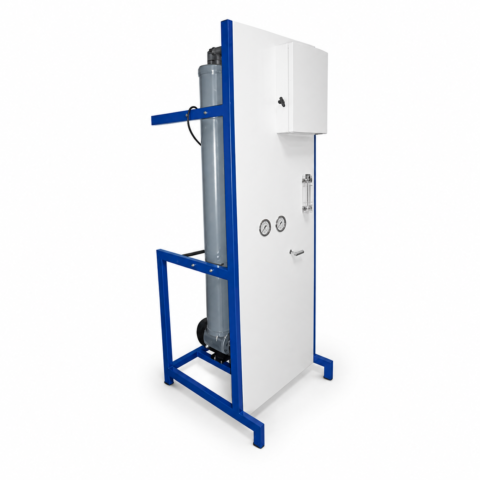
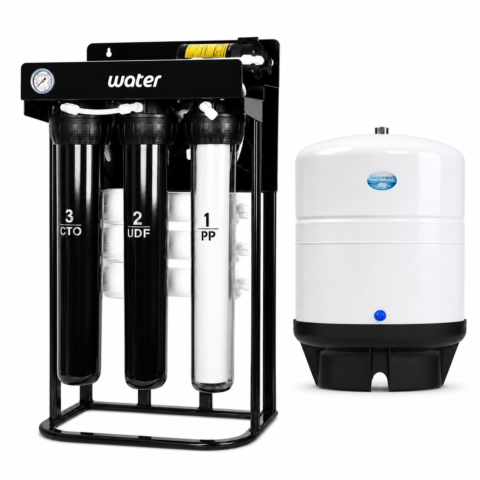
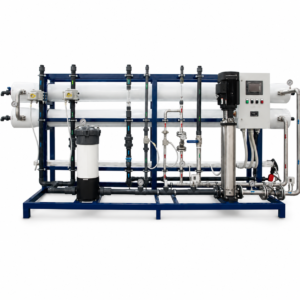
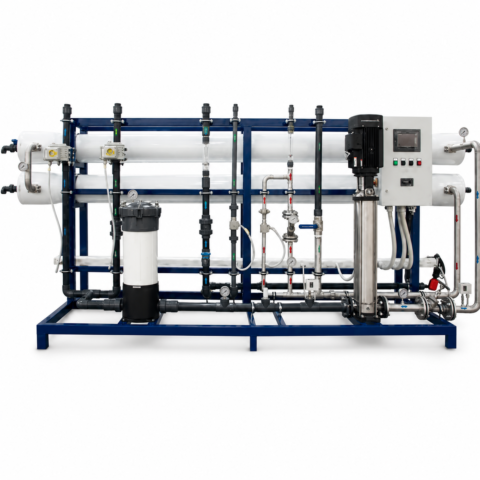
On the equipment side, for the main treatment high-capacity reverse osmosis systems are used, and for the final stage, deionised pure water systems. In a hospital water treatment project this line is built to a separate quality target and usually with its own distribution line.
Special Applications such as Dental and Eye Clinics
Some clinical equipment has conditions defined by the manufacturer for its feed water. Those conditions vary from device to device and are stated in the manual. So the quality target for those lines is set not by a general assumption but by the manufacturer information for the device concerned.
Dental units, the devices in eye clinics and similar special equipment fall into this group. What they have in common is this: the manufacturer of the device defines a requirement for the feed water so that the equipment works correctly.
No technical detail about those conditions is given in this article, because the values are specific to the device and generalising would be misleading. The right approach is to collect the manuals of the equipment in the facility and derive the quality target from those documents.
A practical note for small-scale clinics: in facilities of that kind a compact build serving a single point of use may be enough. The scope is set by the number of pieces of equipment in the facility and by the feed requirement; that assessment is made during the site survey.
In medium-scale buildings such as veterinary clinics and medical centres the picture comes closer to hospital scale: several lines, different quality expectations and a need for continuity all sit together. The same logic of hospital water treatment planning applies in those buildings too.
The Kitchen and Laundry Lines
The kitchen and the laundry are the lines where the load caused by hardness is felt most clearly. Limescale build-up forms on heated surfaces, the performance of the cleaning chemicals can fall and consumption rises. Those two lines bear directly on the operating spend of the facility.
They fall outside the care processes, but they are critical to the facility running without a break. The laundry stopping, or a piece of kitchen equipment failing, disrupts the daily operation directly.
On the laundry side the effects are more marked: build-up on the elements, longer programme times, a rise in chemical consumption and residue after rinsing. We took those headings up in detail in a separate article; laundry water treatment, where you can go through the whole subject.
On the kitchen side the heated surfaces, the drinks equipment and the dishwashers come to the fore. We took up the general framework for that group in our water treatment in kitchens and food service article.
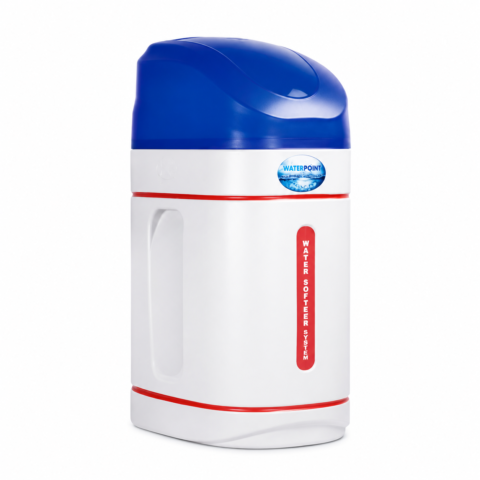
On both lines the answer is generally a softening stage. In a hospital water treatment build those lines call for no advanced treatment, and that is a distinction which markedly affects the total investment.
Which Stages Are Used in a Hospital Water Treatment Build?
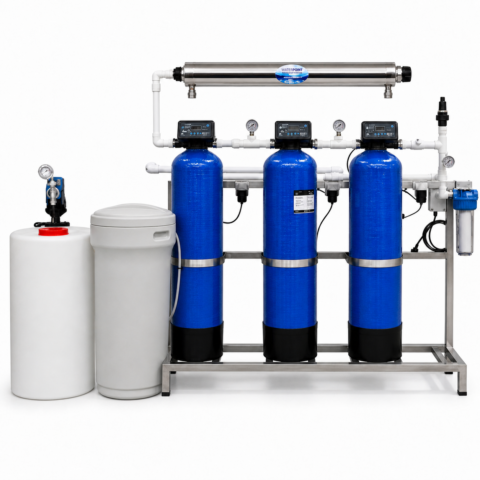
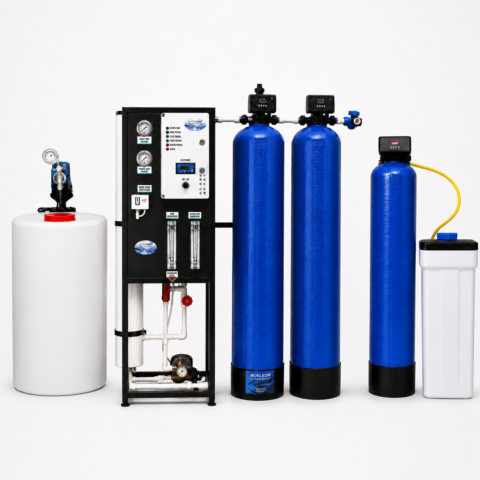
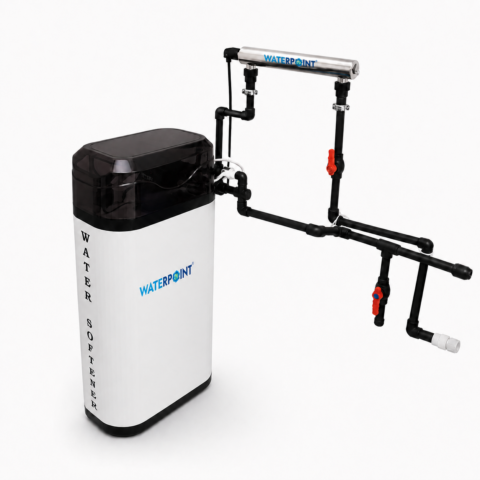
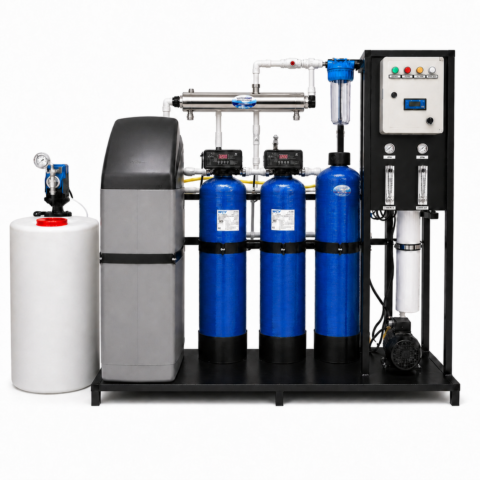
A typical build includes these stages: sediment filtration, activated carbon, water softening and reverse osmosis. On lines aiming at a lower conductivity, deionisation is added, and at the points where microbiological load is handled, UV (ultraviolet) treatment. The choice of stages is made from the analysis result and the target for the line.
The table below matches the line with the right stage:
| Line | The Stage That Comes to the Fore | The Result It Gives |
|---|---|---|
| General utility water | Sediment filtration | It holds particles back and protects the plumbing and the equipment |
| Kitchen and laundry | Softening | Prevents build-up on heated surfaces |
| Autoclave and steam feed | Softening plus advanced treatment where needed | It reduces scaling and the loss of heat transfer |
| The laboratory line | Reverse osmosis | Lowers the dissolved load by up to 99% |
| The lowest conductivity target | Deionisation | It holds the remaining trace ions |
| Chlorine, odour, organic load | Activated carbon | Protects the membrane, reduces the sensory effect |
| Microbiological load | UV (ultraviolet) treatment | Reduces microbiological risks |
The first link in the chain is pre-treatment, and it forms the foundation of the whole build. When the sediment and chlorine load is handled on the inlet line, the stages behind it do their job for the period expected.
The order of the stages matters too. Every stage protects the next; when pre-treatment is skipped the softening resin is fouled by sediment, and when the carbon stage is skipped the load on the membrane rises.
A hospital water treatment build that chain is designed not for a single line but to serve more than one target. A common pre-treatment, then line-by-line advanced stages — that is the usual build.
Let’s establish the stages that suit the lines in your plant
To clarify which stages are needed from your water analysis and your line-by-line quality targets, you can look at the solutions.
See the Industrial SolutionsNot Every Line Calls for the Same Quality
Feeding a whole facility to a single quality target usually means unnecessary investment. The laboratory line carries the highest expectation, while general utility water can be met with a simpler build. Line-by-line planning lowers both the initial investment and the running spend.
This is the heading in engineering a system that saves the most, and it is skipped often all the same. When the whole facility is fed to the highest standard, the advanced treatment capacity is chosen larger than it needs to be; that raises both the investment and the consumable use.
The level of expectation of the lines runs roughly in this order:
General Utility Water
Wet areas and general plumbing. The expectation is relatively low; sediment control is the priority heading.
The Kitchen and the Laundry
Hardness control is decisive. Protecting the equipment and chemical consumption are handled at this level.
Autoclave and Steam Feed
Preventing scale is essential. An advanced stage may be added in line with the manufacturer conditions.
The Laboratory Line
A low conductivity is aimed for. It is the line with the highest quality expectation in the facility.
That order is not a rule but a logic of planning. The spread of lines differs in every facility; the exact targets are defined by the requirements of the equipment manufacturers and by the facility quality system.
In practice the build takes shape as follows: the water entering the facility passes through a common pre-treatment, and additional stages then come into play for the lines calling for high quality. Advanced treatment therefore runs only at the flow rate needed, and the capacity is not enlarged for nothing.
Before starting the engineering, list all the points of water use in the facility and place each one at a level of expectation. That simple exercise is the most effective step there is against unnecessary capacity in a hospital water treatment investment.

Uninterrupted Water and Redundancy
Healthcare facilities run without a break; downtime on the technical lines is not accepted. Softening systems go into regeneration to renew the saturated resin, and on a single-tank build hard water can pass into the line during that time. So twin-tank tandem builds are preferred.
This is the detail most often skipped in the design. The system is installed and the capacity worked out correctly; but the regeneration window is not planned.
The problem shows up like this: regeneration is generally programmed for the night hours. But in a facility running without a break there is no such thing as an “empty hour”. In that case either unsoftened water passes into the line during the cycle, or regeneration is put off and the resin stays saturated.
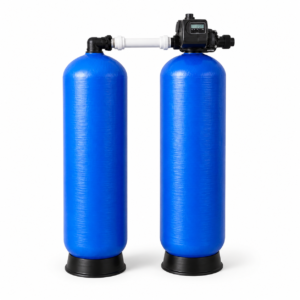
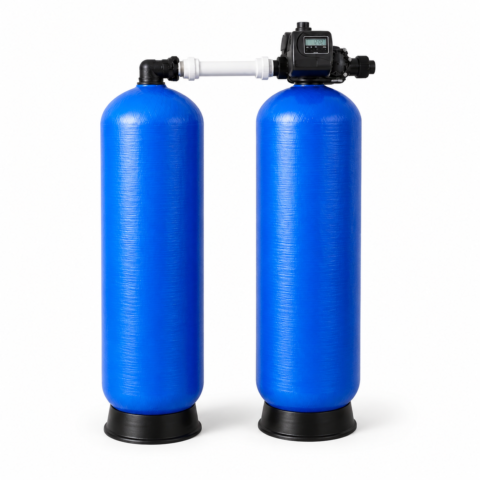
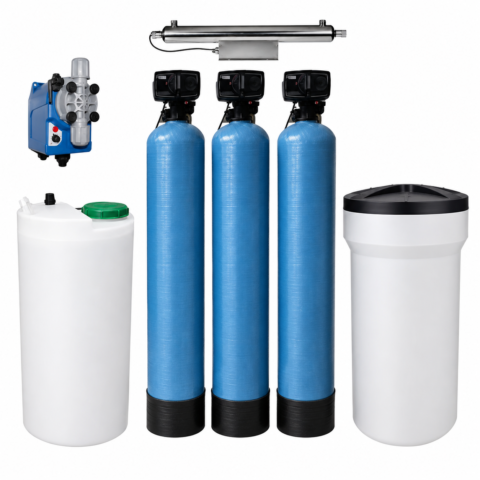
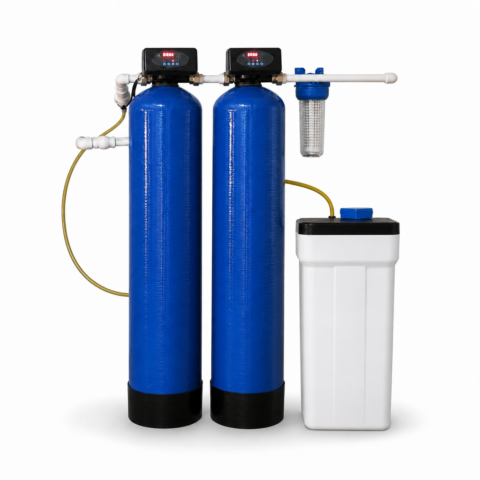
A tandem build removes that dilemma. There are two tanks; when one goes into regeneration the other stays in service. Softened water is delivered to the line without a break. Built for that need, twin-tank tandem softening systems are usually treated as a compulsory component in a hospital water treatment project.
We took up how the cycle works — backwash, brine draw and rinse steps included — in a separate article; for the details see our regeneration cycle article.
For a general framework on preserving water quality throughout a building, the US Environmental Protection Agency has a guide to maintaining water quality in buildings that can be consulted. That source offers a general approach; it does not take the place of Turkish regulations, and local assessment is made by the competent authorities.
A bypass line, so that flow continues during maintenance, should be planned at the installation stage. That detail is settled before installation, not afterwards; otherwise every maintenance operation means a stoppage.
How Is a Hospital Water Treatment Project Planned?
The planning is done with five sets of data: the water analysis result, the line-by-line quality targets, the flow and peak use profile, the installation space and infrastructure conditions, and the maintenance and monitoring plan. Until those headings are clear, the capacity and the build of the stages cannot be settled.
A sound project process runs in this order:
-
Have a Water Analysis Done
The profile of the inlet water is established at an accredited laboratory. Where the source varies with the season, repeating it at different times is advised.
-
Classify the Lines
All the points of use are listed and grouped by their level of expectation. The feed water requirements in the equipment manuals are collected at this stage.
-
Work Out the Flow and Peak Profile
The daily consumption and the simultaneous use at the busiest hour are established. The system is sized to peak demand, not to the average.
-
Build the Stages
A common pre-treatment and line-by-line advanced stages are planned. Where uninterrupted running is needed, the tandem build is defined at this stage.
-
Confirm the Space and the Infrastructure
The layout of the equipment, the drain connection, the power supply, access for salt and room to work on the units are all clarified in advance.
-
Set Up a Maintenance Plan
Consumable renewal, performance tracking and repeat analysis are tied to a plan. The responsible staff are named and records are kept.
The sixth step is the heading that slips most often in institutions. When the question of who checks what, and when, is not defined, maintenance is left to no one and the system does not deliver the performance expected. So in a hospital water treatment project maintenance should be treated as an inseparable part of the buying process.
We took up step by step how to take a sample and how to read the report in our water analysis guide. In facilities an analysis gives a far more accurate result when it is done line by line.
Water Point Su Arıtma Teknolojileri operates from Esenyurt, İstanbul under its founder Ali Genç, with more than 20 years of experience in the sector.
Service Network
For industrial systems there is a service network across Türkiye; for home units service is provided in İstanbul and the neighbouring provinces such as Kocaeli and Tekirdağ. Technical service is provided for units of every make, domestic and foreign.
Warranty
Units, valves, pumps and tanks carry a 2-year warranty and taps a 1-year warranty. Filters, membranes, resin and salt are consumables and fall outside the warranty.
Certification
CE certification is held for the activities carried out.
On-Site Survey
The survey is free if the unit is purchased from us; where only a survey and measurement are wanted, a survey fee of ₺2,000 applies.
Frequently Asked Questions
Why is a hospital water treatment system planned line by line?
Because the lines in a facility do not have the same expectation. The laboratory line calls for low conductivity, while general utility water can be met with a simpler build. Feeding the whole facility to the highest standard means an unnecessary investment in capacity and high consumable use.
Is mains water enough for the technical lines?
That depends on the expectation of the line and on the profile of the inlet water. On some lines pre-treatment is enough, while lines such as steam feed and the laboratory may call for advanced stages. The assessment is made in line with accredited laboratory analysis and the requirements of the equipment manufacturers.
Does dialysis water fall within this scope?
No. Dialysis water is a separate field subject to its own specific regulations and is outside the scope of this article. The requirements for that line are assessed only by the relevant regulations and by a specialist in the subject.
Is a tandem system needed in every facility?
It is needed where there is no period in which the facility genuinely stops. On a single-tank build, unsoftened water can pass into the line during regeneration. In buildings running without a break that risk is not accepted, so a twin-tank build is preferred.
What quality is needed for autoclave feed water?
It would not be right to give an exact value; that condition is defined by the equipment manufacturer in the manual and varies from device to device. The right approach is to collect the manuals of the equipment in the facility and derive the quality target from those documents.
How often should the analysis be repeated?
It would not be right to give a fixed period; the frequency is set by how variable the source is and by the facility quality system. Seasonal change, a change of source, a deviation in equipment performance and verification after commissioning are all situations calling for a repeat analysis.
Can a system be installed in a small clinic too?
Yes. In small-scale facilities a compact build serving a single point of use may be enough. What is decisive is not the size of the facility but the feed water requirements of the equipment and the daily consumption profile. The scope is established during the site survey.
How much space does the system take?
The space needed varies with the capacity, the number of stages and the number of lines. As well as the tank bodies, room has to be left for working on the units, for access for salt and for the plumbing connections. The exact layout is planned during the site survey.
What happens if maintenance slips?
Saturated stages stop doing their job and the quality expected is not delivered to the line. On the softening side, when the salt runs out the system cannot renew itself; in advanced treatment, resin and membrane performance falls. So maintenance should be tied to a written plan and to a named person.
Conclusion
Hospital water treatment planning cannot be done with a single standard. In a facility, water takes on jobs that differ from one another on the autoclave and steam feed, laboratory, kitchen, laundry, heating and cooling, and general utility lines. On the steam side the water changes phase, so the minerals stay in the equipment and scaling advances quickly; on the laboratory line a low conductivity is aimed for and reverse osmosis works together with deionisation. For the kitchen and the laundry, softening is usually enough. That distinction both meets the technical need and prevents an unnecessary investment in capacity. In facilities running without a break, redundancy is an inseparable part of the design. The right order is clear too: the water analysis first, then classifying the lines and collecting the requirements from the equipment manuals, then building the stages to the flow profile and setting up a regular maintenance plan.
Let’s engineer your plant line by line
The site survey is free if the unit is purchased from us; where only a survey and measurement are wanted, a survey fee of ₺2,000 applies. For a build that suits your line-by-line quality targets you can reach us on 0850 304 95 25, on the 0536 729 99 52 WhatsApp line to speak with a specialist, or at [email protected].
Discover the Industrial Solutions