
What Is Ultrafiltration? Where It Sits and What It Holds
Water coming from a well or a surface source sometimes looks slightly cloudy when it is poured into a glass; after rain that cloudiness becomes marked. Conventional cartridge filters hold the coarse sediment, but they cannot handle to the same degree the fine colloidal particles that give the water its cloudy look, or the microbiological load. The name of the technology that comes in at exactly that point is ultrafiltration.
In this guide we take up what ultrafiltration is, its place within the membrane family, what it holds and what it does not, and its difference from reverse osmosis, in technical but understandable language. By the end of the article you will know clearly which technology suits your own water source and why the two methods are so often built together.
What Is Ultrafiltration?
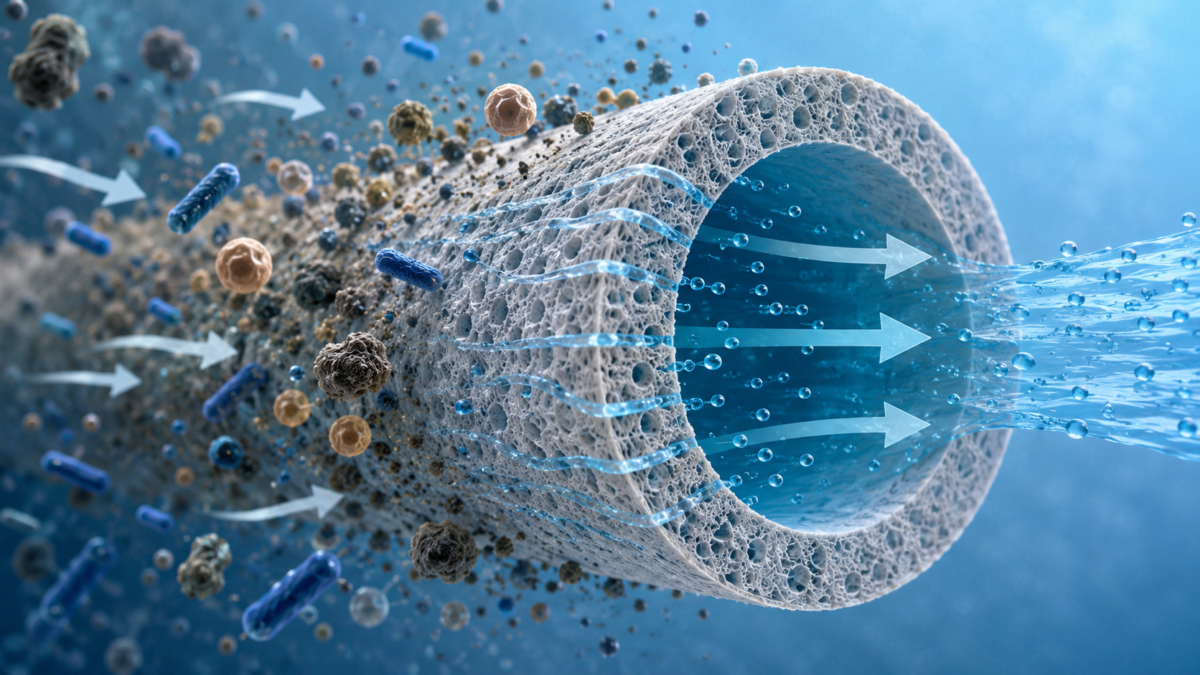
Ultrafiltration is a physical treatment method in which water is passed through a finely porous membrane by a difference in pressure. Suspended solids, the colloids that give cloudiness, particles, and the greater part of bacteria and micro-organisms are held at the membrane surface. The water passes, while the structures held behind are taken away from the system.
The key word here is "physical". No chemical is added to the water through the process; the separation rests entirely on size. While the water molecules, smaller than the pores of the membrane, pass to the other side, every structure larger than a pore stays at the surface. So ultrafiltration is defined as a barrier technology.
The practical result of that approach is that the character of the water is preserved. The mineral content, the degree of hardness and the taste profile do not change; only the cloudiness and the particle load disappear. That property gives a decisive advantage in applications where the mineral balance of the water is to be preserved.
The role of membrane technologies in drinking water treatment is taken up comprehensively in official sources too; the US Environmental Protection Agency’s technical source on microfiltration and ultrafiltration membranes defines the fields of application and the design criteria for those membranes in drinking water treatment.
Ultrafiltration’s Place in the Membrane Family
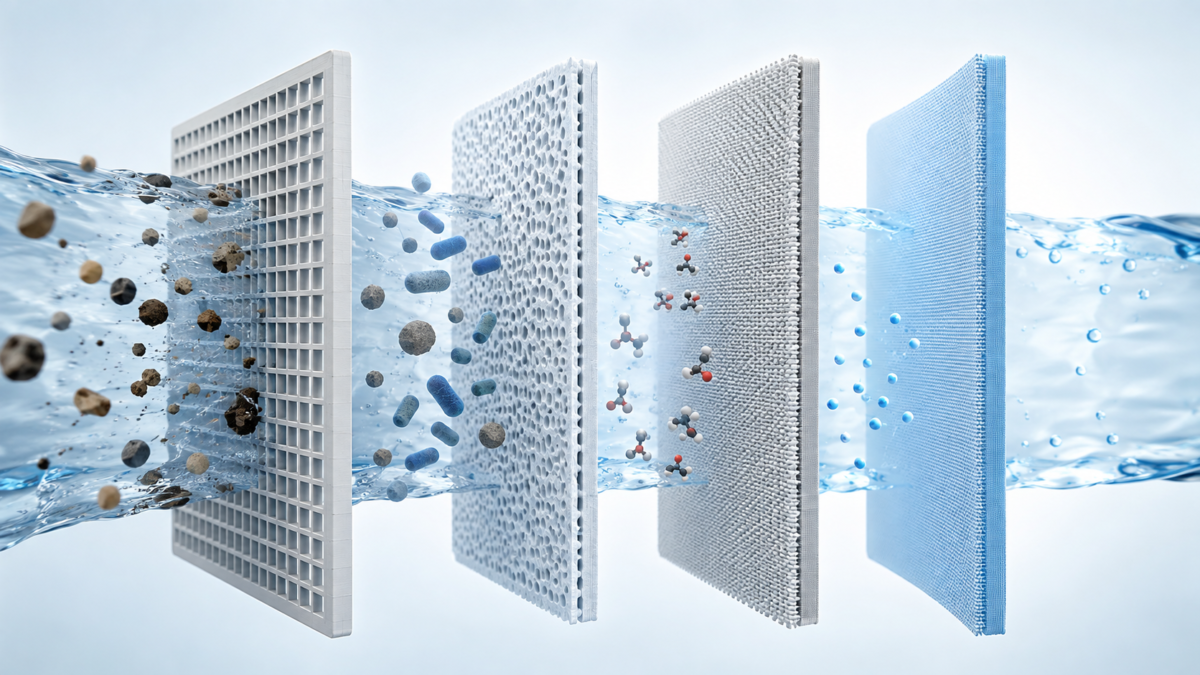
Membrane technologies are ordered by pore size: microfiltration, ultrafiltration, nanofiltration and reverse osmosis. As the pore gets smaller the group of substances held changes and the pressure needed rises. Ultrafiltration sits second in that series; it works on the particle and micro-organism side and does not touch dissolved ions.
Thinking of that order as a ladder is the clearest approach. Each step holds structures smaller than the one before and in return asks for a higher driving force:
Microfiltration
It is the stage with the widest pores. It holds coarse suspended solids and large particles.
Ultrafiltration
It is of finer structure. It holds colloids, cloudiness and the greater part of micro-organisms.
Nanofiltration
It is a selective intermediate stage. It can separate part of the ions that give hardness.
Reverse Osmosis
It is the tightest barrier. It separates dissolved salts and minerals by up to 99%.
In that series ultrafiltration stands on the border line between the "world of particles" and the "world of dissolved solids". It holds structures far finer than the stages before it; but it is permeable to dissolved ions. That position defines both the strength and the limit of the technology.
We covered the general framework of membrane technologies and how the modules work in detail in our membrane filter article. Ultrafiltration is the member of that family specialised on the particle and microbiological load side.
How Does Ultrafiltration Work?
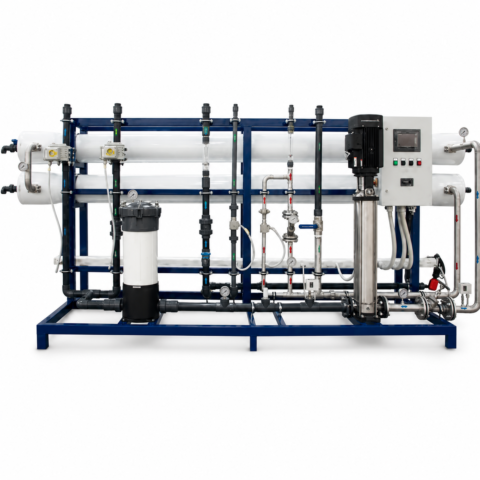
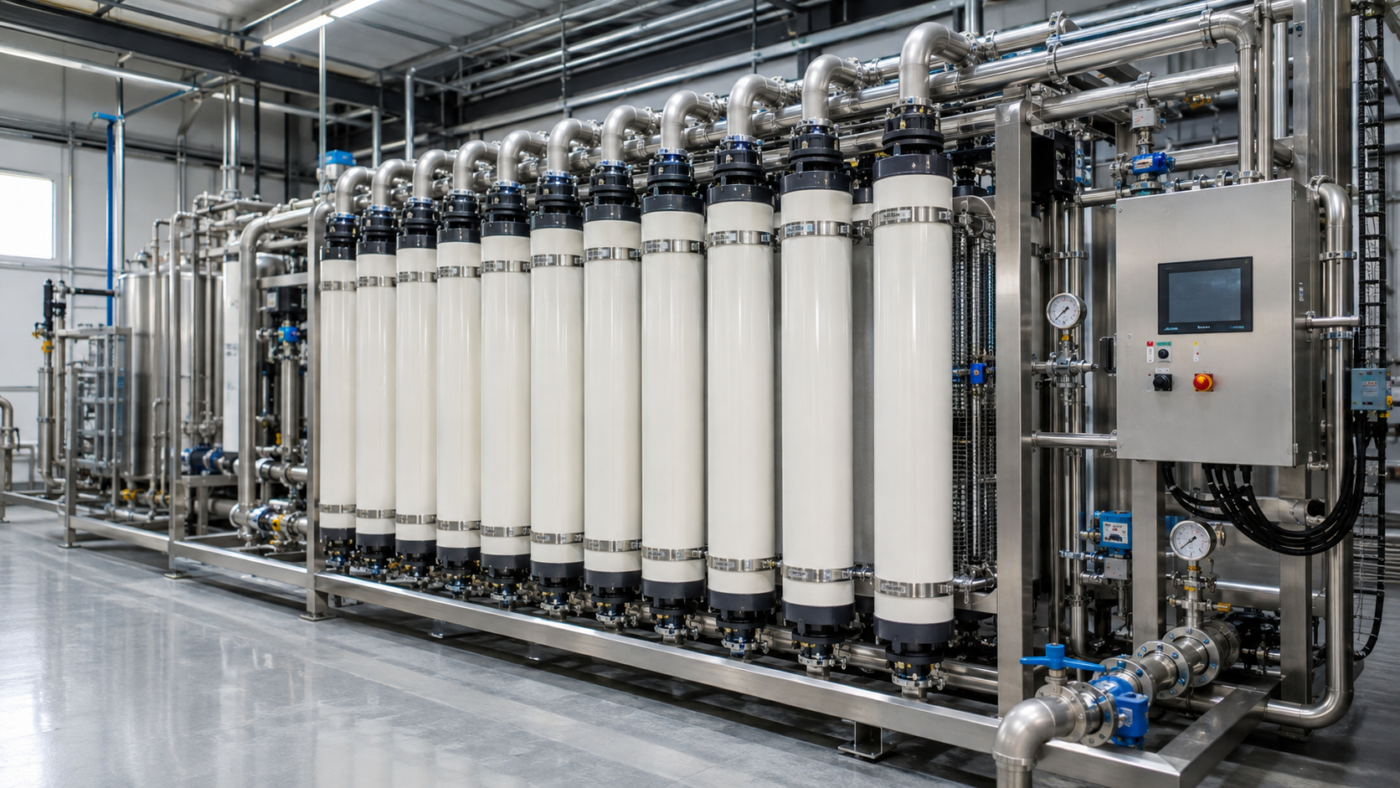
The system works on the difference in pressure between the two sides of the membrane. The water is forced through the finely porous membrane wall; structures larger than the pores cannot pass and build up at the surface. In industrial applications a hollow fibre structure is generally used and that build-up is taken away by regular backwashing.
The physical form of the membrane is what settles the efficiency. The most common structure is the hollow fibre module: hundreds of fine, tube-like fibres are gathered within one module. The water is passed through the inside or the outside of those fibres and filters through the wall. The advantage of that design is that it offers a very large filtering surface in a small volume.
The system can work in two different flow regimes. In the first all the water is passed through the membrane and the substances held build up at the surface; that build-up is cleaned by periodic backwashing. In the second the water keeps flowing along the surface and continuously sweeps away the substances held. Which regime is used is settled by the load of contamination in the incoming water.
The continuity of an ultrafiltration system depends on that cleaning cycle. When the layer building up on the membrane surface is not removed the flow becomes harder, the loss of pressure rises and the efficiency falls. So backwashing is not a maintenance operation but a normal part of running the system.
What Does Ultrafiltration Hold?
Ultrafiltration physically holds suspended solids, the colloids that give cloudiness, fine particles, some large organic structures, and the greater part of bacteria and micro-organisms. As a result the clarity of the water rises markedly and microbiological risks fall.
The groups of structures held can be listed like this:
- Suspended solids: The fine solids floating in the water that do not settle are held at the membrane surface.
- Colloids: The very small structures that do not settle easily, the real source of cloudiness, are separated.
- Cloudiness: Visual clarity rises markedly; the water takes on a clear look.
- Bacteria and micro-organisms: The greater part is held by the physical barrier and microbiological risks are reduced.
- Large organic structures: Some organic components with a large molecular size stay behind.
- Iron and manganese (in oxidised form): Metals that have turned into a solid form can be held as particles.
The last item in that list contains an important detail. Iron and manganese in dissolved form pass through an ultrafiltration membrane; but once oxidised into a solid form they are particles and can be held. So on sources with an iron problem an oxidation stage is built ahead of the membrane.
And on the microbiological side it should be stressed that the mechanism is physical. Nothing is added to the water; the micro-organisms simply stay behind because they are too large to pass the membrane wall. That is an important reason for choosing it in applications where a chemical addition is not wanted.
What Does Ultrafiltration Not Hold?
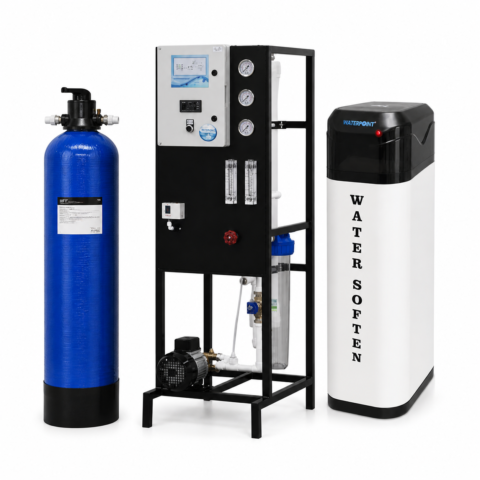
Ultrafiltration is permeable to dissolved substances. Salt, hardness ions, TDS, nitrate and dissolved minerals pass through the membrane. So it does not solve the limescale problem and it does not lower the conductivity of the water. For those needs a softening or a reverse osmosis stage is required.
This section corrects the most common wrong expectation about the technology. The membrane’s work rests on size; a dissolved ion is small on a scale comparable with a water molecule and passes the pore easily. The table below makes the limits clear:
| Contaminant | Ultrafiltration | The Stage Needed |
|---|---|---|
| Suspended solids, cloudiness | It holds them | The UF membrane |
| Colloids and fine particles | It holds them | The UF membrane |
| Bacteria and microorganisms | It holds the greater part | The UF membrane |
| Hardness (calcium, magnesium) | It does not hold them | Water softening |
| TDS and dissolved salts | It does not hold them | Reverse osmosis |
| Nitrate and dissolved ions | It does not hold them | Reverse osmosis |
| Chlorine, odour, taste | Not its main job | Activated carbon |
The expectation "I have had ultrafiltration fitted, my limescale problem will be over" is technically unfounded. The membrane does not hold hardness ions; for limescale build-up a separate softening stage should be planned on the line.
On the measurement side that situation is seen clearly too: at the outlet of an ultrafiltration the TDS value of the water stays largely the same as at the inlet. That is not a fault but a natural result of the working principle of the technology. We explained in detail what the measurement tells you in our article on TDS.
The Difference Between Ultrafiltration and Reverse Osmosis
Ultrafiltration works on the particle and microbiological load side, preserves the mineral structure of the water and works at low pressure. Reverse osmosis separates dissolved salts and minerals, needs a higher pressure and creates a concentrate line. The two are not rivals but answers to different problems.
The comparison of the two technologies runs like this:
| Criterion | Ultrafiltration | Reverse Osmosis |
|---|---|---|
| The Group It Holds | Particles, colloids, micro-organisms | Dissolved salts, minerals, ions |
| Pressure Required | Low | High; it needs a pump |
| Mineral Behaviour | It preserves the mineral structure | It lowers the mineral load |
| Waste Water | Backwash water is produced | A continuous concentrate line is produced |
| The Effect on TDS | No marked effect | It lowers it markedly |
| The Typical Purpose | Clarity and pre-treatment | Drinking water and purity |
The choice is settled by the problem to be removed. If your water comes in cloudy and carries a colloidal load and a microbiological risk, ultrafiltration is the direct answer. If dissolved components such as salinity, high TDS or nitrate are to the front, reverse osmosis is needed. We explained step by step how the membrane separates under pressure in our how reverse osmosis works article.
Where cloudiness and particles are to the front
Clarity and microbiological safety are targeted while the mineral structure of the water is preserved.
- Cloudiness in surface and well water
- A colloidal load and suspended solids
- Where the mineral balance is to be preserved
- The advantage of working at low pressure
Where the dissolved load is to the front
Where salinity, high TDS and ionic contaminants are targeted the membrane has to be tighter.
- High TDS and salinity
- Nitrate and dissolved ions
- A drinking water quality target
- A stage ahead of pure water production
Where Is Ultrafiltration Used?
Ultrafiltration is used in removing cloudiness from well and surface water, in pre-treatment ahead of reverse osmosis, on industrial process lines, in drinking water networks and in water recovery systems. The common point is applications where the particle and microbiological load is the priority problem.
The main fields of use are these:
Well Water
Clarity is obtained on sources carrying cloudiness and a microbiological load.
Surface Water
On lake, river and reservoir sources the suspended solids load is held effectively.
RO Pre-Treatment
By protecting the membrane from fouling it raises the efficiency of the reverse osmosis system.
Industrial Process
Particle-free and clear process water is provided on production lines.
Drinking Water Line
Clarity and microbiological safety are supported while the mineral structure is preserved.
Recovery
It forms a critical separation stage in the reuse of treated water.
In well water applications ultrafiltration is generally part of a chain; it is built not on its own but together with sediment filtration and, where needed, iron and manganese removal. We covered in detail which problem in well water is solved by which stage in our article on treatment stages for well water.
And on an industrial scale the build is sized to the flow of the plant and the profile of the incoming water. For needs in that field, industrial-scale treatment solutions are planned specifically to the project.
Ultrafiltration as Pre-Treatment Ahead of Reverse Osmosis
The greatest enemy of a reverse osmosis membrane is fouling. Ultrafiltration holds colloids and suspended solids from the start and reduces the load reaching the RO membrane. That protection lengthens the life of the membrane, lowers the frequency of cleaning and markedly improves the total operating cost of the system.
That combination is one of the standard approaches of modern water treatment plants. Its logic is economic: the reverse osmosis module is the most valuable component of the system and loses its performance by degrees as a result of fouling. An ultrafiltration stage placed ahead of it removes the main causes of that fouling from the start.
Compared with conventional pre-treatment methods the difference is marked. Sand filters and cartridge filters hold coarse particles; but the fine colloidal structures that really foul the membrane can pass those stages. Ultrafiltration works exactly in that size range and gives the RO inlet far cleaner water.
Even so, pre-filtration does not disappear entirely. To protect the membrane itself there has to be a stage ahead of it holding coarse particles; on sources with a high particle load a sand filters with automatic backwashing takes on that job. The logic of the chain holds here too: every stage protects the next.
When ultrafiltration and reverse osmosis are built together the order is critical: first the particles and colloids are held, then the dissolved load is separated. The reverse order leads to the RO membrane fouling in a short time.
Maintenance in Ultrafiltration Systems
At the centre of maintenance is backwashing. The layer building up on the membrane surface is taken away at regular intervals by reversing the flow. And for the stubborn fouling that forms over time, a chemical cleaning is applied. The quality of the pre-filtration directly settles the frequency of those two operations.
The discipline of running the system gathers under four headings:
-
Regular Backwashing
The flow is reversed, the layer built up at the surface is loosened and sent to the drain. That operation is carried out automatically.
-
Following the Pressure Difference
The difference in pressure between inlet and outlet is the earliest indicator of fouling. The rise is watched and the time to act is settled.
-
Chemical Cleaning
Organic and inorganic build-up that backwashing cannot remove is cleaned by a suitable procedure. It needs a specialist.
-
Checking the Pre-Filtration
As long as the stages ahead of it do their job the load on the membrane falls and the frequency of cleaning drops.
Fouling is an unavoidable fact in an ultrafiltration system; the aim is not to remove it but to keep it at a manageable level. Backwashing is the routine tool of that management. When it is neglected the layer on the membrane surface compacts and becomes hard to reverse.
Chemical cleaning is a rarer but more critical operation. Because the wrong chemical or a faulty procedure can do permanent damage to the membrane, that operation should be carried out in line with the maker’s instructions and with technical support. The frequency of cleaning changes with the quality of the incoming water, the flow in use and the effectiveness of the pre-treatment.
Let’s establish the membrane answer that suits your water
Is cloudiness or the dissolved load your priority problem? To plan the right build against your analysis result, you can look through the options.
See the Ultrafiltration SystemIs Ultrafiltration Right for You?
The decision is made with a water analysis. If cloudiness, suspended solids and a microbiological load are the priority problem, ultrafiltration is directly suitable. If salinity, high TDS or nitrate are to the front, reverse osmosis is needed. Where both problems are present the two technologies are built together in stages.
You can run the decision process with a simple logic. First set out the profile of your water: which parameters are outside the limits? Then divide those parameters into two groups — the particle side and the dissolved solids side. Whichever side carries the weight is the side the technology turns to.
Three typical scenarios come out like this. If there is only cloudiness and a microbiological risk, an ultrafiltration stage is enough; the mineral structure of the water is preserved. If there is only high TDS and salinity, reverse osmosis is needed. If both are present, the right build is a staged chain with the UF stage placed ahead of the RO.
The flow and the purpose of use affect the choice too. There is a difference of scale between the daily need of a villa and the need of a production plant running continuously; the same technology is used in both cases but the number of modules and the level of automation change.
One last thing should be said: an ultrafiltration system is not a "complete treatment" answer on its own. It is a strong link in the chain and takes on meaning together with the other stages. The right build is always settled by an analysis of the raw water and real data on use.
Frequently Asked Questions
What is ultrafiltration, put briefly?
It is a physical treatment method in which water is passed through a finely porous membrane by a difference in pressure. Suspended solids, colloids, particles and the greater part of micro-organisms are held at the surface; the water passes the membrane and comes out clear.
Does ultrafiltration solve the limescale problem?
No. The membrane does not hold calcium and magnesium ions in dissolved form. For limescale build-up a separate softening stage is needed on the line. Ultrafiltration works on the particle and microbiological load side.
Does it lower the TDS value?
It does not lower it markedly. Because dissolved salts and minerals pass through the membrane, the difference in TDS between inlet and outlet stays small. To lower the dissolved load a reverse osmosis stage is needed.
Which should I choose between ultrafiltration and reverse osmosis?
It depends on your problem. If cloudiness, suspended solids and a microbiological load are to the front, UF is suitable. If salinity, high TDS and nitrate are to the front, RO is needed. Where both problems are present the two technologies are used together in stages.
How often does the system backwash?
There is no fixed period; the contamination load of the incoming water, the flow in use and the effectiveness of the pre-treatment are what decide. A rise in the pressure difference is the most reliable indicator of the need to backwash.
Can it be used without pre-filtration?
It is not advised. Coarse particles foul the membrane surface quickly and raise the frequency of cleaning. A suitable filtration stage placed ahead of it protects both the efficiency and the working life of the membrane.
Does the mineral structure of the water change?
No. Because dissolved minerals pass through the membrane, the mineral balance and the taste profile of the water are preserved. That property is the main advantage bringing ultrafiltration to the front in applications where the mineral content is to be preserved.
Conclusion
Ultrafiltration is a strong barrier technology standing, within the membrane family, on the border between the world of particles and the world of dissolved solids. It physically holds cloudiness, colloids, suspended solids and the greater part of micro-organisms; and in doing so it does not touch the mineral structure of the water and needs no chemical addition. Its limit is clearly defined: hardness, TDS and dissolved ions pass this stage. So the right approach is to position the technology not as an answer on its own but as a link in a chain built to the need. Used as pre-treatment ahead of reverse osmosis it protects the membrane from fouling and markedly raises the efficiency and the life of the whole system. The basis of the decision is always the same: first the water analysis, then the choice of technology.
UF or RO? Let us decide together against your analysis result
To plan the membrane build that suits the profile of your water source, your flow and your purpose of use, you can consult the Water Point expert team.
See the Reverse Osmosis Systems