
What Is a Membrane Filter? Types, Life and Replacement
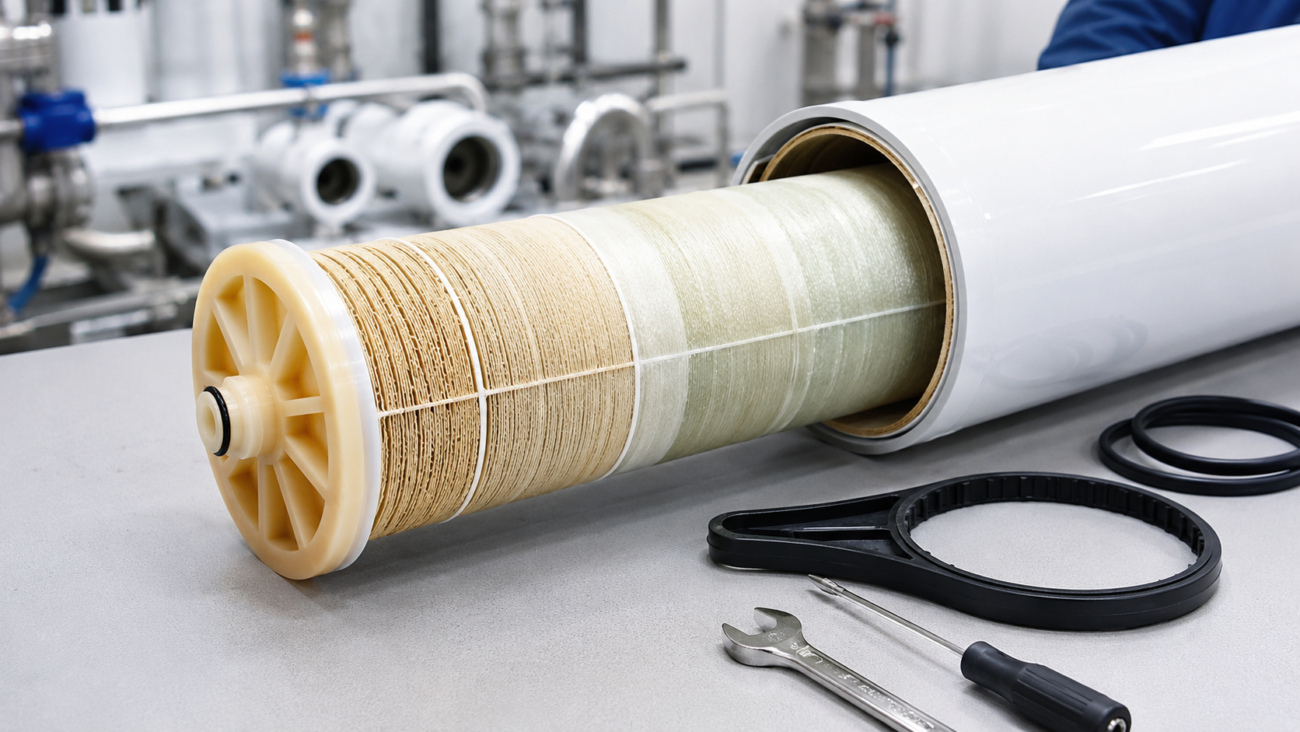
You change your filters on time, the unit runs quietly, water comes out of the tap. And yet the water does not taste the way it used to, the tank fills more slowly and your meter shows a slightly higher reading every time. That picture almost always points to one place: the membrane filter at the heart of the system has begun to tire. Because while pre-filters foul visibly, a membrane filter loses performance quietly and by degrees.
In this guide we take up the membrane filter from end to end: what it is, how it differs from conventional filters, what types there are, what determines its life, what wears it out most, and how to choose the right part. By the end of the article you will be able to judge the performance of the membrane filter in your own system and make the decision to replace it on data rather than on guesswork.
What Is a Membrane Filter and What Does It Do?
A membrane filter is a semi-permeable layer through which water is passed under pressure. While it lets water molecules through, it holds back most of the dissolved salts, minerals and heavy metals. In that way it takes on the most critical separating job in a treatment system and markedly lowers the dissolved solids load of the water.
The key phrase in that definition is “semi-permeable”. A membrane filter is not a barrier that either passes everything or stops everything; it behaves selectively. Water molecules can pass through its structure, while ions in solution and larger components stay behind. That selectivity is a mechanism entirely different from ordinary straining.
In practice the membrane filter is the stage that “does the real work” in a treatment system. The filters before it prepare the way, the ones after it refine the result. The stage that changes the chemical character of the water, that lowers the TDS value and that defines treated water is the membrane filter stage. So the performance of the system depends largely on the health of that one part.
One more important point: the membrane filter is also the most costly component of the system. Where pre-filters are relatively economical consumables changed often, the membrane filter is longer-lived but a more valuable part. That economic balance is the basis of the maintenance strategy too: changing the cheap stages on time in order to protect the expensive one.
How Does a Membrane Filter Differ From Conventional Filters?
Conventional cartridge filters work mechanically and hold only particles; they strain out suspended matter such as sediment, sand and rust. A membrane filter, on the other hand, separates dissolved substances. The difference between them is one of scale: one targets the dirt you can see, the other the ions dissolved in the water.
Understanding that distinction corrects the point unit owners get wrong most often. However good a sediment filter is, it does not lower the salinity of the water; an activated carbon stage removes odour and chlorine but does not change the dissolved mineral load. The only stage that can do those jobs is the membrane filter stage.
| Criterion | A Conventional Cartridge Filter | A Membrane Filter |
|---|---|---|
| The Working Principle | Mechanical straining | Selective passage under pressure |
| Target | Suspended particles, sediment | Dissolved salts and minerals |
| The Effect on TDS | No marked effect | It lowers it markedly |
| Pressure Required | Low | High; a pump may be needed |
| Waste Water | None is produced | A concentrate line is produced |
| Frequency of Replacement | More often | At longer intervals |
There is one more striking difference in the table: waste water. On conventional filters the dirt held stays inside the cartridge and leaves the system when the cartridge is changed. A membrane filter, by contrast, continuously flushes the substances it holds out through the concentrate line. That is not a fault but a requirement of how it works; otherwise the substances held would build up on the surface and block the stage in a short time.
In short: conventional filters prepare the way for the membrane filter, and the membrane filter carries out the treatment itself. The two are not rivals but different links in the same chain.
How Does a Membrane Filter Work?
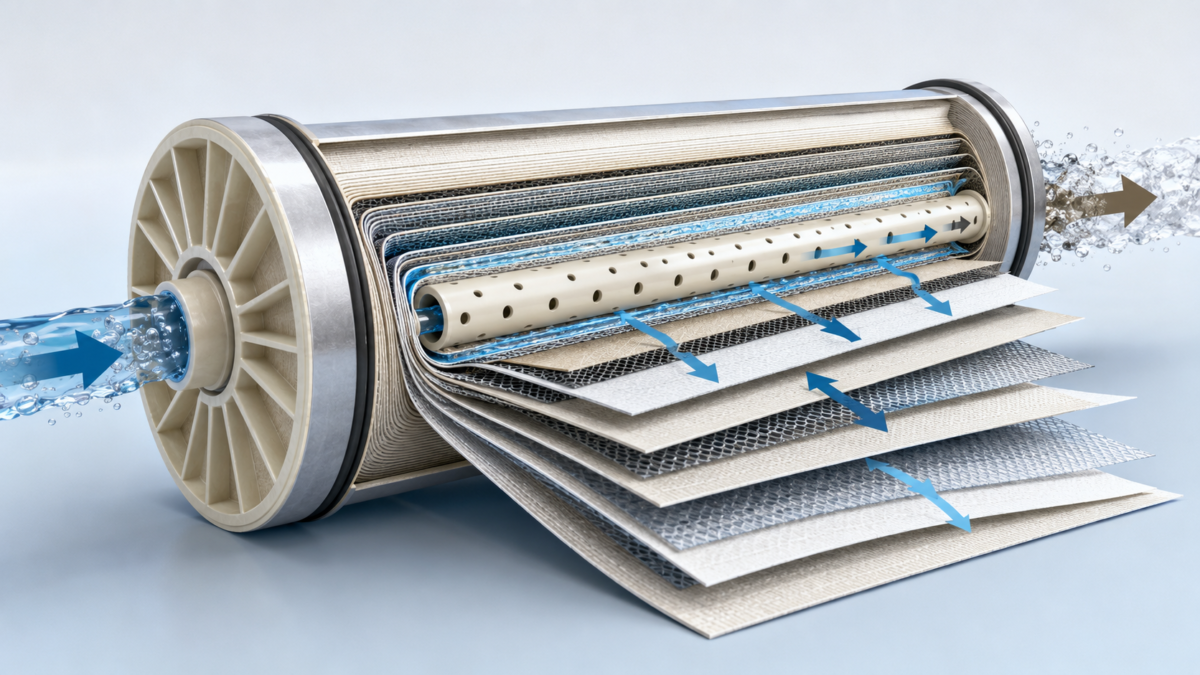
A membrane filter works on the reverse osmosis principle. Water is pushed under pressure towards the semi-permeable layer; the water molecules cross the layer while the dissolved substances stay behind. The result is two separate flows: treated water, and the concentrate carrying the substances held. Pressure is the driving force that makes that separation.
In natural osmosis, water passes by itself from the dilute side to the concentrated side to balance the difference in concentration. In reverse osmosis that flow is turned round by pressure applied from outside. The water is forced from the concentrated side to the dilute side and is freed of the dissolved substances it leaves behind. We set out the detail of the mechanism step by step in our article on how reverse osmosis works .
Throughout that process there is a continuous flow across the membrane filter. Part of the water crosses the layer and goes to the treated line, while the other part keeps flowing along the surface, sweeping the substances held into the concentrate line. Without that “sweeping” flow, the salts held would build up on the surface and the membrane filter would lose its function in a short time.
The role of pressure works in two directions. Sufficient pressure both lets the water cross the layer and keeps the flow across the surface lively, preventing build-up. When the pressure falls, two problems start at once: production slows and build-up on the surface speeds up. So when a membrane filter is being assessed, the working pressure is always the first parameter to check.
Membrane filtration is a technology accepted not only in domestic units but at public scale in water treatment plants; indeed the US Environmental Protection Agency technical documents on surface water treatment take up membrane technologies among the defined methods in drinking water treatment.
What Types of Membrane Filter Are There?
Membrane filter types divide into four according to the size of what they hold: microfiltration (MF), ultrafiltration (UF), nanofiltration (NF) and reverse osmosis (RO). MF holds the coarsest particles, while RO goes down to dissolved ions. Which type is needed is settled by the contaminant to be removed.
That classification can be thought of as a ladder: every step holds smaller components than the one before it and calls for higher pressure.
Microfiltration (MF)
It holds suspended solids and coarse particles. It is generally used for pre-treatment.
Ultrafiltration (UF)
It separates finer particles and large-molecule components; it provides clarity.
Nanofiltration (NF)
It holds part of the hardness-forming ions; it is a selective intermediate stage.
Reverse Osmosis (RO)
It separates dissolved salts and minerals at rates of up to 99%; it is the highest level of treatment.
The RO membraneused in domestic and office treatment units is the top step on that ladder. The part users call simply “the membrane” in everyday speech is almost always this type. The phrase reverse osmosis membrane describes the same component; there is no technical difference between the two.
A UF-type membrane filter serves a different purpose: it does not hold dissolved salts but raises the clarity of the water and helps reduce microbiological risks. So on some systems it is preferred not instead of RO but together with RO, or in a different scenario of use.
Choosing the right type depends on the problem to be dealt with. Where salinity and a high TDS are involved, an RO-type membrane filter is needed; where there is only a cloudiness and particle problem, the lower steps may be enough. That decision should always be made with a water analysis.
The Difference Between Domestic and Industrial Membrane Filters
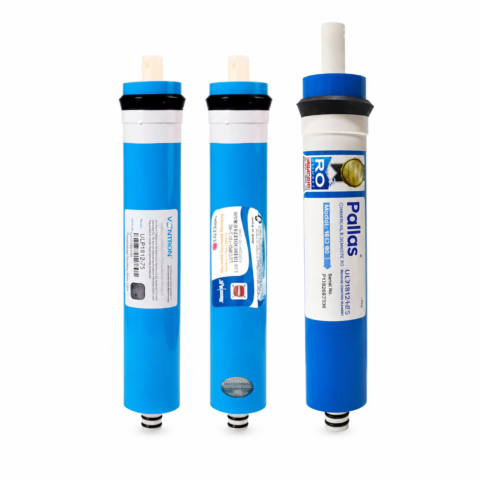
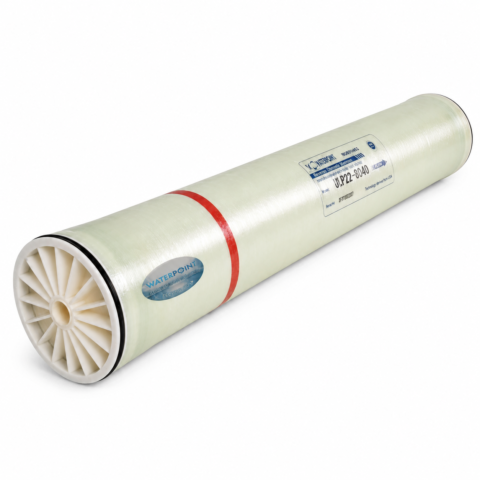
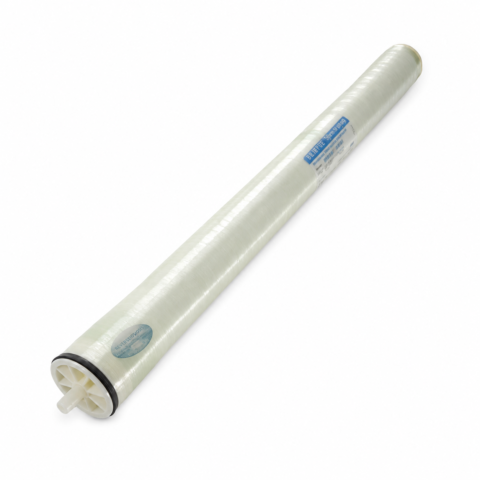
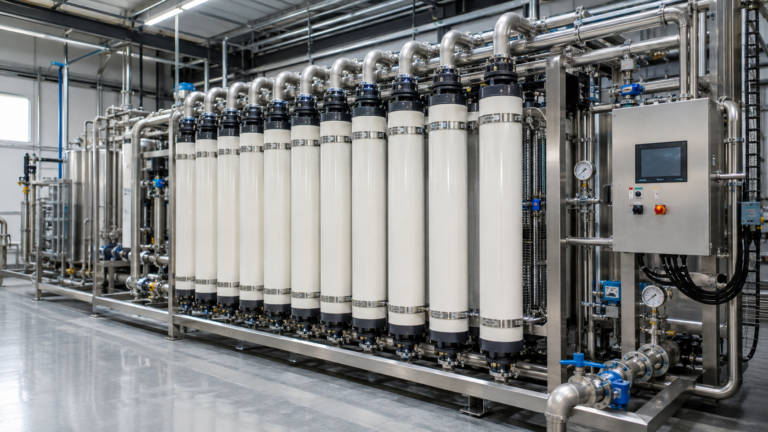
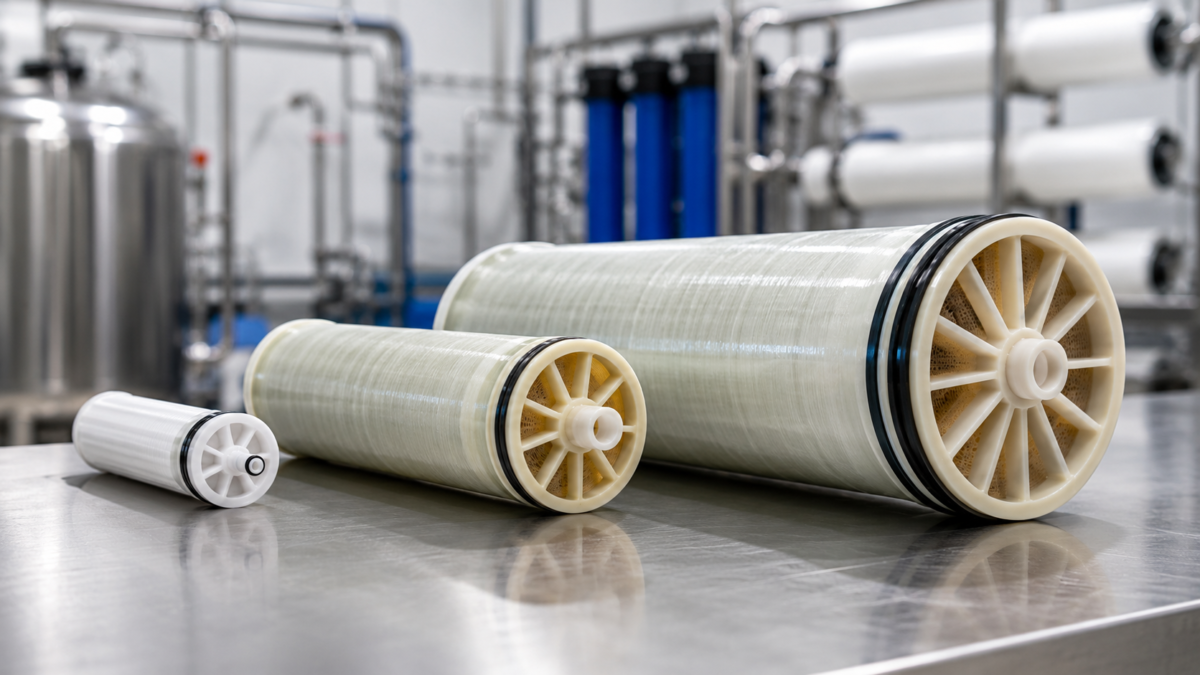
The basic difference between domestic and industrial membrane filters is scale and housing structure. Domestic systems use compact bodies such as the 1812, while industrial lines prefer large-diameter modules such as the 4040 and the 8040. The working principle is the same; what changes is the capacity, the durability and the housing structure.
The model codes are in fact a language of size. Compact bodies are designed to fit under-counter units; large-diameter modules are used on high-flow lines, often several at a time in parallel or in series.
A compact body structure
A single-module structure used in under-counter systems and easy to change.
- Compact body sizes such as the 1812
- It runs on mains pressure or with a small pump
- It can be changed by the user
- It is aimed at daily drinking and kitchen consumption
High-flow modules
A multi-module structure designed for production lines and plants.
- Large-diameter modules such as the 4040 and the 8040
- It runs with a high-pressure pump
- It calls for service and a technical team
- It is sized to the continuous production flow
Every membrane filter works inside a housing. The housing is the closed vessel that holds the module against the pressure and governs the inlet and outlet lines. The most common mistake during a change is forcing a module of a different size into the existing housing; that creates both a sealing problem and a loss of performance. Where the housing has to be renewed, a compatible membrane housing should be used.
In domestic use the most common choice is one matching the standard housing: a 1812-size membrane filter. On the industrial side the module is chosen for the project; the Toray TM720D-400 reverse osmosis membrane is a model widely used on medium to high capacity lines, for instance. On sites with a larger flow the choice falls on 8040-size modules .
What Determines the Life of a Membrane Filter?
The life of a membrane filter is not a fixed period; it varies markedly with the quality of the inlet water and the conditions of use. Hardness, the TDS load, the presence of chlorine, the amount of sediment, the working pressure and the discipline of pre-filter maintenance all bear directly on its life. The same model can be used up in very different times at two different sites.
Life is measured not by the calendar but by conditions. A membrane filter running on clean, soft inlet water holds its performance for a long time; on hard water with a high TDS it tires far more quickly. The main factors that determine its life are these:
- Inlet water quality: As the TDS and the contaminant load rise, the work the module has to do grows.
- Hardness: Calcium and magnesium form scale on the surface and lower the permeability.
- Chlorine and oxidisers: They do permanent damage to the structure of the module; it is the most critical risk factor.
- Sediment and suspended solids: They coat the surface and lead to fouling.
- The working pressure: Low pressure both lowers production and speeds up build-up.
- Pre-filter maintenance: Stages not changed on time leave the whole load to the membrane.
Looking at that list, one clear fact emerges: a membrane filter is usually used up not because it has aged but because it was not protected. The way to extend its life has to do not with the module itself but with the stages in front of it.
What Wears a Membrane Filter Out Most?
There are four main things that wear a membrane filter out: chlorine and oxidisers, scaling from limescale, fouling from sediment, and running dry. All of them can be prevented with pre-treatment and correct operation. Without that protection the module loses its performance before it has completed its expected life.
Knowing the four threats separately also shows which measure to take against which:
Chlorine Damage
Free chlorine does permanent, irreversible damage to the structure of the module. The carbon stage is the only defence against it.
Scaling
In hard water, calcium and magnesium precipitate on the surface, lowering the permeability and slowing production.
Fouling
Sediment, colloids and organic deposits coat the surface; the flow becomes harder and the pressure loss rises.
Running Dry
A module left without water, or dried out for a long time, can be damaged structurally.
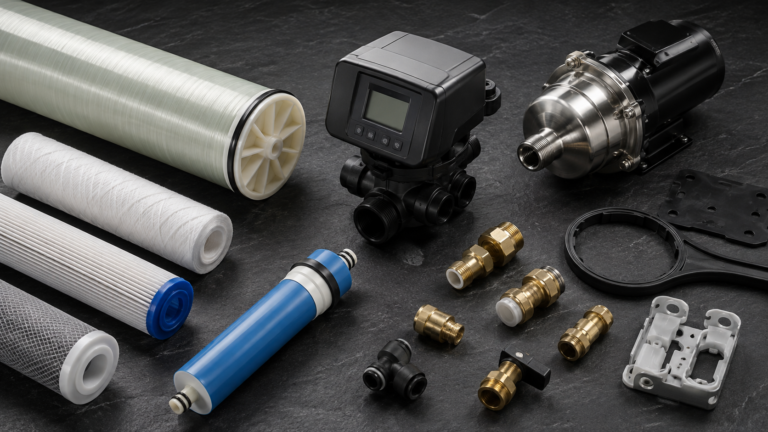
The most insidious of those threats is chlorine, because its effect is not immediate but cumulative, and it cannot be seen. When a saturated carbon filter starts letting chlorine through, the membrane filter is damaged quietly, and the problem is only noticed months later as a fall in performance. So renewing the front stages on time is not a theoretical recommendation but a direct protective measure. To refresh the front line, a compatible five-piece pre-filter set can be used.
There are two ways to deal with scaling. The first is to lower the hardness at source; on high-hardness water a softening stage is the most effective protection there is for a membrane filter. The second is a chemical measure: an antiscalant solution dosed into the line delays limescale crystals precipitating on the surface and extends the life of the module. On industrial systems that practice has become standard.
Chlorine damage cannot be undone. Scaling and fouling can be managed with cleaning up to a point, while the structural effect of chlorine is permanent. So changing the carbon stage before it reaches saturation is the most important rule in the economics of a membrane filter.
How Do You Know When It Is Time to Change the Membrane Filter?
Four signs show that it is time to change the membrane filter: a marked drop in the flow of treated water, a lasting rise in the TDS reading of the outlet water, a change in the taste of the water, and a difference in the waste water flow. When those signs are seen together, the module has done its job.
The signs appear by degrees; that is why regular monitoring is critical:
- The tank fills slowly: A drop in the rate of production is the first sign of build-up on the surface.
- The reading is rising: If the difference between inlet and outlet is closing, the separation has weakened.
- The taste is changing: A salty or “stale water” quality starts to appear.
- The waste water flow has changed: A marked rise or fall in the flow on the concentrate line is a sign of a problem.
- The pressure has dropped: As the module fouls, the pressure balance in the system is upset.
The most objective of those signs is a measurement. Measuring the inlet water and the treated water under the same conditions and comparing them takes the state of the membrane filter out of guesswork and turns it into data. We took up in detail how to interpret that measurement in our article explaining TDS .
One important warning: those signs do not always come from the module. Low inlet pressure, a blocked pre-filter or a faulty check valve produce similar results. So before changing a membrane filter the front stages and the pressure should always be checked; otherwise the new module will meet the same problem.
Are you looking for the right membrane filter for your system?
To establish the module that suits your housing size and system capacity, and to plan the protective stages in front of it, you can look at the options.
See the Reverse Osmosis SolutionsChanging a Membrane Filter and Choosing the Right Part
The right membrane filter is chosen on three criteria: compatibility with the housing size, suitability for the capacity of the system, and domestic or industrial class according to the type of use. An incompatible module creates a sealing problem and a loss of performance; so matching the size is the first thing to check when changing one.
The change is carried out in these steps. First the water to the system and the pump, if there is one, are turned off. Then the housing is opened and the old module carefully removed. The new membrane filter is fitted with its gasket seated and the direction mark the right way round. The housing is closed, the system is pressurised again, and the first water produced is run off for a while to rinse the module. The last step is a measurement: the performance of the new module is confirmed by the difference between inlet and outlet.
On domestic systems that operation can be carried out by a careful user. On industrial lines, technical service support is needed because of the weight of the module, the management of pressure and the commissioning procedure. We took up the whole filter maintenance routine in detail in our filter change guide .
The most common mistake in choosing a part is looking at price alone. An incompatible or poor-quality module comes back as leaks, lower treatment than expected and early exhaustion. The right approach is to choose a membrane filter of known manufacturer quality that suits the capacity of the system and the size of the housing.
Once a new membrane filter has been fitted, it is advised to run off the first water produced for a while. That rinsing step clears from the system any traces of the protective agent left in the module during production and storage.
Ways to Raise the Efficiency of a Membrane Filter
The way to raise efficiency lies not in changing the module but in protecting it. Discipline in pre-filtration, a suitable working pressure, softening as protection on hard water, an antiscalant dose where needed, and regular monitoring of the measurements all markedly extend both the performance and the working life of a membrane filter.
Those five headings are the practices that make the most difference in the field:
| The Practice | What It Does | What It Gives |
|---|---|---|
| Discipline in pre-filtration | It removes sediment and chlorine from the start | It protects the module from physical and chemical damage |
| Suitable pressure | It keeps the surface flow lively | It preserves production and delays build-up |
| Hardness control | It lowers the calcium and magnesium load | It reduces the risk of scaling |
| An antiscalant dose | It delays crystals forming | It extends the life on hard water |
| Regular measurement | It shows a loss of performance early | It prevents an unplanned stoppage |
What those practices have in common is that all of them are far more economical than changing a membrane filter. When you set the cost of a pre-filter set against the cost of a module, the return on protective maintenance speaks for itself.
On industrial lines one more heading is added to that: periodic chemical cleaning. The scale and organic layer building up on the surface can be cleaned with a suitable procedure and the performance of the module partly recovered. But that operation calls for a specialist and is not suitable for every membrane filter; a cleaning carried out wrongly can do permanent damage to the module.
Finally, the discipline of operation should not be forgotten either. On systems that will not be used for a long time the module should not be left dry, and on plants working seasonally a check should be made before commissioning. Those small habits make a bigger difference to the life of a membrane filter than you would expect.
Frequently Asked Questions
What is a membrane filter, in short?
It is a semi-permeable layer through which water is passed under pressure. While it lets water molecules through, it holds back most of the dissolved salts, minerals and heavy metals. It is the stage that actually lowers the dissolved solids load in a treatment system.
When should a membrane filter be changed?
There is no fixed period; it varies with the quality of the inlet water and the conditions of use. The most reliable indicator is a measurement: if the TDS value of the treated water is rising permanently and the rate of production is falling markedly, it is time for a change.
Is the membrane filter affected if the pre-filters are not changed?
It is affected directly. A saturated sediment filter leads to the surface fouling, and a saturated carbon filter lets chlorine through and causes permanent structural damage. Renewing the front stages on time is the most effective way of protecting the module.
Can domestic and industrial membrane filters be used in place of one another?
No. The housing sizes, the working pressures and the capacities are different. Compact modules such as the 1812 belong to under-counter systems, while large-diameter modules such as the 4040 and the 8040 belong to industrial lines. Using the wrong one creates sealing and performance problems.
Does a membrane filter treat all the water — why is there waste water?
Because the substances held have to be carried out of the system, a concentrate (waste) line is produced. Without that flow the salts held would build up on the surface and block the module in a short time. Waste water is not a loss but a requirement of how it works.
Is using an antiscalant essential?
It is not essential on every system. On water of high hardness and on industrial lines it is widely used because it delays the risk of scaling. On inlet water of low hardness, pre-filtration and a suitable pressure usually give enough protection.
Why is the first water run off from a newly fitted membrane filter?
It is advised to run off the first water produced for a while so that any traces left in the module during production and storage are cleared from the system. Once that rinsing step is complete, a measurement is taken to confirm the performance of the new module.
Conclusion
In a treatment system the membrane filter is the part that works quietly but settles the result. Where conventional filters hold particles, it is the only stage that lowers the dissolved solids load; so the taste of the water, its TDS value and its general quality depend directly on its health. Its life is measured not by the calendar but by conditions: the better hardness, chlorine, sediment and the pressure balance are managed, the longer the module runs. When the signs appear (a drop in production, a rise in TDS, a change in taste), the front stages and the pressure should be checked first, and then the change made with a membrane filter matching the housing size. In the end the most economical strategy is clear: change the cheap stages on time in order to protect the expensive one. A membrane filter chosen correctly and protected correctly keeps your system running for years at the performance it had on the first day.
Let us establish the module and the protective stages that suit your system together
For a membrane filter chosen to suit your housing size, your inlet water quality and your capacity, and for maintenance planning, you can consult the Water Point expert team.
Discover the Solution That Suits You