UV Lamp Replacement: Why a Lit Lamp Is Not Proof
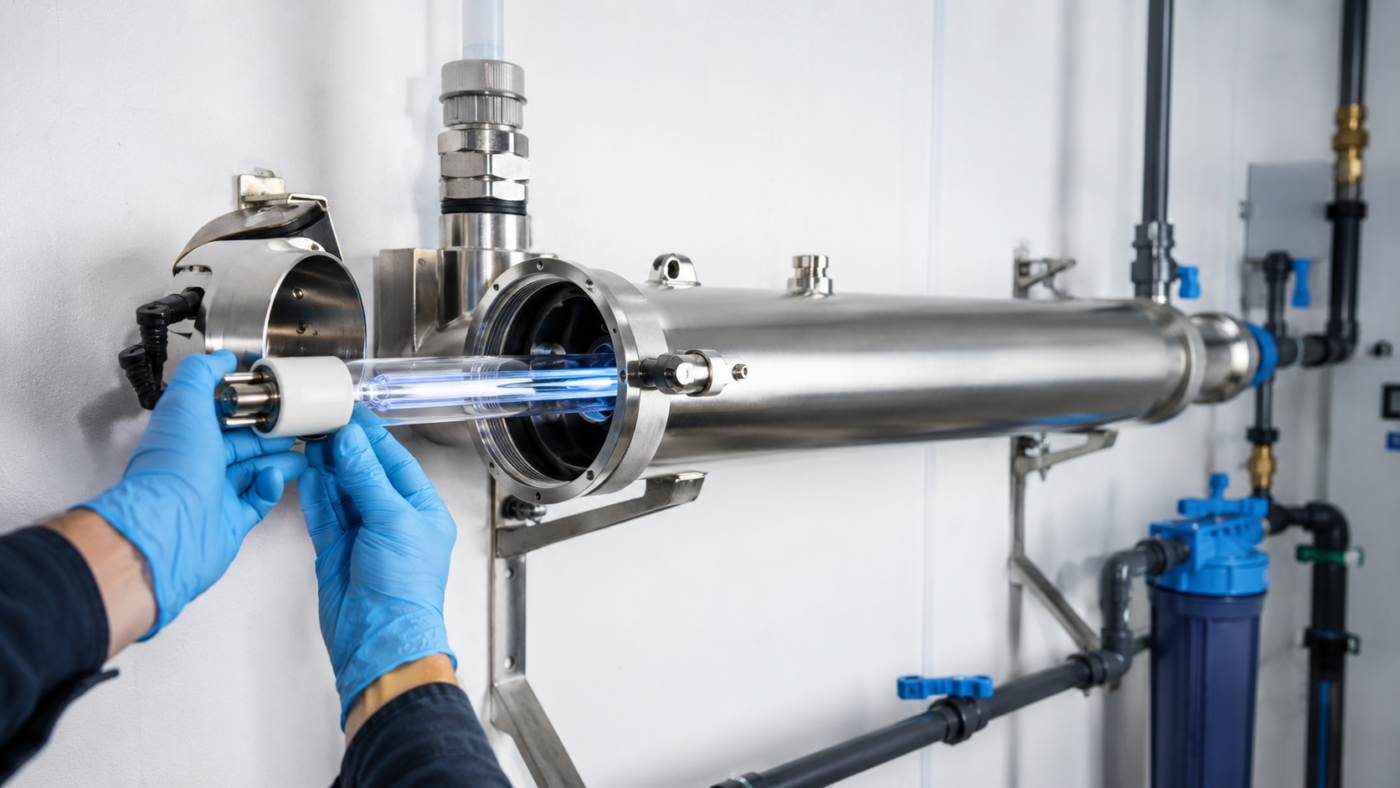
You open the cabinet, the bluish light on the unit is on and you feel reassured: the system is working. That assumption is extremely common, and a fallacy begins at exactly that point. Because ultraviolet lamps lose the intensity of their light as their working life goes on; even if they keep burning, their treatment efficiency falls. UV lamp replacement is where the most critical point of the subject lies.
In this guide we take up why the lamp has to be renewed periodically, why the quartz sleeve is the maintenance item most often overlooked, how the time to change is recognised and the general flow of the operation. We have given the safety warnings a section of their own; because these units are systems with an electrical connection.
Why Is UV Lamp Replacement Necessary?
Ultraviolet lamps lose, by degrees, the effective light intensity they give out as their working life goes on. Even if the lamp keeps burning, the energy reaching the water falls and the treatment efficiency drops. So a lamp is renewed not when it fails but when the period the maker states has run out.
It is a component that works on the logic of a consumable. Just like a filter cartridge, a lamp has a defined working life. The difference is this: when a filter fills the flow becomes harder and the user notices; when a lamp tires it gives no sign from outside at all.
So the performance of the system is managed by the calendar. The lamp’s job is to reduce microbiological risks, and that job can only be done with enough light intensity. When the intensity falls the system looks as though it is working, but it does not produce the expected effect.
A UV lamp replacement plan: a system run without one quietly loses its effect over time. So the replacement is not a repair made after a fault but a maintenance item planned in advance.
Why Is "If It Is Burning It Must Be Working" a Wrong Assumption?
The light you can see and the effective light that does the treatment are not the same thing. As a lamp comes near the end of its life the visible glow continues while the effective intensity falls markedly. So the observation that it "is burning" does not show that the system is working at its expected performance.
That distinction is the backbone of this whole article and the point that leads to the most mistakes in practice. The user looks for an indicator; the only indicator found is the light. But that indicator misleads.
The comparison below makes the situation clear:
A New Lamp
The effective light intensity is at the design level. As it passes through the reactor the water takes the expected energy and the system works at its defined performance.
A Lamp at the End of Its Life
The visible glow continues; but the effective intensity has fallen. The user can see no difference from outside, while the treatment efficiency has dropped.
The basic issue here is this: the presence of light is not a measure of performance. Real performance is measured through the indicator if the unit has a sensor, and by following the hours of use if it does not.
An UV lamp replacement decisions should rest on records, not on observation. Noting the date of installation and the date of the last replacement is the most reliable way of managing this component.
The lamp being alight is not an adequate check. The replacement is planned to the period the maker states in the user manual; if the unit has a counter or a warning indicator, that indicator is taken as the basis.
Which Parts Are in a UV System?
An ultraviolet unit is made up of four main components: the lamp, the quartz sleeve separating the lamp from the water, the reactor body the water passes through, and the ballast or driver unit feeding the lamp. In terms of maintenance the two most critical components are the lamp and the quartz sleeve.
The job of each component, briefly, is this:
The Lamp
It produces the light that does the treatment. It has a defined working life and is renewed periodically.
The Quartz Sleeve
It separates the lamp from the water; it lets the light pass into the water. Its transparency must be preserved.
The Reactor Body
The chamber the water passes through. It makes sure the flow is in contact with the lamp for long enough.
The Ballast / Driver
The electronic unit feeding the lamp. If it fails the lamp may not light at all.
The gaskets
It provides the seal between the sleeve and the body; it should be checked at replacement.
The Indicator / Counter
Present on some models; it follows the hours of use and gives a warning.
Among those components only the lamp and the quartz sleeve need regular maintenance. The reactor body and the ballast need no intervention outside a fault. So a UV lamp replacement operation generally means taking those two components up together.
How the system works, how the water moves through the reactor and what the method does and does not do we took up in a separate content; for the details you can look at our the working principle of ultraviolet treatment article. The subject of this article is not the principle but the maintenance side.
The Quartz Sleeve: The Maintenance Item That Gets Overlooked
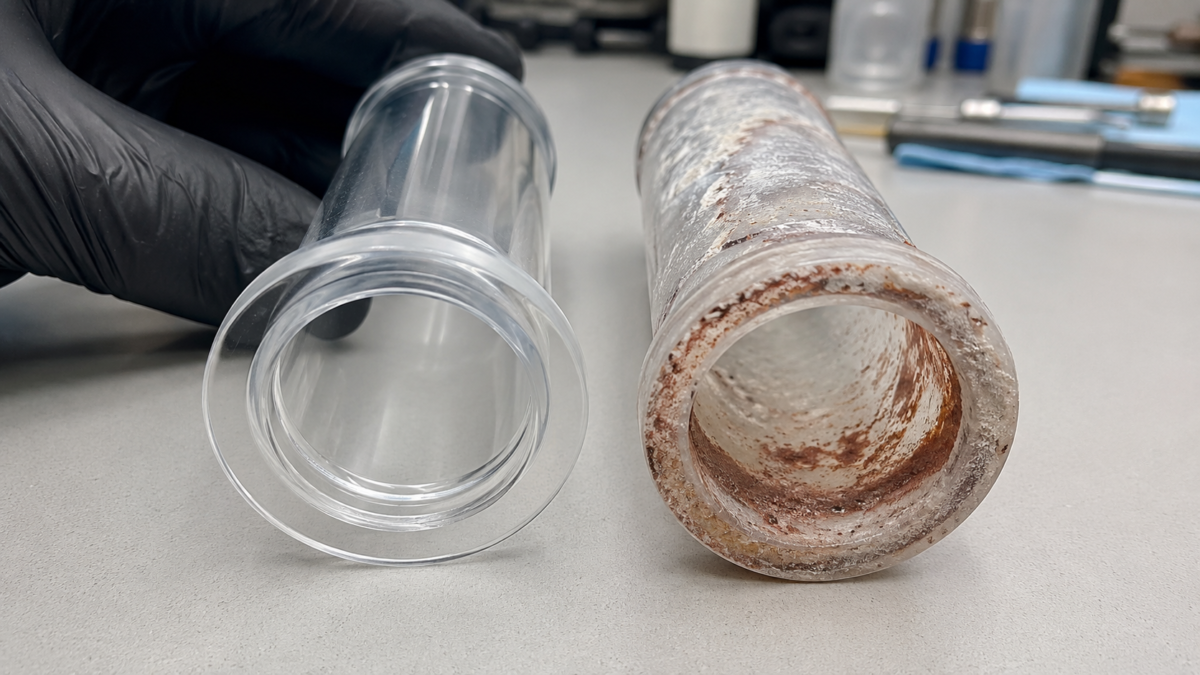
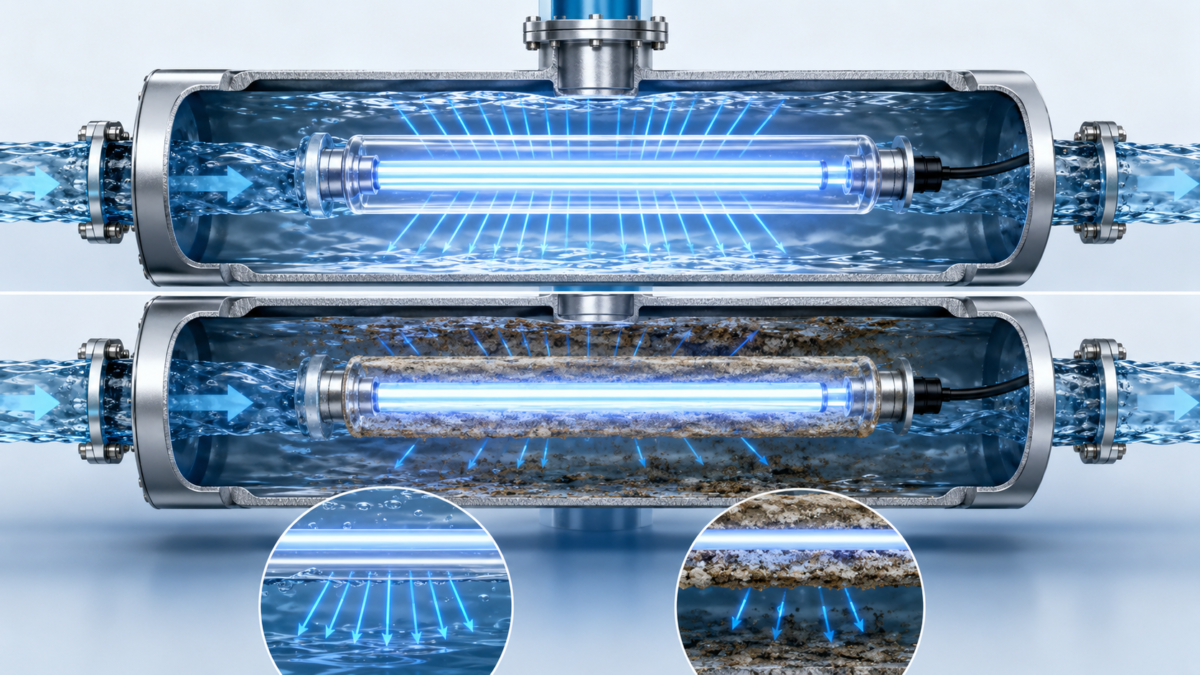
The quartz sleeve is a transparent tube separating the lamp from the water. The layer of limescale, iron and sediment building up on it prevents the light reaching the water. In that case the treatment efficiency falls even if the lamp is brand new. So the sleeve should be checked regularly along with the lamp.
The function of the sleeve is critical: it is the only path the light takes. A thin layer forming on its surface holds an important part of the light and prevents it reaching the water. That effect happens independently of the lamp tiring.
The source of the build-up is the incoming water. In hard water limescale, and in sources containing iron a metallic build-up, collects on the sleeve surface. And in cloudy, sediment-laden water the particles cling to the surface.
So two scenarios should be told apart:
| Situation | What Happens | The Answer |
|---|---|---|
| The lamp has tired | The effective light intensity falls | The lamp is renewed |
| The sleeve has fouled | The light cannot reach the water | The sleeve is cleaned |
| Both together | Efficiency falls on two fronts | The lamp is renewed, the sleeve is cleaned |
| A crack in the sleeve | A risk of leaking and failure arises | The sleeve is renewed; a service assesses it |
The practical approach is that the sleeve is always checked while the lamp is being renewed. The unit is already open; cleaning the sleeve on that occasion adds no cost of labour. The cleaning should be done by the method the maker advises and in a way that does not scratch the sleeve.
The frequency of cleaning the sleeve changes with the quality of the incoming water. In hard and iron-bearing waters the build-up is fast; on a clean source an occasional check may be enough. When a UV lamp replacement plan is drawn up, those two components should be put on the calendar together.
What Settles the Time to Replace?
The main reference settling the time to replace is the period the maker states in the user manual. Beyond that, whether the system runs continuously or intermittently, how often it is switched on and off, and the quality of the incoming water all have an effect. Because of those variables a single period cannot be given for every installation.
Knowing the factors affecting the period makes the planning easier:
- The maker’s period: That is the reference to take as the basis; it is defined in the manual.
- The working regime: A unit running continuously and one running intermittently age differently.
- How often it is switched: A frequent start-stop cycle puts an extra load on the lamp.
- Inlet water quality: Cloudiness and mineral load affect the efficiency and the fouling of the sleeve.
- The conditions of installation: The ambient temperature and the stability of the electrical supply play a part too.
- The intensity of use: On a plant scale, as the flow rises the discipline of following becomes more critical.
Because of those variables it would not be right to give a value here in hours or months. The period stated in the unit’s user manual should be taken as the basis; if the unit has a counter or a warning indicator, that indicator should be followed.
For a technical frame on the operating conditions and monitoring approaches of ultraviolet treatment, the US Environmental Protection Agency’s technical source on ultraviolet treatment can be looked at; the source offers a comprehensive assessment of monitoring and maintaining such systems.
The Signs Showing the Time to Replace Has Come
The most reliable indicator is the warning light or the counter notice on the unit. Besides that, the lamp not lighting at all, a marked weakening in the visible light, a build-up visible on the quartz sleeve, and a change in the taste or odour of the water are signs calling for a check.
The table below matches what you observe with its possible meaning:
| What Is Observed | The Possible Meaning | What Should Be Done |
|---|---|---|
| A warning light or a counter notice | The defined period has run out | The lamp is renewed, the indicator is reset |
| The lamp does not light at all | The lamp has reached the end of its life or there is a supply problem | The power should be cut and a service should assess it |
| A weakening in the visible light | The lamp may have tired | The hours of use are checked |
| A white or brown build-up on the sleeve | Fouling from limescale or iron | The sleeve is cleaned, the pre-treatment is reviewed |
| A change of taste or odour in the water | There may be a problem across the system | All the stages should be assessed |
| The period has run out but there is no sign | The effective intensity may have fallen | The replacement is made without waiting for a sign |
The last row of the table is especially important. The absence of any sign does not mean the system is working at full performance. On this component, following the calendar rather than waiting for a sign is the right approach.
And the build-up on the sleeve is the only indicator that can be checked by eye. When the unit is opened for maintenance, looking at the transparency of the sleeve gives a quick idea of the general state of the system. That check should be carried out routinely during a UV lamp replacement .
How Does Pre-Filtration Affect Lamp Life?
In cloudy, sediment-laden water the light cannot reach all of the water; the suspended solids block it. And sediment and hardness foul the quartz sleeve quickly. A suitable pre-filtration both protects the treatment efficiency and supports the continuity of the system by lengthening the maintenance interval.
That is the most important precondition of ultraviolet treatment. Light travels in clear water; as the cloudiness rises the effective distance shortens. So the ultraviolet stage is never positioned at the head of the chain but after the filtration.
Pre-filtration provides two benefits:
Protecting the Efficiency
In clear water the light travels more effectively; the system works at its design performance.
Sleeve Life
When the particle and mineral load falls the sleeve stays clean for longer.
The Maintenance Interval
The need for cleaning grows rarer; the operating load and the frequency of service fall.
Predictability
When the incoming water is stable the maintenance calendar is planned more accurately.
How to follow the cartridge stages and the signs of replacement we filter change guide took up. And on sources with a high particle load bed-type filtration comes in; the working logic of that stage we sand filter article .
In installations using well water the pre-treatment is especially decisive; which problem is removed by which stage we treatment stages for well water took up in our content. And in systems with a tank, standing is a separate heading; the subject we tank water quality .
How Is a UV Lamp Replacement Done?
The operation goes in a certain order: the power is cut, the water is shut off and the pressure released, the lamp is carefully removed, the quartz sleeve is checked and cleaned, the new lamp is fitted and the system is brought back into service and the first water run off. In practice the unit’s own user manual should be taken as the basis.
The flow below shows the general logic; it is not an instruction specific to a make or model:
-
Cut the Power
The electrical connection of the unit is disconnected. No operation is begun without that step; the unit is an electrical appliance.
-
Shut the Water Off and Release the Pressure
The inlet valve is closed and the pressure left in the line is released safely. The water inside the reactor is drained.
-
Remove the Lamp
The connector is disconnected and the lamp is drawn out slowly. Because of its glass structure care should be taken against knocks and sudden movement.
-
Check the Quartz Sleeve
The transparency of the sleeve is examined. If there is build-up it is cleaned by the method the maker advises, without scratching the surface; if there is a crack it is renewed.
-
Look Over the Seals
The sealing components are checked. Worn seals should be renewed during the replacement.
-
Fit the New Lamp
A compatible lamp is put in place and connected. Care is taken not to touch the glass of the lamp with bare hands.
-
Bring the System Into Service
The water is turned on by degrees, the seal is checked, and then the power is connected.
-
Run the First Water Off
Once the system is running, the standing water in the line is run off for a while and it is put into use.
That flow is not applied in the same detail on every unit; on some models the sleeve is fixed, on others the connection arrangement differs. So during a UV lamp replacement the diagram in the unit’s user manual should be taken as the basis.
Compatibility is important too. The lamp has to suit the body size and the supply arrangement of the unit. An incompatible lamp either cannot be fitted or, even if it is, does not give the expected performance. The choice of a suitable ultraviolet lamp should be made by stating the model of the unit.
Safety Warnings
Ultraviolet units are systems with an electrical connection and they work under pressure. So before every intervention the power must be cut, the water shut off and the pressure released. A bare lamp in operation should not be looked at directly; broken lamps should be disposed of properly.
This section is a heading not to be skipped. All the warnings below should be read before the operation:
- The electrical connection of the unit must be disconnected before the work begins.
- The inlet valve must be closed and the pressure left in the line released safely.
- A bare lamp in operation should not be looked at directly; nor should a lamp taken out of the body be energised even when the unit is closed.
- The lamp is of glass; it should be protected against knocks and carried carefully.
- The glass of the lamp should not be touched with bare hands; where necessary a clean cloth should be used.
- A broken lamp should be disposed of properly and in line with the relevant waste rules.
- No material that will scratch the surface should be used in cleaning the quartz sleeve.
- On industrial, central and high-capacity systems the operation should be carried out by a technical service.
The last item deserves special stress. On a compact domestic unit an experienced user can carry out the operation following the manual; but industrial ultraviolet units and central installations are of a different scope and need a technical service.
In every case where you are not sure, the right course is to call a service. A faulty intervention on a unit where electricity and pressure are present together can create both personal risk and damage to the equipment.
Let us establish the lamp that suits your unit
For lamp and quartz sleeve options compatible with your unit model, and for maintenance support, you can look through the solutions.
See the Lamp OptionsThe Check and the Record After Replacement
Once the operation is finished the seal is checked, the indicator is reset if the unit has a counter, and the date of replacement is recorded. That record is what makes planning the next period possible. Without a record, when the component was last renewed becomes unclear over time.
What should be done after a replacement is this:
- The seal check: The sleeve and body connections are examined by eye once the water is turned on.
- Confirming operation: When the unit is energised the indicator and the running state are checked.
- Resetting the indicator: On models with a counter the hours of use are reset; otherwise the warning misleads.
- The date record: The date of replacement is noted and the next period is put on the calendar.
- A note on the sleeve: If build-up was seen on the sleeve, the pre-treatment should be reviewed.
- Planning a spare: The supply of a lamp for the next period can be planned in advance.
The habit of keeping records is more critical on this component than on the other consumables. A filter cartridge gives a sign; a lamp does not. So the calendar is the only reliable management tool.
A UV lamp replacement records should contain the date, the lamp model used and the state of the sleeve. Those three pieces of information are used directly at the next maintenance, both for compatibility and for assessing the pre-treatment.
On models with a counter, if the indicator is not reset the system keeps giving a warning even though it is running with a new lamp. In the reverse case, if the indicator has been reset but the lamp has not been changed, the following runs entirely on wrong information.
Frequently Asked Questions
If the lamp is burning do I still have to change it?
Yes. The visible light and the effective light that does the treatment are not the same thing. As a lamp comes near the end of its life its glow continues while the effective intensity falls. So the replacement is planned to the period the maker states; the presence of light is not an indicator of performance.
How often should the quartz sleeve be cleaned?
The frequency changes with the quality of the incoming water. In hard and iron-bearing waters the build-up is fast; on clean sources a rarer check may be enough. The practical approach is that the sleeve is always checked while the lamp is being renewed, and cleaned if needed.
Can I change the lamp myself?
On a compact domestic unit it can be done by following the user manual and the safety rules. But the unit is an electrical system under pressure; no work should begin before the power is cut. On industrial and central systems the operation should be carried out by a technical service.
Can I use the water if the lamp is not lit?
When the lamp is not working the ultraviolet treatment is out of circuit and microbiological safety is not supported by that stage. In that case care should be taken over using the water and the system should be brought back into working order as soon as possible. If the fault continues a technical service should be called.
Which lamp is compatible with my unit?
Compatibility is settled by the body size and the supply arrangement of the unit. An incompatible lamp cannot be fitted or does not give the expected performance. The safest way is to have the compatibility checked by stating your unit model.
Does cloudy water affect the lamp’s performance?
Yes. Light travels in clear water; suspended solids block it and shorten the effective distance. And sediment fouls the quartz sleeve quickly. So the ultraviolet stage is always positioned after the filtration.
When I change the lamp should I renew the sleeve too?
It is not obligatory. If the sleeve can be cleaned and there is no damage such as a crack or a scratch, it stays in use. But if a permanent layer has formed on its surface or there is damage, it has to be renewed; that assessment is made during the replacement.
What should I do if the system has not been used for a long time?
Before bringing it back into service the standing water in the line should be run off for a while, the sleeve should be checked and the hours of use of the lamp reviewed. If the period has run out the lamp should be renewed before the system is started.
Why should I record the date of replacement?
Because this component does not show that it has tired. A filter cartridge gives a sign such as a fall in flow; a lamp does not. A record of the date is the only reliable method of planning the next period accurately.
Conclusion
The most common mistake on ultraviolet units is taking the presence of light as an indicator of performance. Yet a lamp loses its effective light intensity as the hours of use go on, and gives no sign of it from outside. Add to that the layer building up on the quartz sleeve and the efficiency falls on two fronts; the system looks as though it is working but does not produce the expected effect. So the right management is done by the calendar: the period the maker states is taken as the basis, the indicator is followed if the unit has a counter, and the sleeve is checked at every replacement. Pre-filtration in turn both protects the efficiency and lengthens the maintenance interval. And last, safety: the unit is electrical and under pressure; the power must be cut before every intervention, and on industrial and central systems a technical service should be called.
Get in touch for choosing a compatible lamp and for maintenance
The site survey is free if the unit is purchased from us; for a survey and measurement only, a survey fee of ₺2,000 applies. To choose a lamp and quartz sleeve compatible with your unit model you can reach us on 0850 304 95 25 or at [email protected].
Discover the UV Treatment Solutions