How UV Water Treatment Works: Light, Flow and Limits
The water you pour into a glass can be perfectly clear and its smell may not trouble you at all; even so it can contain bacteria and micro-organisms that the eye cannot see. Conventional filters reach their limit at that point: they hold sediment and remove chlorine and odour, but on their own they cannot give the expected protection on the microbiological side. The technology that closes that gap is ultraviolet treatment, and how UV water treatment works — the answer to that question begins with understanding how protection is provided without adding anything to the water.
In this guide we take up honestly the effect of ultraviolet light on micro-organisms, what happens inside the unit, in which situations the system is brought in and, most importantly, what it does and does not do. By the end of the article you will be able to judge whether this technology is needed for your own water source.
What Is Ultraviolet Treatment and How Does Its Basic Logic Work?
The short answer to how UV water treatment works is this: the water is passed around a lamp giving out ultraviolet light, and the ability of the bacteria and micro-organisms exposed to that light to multiply is stopped. The process happens without adding a chemical to the water; the taste, the odour and the chemical content of the water do not change.
The logic rests on a physical effect, not on a chemical reaction. The water is exposed to the light along the reactor it passes through, and that exposure puts the reproductive mechanism of the micro-organisms out of action. The process is immediate: it happens while the water flows, and no separate tank is needed for a holding or contact time.
The most marked difference of that approach is that no substance is added to the water. In chemically based methods a component is put into the water and that component can show itself as taste, odour or residue. In ultraviolet treatment only light is used; when the water leaves the reactor it keeps the chemical state it came in with. UV water treatment technology has spread so widely in homes, businesses and production lines for exactly that reason.
The technical frame of the subject is taken up comprehensively in official sources too; the US Environmental Protection Agency’s technical document on ultraviolet treatment explains the working of the system and the design criteria in detail.
What Does Ultraviolet Light Do to Micro-Organisms?
Ultraviolet light affects the genetic material of micro-organisms and prevents them multiplying. A bacterium or micro-organism exposed to the light becomes unable to reproduce even if it continues to exist as a cell. So ultraviolet treatment is defined as a physical method that reduces microbiological risks without adding a chemical to the water.
The essence of the effect is the stopping of the ability to multiply. For a micro-organism to create a water-borne risk it has to be able to multiply; ultraviolet light targets exactly that ability. When the genetic material is affected by the light, the cell cannot complete the process of division and reproduction.
The practical result of that mechanism is this: the process gives protection on the microbiological side without touching the chemical composition of the water. The mineral content, the degree of hardness, the conductivity and the taste profile stay the same. UV treatment is preferred, in that respect, in uses where the character of the water is to be preserved.
The strength of the effect is not fixed; the clarity of the water, the rate of flow and the state of the lamp are what decide. When those three variables are kept in ideal conditions the system produces the expected performance. To answer fully the question of how UV water treatment works those variables have to be taken into account too; in the next sections we take up each of them separately.
What Is Inside the Unit?
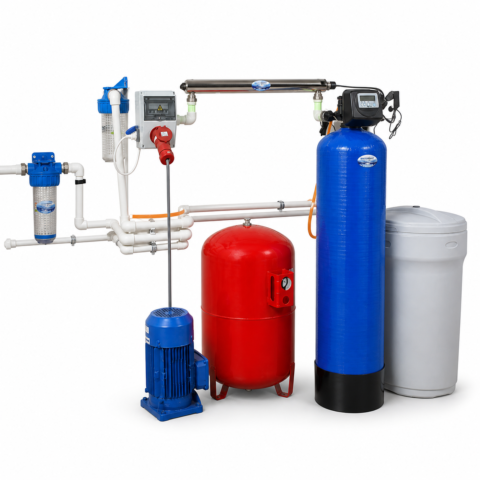
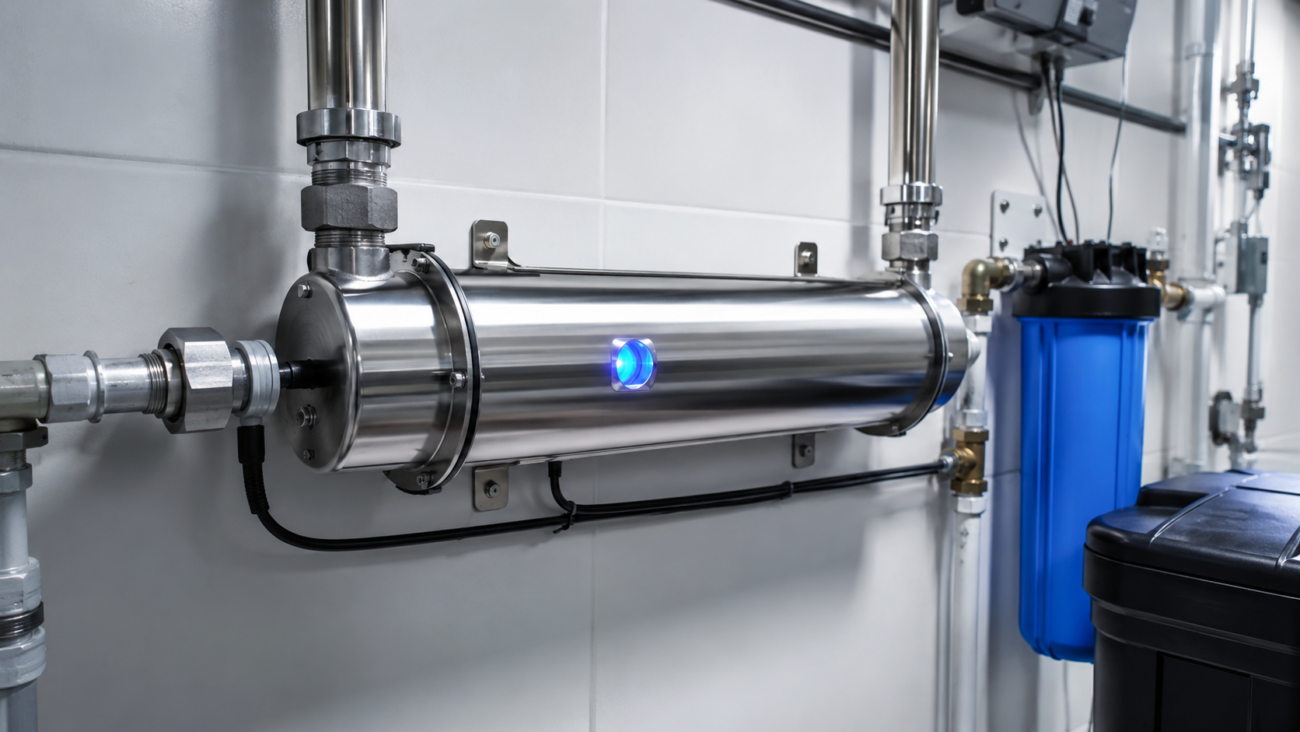
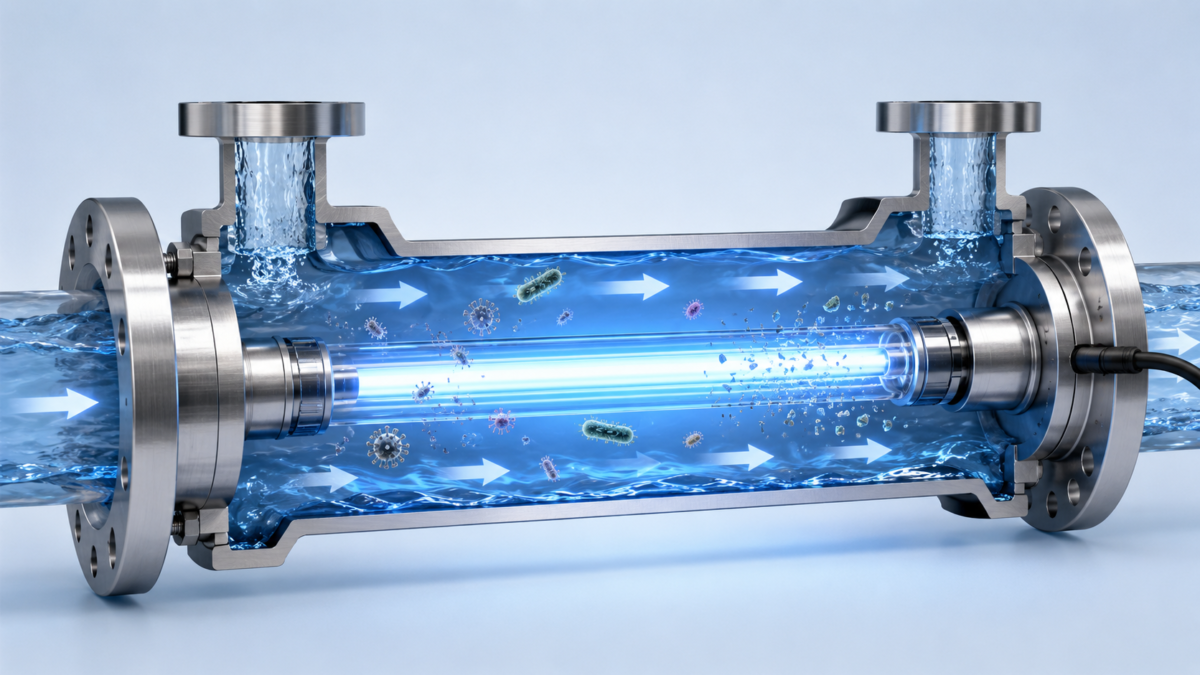
A typical ultraviolet unit is made up of four main components: the lamp producing the light, the quartz sleeve insulating the lamp from the water, the reactor body the water passes through, and the inlet and outlet connections directing the flow. The water is exposed to the light as it passes through the narrow volume around the lamp and leaves the line treated.
The structure is plain but the function of every part is critical:
The Components of an Ultraviolet Unit
The water is exposed to the light as it passes through the volume around the lamp.
The UV lampis the heart of the system and its capacity to produce light falls over time; so even though it visibly keeps burning it has to be changed periodically. The quartz sleeve is the second critical part: the layer of limescale or sediment forming on it prevents the light reaching the water and can leave the system apparently working but ineffective.
So the maintenance of the unit gathers under two headings: renewing the lamp on time and keeping the quartz sleeve clean. That is exactly the maintenance-side answer to the question of how UV water treatment works.
The Greatest Advantage: It Adds Nothing to the Water
The most marked strength of ultraviolet treatment is that it uses no chemical. Because no substance is added to the water the taste, the odour and the mineral balance do not change; no chemical residue forms in the treated water. That property gives a decisive advantage in drinking and production applications where the natural character of the water has to be preserved.
In chemically based methods the dose setting, managing the residue and the effect on taste all need constant following. On the ultraviolet side none of those loads exists: the system runs, the water passes and the chemistry of the water stays as it is. The practical meaning of that simplicity is these headings:
- Taste and odour are preserved: Because no substance is added to the water the drinking profile does not change.
- No residue forms: No chemical remains in the treated water.
- No dose following is needed: Stocking chemicals, measuring and setting the dose all disappear.
- It works immediately: It needs no holding tank or contact time; the process is completed while the water flows.
- Plain operation: Maintenance consists essentially of renewing the lamp and cleaning the sleeve.
Those advantages bring the system to the front especially in buildings using well or tank water. But there is another side to the coin and an honest assessment has to see that side too.
What Does It Not Remove? The Limits of the System
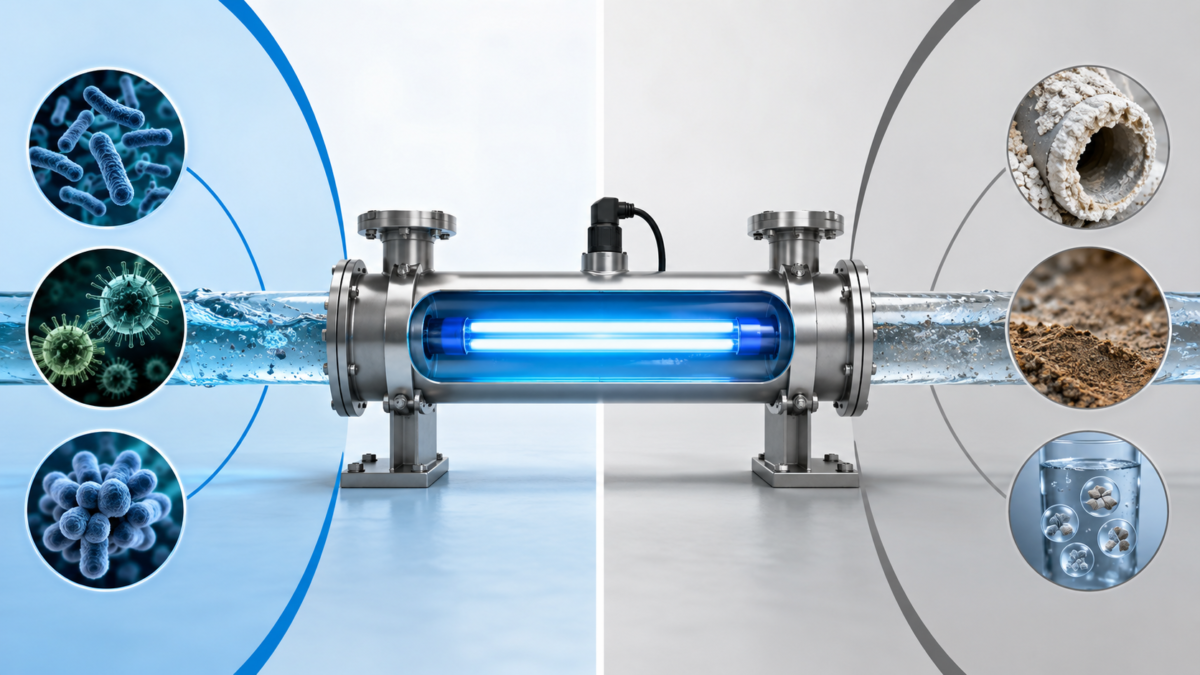
Ultraviolet treatment works only on the microbiological side. It does not remove sediment, limescale, hardness, heavy metals, chlorine, nitrate or the dissolved solids load; it does not lower the TDS value. So it is used not on its own but as the last link of a treatment chain built to the need.
This section corrects the most common wrong expectation about this technology. Ultraviolet light does not act on the chemical substances dissolved in the water or on suspended solid particles; its field of work is only living micro-organisms. The table below sets out the limits clearly:
| Problem | Ultraviolet Treatment | The Solution Needed |
|---|---|---|
| Bacteria and microorganisms | It prevents multiplying | An ultraviolet unit |
| Sediment, sand, cloudiness | It does not remove | Pre-filtration |
| Limescale and hardness | It does not remove | Water softening |
| Chlorine, odour, taste | It does not remove | Activated carbon |
| Heavy metals, nitrate, TDS | It does not remove | Reverse osmosis |
| Iron and manganese | It does not remove | Oxidation + filtration |
The thought "I have had ultraviolet fitted, my water is completely treated" is wrong. The system only supports microbiological safety; for limescale, sediment and chemical content separate stages are needed. Which stages are needed is settled by a water analysis.
Knowing those limits is critical for a correct investment. The honest answer to how UV water treatment works includes what the technology does not do as much as what it does. If you wonder which problem in well water is removed by which stage, our content on treatment stages for well water takes up the whole chain step by step.
Why Is Pre-Filtration Essential?
For ultraviolet light to be effective the water has to be clear. Cloudiness and suspended particles block the light and leave micro-organisms in shadow. So the unit is always positioned after the pre-filtration; without removing sediment and particles the expected result cannot be obtained.
The logic is simple: light is effective only where it can reach. A particle suspended in the water forms something like a shield for the micro-organism behind it. As the water grows cloudier that shadowing effect rises and the system, even though it looks as though it is working, cannot produce the expected protection.
A second effect happens on the quartz sleeve. In sediment-laden or limescaled water the sleeve surface becomes coated over time; the passage of the light into the water falls. That is a gradual and silent loss of performance. So the pre-filter stages placed ahead of the line both provide the clarity and protect the efficiency of the unit.
And in waters where the hardness is high, limescale build-up on the sleeve speeds up; in that case adding hardness control to the pre-treatment chain becomes decisive for the long-term performance of the ultraviolet unit. A complete answer to how UV water treatment works must always include the note "it works in clear water".
Are you looking for the right ultraviolet answer for your water source?
To plan the unit that suits your flow and your point of use, together with the pre-treatment stages needed, you can look through the options.
See the UV Treatment SystemsIn Which Fields of Use Does It Come In?
Ultraviolet treatment is used in buildings using well or tank water, in villas and estates, in food and drink production, in restaurants and hotels, and on industrial lines. The common point is uses where microbiological safety is the priority and the chemical character of the water is to be preserved.
The system becomes meaningful at every point where a microbiological risk is on the agenda:
Well Water
On sources not under public inspection, the microbiological load is the most frequently met risk.
Systems With Storage
In tanks where the water stands, conditions suitable for micro-organisms to multiply can form.
Villas and Estates
Positioned at the building inlet, it supports microbiological safety across the whole line.
Food and Beverage
It is a method preferred in production water because a chemical addition is not wanted.
Hotels and Restaurants
At busy service points water safety is an operational necessity.
Industrial Lines
In process water, microbiological control supports the safety of the product and the line.
The scale of the unit changes with the point of use. On the kitchen drinking water line under-counter ultraviolet units are enough; while for protection covering the whole building solutions installed at the building inlet are preferred. And in plants with a high flow, industrial-scale units are sized project by project.
How Is the Right System Determined?
The right unit is settled by assessing the flow of water, the point of use and the need for pre-treatment together. In a unit chosen too small for the flow the water passes through the reactor too fast and the effectiveness falls. And the periodic replacement of the lamp is a requirement for the system to keep up its performance.
Four headings should be made clear when choosing. The first is the flow: the instantaneous flow the system has to meet is the main criterion settling the size of the unit. The second is the point of use: is the protection wanted for a single tap or for the whole building line? The third is the need for pre-treatment: if the clarity of the water is not enough, filtration should be planned first. And the fourth is the discipline of operation: whether the maintenance of the lamp and the sleeve can be done regularly should be assessed from the start.
The most neglected of those four headings is maintenance. A lamp loses its capacity to produce light over time; even though it visibly keeps burning it may not produce the expected effect. So renewing it periodically with a spare ultraviolet lamp is a requirement for the continuity of the system. The exact interval for replacement is settled by the conditions of use and the maker’s advice.
An ultraviolet unit has to work without interruption. When the power is cut or the lamp goes out of circuit, the water passing the line is not treated. So the working state of the system should be checked regularly.
In short, the question of how UV water treatment works is answered fully not by the technology alone but together with correct sizing and regular maintenance. The right build is settled by a water analysis and real data on use.
Frequently Asked Questions
How does UV water treatment work — what is the shortest answer?
The water is passed through a reactor around a lamp giving out ultraviolet light. The ability of the bacteria and micro-organisms exposed to the light to multiply is stopped. The process happens without adding a chemical to the water and is completed immediately, while the water flows.
Does ultraviolet treatment change the taste of the water?
No. Because no substance is added to the water the taste, the odour and the mineral balance stay as they are. That property is a decisive advantage in drinking and production applications where preserving the natural character of the water matters.
Is an ultraviolet unit enough on its own?
No. The system works only on the microbiological side; it does not remove sediment, limescale, chlorine, heavy metals or the dissolved solids load. If those problems are present, stages such as pre-filtration, softening or reverse osmosis are needed as well.
Is it effective in cloudy water?
The effectiveness falls markedly. Suspended particles block the light and leave micro-organisms in shadow. So the unit must be positioned after the pre-filtration and the clarity of the water must be provided.
When should the lamp be changed?
A lamp loses its capacity to produce light over time and its performance falls even though it keeps burning. So it should be changed periodically. The exact interval is settled by the conditions of use and the maker’s advice for the unit.
Should the system stay on all the time?
Yes. While the unit is out of circuit the water passing the line is not treated. In a power cut or a lamp failure the protection is interrupted; so the working state of the system should be checked regularly.
Conclusion
The answer to how UV water treatment works can be summed up in two sentences: the water is exposed to ultraviolet light and the ability of bacteria and micro-organisms to multiply is stopped; that process happens without adding any chemical to the water. The strength of the technology is in its simplicity, its limit in its scope. While it supports microbiological safety it does not remove sediment, limescale, chlorine or the dissolved solids load. So the right approach is to position the unit not as an answer on its own but as the last link of a treatment chain supported by pre-filtration. Clear water, the right flow and a lamp renewed on time are the three basic conditions for the system to keep up its expected performance.
Let us plan the unit and the pre-treatment stages to suit your flow together
To establish the ultraviolet answer that suits your water source, your point of use and your flow, you can consult the Water Point expert team.
Discover the System That Suits You