

Made to order
Product Category
Water Softeners
A water softener holds back the calcium and magnesium ions that make water hard, stopping limescale at its source. Limescale shortens the life of every piece of equipment that handles water — combi boilers, water heaters, heat exchangers, washing machines and dishwashers — raises energy consumption…
Made to order
Made to order
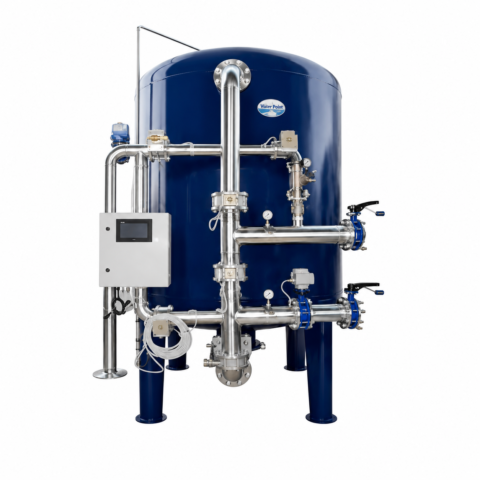
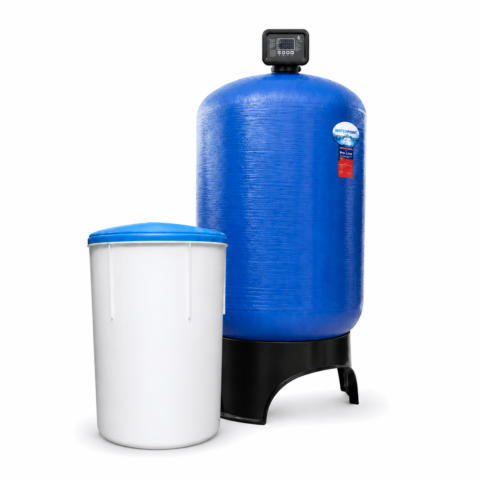
A water softener holds back the calcium and magnesium ions that make water hard, stopping limescale at its source. Limescale shortens the life of every piece of equipment that handles water — combi boilers, water heaters, heat exchangers, washing machines and dishwashers — raises energy consumption and narrows the bore of pipework over time. That makes softening one of the basic investments that protects an installation, in homes and businesses alike.
How softening works
Water passes through a bed of cation exchange resin. The resin holds sodium ions and swaps them for the calcium and magnesium in the water. Nothing is filtered out mechanically — this is an ion exchange, which is why a softener does not remove sediment, chlorine or dissolved solids and is never a substitute for a drinking-water system.
When the resin is saturated it is regenerated: a brine solution drawn from the salt tank flushes the calcium and magnesium out to drain and reloads the resin with sodium. The valve on top of the vessel decides when that happens.
Timer valve or metered valve?
Timer-controlled
Regenerates on a fixed schedule regardless of how much water was used. Simple and cheaper, but it wastes salt and water when consumption is low, and it can run out of soft water when consumption spikes. Suited to steady, predictable use.
Metered (volumetric)
Counts the litres that pass and regenerates when the resin's capacity is genuinely used up. It uses noticeably less salt and water over a year and holds soft water through irregular demand. For anything beyond a small household this is the one worth paying for.
Tandem (duplex) systems
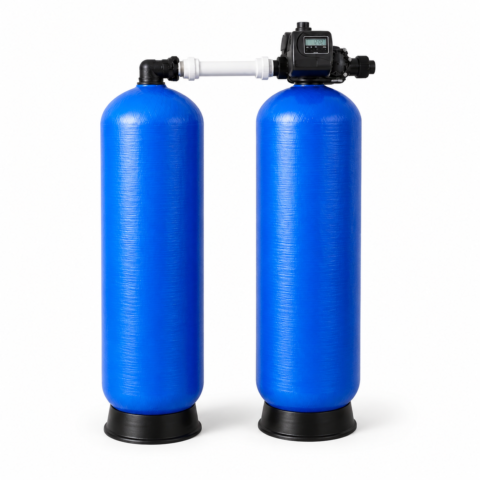
Two vessels alternate, so one is always in service while the other regenerates. Where soft water cannot be interrupted — boiler feed, production lines, hotels — this is the configuration that matters.
Sizing: hardness × consumption
Two numbers decide the resin volume: your water hardness in French degrees (°fH) and your daily consumption in litres. Multiply them and you get the daily hardness load the resin has to carry; divide the resin's exchange capacity by that load and you get the days between regenerations. Sizing for roughly three to seven days between regenerations is a sensible working range — much shorter and salt use climbs, much longer and the resin sits saturated.
This is why we ask for a hardness measurement before recommending a size. Istanbul mains water, well water and tank water can differ by a factor of three within the same district, and a softener sized from an assumption is either undersized or over-specified.
Salt, maintenance and running cost
Use tablet salt made for water softeners. Table salt and coarse rock salt leave insoluble residue that clogs the injector and the brine valve. Keep the salt level above the water line in the brine tank and check it monthly.
Resin is a consumable and its life depends on the water it treats — chlorine, iron and turbidity all shorten it. Because of that, resin and salt sit outside warranty cover. The vessel, the valve and the pump carry a 2-year warranty.
Don't know your hardness? A test kit costs very little and settles the question in a minute — or we measure it during the site survey, which is free when the system is purchased from us. Call 0850 304 95 25.