Made to order
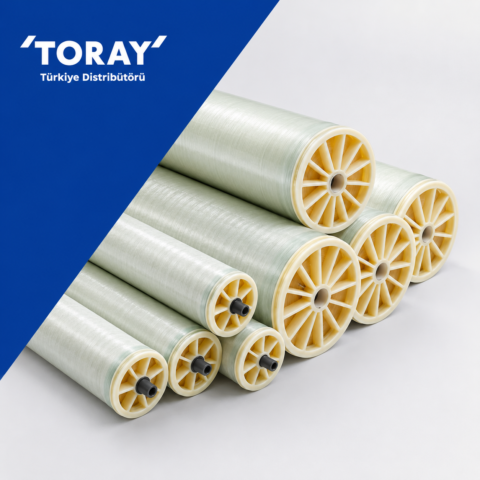
Toray TM720D-400 Reverse Osmosis Membrane
~11,000 gpd (41.6 m³/day)
Aromatic Polyamide TFC
₺77,218.08

Categories
Solutions
Company
Product Category
The membrane is the stage that actually lowers dissolved solids. Everything ahead of it exists to protect it, and everything behind it depends on how well it is working. Choosing one comes down to three figures: the element size, the rated capacity, and the salt rejection.
The membrane is the stage that actually lowers dissolved solids. Everything ahead of it exists to protect it, and everything behind it depends on how well it is working. Choosing one comes down to three figures: the element size, the rated capacity, and the salt rejection.
Domestic elements are rated in GPD — 50, 75, 100, 300, 400, 600 — and fit standard 2012 or 3012 housings. Industrial elements are named by dimensions: a 4040 is 4 inches by 40 inches, an 8040 is 8 by 40, and they sit in pressure vessels. Seawater membranes are built for far higher feed pressure and are not interchangeable with brackish-water elements.
Rejection is typically 96–99%. Feed water at 500 ppm TDS therefore leaves at roughly 10–20 ppm. A domestic membrane with working pre-filters commonly lasts 2–3 years; the calendar is not the signal. Replace it when permeate conductivity rises, when flow falls at the same pressure, or when the pressure differential across the stage grows.
Chlorine oxidises a thin-film composite membrane permanently — a failed carbon stage is the most common cause of premature replacement. Iron and turbidity foul the surface; hardness scales it. Membranes are consumables and their life depends on the water they see, so they sit outside warranty cover.